
What Is a Blog Content Approval Workflow? How It Reduces Publishing Delays

TL;DR
A blog content approval workflow is a named sequence of checkpoints with owners and time windows. Without it, drafts sit in informal review queues and publishing delays compound.
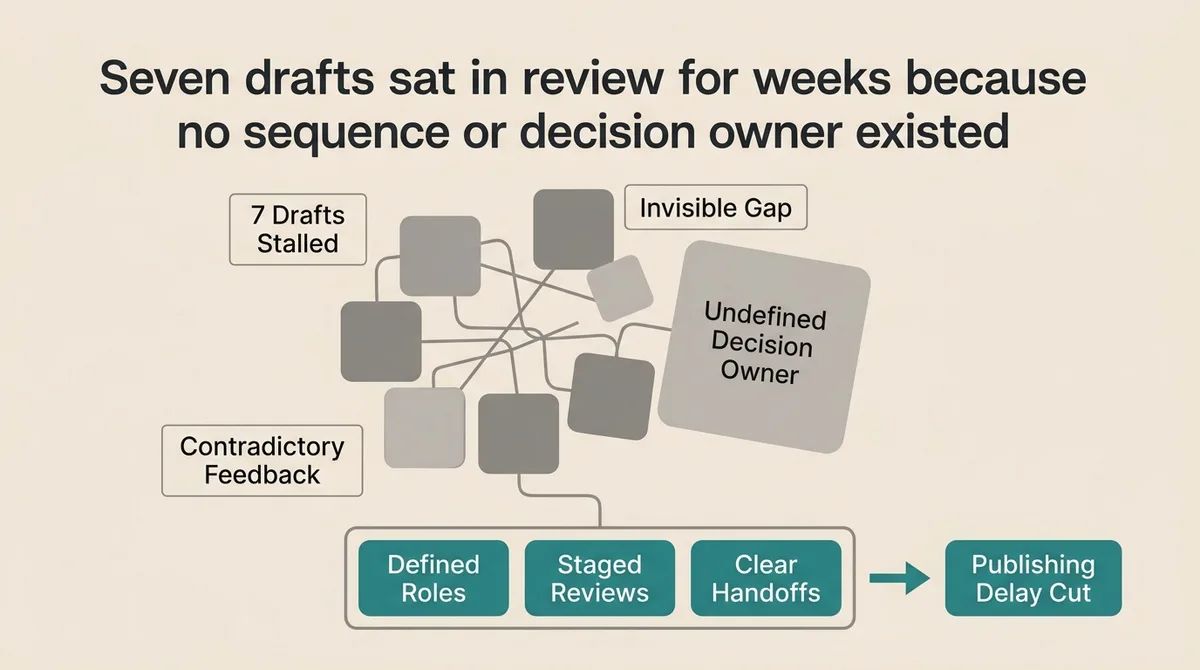
You opened the CMS on a Tuesday and found seven drafts sitting in “review” from three weeks ago. One had feedback from two different people that directly contradicted each other. Nobody had published anything.
Most teams try to fix this by adding a reviewer or switching tools. Neither works. The problem is structural: no defined sequence, no named decision owner per stage, and no time limit on each handoff. Every draft stalls in the same invisible gap between “written” and “approved.”
A blog content approval workflow is a sequenced system that moves a draft through defined checkpoints, with a named owner at each step and a response window that forces a decision. One vendor survey reports cutting average approval time from about 4.7 days to about 1.8 days with this kind of structure. This article is for content leads and agency operators who want faster approvals without adding headcount.
What is a blog content approval workflow?
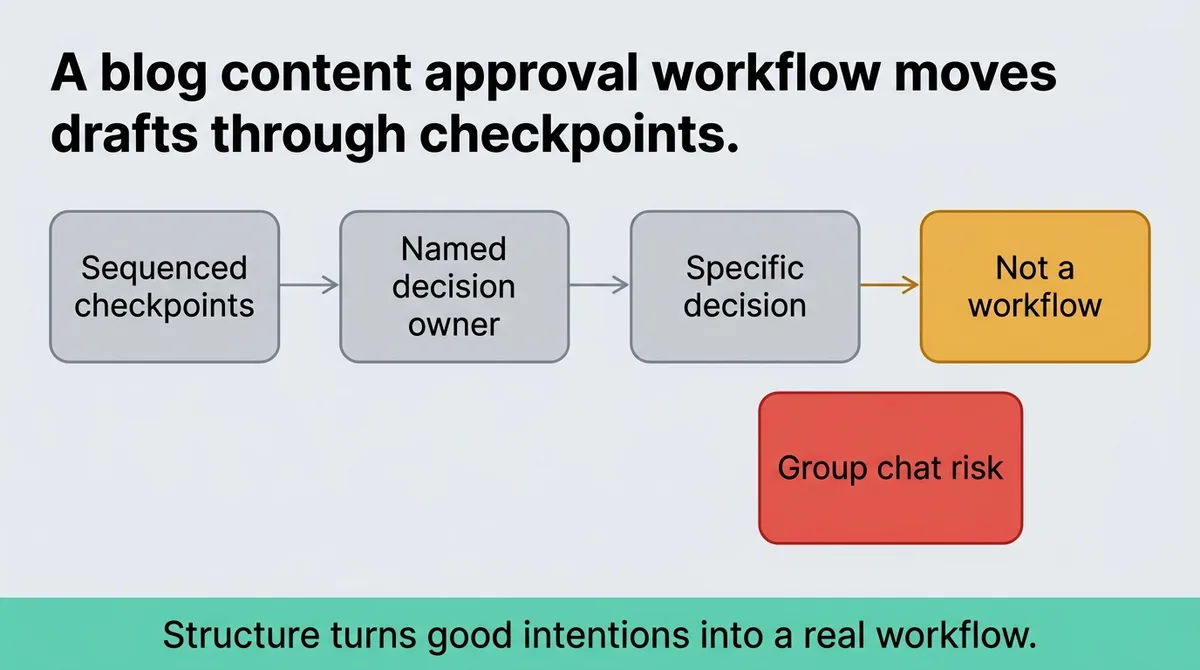
A blog content approval workflow is the sequenced system that moves a draft from written to published through defined checkpoints. Each checkpoint has a named owner and a specific decision to make. Without that structure, the process is not a workflow. It is a group chat with good intentions.
What a Blog Content Approval Workflow Actually Is (and What It Is Not)
Most teams treat content review as a handoff. A writer sends a draft, a manager reads it when available, comments accumulate in a doc, and someone eventually publishes it. That is not a workflow. It is an informal queue with no exit condition.
A real approval workflow defines three things: the stages a draft must pass through, the person who owns the decision at each stage, and what “approved” means at each checkpoint. When any of those three elements is missing, drafts stall.
Here is the sting: having a review process is not the same as having an approval workflow. A checklist tells people what to look at. A workflow tells people when to decide and who is accountable if they do not.
One vendor survey suggests how far many teams are from this structure: it reports that the average approval chain involves 4.2 people [2], and 74% of content requires multiple stakeholder approvals before it publishes [2]. That is not inherently a problem. The problem is routing those approvals without defined sequence or ownership. When approvals happen in parallel with no clear order, every reviewer assumes someone else will make the final call.
An approval workflow is also not a style guide, a content calendar, or an editorial brief. Those tools feed into the workflow. They do not replace it. The workflow is the operational layer that moves content through the system. Without it, every other content tool loses its output to the same bottleneck.
Where Delays Are Actually Happening in Your Review Process
Most teams diagnose their publishing delays as a capacity problem. They assume the fix is more writers, faster turnarounds, or a better briefing process. Those adjustments treat the output side of the problem. The delay is almost always on the approval side.
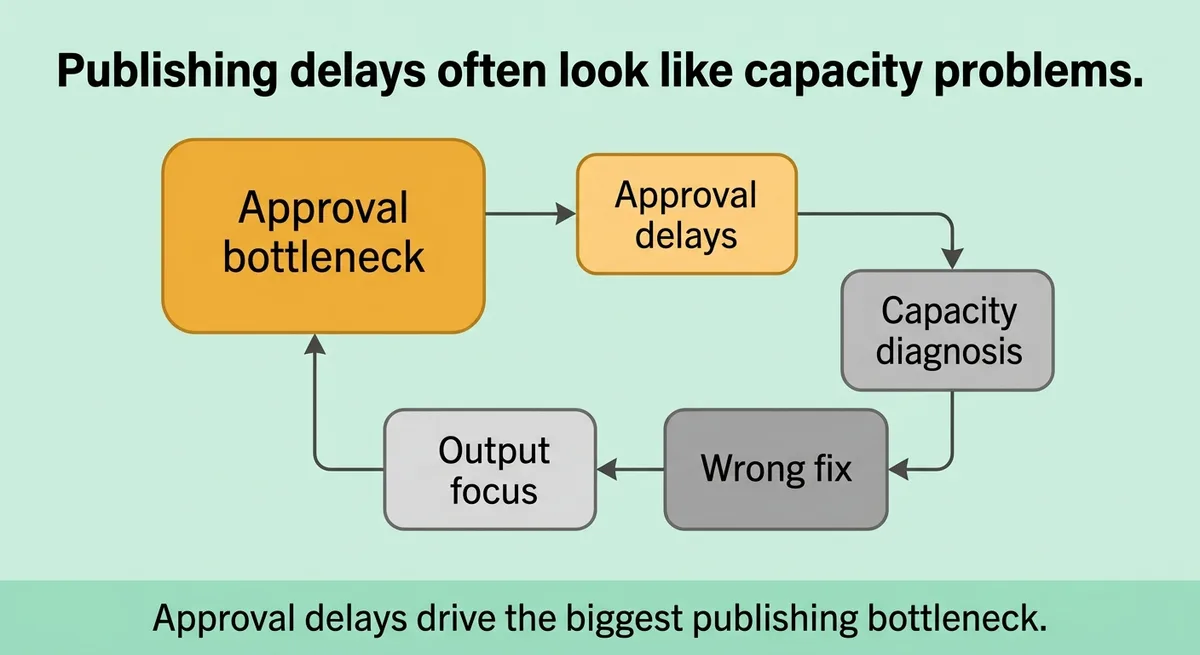
One vendor survey reports that in 62% of cases, teams cite approval delays as the top publishing bottleneck [2]. Manual routing, meaning sending a draft to a reviewer by email or Slack without a defined response window, produces an average cycle of about 4.7 days per asset in that survey [2]. Across a monthly publishing target of even eight posts, that delay adds up quickly before a single word changes.
The delay concentrates at two specific points. First, the handoff between writer and editor has no formal trigger. The writer considers the draft done. The editor has no notification that a decision is waiting. Second, compliance or brand checks often run at the wrong stage. Running those checks after copy approval means a late-stage rejection sends the draft backward through the entire sequence. The same survey reports that 44% of teams identify compliance checks as a major delay source [2], and that figure often reflects late-stage placement, not the check itself.
For example, imagine a B2B SaaS content team with one editor and two freelance writers. The editor reviews drafts when they appear in a shared folder. No deadline exists for the review. The writers treat submission as completion. Two weeks pass, no post publishes. The editor was waiting for a brief update from the product team. Nobody told the writers. The draft sat at a handoff point with no owner and no resolution window.
The same vendor survey reports that the average asset moves through 2.9 approval rounds before it publishes [2]. Each round represents a return trip through the sequence. Cutting that number starts with mapping where each round originates. Most originate from the same gap: a reviewer who lacked context at the start of the process and compensates by requesting changes mid-review.
Stop adding reviewers to fix quality. Start placing context at the beginning of each stage so reviewers can decide without requesting more information.
How to Build a Sequenced Approval Process with Clear Ownership and Handoffs
Building this structure does not require a new tool. It requires four decisions: how many stages the process needs, who owns each stage, what the decision criteria are at each stage, and how long each stage has before it escalates.
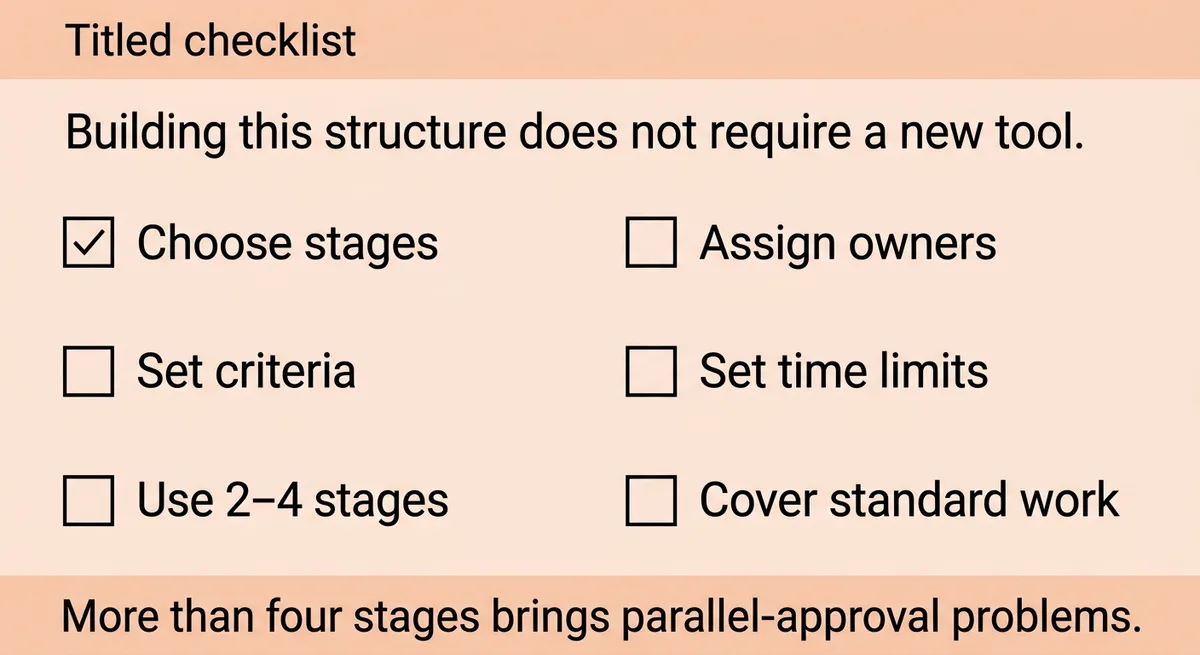
A 2-to-4 stage model handles most blog publishing sequences [2]. Fewer than two stages skips necessary review. More than four stages introduces the same parallel-approval problem described earlier. For a standard blog post, three stages cover the work: structural review, copy approval, and final publishing check. Each stage produces one decision. Approved, rejected with specific changes, or escalated.
Stage | Decision Owner | Response Window |
|---|---|---|
Structural review | Editor or content lead | 24 hours [2] |
Copy approval | Marketing lead or brand reviewer | 24 hours [2] |
Publishing check | CMS owner or ops lead | Same business day |
Each row in that table represents a single named person, not a team or a role category. “Marketing” is not a decision owner. A specific person is. When two people share ownership of a stage, neither acts with urgency. The draft waits.
The 24-hour response window is the operational constraint that makes this work [2]. It does not mean every draft gets reviewed in 24 hours. It means every reviewer knows they have 24 hours to respond before the draft escalates to the next available decision-maker. That escalation path must be defined in advance. Without it, the window is a suggestion, not a constraint.
One vendor survey reports teams running this structure cutting average approval cycles to about 1.8 days [2]. That reduction comes from one mechanism: every draft has a named next action and a time limit on that action. The draft never enters a state where it is “with someone” without a deadline attached.
One implementation caveat: the sequence only holds if the brief entering stage one is complete. A draft that enters structural review without a keyword, target audience, and content goal will generate revision requests that send it backward. The 2-to-4 stage model assumes the brief precedes the draft. If it does not, add a brief-validation checkpoint before stage one, not inside it.
The math is straightforward. Shorten the cycle per post, multiply across your publishing volume, and the time recovered over a year can be meaningful.
Why Adding More Reviewers Makes Publishing Slower, Not Safer
The instinct to add reviewers is understandable. A post goes live with an error, or a draft misses a brand standard, and the response is to involve more people earlier. The error gets fixed. The process gets slower. And the next error still happens.
Adding a reviewer to a stage does not increase accuracy. It distributes accountability until nobody holds it. When three people review the same draft at the same stage, each assumes the others caught the errors. The draft ships with the same problems, just later.
One vendor survey supports a harder position: it reports that teams with defined approval processes see a 2.6x speed advantage over teams relying on manual routing [2]. That advantage does not come from working faster. It comes from removing the structural condition that creates delay: shared or undefined ownership at each stage.
In one vendor survey, 68% of teams named lack of clear process as the top reason content quality fails [1]. Not lack of reviewers. Not lack of budget. Lack of process. More reviewers without a defined process adds volume to the problem, not resolution.
For example, imagine a content agency managing six client blogs. Each blog has two internal reviewers plus the client as a third approver. The client approves last. That sequence means every draft waits for two internal rounds before the client sees it. If the client rejects a structural choice, both internal rounds were wasted. Restructuring to a single internal reviewer who validates structure before client review can remove one full round from each asset.
The practical fix is a defined cap: one decision owner per stage, two at most for high-stakes content. Two reviewers at a single stage should only exist when both reviewers hold different decision authority, such as one for legal and one for brand, and their reviews run sequentially, not in parallel.
The roughly 4.7-day average approval cycle reported in one vendor survey [2] reflects teams that have not set this cap. It is not an industry standard to accept. It is a measurement of what happens without structural limits on approval chain length.
Publishing speed is a product of how few people a draft needs to satisfy, not how many. Every additional approver is a new failure point with a new response latency. Clean handoffs between fewer, named owners tend to outperform broad review panels.
How Fewer Approvers and Cleaner Handoffs Get Content Published Faster
The core shift is narrow. Replace shared review stages with single named owners. Set a 24-hour response window per stage. Define what escalation looks like when that window closes. Run compliance and brand checks at the stage where they belong, not at the end.
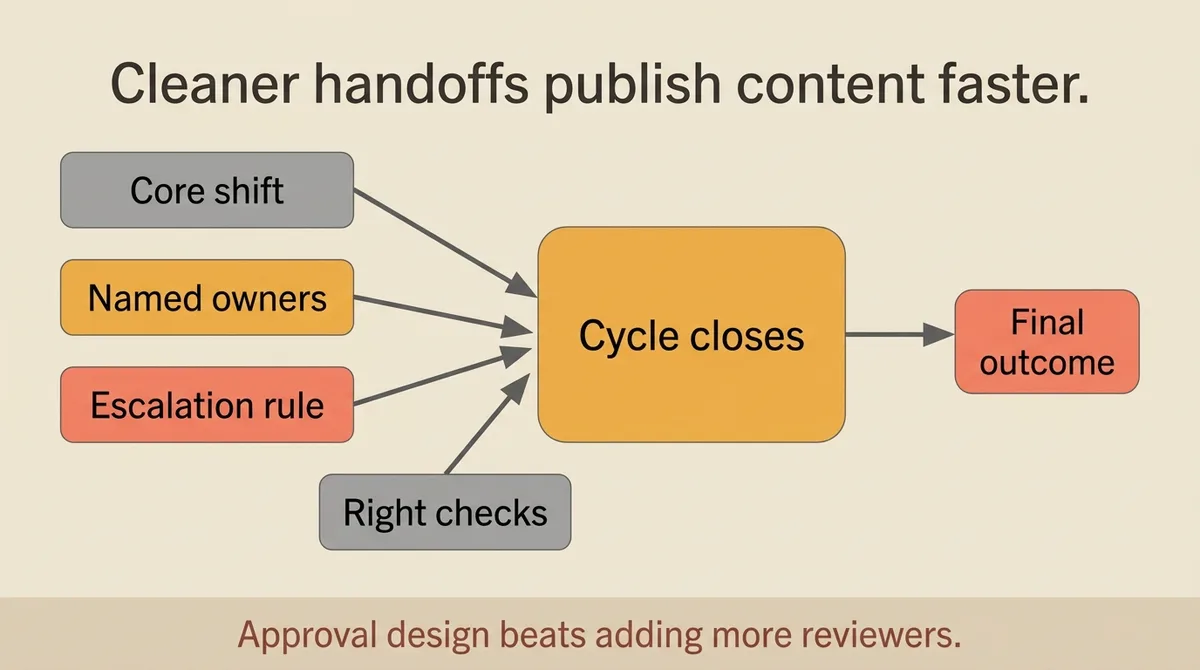
A four-person approval chain producing a 4.7-day cycle is not a team problem. It is a design problem. The same four people, assigned to separate sequential stages with defined criteria, can close the same cycle in under two days.
The blog content approval workflow is not a governance document. It is an operational sequence with names, windows, and decisions attached to every step. Teams that treat it that way publish more, revise less, and stop losing content to the same stall points every month.
Name the owner. Set the window. Publish the post.
References and Citations
[1]https://www.usebubbles.com/blog/content-approval-workflow
[2]https://www.narrareach.com/blog/content-approval-workflow
FAQ
A blog content approval workflow is a sequenced system that moves a draft from written to published through defined checkpoints, each with a named owner and a specific decision to make. Without that structure, review is just an informal queue with no exit condition, and drafts stall indefinitely. One vendor survey reports teams with a real workflow cutting average approval cycles from about 4.7 days to about 1.8 days.
Reduce blog publishing delays by assigning a single named decision owner to each approval stage, setting a 24-hour response window per stage, and defining an escalation path when that window closes. Running compliance and brand checks at the correct stage rather than at the end of the sequence can reduce a common cause of late-stage rejections that send drafts backward. Platforms like Zelitho can help reduce upstream friction further by connecting topic selection, drafting, and CMS publishing in one system, designed so the draft arriving at your first review stage is more structured and complete.
Adding more reviewers slows approvals because shared ownership at a single stage distributes accountability until nobody holds it, and each person assumes the others will catch errors. One vendor survey reports that teams with defined approval processes run about 2.6 times faster than teams relying on manual routing, and that advantage comes from removing shared ownership, not from increasing reviewer count. The practical fix is capping each stage at one named decision owner, or two only when both hold different decision authority and review sequentially rather than in parallel.
Most blog posts need between two and four approval stages: fewer than two skips necessary review, and more than four reintroduces the parallel-approval problem that causes stalls. A standard three-stage model covers structural review, copy approval, and a final publishing check, each producing one clear decision: approved, rejected with specific changes, or escalated. Each stage requires a single named owner and a 24-hour response window to remain actionable rather than advisory.
The most effective approach combines a clearly mapped approval sequence with a platform that reduces the number of handoffs a draft must survive before it reaches review. Zelitho is designed to help with the pre-review half of the problem by handling keyword selection, research-backed drafting, on-page optimization, and direct CMS publishing inside one connected system, which can mean fewer incomplete drafts enter the approval queue in the first place. On the process side, the structural fix requires no new tool: name one owner per stage, set a 24-hour response window, and define escalation before you need it.