
Content Batching for Faster Blog Production

TL;DR
Content batching for blog posts groups planning, drafting, and publishing into focused blocks so you spend less time restarting. Cadence and fewer context switches usually beat one-off hero posts.
You open the CMS on a Tuesday morning, stare at a blank draft your freelancer half-finished three weeks ago, and realize the blog has been quiet for two months. The deadline pressure is real, but the output still does not appear.
Posting one article at a time forces a full restart every cycle. You brief, wait, review, edit, and schedule, then repeat the entire sequence from scratch the following week. That restart cost compounds until publishing stops entirely.
Content batching groups similar production tasks into dedicated time blocks across a full month. You plan topics in one session, draft several posts in another, then edit and schedule in bulk. This cuts the restart cost on every cycle. It works best for marketing leads managing a regular blog cadence and agency founders running multiple client content programs simultaneously.
What Content Batching Actually Means and What It Is Not
Most people hear “batching” and picture a writer cranking out five rough posts in one afternoon. That is bulk writing. It is not this.
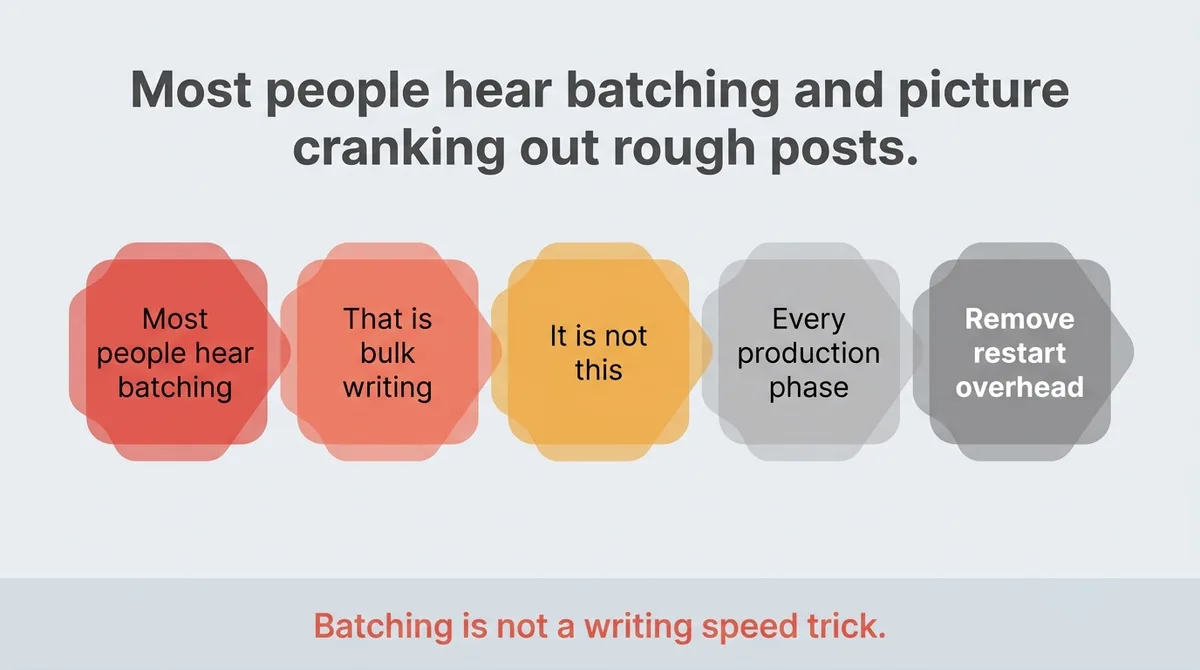
The system covers every production phase, not just drafting. Planning, outlining, drafting, editing, and scheduling each get their own dedicated session. You are not writing faster. You are removing the overhead that fires up every time you restart the process for a single post.
The false assumption: batching is a writing productivity trick. It is a production scheduling decision.
A practical structure uses 3 to 5 content pillars as your planning anchors [1]. Each pillar is a core topic area your blog covers consistently. Within those pillars, you target 3 to 4 ideas per pillar each month [1]. That gives you 9 to 20 topics planned in a single session, rather than sourcing one idea per deadline.
Here is how the phases differ from one-at-a-time production:
Phase | One-at-a-Time | Batched |
|---|---|---|
Topic selection | Weekly, reactive | Monthly, structured by pillar |
Drafting | One post per sitting | 3–5 posts per writing block |
Editing | Mixed into drafting | Separate dedicated session |
Scheduling | Ad hoc after each post | Queued in bulk at month start |
The batched column does not compress time. It removes decision fatigue and context switching from the production sequence.
Stop treating each post as its own project. Start treating the month as the production unit.
How the Batching Workflow Runs From Planning Through Publishing
The workflow has four distinct phases. Each phase happens in a time block. No phase bleeds into the next.
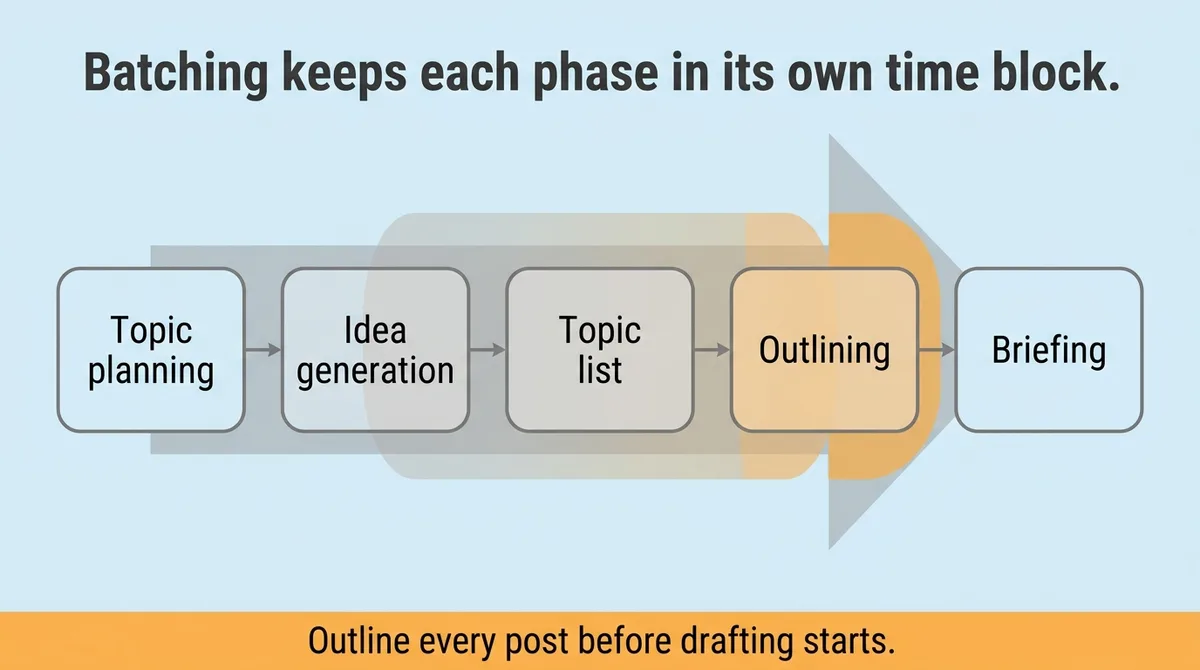
Phase one: topic planning. Set aside one session early in the month. Review your content pillars. Generate 3 to 4 ideas per pillar. Document each with a working title, target keyword, and intended audience. This session ends with a full topic list, not a blank content calendar.
Phase two: outlining and briefing. Before drafting starts, outline every post on your list. Each outline captures the angle, key sections, and any source material. If you work with freelancers, this is when you send briefs. You batch the briefing process, so you make one round of handoffs instead of one per week.
Phase three: drafting. Schedule two to three focused writing blocks across the month. Drafting happens only in these blocks. You are not reviewing emails, approving other work, or fielding questions during this time. Each block produces two to four rough drafts.
Phase four: editing and scheduling. Edit all drafts in one or two sessions near the end of the month. Then queue everything for publishing. The scheduling recommendation is 1 to 2 hours at the start of each month to queue posts in your CMS [1]. That time block handles the final step for every piece produced that cycle.
For example, imagine a two-person content team at a B2B SaaS company with a blog targeting one post per week. In the old model, every Monday they draft one post from scratch, edit it by Wednesday, and publish Thursday. Three weeks into the quarter, a freelancer misses a deadline and the calendar breaks. Under a batched model, they plan the month’s 4 topics in one session on the first Monday. They draft two posts in each of two writing blocks, edit all 4 in a single afternoon, and schedule all 4 posts before the second week begins. The deadline miss from the freelancer still happens, but it hits a buffer, not a live publishing slot.
The key operational shift is that production runs ahead of the calendar. You are not creating content for this week. You are creating content for the next four weeks.
Why Publishing Without a Batching System Quietly Breaks Your Output
Reactive publishing does not feel broken at first. You ship one post this week, miss next week, ship the week after. The blog stays technically active. The calendar just looks thin.
The cost accumulates in three places: time, quality, and consistency.
On time: every post restart includes topic selection, brief creation, context loading, and publishing setup. These overhead tasks repeat fully each cycle. They do not shrink just because you did them last week.
On quality: writing quality drops when you draft under deadline pressure. You skip research steps. You cut the editing pass. You publish a post that is 70 percent of what it could have been because the deadline arrived before the draft was ready.
On consistency: one consultancy article argues that consistency outweighs one-off post quality [2]. A blog that publishes sporadically does not build the compounding traffic that a steady cadence produces. The gap between your best single post and your worst month of output is less important than whether you published at all.
Inconsistency is not a motivation problem. It is a structural problem.
Production that depends on a weekly restart stops at any friction point. A sick freelancer, a busy approval week, or a founder pulled into sales calls for ten days, each of these events breaks the output. A batched system absorbs those disruptions because content already exists in the queue.
The agency founder managing five client blogs by hand feels this most directly. Each client blog operates as its own weekly production line. If one freelancer runs late, that blog goes dark. The founder spends their week doing emergency drafts instead of growing the business. The system fails at exactly the scale it needs to work.
When Batching Fits Your Workflow and When It Does Not
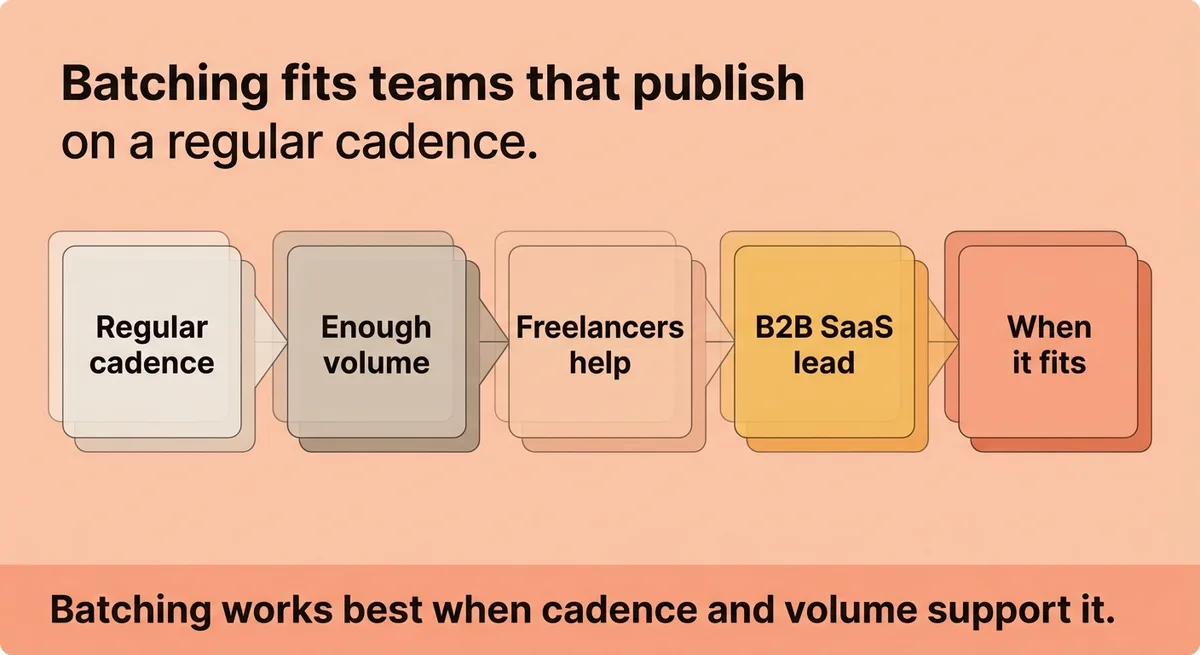
Batching is a strong fit for any team that publishes on a regular cadence and wants to stop rebuilding the production process every week. If you target two to four posts per month, you have enough volume to make grouped sessions worthwhile. If you work with freelancers or contractors, batching the briefing and review phases removes the scattered back-and-forth that kills timelines.
It fits well in these situations:
A marketing lead at a B2B SaaS company who manages blog production alongside three other channels. That person cannot afford to treat content as a weekly emergency. Batching moves blog production into a predictable monthly rhythm, so it does not compete for attention every time another priority appears.
An agency founder running content programs for multiple clients simultaneously. Batching lets you plan and brief all clients in one session, draft or coordinate all content in another, and handle reviews and scheduling in a third. The alternative is a context-switching loop that runs from Monday to Friday with no clean stopping point.
Batching is a weaker fit in these situations:
News-adjacent content that must react to industry events within 48 hours does not batch well. The planning-to-publishing window is too short. A reactive workflow fits better there.
Content programs with no clear publishing target should not batch first. Define a consistent target, even if it is just one post per month, before organizing production around it. Batching a chaotic content program produces batches of chaos.
Solo writers who prefer to think and draft simultaneously may find the separated-phases structure unnatural. Some writers generate better work when planning and drafting overlap. The system should match the actual cognitive process, not fight it.
One implementation caveat that is easy to miss: batching requires your approval chain to batch too. If you write four posts in one block but your founder or legal team reviews one post at a time over four separate weeks, the queue never fills. Align your reviewers to the monthly cadence before you build the production schedule around it.
Choose Your Production Model Before Your Next Deadline Forces It
You will run a production model either way. The difference is whether you choose it or whether a missed deadline chooses it for you.
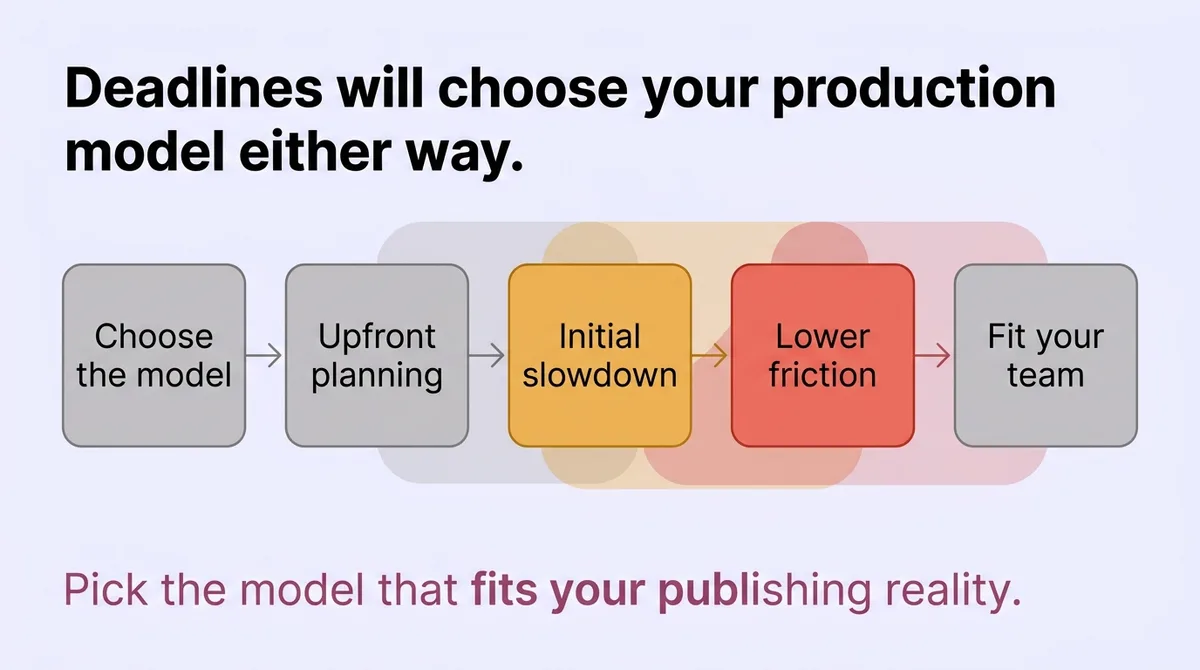
A batched workflow requires one month of upfront planning to set up the pillar structure, brief your contributors, and build your first queue. That month feels slower. Every month after it runs with less friction than your current setup does today.
Pick the model that matches your publishing target, your team structure, and your approval process. Then commit to it before the next blank Tuesday morning in your CMS.
Your next post should already exist before your audience expects it.
References and Citations
[1]https://keepcalmandchiffon.com/blog/batch-content/
[2]https://www.theloopconsulting.ca/blog/batch-create-your-contet
FAQ
Content batching groups similar blog production tasks into dedicated time blocks, so you plan topics in one session, draft several posts in another, and edit and schedule in bulk, removing the restart overhead that fires up every time you produce a single post. The speed gain comes not from writing faster but from eliminating repeated context-switching and decision fatigue across topic selection, briefing, drafting, editing, and CMS publishing. Platforms like Zelitho can support this connected-workflow approach, helping with keyword selection, draft generation, and publishing in one place so fewer phases need a separate tool or handoff.
Start by defining 3 to 5 content pillars, the core topic areas your blog covers consistently, then generate 3 to 4 ideas per pillar in a single planning session at the start of the month. After that, outline and brief all posts in one block, draft them across two to three focused writing sessions, and finish with a single editing and scheduling pass that queues every post in your CMS before the first live date. The critical rule is that no phase bleeds into the next: planning stays separate from drafting, and editing stays separate from both, so each block has a clean start and end.
Publishing one post at a time forces a full production restart every cycle, and any friction point, a sick freelancer, a busy approval week, or a founder pulled into sales calls, breaks the output entirely rather than hitting a buffer. One consultancy article argues that consistency outweighs one-off post quality, and sporadic publishing tends to miss the compounding traffic that a steady schedule produces. Inconsistency here is a structural problem, not a motivation problem, and it gets worse as the number of posts or client blogs you manage increases.
Yes, content batching is especially well-suited for agencies running multiple client blogs because it lets you plan and brief all clients in one session, coordinate or draft all content in another, and handle reviews and scheduling in a third, replacing a constant context-switching loop with three clean work blocks. Without batching, each client blog operates as its own weekly production line, so one freelancer running late sends a single client’s blog dark and pulls the agency founder into emergency drafts. Zelitho can help agencies apply this batched workflow across multiple client blogs, depending on your plan and workspace setup.
Before switching, define a clear publishing target, even if it is only one post per month, because batching a chaotic content program without a target just produces batches of chaos. You also need to align your approval chain to the monthly cadence: if your legal team or founder reviews one post at a time over four separate weeks, the queue never fills and the batched model cannot function. Once those two conditions are in place, the upfront cost is roughly one month of slower production to build the pillar structure, brief contributors, and fill the first queue, after which every subsequent month runs with less friction than the one-at-a-time model.