
How to audit content workflow bottlenecks: A practical guide

TL;DR
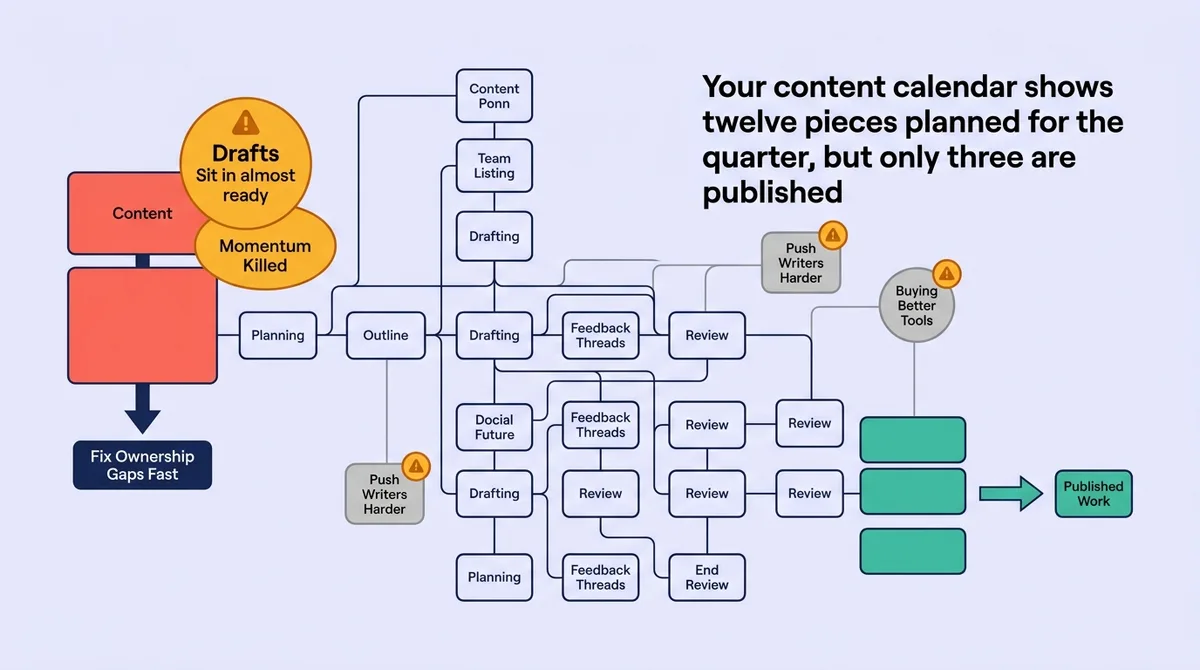
Your content calendar shows twelve pieces planned for the quarter. Eight weeks in, three have published. The rest sit in some version of “almost ready.” You have drafts. You have feedback threads. You just don’t have published work. This guide explains how to audit content workflow bottlenecks before they slow the publishing calendar.
Most teams respond by pushing writers harder or buying better tools. That doesn’t fix the problem because the problem isn’t output speed. It’s that no one knows which specific stage killed the momentum.
This article breaks the content workflow into four auditable stages: planning, production, review, and release. Each stage has distinct failure signals. Each signal points to a specific ownership gap. Marketing leads and agency operators who run this check stage by stage stop guessing and start fixing the right thing.
What does a content workflow audit actually check?
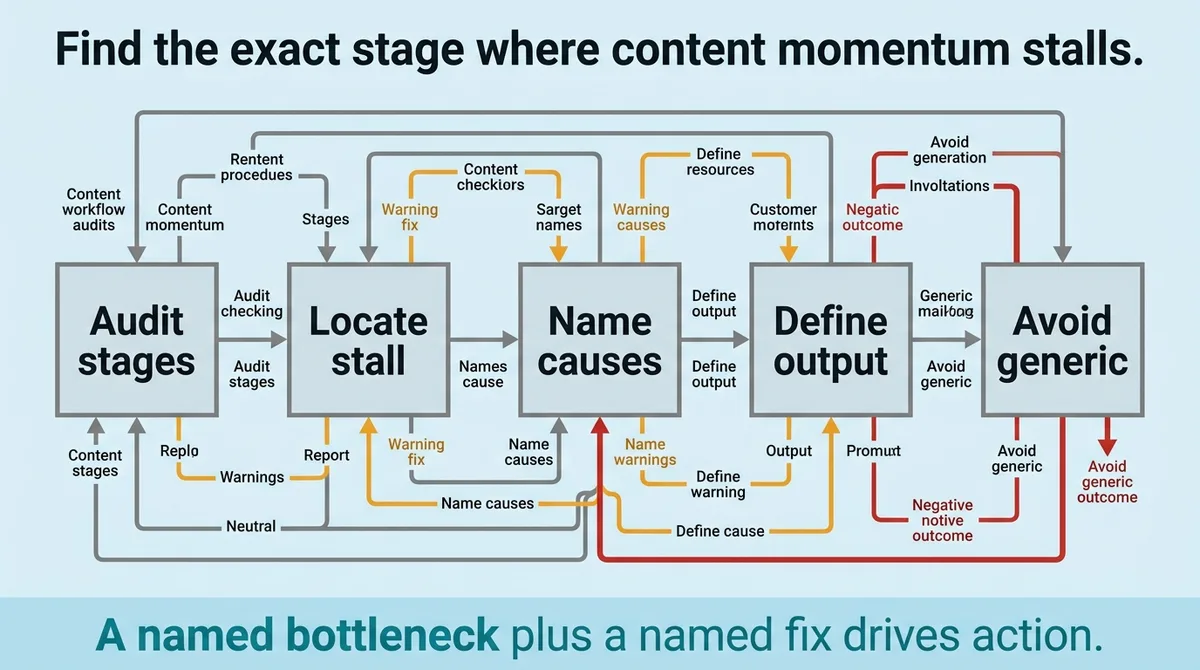
A content workflow audit checks each stage of the production process separately, looking for the exact point where work slows, loops, or stops moving. It identifies whether the cause is unclear ownership, a missing handoff, or a gap in process documentation. The output is a named bottleneck with a named fix, not a general recommendation to improve communication.
Why Treating Your Workflow as One Process Hides Every Bottleneck
You open the project board on a Monday morning and everything looks active. Cards are moving. Comments are accumulating. Three pieces are labeled “in progress.” But none of them have published in six weeks.
The instinct is to look at the whole system and ask what’s slowing down. That instinct is wrong.
Evaluating the workflow as a single continuous process averages out the failure. A piece that spent two days in production and eleven days waiting for review looks identical to a piece that stalled at brief assignment. The average cycle time tells you nothing useful.
Stop diagnosing the workflow as one unit. Start treating each stage as a separate process with its own inputs, outputs, and failure modes.
An effective audit has three core components and divides into two basic parts: risk assessment and control testing [2]. Both parts apply to each stage independently. That distinction matters because a risk in the review stage does not respond to fixes in the production stage. Conflating them wastes time and creates friction between team members who weren’t responsible for the actual break.
Here’s the false assumption most teams carry: if the content is stalling, the writer is the bottleneck. Teams route pressure toward whoever last touched the work. A review queue with no assigned owner, no time limit, and no escalation path sits invisible behind that assumption.
A stage-by-stage view makes that queue visible. A single-process view buries it.
View Type | What You See | What You Miss |
|---|---|---|
Single process | Overall output speed | Which stage caused the delay |
Stage-by-stage | Cycle time per stage | Nothing; each failure is visible |
Before any audit begins, the team must map its workflow into named stages. Not categories. Not statuses. Named stages with clear entry and exit conditions. That map becomes the audit surface.
The Four Stages Where Content Work Stalls, Loops, or Disappears
Every content workflow breaks at one of four points. The breakdown looks different at each stage, and so does the fix.
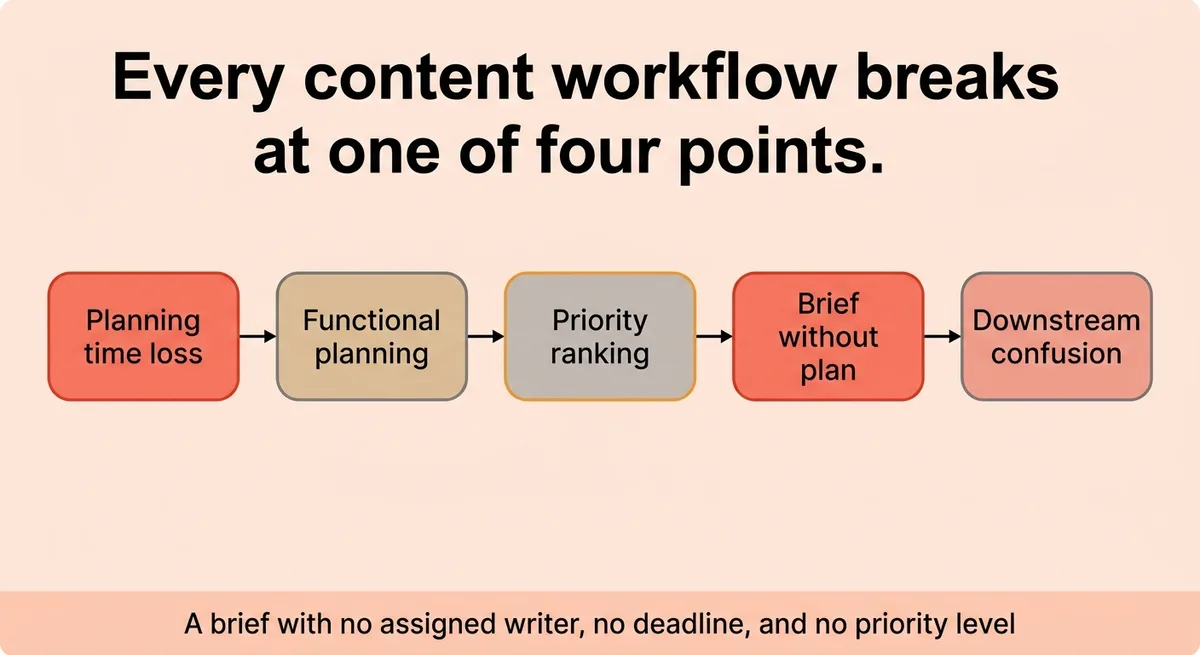
Planning is where most teams lose time they never notice losing. Four specific actions define a functional planning stage: task grouping, ownership assignment, time estimation, and priority ranking [2]. Skip any one of them and the downstream stages inherit the confusion. A brief with no assigned writer, no deadline, and no priority level is not a plan. It’s a wish.
Production fails when writers wait. They wait on briefs that weren’t finalized. They wait on brand assets that live in someone’s personal drive. They wait on approvals that weren’t formally requested. The work isn’t blocked because the writer can’t produce. It’s blocked because the inputs required to produce were never formally handed off.
Review is where rework loops start. A piece enters review, receives broad directional feedback, goes back to the writer, comes back to review, receives different feedback from a second stakeholder, and loops again. The signal here isn’t slow review. It’s feedback that restarts rather than progresses the work. Each loop adds days. Over a quarter, those days compound into missed windows.
Release has its own failure mode that most teams don’t name: content that’s finished but not published. The copy is approved. The images are ready. The CMS is waiting. But the person who can publish is not the person who finished the review, and no handoff was ever formally made. The work disappears into an inbox or a Slack thread labeled “ready to go” and sits there.
The table below maps each stage to its primary failure signal and the ownership gap it exposes.
Stage | Primary Failure Signal | Ownership Gap |
|---|---|---|
Planning | Missing brief elements, duplicated tasks | No one owns the entry checklist |
Production | Writer waiting on assets or inputs | Handoff from planning to production undefined |
Review | Feedback loops that restart the draft | No single reviewer owns the final decision |
Release | Approved content sitting unpublished | No one owns the transition from approval to CMS |
One operational detail most teams get wrong: they assign ownership of work within each stage but never assign ownership of the transition out of that stage. The person who writes the draft does not automatically own getting it into review. That gap is where content disappears.
How to Run the Actual Audit: Signals, Checks, and Handoff Controls
The audit runs stage by stage. For each stage, you check two things: what happened to the work inside the stage, and whether the handoff out of the stage was documented.
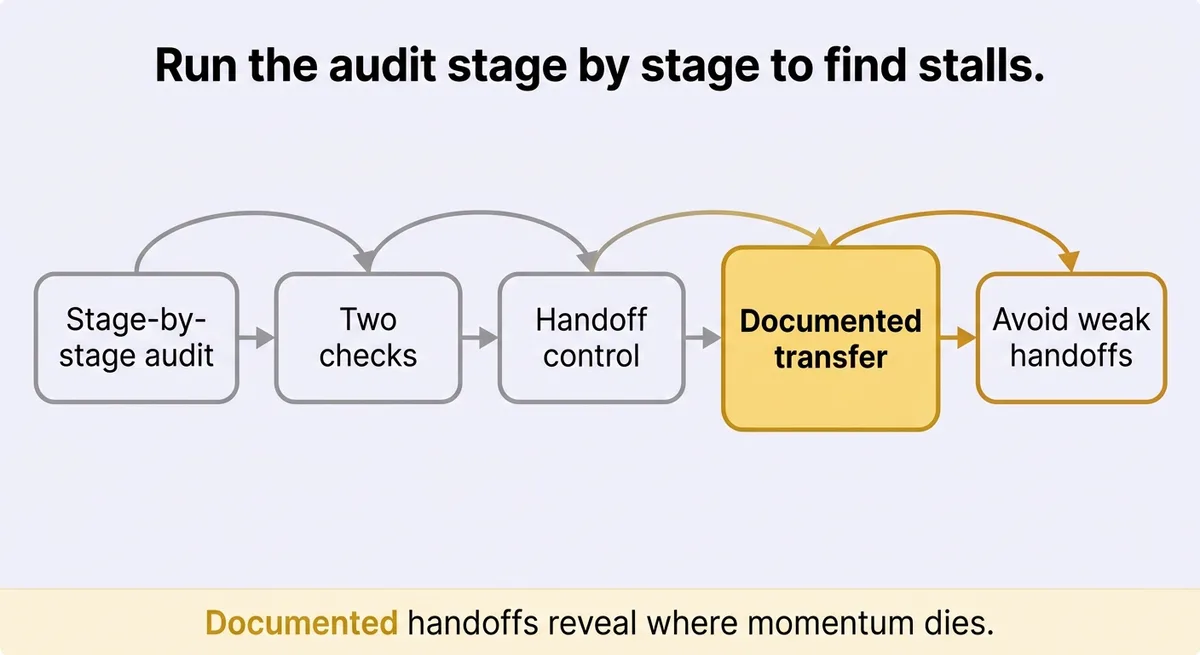
A handoff control is a defined moment where one person’s responsibility ends and another’s begins, with that transfer recorded somewhere both parties can see. Not in an email thread. Not in a verbal update during standup. In a shared system where the handoff timestamp, the receiving owner, and the expected next action are visible.
Audit records carry five documentation purposes that go well beyond compliance: they create visibility into stage timing, expose repeated failure patterns, clarify ownership disputes when they arise, track cycle time per stage, and surface rework signals before they become calendar problems [2]. Most teams only think about documentation as a compliance requirement. It is actually a diagnostic tool.
For example, imagine a content team that starts tracking time-in-stage for every piece over a four-week period. Production averages two days per piece. Review averages six. Without the time-in-stage data, the team assumes the writer is slow. With it, they see the writer is finishing on time and the review queue is the constraint. That data doesn’t come from instinct. It comes from documented handoffs.
Here is the per-stage checklist the audit uses.
Planning stage check:
Healthy signal: Every brief has an assigned writer, a due date, and a priority level before it leaves planning.
Failure signal: Briefs exist in draft form with no assigned owner or no deadline.
What to look for: How many pieces sat in planning for more than five business days?
Production stage check:
Healthy signal: Writers begin drafts within one day of receiving a complete brief.
Failure signal: Writers are waiting for assets, direction, or approvals that weren’t included in the handoff.
What to look for: Are any drafts stalled with a comment asking for something that should have been provided at brief?
Review stage check:
Healthy signal: Each piece enters review once, receives consolidated feedback from one decision owner, and returns to production only if a structural issue exists.
Failure signal: The same piece has been marked “in review” more than once in the same cycle.
What to look for: How many feedback threads include contradictory direction from different stakeholders?
Release stage check:
Healthy signal: Approved content publishes within two business days of final sign-off.
Failure signal: Pieces marked “approved” have no publish date assigned.
What to look for: How many approved pieces are sitting without a scheduled publish action?
Stop relying on team memory to answer these questions. Start pulling the actual record from wherever your work lives.
What Happens When You Do Not Fix the Bottleneck You Found
The cost of a known but unaddressed bottleneck is not one delayed post. It’s the compounding effect across an entire calendar.
A quarterly campaign misses its window because review delays pushed the release two weeks past the planned date. The content existed. The team worked on it. The window closed anyway. That’s not a productivity problem. That’s a structural one. The structure won’t fix itself after the fact.
Here’s what accumulates when the bottleneck stays named but unresolved: rework builds up in the review stage, writers lose confidence that their work will actually ship, and the content calendar stops being a planning tool and becomes a record of intentions. Once the calendar loses credibility, planning gets harder. Fewer people trust the schedule. More work gets deprioritized informally.
The hidden worry most teams don’t say out loud: they already know where the bottleneck is, but acting on it feels like assigning blame. Pointing at the review stage feels like pointing at the person doing reviews.
This audit is not a performance evaluation. It makes the process structure visible so fixes become obvious and non-personal. The fix is rarely “that person needs to move faster.” The fix is usually “that person needs a defined time limit, a clear decision authority, and a handoff protocol that doesn’t depend on them remembering to pass the work forward.”
For example, teams that identify a review bottleneck but don’t act on it often spend the next quarter rearranging other stages. They improve the brief template. They switch project management tools. Publish rates don’t change because the constraint was never in those stages.
After the audit, each identified bottleneck must have a named owner for the fix. Not a team. Not a process. A person who owns the change and a date by which it applies. Without that, the audit document becomes one more piece of content that was produced but never shipped.
Where your content workflow breaks and who actually owns the fix
The breakdown is almost never where the team thinks it is.
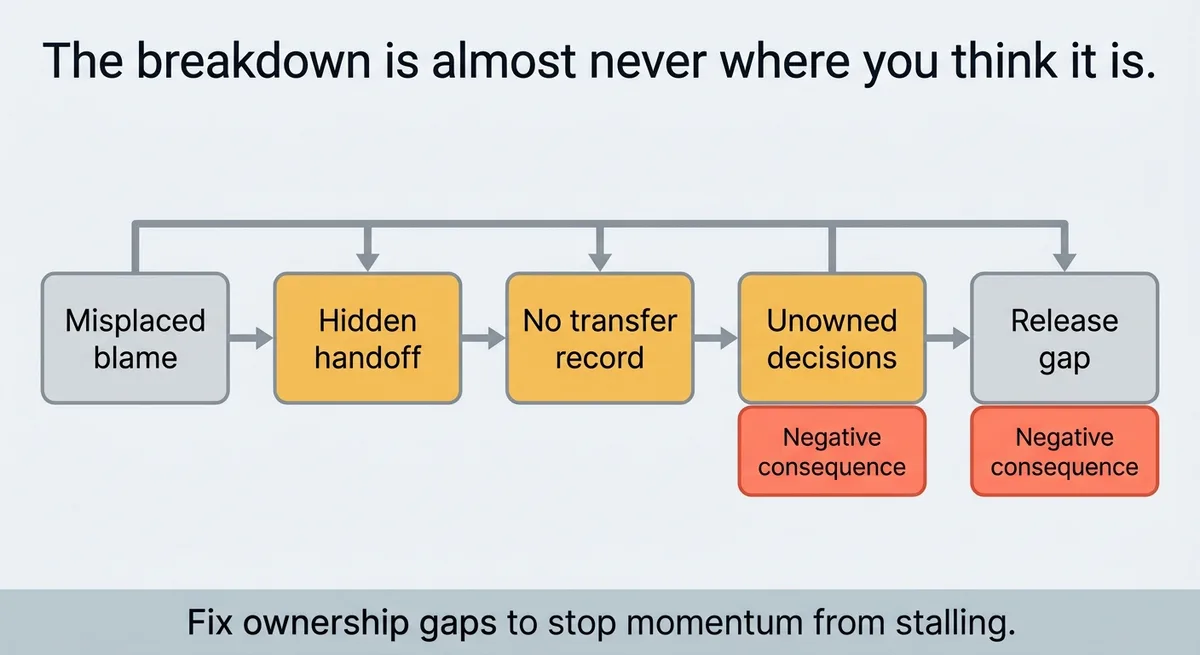
Most content teams point to writing speed, tool friction, or stakeholder availability as the source of their calendar problems. The actual break is usually a handoff that was never formalized. Work crosses from planning to production without a documented transfer. Review produces feedback without a single decision owner. Approval happens but the release step belongs to no one.
Running this check stage by stage takes the diagnosis out of opinion and puts it into observable data: time-in-stage, handoff records, rework counts, and publish lag. Each data point points to a specific stage. Each stage points to a specific fix.
The audit is only useful if it ends with a named owner for each fix. Assign the fix. Set the date. Publish the work.
References and Citations
[1] https://www.oxcyon.com/centralpoint-dxp/oxcyon-glossary-terminology-centralpoint/workflow-audit-management-878
[2] https://www.boombirds.com/blog/2021/05/19/audit-workflow-effective/
FAQ
You identify the delaying stage by tracking time-in-stage for every piece separately across planning, production, review, and release, rather than looking at overall cycle time. A piece that spent two days in production and eleven days waiting for review looks identical in aggregate, but the stage-by-stage view exposes the review queue as the real constraint. Pull the actual records from your project system: time-in-stage, handoff timestamps, and rework counts each point to a specific stage with a specific fix.
The four most common bottlenecks in a content production workflow are: briefs leaving planning without an assigned writer or deadline, writers waiting on assets or inputs that were never formally handed off, review loops where multiple stakeholders give contradictory feedback without a single decision owner, and approved content that sits unpublished because no one formally owns the handoff from approval to CMS. The most overlooked pattern is that teams assign ownership of work within each stage but never assign ownership of the transition out of that stage, which is exactly where content disappears.
One person must own the final review decision and deliver consolidated feedback in a single pass, rather than allowing multiple stakeholders to submit feedback independently at different times. When review has no single decision owner and no time limit, feedback tends to restart the draft rather than progress it, adding days per loop that compound across a quarter. Platforms like Zelitho address this at the structural level by keeping drafting, editing, and publishing inside one connected system, so the handoff from draft to publish does not depend on separate stakeholders remembering to pass work forward.
Approved content sits unpublished because no one formally owns the handoff from approval to CMS, so the fix is to name a specific person responsible for scheduling publication within two business days of final sign-off. This is a structural gap, not a speed problem: the copy is done, the images are ready, but the transition step belongs to no one and gets lost in a Slack thread. Zelitho eliminates this gap by connecting approval directly to direct publishing in WordPress or Webflow inside the same platform, removing the manual handoff step entirely.
Run the audit by checking each of four stages separately: planning, production, review, and release. For each stage, ask two questions: how long did work sit inside this stage, and was the handoff out of this stage documented in a shared system with a timestamp, a receiving owner, and a next action? For planning, check whether every brief left with an assigned writer, a due date, and a priority level. For production, check whether any draft has a comment asking for something that should have been in the original brief. For review, count how many pieces entered review more than once in the same cycle. For release, count how many approved pieces have no scheduled publish action. The audit ends only when each identified bottleneck has a named person who owns the fix and a date by which it takes effect.