
How to Draft a Research-Backed Blog Post With Citations

TL;DR
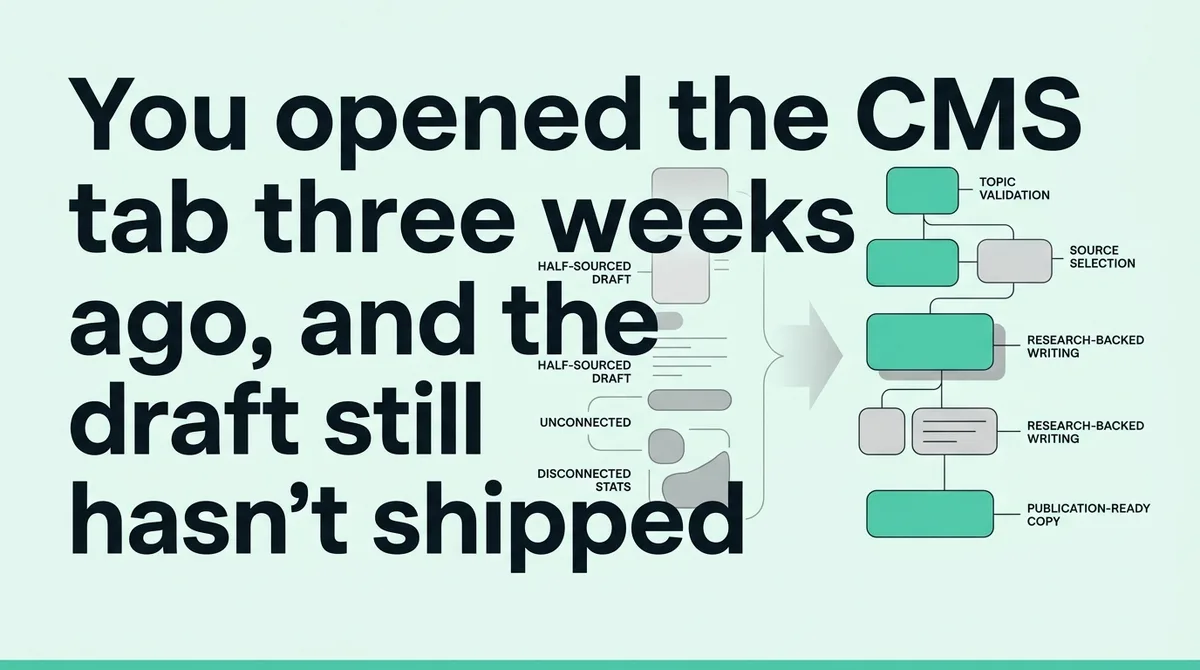
You opened the CMS tab three weeks ago. The draft is still sitting there, half-sourced, with a ChatGPT outline at the top and a freelancer’s notes at the bottom. Nothing shipped.
The common fix is to write first and add citations later. That produces posts where statistics float in the introduction and disappear before the argument lands. Readers notice. Editors notice. The post looks credible on the surface but collapses under a second read.
This guide treats source selection as the first drafting decision, not the last. You validate sources before writing a sentence, map evidence to specific claims before writing a paragraph, and place citations inline during the draft, not during cleanup. The result is a post that holds together under scrutiny. It works for content leads managing stalled pipelines and agency founders trying to ship consistent work across multiple client accounts without adding headcount.
What does it actually mean to write a research-backed blog post?
A research-backed blog post connects every factual claim to a primary source before the draft is finalized. It is not a post that mentions a study once and moves on. The research shapes the argument. Each section answers a specific claim with specific evidence, and the citation appears at the point of the claim, not at the end of a section.
The goal is a post that a skeptical editor can fact-check in under ten minutes and find no broken links, no misattributed statistics, and no sourced-sounding claims with no source attached.
Why Most Blog Posts Feel Thin Even When They Cite Sources
Adding a citation does not make an argument credible. It makes an argument look like it tried.
That distinction matters more than most writers realize. Over 850 million blog posts are published each month [1], and more than three out of four internet users read blogs regularly [1]. That volume means readers have absorbed thousands of posts that open with a statistic, never return to it, and end with a list of links that nobody checks. The format has trained readers to distrust citations they cannot trace back to a real claim.
The false assumption worth naming: a hyperlink is proof. It is not. A link to a study that does not support the sentence it follows is decoration, not evidence.
Here is what thin citation looks like in practice. Imagine a writer drafts a post on B2B email open rates. In paragraph one, they cite a 2022 industry report showing a 21% average open rate. By paragraph four, they are making claims about subject line length with no source attached. The study from paragraph one never appears again. A reader who clicks the link in paragraph one gets the data. A reader who reads paragraph four gets the writer’s opinion, packaged as fact.
The table below shows the difference between citation as decoration and citation as argument support:
Element | Citation as Decoration | Citation as Argument Support |
|---|---|---|
Placement | End of paragraph or section | Immediately after the claim it supports |
Role in argument | Adds appearance of credibility | Proves the specific claim being made |
Reader experience | Skimmed or ignored | Traceable and verifiable |
Stop adding sources after you write. Start selecting sources before you write a sentence.
The sections below treat research, drafting, and citation as one connected process. Each step feeds the next. Nothing gets retrofitted.
Step 1, Validate Your Topic and Select Sources Before You Write a Single Word
Most stalled drafts share one root cause. The writer started writing before they confirmed that credible sources exist for the claims they planned to make.
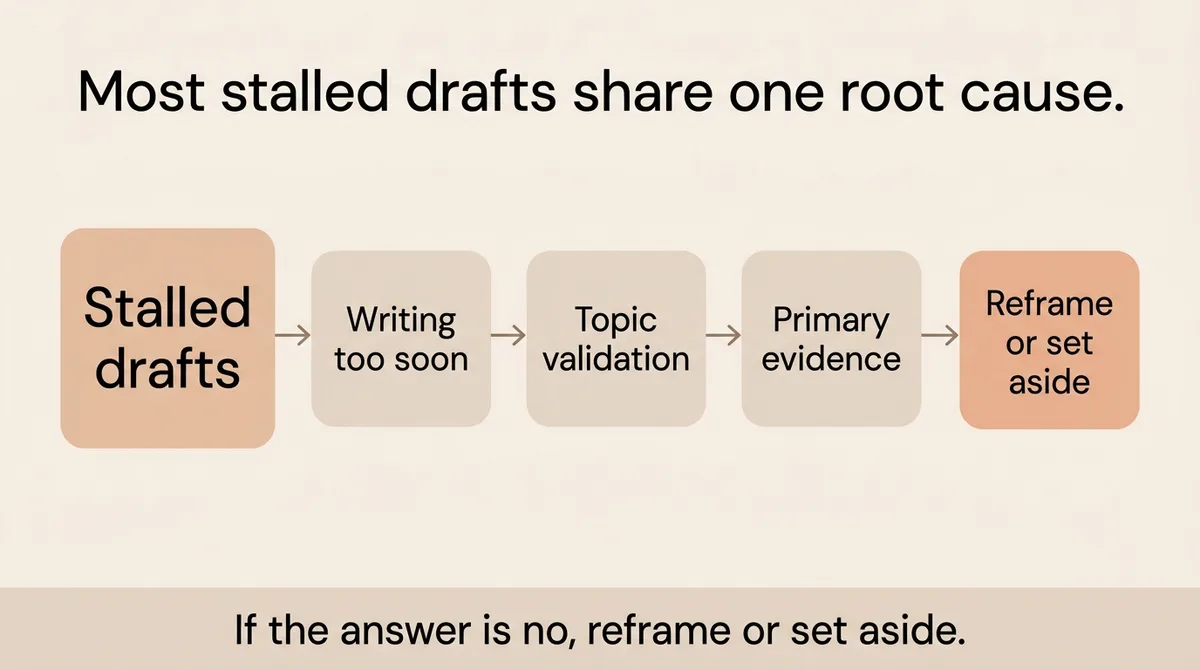
Topic validation is not keyword research. It is a source audit. Before opening a draft document, the question to answer is: can I find primary evidence for the three to five central claims this post needs to make? If the answer is no, the topic either needs to be reframed or set aside.
A study referenced in one content analysis included 75,000 answers from respondents [4]. That scale is what makes a statistical claim worth citing. When a claim rests on a source with a sample of 200 self-selected survey responses from a vendor’s own user base, the claim is not research-backed. It is marketing wearing a citation.
Four questions to ask before accepting any source:
- Recency: Is the data from the last three years? For fast-moving industries, is it from the last eighteen months?
- Sample size: Does the study report how many respondents or data points it used?
- Domain authority: Is the source a peer-reviewed journal, a government body, an industry association, or a primary research organization?
- Direct relevance: Does this source prove the exact claim you plan to make, or does it only gesture in the same direction?
For example, imagine a content lead at a SaaS company building a post on customer churn. They find a widely-shared statistic claiming it costs five times more to acquire a new customer than to retain one. They search for the original source and find it traces back to a marketing blog citing another marketing blog. No study, no sample size, no methodology. The topic is not wrong. The supporting source is. Starting the draft now means building the argument on a claim that will not hold if a reader asks where it came from.
Skipping this step has a predictable consequence. Posts built on weak sources get quietly ignored by editors who notice the gap and challenged in comments by readers who checked the link. Neither outcome ships the post on cadence.
The operational output from this step is a source shortlist document. Before the draft opens, the writer has five to eight validated sources, each tagged to the claim it will support. That document becomes the skeleton of the outline.
Step 2, Organize Evidence Into a Draft Structure That Holds an Argument
A post with six sources and no claim map is a pile of evidence with no argument. The sources do not organize themselves.
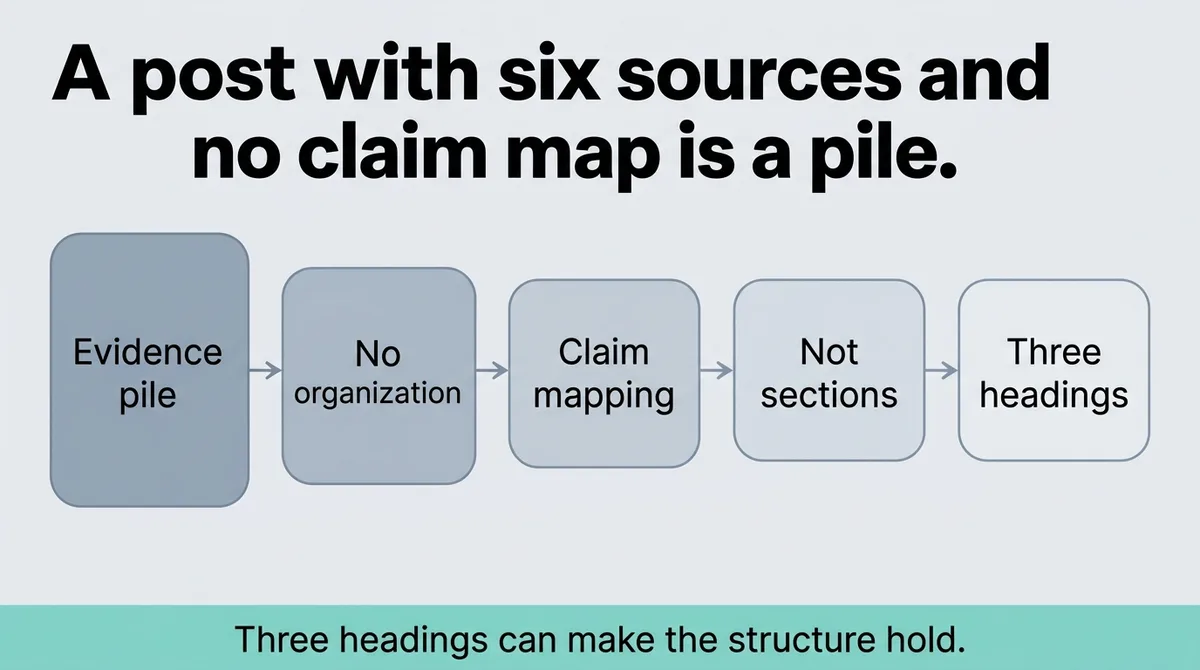
The goal of this step is to match each source to a specific claim before writing a single paragraph. Not to a section. Not to a heading. To the exact sentence that source will prove.
Outlines work best with around three headings when starting a post structure [1]. That constraint is useful. Three headings force the writer to decide which claims are central and which are peripheral. A post trying to support twelve claims with three headings will collapse into a listicle. A post supporting three claims with strong evidence per claim will hold.
For longer posts, structure can scale. A draft-writing workflow can support articles up to 5,000 words when the structure is in place [1]. The keyword is “when the structure is in place.” Length does not create argument depth. Mapped evidence does.
Here is what happens without claim mapping. A writer researches a post on content marketing ROI and collects six sources. All six are relevant to the introduction. The body of the post has four sections and no sourced claims. The writer fills those sections with their own analysis. The post reads as a confident opinion piece, not a research-backed post. Readers who click into the post looking for evidence leave without it.
The claim-evidence-connection sequence works like this:
Claim | Source | What It Proves |
|---|---|---|
Most blog posts cite nothing credible | Industry volume data [1] | 850M posts/month creates noise; credibility requires differentiation |
Large sample sizes increase claim weight | Study with 75,000 responses [4] | Scale of data is measurable and relevant to source selection |
Outline depth determines argument capacity | Workflow structure guidance [1] | Post length without structure produces disconnected sections |
Before drafting begins, the writer builds this table for their specific post. One row per major claim. If a claim has no source in the source column, it either needs one or it gets cut.
The operational output from this step is a one-page claim map. It is not an outline in the traditional sense. It is a decision document. Every paragraph in the draft will trace back to a row in this table.
Step 3, Place, Format, and Finalize Citations So the Post Is Ready to Publish
A citation placed at the end of a paragraph does not prove the sentence it is meant to support.
Readers process information sequentially. When a writer states a claim and places the citation two sentences later, the reader has already absorbed the claim as the writer’s opinion. The citation arrives too late to shape how the claim is read.
Inline citation placement follows one rule: cite immediately after the claim, not after the paragraph.
“Email open rates have declined 12% year over year. Subject line personalization increases click-through rates by 14%. Mobile preview text affects 43% of open decisions [source].” This is a citation placed too late. The reader cannot tell which of the three sentences the source supports.
The first-draft review checklist confirms that five to ten target keywords appear correctly and that each citation links to a live, resolving URL [1]. Both checks happen during editing, not at publication. A broken link discovered after a post goes live requires a correction that most CMS workflows handle slowly.
Pre-publication citation checklist:
- Every sentence containing a number or statistic has an inline citation immediately after it.
- Every citation URL resolves to the correct source page, not a redirect or 404.
- Citation format is consistent across the post. If you use numbered citations, use them throughout. Do not mix formats.
- Every cited source appears in the references list at the bottom of the post.
This checklist is a named step in the editing pass. Not an afterthought. Not something done if time allows. A post that reaches publication with a misattributed statistic or a broken citation link damages the credibility of every other claim in the post, including the ones correctly sourced.
The consequence of skipping this step is not always immediate. Sometimes a post with weak citation handling ranks and receives traffic for months. Then a reader or competitor checks the sources, finds the gap, and the post’s credibility collapses in the comments or on social. Editors and content teams who notice the pattern quietly deprioritize the publication in future outreach. The damage compounds slowly.
Citation review placed inside the editing workflow prevents that outcome. It takes ten minutes for a 1,500-word post. For a 3,000-word post, plan twenty. That time spent before publication saves the time required to correct or retract claims after it.
Research first, draft second, cite as you go
The three steps above are not a checklist to follow after writing. They are the order in which writing should happen.
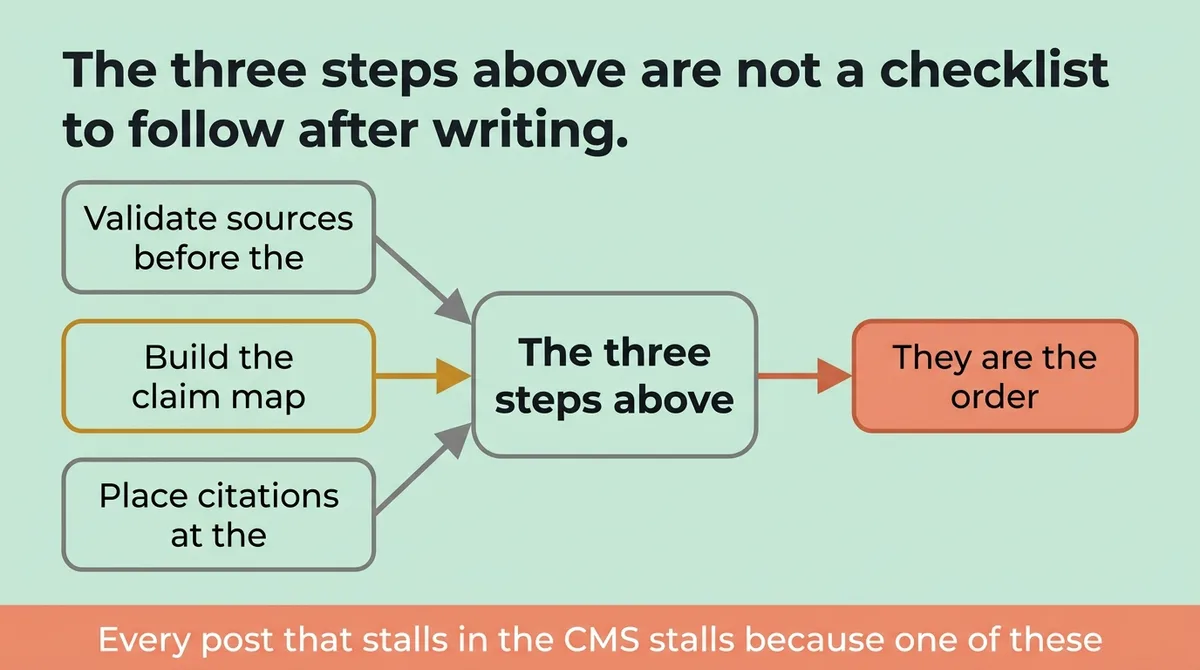
Validate sources before the draft opens. Build the claim map before writing paragraphs. Place citations at the point of each claim during drafting, not during a final pass.
Every post that stalls in the CMS stalls because one of these three steps was skipped or sequenced wrong. The draft has no spine because the sources were never mapped to specific claims. The citations are weak because the sources were chosen after the argument was built. The post never ships because the editing pass keeps finding gaps that require new research.
Running these steps in order eliminates each failure point before it appears.
A cited post that holds together under scrutiny is not harder to write than an uncited post. It takes different preparation. The preparation happens before the cursor hits the first sentence.
Start the source shortlist before the outline. The draft will write itself.
References and Citations
[1]https://www.bramework.com/blog-workflow/
[4]https://www.getmasset.com/resources/blog/write-a-listicle-ai-will-cite
FAQ
Citations belong immediately after the specific claim they support, not at the end of a paragraph or section. When a citation arrives two sentences after the claim, readers have already absorbed the claim as the writer’s opinion, and the citation no longer shapes how it is read. A clean pre-publication check confirms that every sentence containing a number or statistic has an inline citation directly after it, and that every URL resolves to the correct source page.
Before writing a single sentence, ask four questions about every source: is the data from the last three years, does the study report its sample size, is the publisher a peer-reviewed journal or primary research organization, and does the source prove the exact claim you plan to make rather than just gesturing in the same direction? A source that traces back through two marketing blogs with no methodology is not research, it is marketing wearing a citation. The output of this step should be a shortlist of five to eight validated sources, each tagged to the specific claim it will support.
Blog posts feel thin with citations when the sources are added after the argument is built rather than used to shape it, so statistics appear in the introduction and never connect to the body claims. A hyperlink is not proof; a link to a study that does not directly support the sentence it follows is decoration, not evidence. Posts that cite three claims in the opening paragraph and then make four uncited claims in the body train readers to distrust the format entirely.
A claim map is a one-page document built before drafting that matches each major claim in the post to the exact source that proves it, so no paragraph gets written without knowing what evidence supports it. Without this step, a writer with six relevant sources often places all of them in the introduction and fills the body sections with unsupported opinion. Platforms like Zelitho build this kind of claim-to-evidence structure into the drafting workflow so that research is mapped before a paragraph is written, rather than retrofitted during editing.
Drafts stall most often because research, claim mapping, and citation placement are treated as separate steps done in the wrong order, so the post keeps cycling back for more sourcing during editing. Running source validation before the outline, building a claim map before writing paragraphs, and placing citations inline during drafting eliminates each failure point before it appears. Zelitho addresses this directly by combining keyword discovery, research-backed draft generation with citations, on-page editing, and CMS publishing into one connected workflow, so teams are not coordinating across separate tools and handoffs that slow the pipeline.