
How to Design an SEO Content Workflow: Steps, Structure, and Purpose

TL;DR
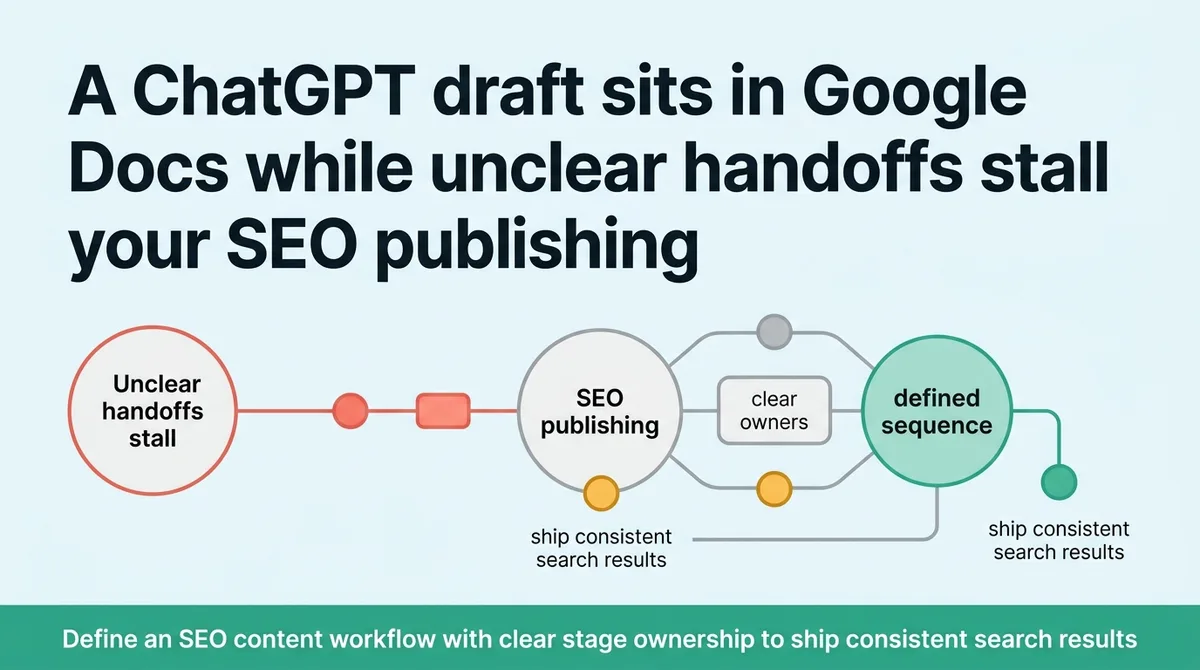
You have a ChatGPT draft sitting in Google Docs. A freelancer is waiting on feedback. The CMS has three posts in “draft” status with no publish date. The blog has not shipped in six weeks.
Most teams respond by adding another writer or switching tools. Neither fix works because the bottleneck is not output. It is the absence of a defined sequence with clear owners at each handoff.
A content workflow without stage-level ownership is just a schedule with good intentions. Each stage needs an input, an owner, and an exit condition before the next stage begins. When that structure exists, content moves from topic to publication in a predictable window. Without it, revision loops and unclear handoffs stretch timelines until publishing stops entirely. This article defines each stage, names who owns it, and explains what breaks when any part is missing.
What is an SEO content workflow?
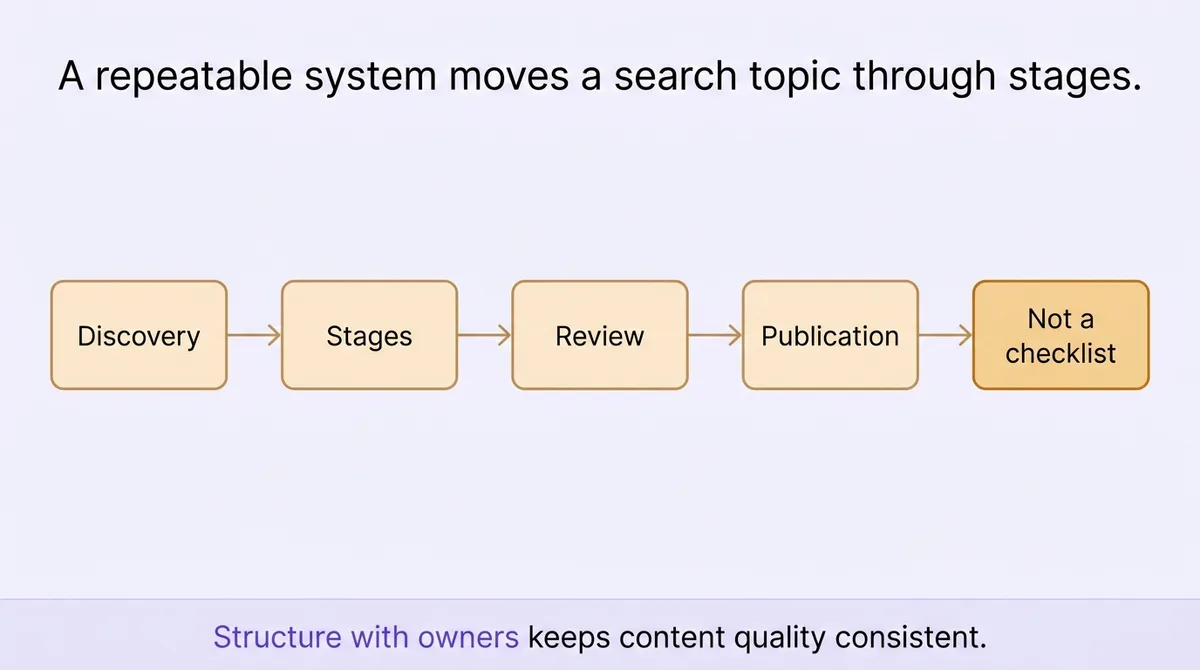
An SEO content workflow is a repeatable system that moves a search topic through defined stages, from discovery to publication, with a named owner and a clear exit condition at each step. It is not a writing checklist or an editorial calendar. It is a cross-functional operating structure that controls how content gets made, reviewed, and published at consistent quality. This guide explains how to design an SEO content workflow.
What an SEO Content Workflow Actually Is (and What It Is Not)
A workflow is not a list of writing tasks. That distinction matters more than most teams realize.
Stop calling it a “content process” when what you mean is a rough order of operations that lives in someone’s head. Start treating it as a managed system with defined inputs, owners, and exit criteria at every stage.
An SEO content workflow controls six operational areas: topic selection, brief creation, draft production, SEO review, editorial review, and publication [1]. Each area has a specific owner. Each owner hands off a defined output. When that hand-off happens without a clear exit condition, the next stage starts on incomplete work, and the quality problem compounds forward.
An editorial calendar tells you what to publish and when. A writing style guide tells you how to write. A workflow tells you who does what, in what order, and what “done” means at each stage. These are different tools. Teams that conflate them end up with a calendar full of missed dates and a style guide nobody reads.
The sting line: a workflow without exit criteria is just a schedule with optimism attached.
Six components form the operational backbone of a functioning system [1]: a defined topic selection method, a brief template, a draft production stage, an SEO review gate, an editorial review gate, and a publication step with distribution built in. Remove any one of those, and the system develops a gap where quality degrades or timelines expand unpredictably.
The Stage-by-Stage Path from Topic to Published Asset
Most content breakdowns happen at handoffs, not inside stages. Knowing the sequence exposes exactly where your process loses momentum.
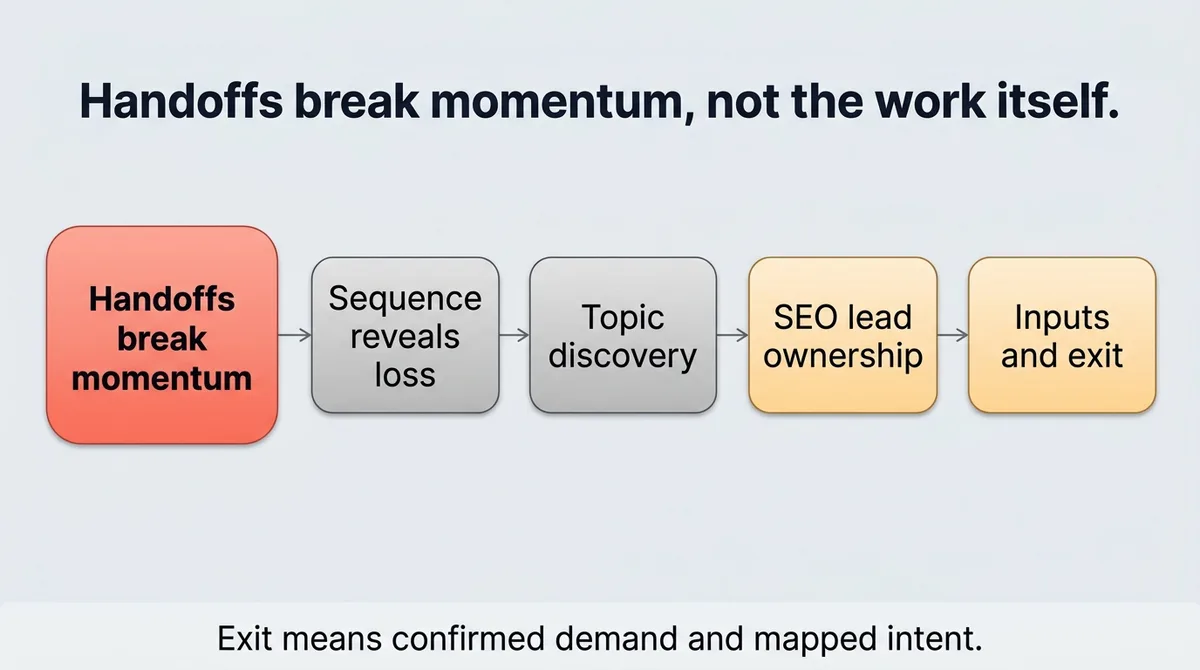
The first stage is topic and keyword discovery. The SEO lead owns this stage. The input is a target keyword set or content gap analysis. The output is a prioritized topic list with primary keyword, search intent classification, and estimated difficulty. The exit condition is a topic that has confirmed search demand and a mapped intent before a brief is created.
The second stage is brief creation. The content strategist or SEO lead owns this stage. A structured brief that pre-solves search intent alignment means the SEO review stage later can be completed in as little as 30 minutes [1]. Without a structured brief, the writer makes intent assumptions that require correction after the draft is complete, adding a full revision cycle.
Draft production follows. The writer owns this stage. A focused, brief-driven draft typically takes two to three hours to produce [1]. That time estimate assumes the brief is complete. When the brief is missing key direction, writers spend that time guessing rather than writing, and the draft reflects it.
The full cycle from brief to publication commonly runs three to five days when handoffs are defined and each stage exits on time [1].
Stage | Owner | Input | Output | Exit Condition |
|---|---|---|---|---|
Topic and keyword discovery | SEO lead | Keyword data, content gaps | Prioritized topic list with intent map | Confirmed search demand and intent classification |
Brief creation | Content strategist | Topic list, SERP analysis | Structured content brief | Brief reviewed and approved before writer assignment |
Draft production | Writer | Approved brief | Complete first draft | Draft matches brief scope and word count |
SEO review | SEO lead | First draft | Marked-up draft with on-page notes | All SEO elements confirmed: title, headers, keyword placement |
Editorial review | Editor | SEO-reviewed draft | Final edited draft | No structural, factual, or clarity issues remain |
Publication and distribution | Content manager | Final draft | Published URL | Post live with meta data, internal links, and distribution sent |
Each row in that table represents a gate, not a suggestion. If a stage exits without meeting its condition, the next stage inherits the deficiency. That is where rework accumulates.
Why Skipping Workflow Structure Costs More Than It Saves
Teams believe moving fast without a defined process saves time. The math does not support that belief.
Without a defined workflow, content cycles routinely stretch to two or more weeks per asset because revision loops have no resolution mechanism [1]. Compare that to a structured workflow, where per-asset production time runs three to five days [1]. For a team publishing three blog posts per week [1], the difference is not marginal. At two-plus weeks per post without structure, that team cannot mathematically maintain publishing cadence. The backlog builds faster than output clears it.
For example, imagine a content team that adds a second freelancer to fix a publishing bottleneck. The freelancer delivers drafts. The SEO review takes four days because the brief was incomplete. The editor requests structural changes because the intent was wrong. Two weeks pass. The post publishes ten days late. The freelancer was not the problem. The process was.
The hidden cost sits further out. A new post can take six months to show stable organic ranking movement [1]. Every week of publication delay pushes that window back. A team that slips its cadence by four weeks does not lose four weeks of ranking time. It loses four weeks of compounding search presence, spread across every post that was late.
The specific mistake most teams make: they add more writers to a broken process. More writers produce more drafts entering a broken review system. The backlog shifts from the writing stage to the review stage. Output volume increases. Publish rate does not.
The operational consequence is a content operation that works hard and ranks slowly. Fixing the process is not a project management exercise. It is the condition for the team’s work to produce search results at all.
How to Build Consistency, Measurement, and Improvement Into the Workflow
Most content quality failures are workflow design failures, not writer failures. Unclear briefs, missing SEO review gates, and no feedback loop between performance data and future briefs produce bad content reliably, regardless of how skilled the writer is.
Running a workflow without measurement produces output. Running a workflow with measurement produces improvement. Those are different results.
Three operational layers make a workflow self-correcting over time.
Standardization means every stage is executable without tribal knowledge. Brief templates, SEO checklist formats, and editorial review criteria live in shared documents. Any owner at any stage can execute the stage without asking someone else how. When a freelancer joins or a team member leaves, the work does not stop.
Automation removes humans from status tracking. Handoff notifications, deadline reminders, and stage transitions happen through the project management tool, not through someone remembering to send a Slack message. Humans focus on judgment calls: is this brief strong enough to send to a writer? Does this draft match intent? Automation handles the coordination layer beneath those decisions.
Measurement and improvement close the feedback loop. Each stage owns a specific metric. Brief quality can be measured by how often drafts come back for structural revision. Draft alignment can be measured by how many SEO review notes each draft generates. Stage cycle time shows where handoffs slow. Publish rate shows whether the system is operating at target cadence.
Teams that run monthly content reviews as a structured audit cycle catch performance gaps earlier [1]. They adjust briefs before the next production batch runs, rather than discovering six months later that the content missed intent entirely. That review cycle does not need to be long. One owner, one set of metrics, once a month.
The metrics to track at each stage:
- Brief stage: revision rate before writer assignment
- Draft stage: hours from brief receipt to draft submission
- SEO review stage: average notes per draft
- Editorial stage: average rounds before final approval
- Publication stage: posts published versus posts scheduled
When those numbers move in the wrong direction, the audit finds which stage caused it. The fix targets that stage, not the team’s overall effort level.
The friend advice version: stop hiring to solve a workflow problem. Fix the stage where work stalls, then hire.
A workflow audit does not need to be a large operation. One person, one hour, one set of stage cycle times compared against the previous month. If time-in-stage is growing, the exit condition for that stage is not clear enough. Tighten the exit condition before the next production cycle starts.
Structure Is What Turns Content Effort into Search Results
A defined workflow does not make content creation easier. It makes the right output predictable.
Teams that publish on cadence, with search-aligned content and clean review cycles, do not have better writers. They have a clearer process that writers operate inside. The stages are defined. The owners are named. The exit conditions are specific. When a stage completes, the next stage starts with complete inputs.
That sequence, repeated without gaps, is what produces a content operation that ranks.
References and Citations
[1]https://monday.com/blog/marketing/seo-workflow/
FAQ
A standard SEO content workflow runs through six stages: topic and keyword discovery (owned by the SEO lead), brief creation (owned by the content strategist or SEO lead), draft production (owned by the writer), SEO review (owned by the SEO lead), editorial review (owned by the editor), and publication with distribution (owned by the content manager). Each stage requires a defined input, a named owner, and a clear exit condition before the next stage begins. When any stage hands off incomplete work, the quality problem compounds forward through every stage that follows.
With a structured SEO content workflow where every stage has a defined owner and exit condition, the full cycle from brief to published post typically runs three to five days. Without that structure, revision loops and unclear handoffs routinely stretch the same cycle to two or more weeks per asset. Platforms like Zelitho compress this further by connecting topic selection, draft generation, on-page optimization, and CMS publishing inside a single system, removing the coordination delays that accumulate across separate tools.
Adding more writers to a slow publishing schedule moves the bottleneck rather than removing it: more drafts enter a broken review system, so the backlog shifts from the writing stage to the SEO and editorial review stages without improving publish rate. The actual constraint is almost always a missing or unclear process structure, not insufficient writing output. Fixing the stage where work stalls, whether that is brief creation, SEO review, or editorial sign-off, is the correct lever before any hiring decision.
An editorial calendar tells you what to publish and when, while an SEO content workflow defines who does what, in what order, and what done means at each stage. A writing style guide covers how to write; a workflow covers the cross-functional operating structure that moves content from topic to publication. Teams that treat these as the same tool end up with a calendar full of missed dates and no clear mechanism to resolve the delays.
A self-correcting SEO content workflow requires three layers: standardization so every stage is executable without tribal knowledge, automation so handoffs and deadline reminders happen through your project management tool rather than manual follow-ups, and a monthly measurement review that tracks stage-level metrics like brief revision rate, SEO notes per draft, and posts published versus posts scheduled. When a metric moves in the wrong direction, the audit points to the specific stage causing the problem rather than the team’s overall effort. Tools like Zelitho embed several of these layers directly into the production path, connecting topic planning, draft creation, and publishing so fewer coordination steps happen outside the system.