
How to Research and Write SEO Blog Posts That Rank

TL;DR
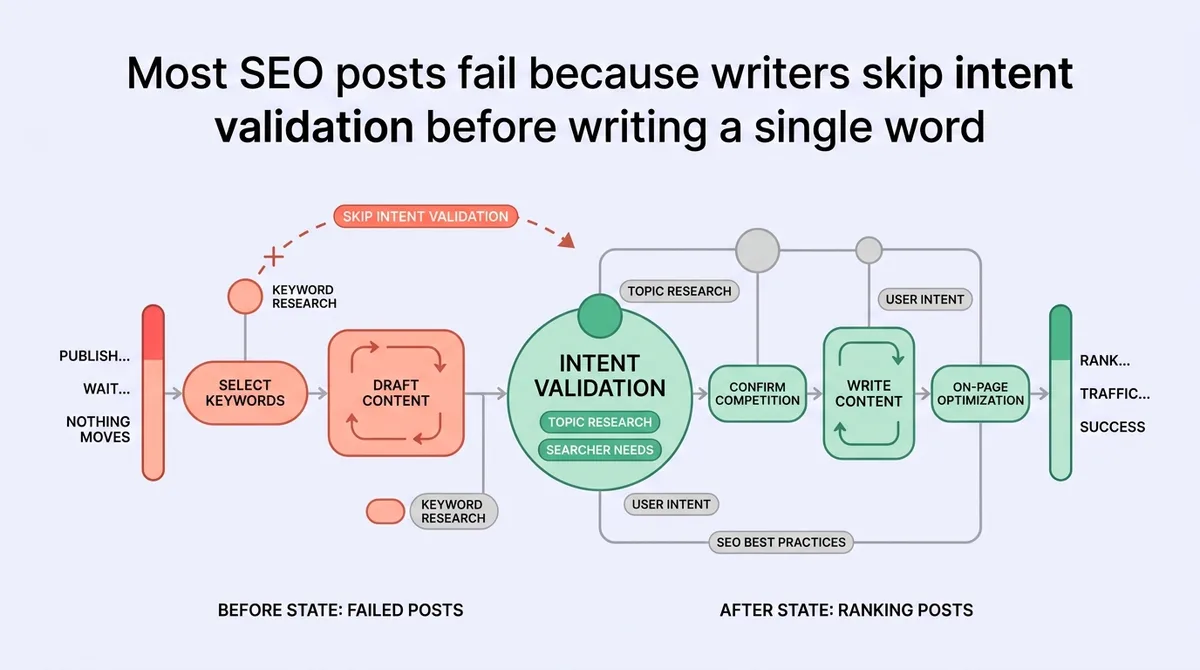
You publish a post. You wait. Nothing moves. You publish three more. Still nothing. The real problem is not the writing. It is what you skipped before you wrote a single word.
Most blog content fails because writers select keywords and draft immediately. They skip intent validation entirely. They match a topic to a search term without confirming what the searcher actually wants, or whether the site can realistically compete for that term.
This guide walks through the SIRVO System: Search Intent, Research, Validation, and Optimization. It is a repeatable four-stage process for content leads, agency founders, and marketing teams who publish posts that sit unread for months. Follow the steps in order and you will know exactly why each post earns its place in search results, or why it should not be published yet.
What does it actually take to write an SEO blog post that ranks?
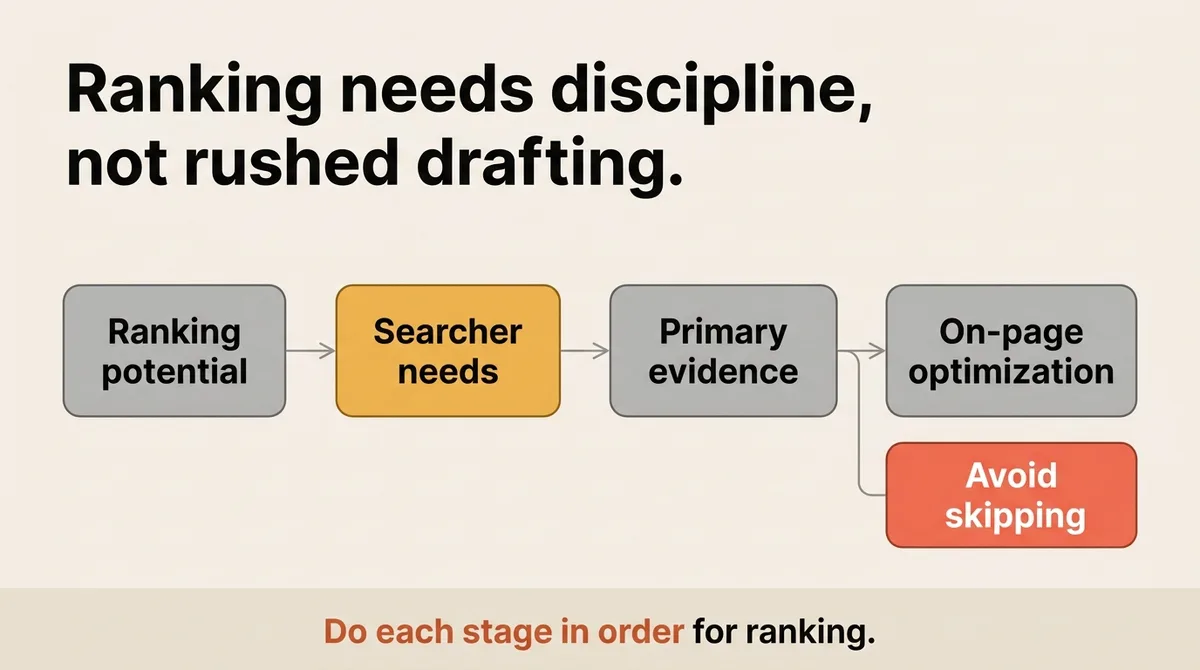
Ranking requires four things done in sequence: confirm the topic has realistic ranking potential, map what the searcher needs, build content from primary evidence, and optimize the post before it goes live. Skipping any one stage compounds the next. The entire process takes discipline over speed.
Why Most Blog Posts Never Rank and What You Are Getting Wrong Before You Write a Single Word
Picture a content lead with a tab open to a Google Sheet. Twenty published posts, all targeting broad keywords like “project management software” and “marketing strategy.” Six months have passed. Organic traffic shows eleven sessions total. The posts exist. They just do not rank.
That scenario is not rare. It is the default result when content volume replaces content strategy.
The false assumption behind most blog programs is this: publishing more posts faster leads to more rankings. It does not.
Publishing more of the wrong posts faster wastes time you cannot recover. SEO results typically take 3 to 6 months to materialize [1]. Every misaligned post you publish is a six-month delay stacked on itself. The opportunity cost is not abstract. It is a post that could have ranked sitting dead while a competitor owns that SERP position.
Seven core ranking factors apply before user experience signals are even considered [1]. Keyword density alone does not appear on that list. What appears: relevance, authority, and intent alignment. Most blog programs fail at the first one.
The SIRVO System addresses this directly. SIRVO stands for Search Intent, Research, Validation, and Optimization. This guide runs through each stage in order because the order matters. Jumping to writing before validating intent is the core error. It is also the most common one.
Stop treating SEO as a formatting problem. Start treating it as a research problem solved before the draft opens.
How to Validate a Topic Before You Write It So You Do Not Waste Six Months on the Wrong Post
The private worry most content leads never say aloud: “I don’t know if this topic can rank, or if I am pointing at sites I will never beat.”
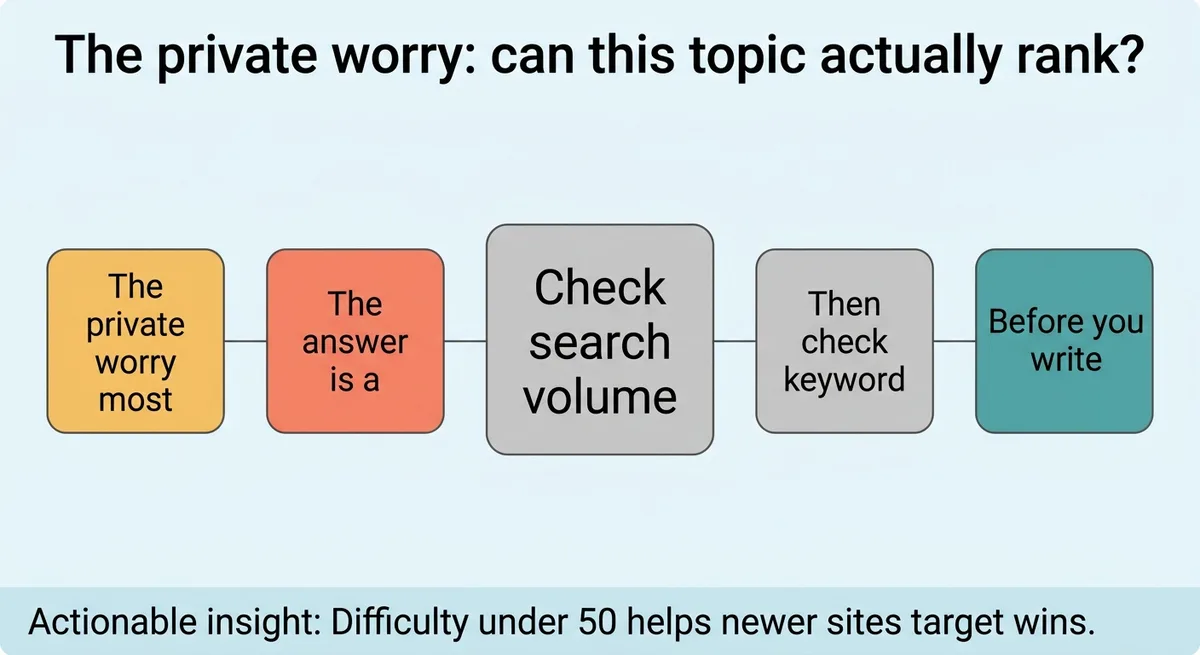
That worry is legitimate. The answer is a four-field check before any post gets drafted.
Check search volume first. A topic with no search demand produces no traffic even if it ranks first. Then check keyword difficulty. A difficulty score under 50 is a realistic target for newer or mid-authority sites [1]. Scores above that require domain authority and backlink profiles most growing sites do not have yet.
The spectrum matters here. Targeting a keyword with 23,262 competing pages produces a different ranking timeline than targeting one with 74 competing pages [1]. Neither extreme is automatically correct. A keyword with 1,734 competing pages [1] often sits in a productive middle range: real demand, realistic competition.
After checking volume and difficulty, review the actual SERP. Look at 5 to 10 top results [4]. Count whether 3 out of the top 5 are large authority domains [4]. If they are, and your domain authority is significantly lower, that keyword goes back to the shelf. You are not writing against Wikipedia and G2 with a 30-post blog.
Use this table before approving any topic for drafting:
| Topic | Monthly Volume | Difficulty Score | SERP Composition |
|---|---|---|---|
| [Your topic] | [X searches/mo] | [Score / 100] | [Authority-heavy or mixed?] |
| Example A | 1,900 | 38 | 2 of top 5 are niche blogs |
| Example B | 8,100 | 71 | Top 5 are G2, HubSpot, Gartner |
Example A moves forward. Example B goes back to the list until your domain authority supports it.
Every topic must pass all four fields before writing begins. If it fails one, shelve it. You are not rejecting the idea forever. You are protecting six months of effort from a ranking outcome that the data already predicted.
How to Research Your Post Using Source Diversity and Evidence Quality Instead of Just Reading Competitors
Here is a blind spot most content programs never identify. Researching a post by reading the top five ranking articles and rewriting them produces recycled answers. Google has the originals. It has no reason to rank your version over theirs.
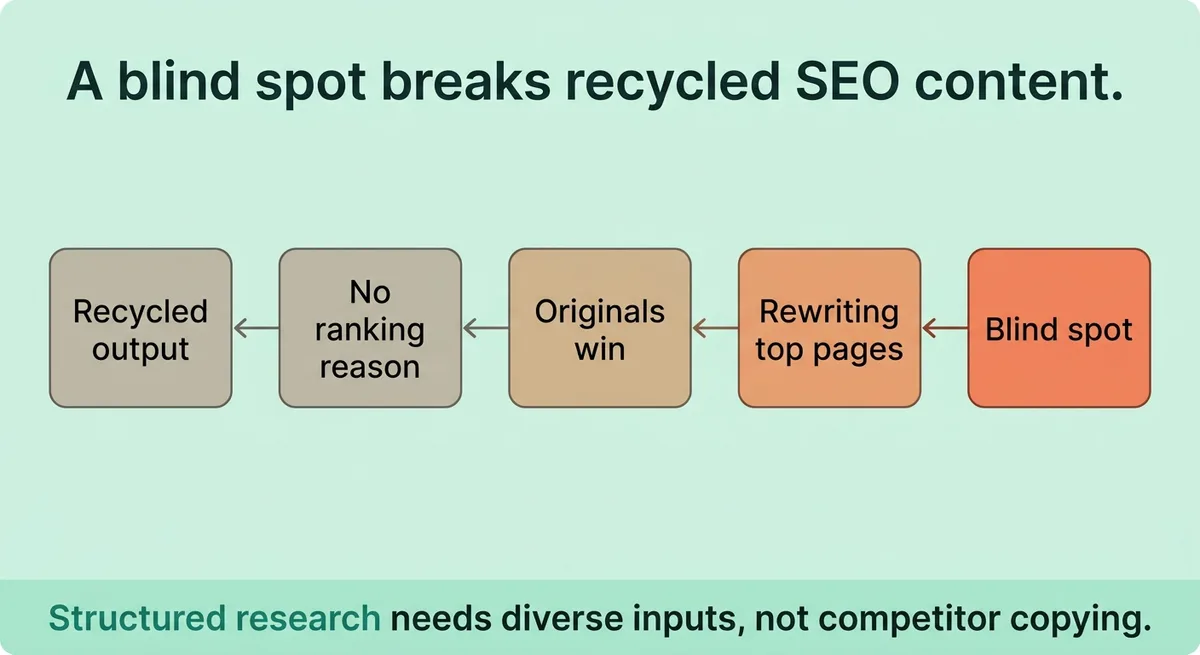
Recycled research produces recycled content. The fix is not to write longer. It is to source differently.
Writers producing hundreds of articles per year still use structured research processes with diverse inputs [2]. That includes three distinct chatbots for initial landscape mapping [4], dozens of newsletters [4], and primary studies. The goal is at least one piece of evidence in your post that does not appear in the top-ranking competitors. That differentiation signals original thought, not just rephrasing.
Gathering 8 audience questions from forums, comment sections, and community threads before drafting [4] changes what the post covers. It answers what people actually ask, not what competitors assumed they wanted to know. Posts built from real questions address real concerns. Posts built from competitor research address whatever the original writers assumed.
Five source types to pull before you draft:
- Forum threads and community posts (Reddit, LinkedIn comments, Quora)
- Primary research and published studies
- Industry newsletters with original reporting [4]
- AI tools used critically for landscape mapping, not fact sourcing
- Your own customer data, support tickets, or sales call notes
The last one is the most underused. A 600-post blog archive [4] sitting inside a company contains question patterns that no competitor has accessed. Mining it before drafting gives you angles unavailable to anyone starting from a blank SERP.
The operational rule: every post needs at least one source that does not appear in the top-ranking articles. If you cannot find one, keep researching.
How to Structure, Write, and Optimize Your Post So It Is Ready to Rank on Publish Day
The SIRVO System ends at optimization, and optimization happens before publish, not after. Fixing SEO three months post-launch is not a repair. It is a restart. The post has already been crawled, indexed with its original signals, and ranked accordingly. Changing it later requires Google to recrawl, reprocess, and rerank. That cycle costs weeks.
Keyword use falls between 5 to 10 uses per 1,000 words for standard posts [3]. Pushing toward 10 to 15 uses per 1,000 words [3] risks over-optimization and reads as unnatural to both crawlers and readers. Use the primary keyword in the title tag, the first paragraph, one H2, and the meta description. From there, let synonyms and related terms carry the rest.
For reference on targeting: the phrase “search engine optimization tips” carries a monthly search volume of 2,900 [3]. That is a realistically targetable informational keyword for a mid-authority site. Use that benchmark to calibrate your own targets.
Two distinct link types serve two distinct functions [3]. Internal links distribute authority across your site. Each one tells Google which other pages matter. External links to credible sources build topical trust by associating your content with verified information. Both belong in every published post. One without the other leaves a signal gap.
Use this publish-day checklist before every post goes live:
| Element | Requirement | Common Error |
|---|---|---|
| Title tag | Primary keyword, under 60 characters | Keyword missing or duplicated |
| Meta description | 150 to 160 characters, one keyword use | Written after publish or left blank |
| Header hierarchy | H1 once, H2 per section, H3 for subsections | Multiple H1s or skipped H2s |
| Image alt text | Descriptive phrase, keyword where natural | Left blank or stuffed with keywords |
| Internal links | Minimum 2 per post | Zero, or pointing to unrelated pages |
| External links | Minimum 1 credible source | None, or linking to competitor posts |
| Call to action | One clear next step for the reader | Missing or buried below the fold |
Posts optimized before publish capture indexing momentum from the first crawl. Posts fixed months later restart that process and compete against a crawl budget already allocated elsewhere. The gap between the two groups widens every week.
Run the SIRVO System as a final pre-publish audit. Search intent confirmed. Research sourced from multiple inputs. Topic validated against real SERP data. On-page elements in place. That sequence, done in order, is what a post needs before it earns the right to sit in search results.
Research First, Write Second, Optimize Always, Publish Once
The SIRVO System is not a shortcut. It is a sequence that removes the guesswork from why posts fail.
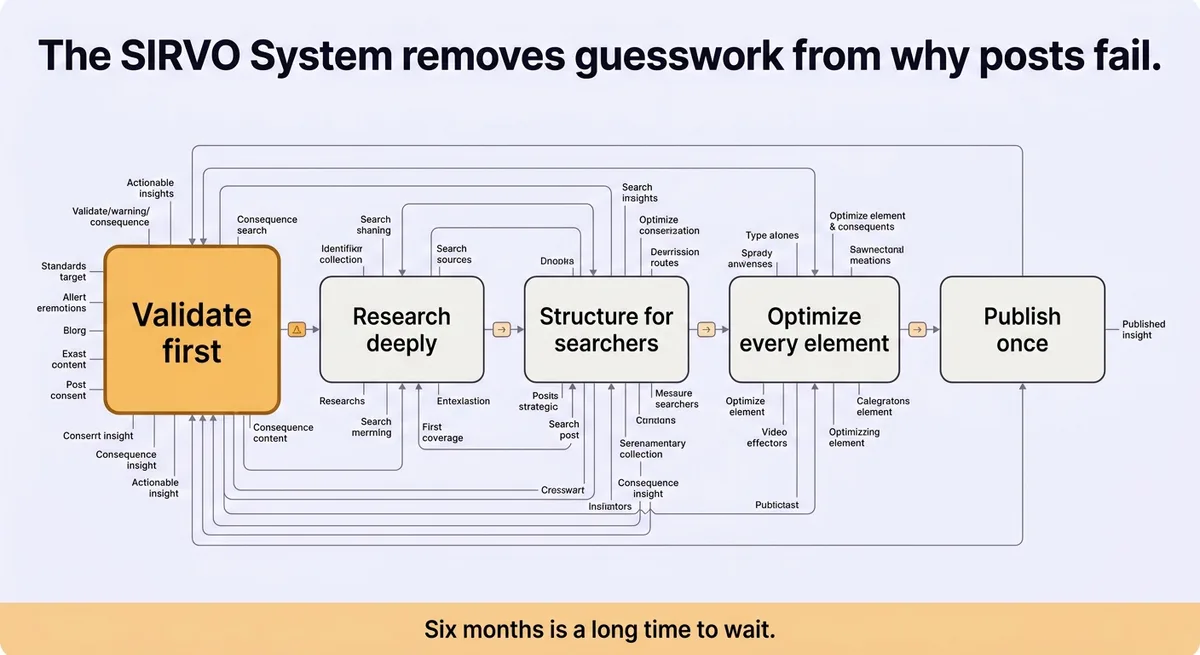
Validate before you draft. Research from sources your competitors have not touched. Structure around what searchers need, not what feels logical from inside your office. Optimize every element before the post goes live, not after it stalls.
Six months is a long time to wait for a result you could have predicted before writing a word. Follow the sequence. Publish once. Make it count.
FAQ
Why do most SEO blog posts never rank even after months of waiting?
Most SEO blog posts never rank because writers skip intent validation and topic difficulty checks before drafting, publishing content that has no realistic chance of competing on the SERP. The three core ranking factors are relevance, authority, and intent alignment, and most blog programs fail at the first one by selecting broad keywords without confirming the searcher’s actual need or the site’s competitive position. Platforms like Zelitho address this by running keyword discovery, difficulty scoring, and SERP validation inside the same workflow before a draft is ever generated, so misaligned topics get caught before they consume six months of waiting time.
How do you validate a keyword topic before writing a blog post?
Validating a keyword topic before writing requires a four-field check: confirm there is real monthly search volume, verify the difficulty score is under 50 for newer or mid-authority sites, review the actual SERP to see whether 3 of the top 5 results are large authority domains, and count competing pages to gauge realistic ranking timelines. If a topic fails any one of those four checks, it should be shelved until your domain authority supports it, not drafted anyway. A keyword with 74 competing pages sits in a very different competitive reality than one with 23,262, and skipping that check is the single most common reason blog programs stall.
What is the right keyword density for an SEO blog post?
The right keyword density for a standard SEO blog post is 5 to 10 uses per 1,000 words, with anything pushing toward 10 to 15 uses per 1,000 words risking over-optimization penalties and unnatural reading. Place the primary keyword in the title tag, the first paragraph, one H2, and the meta description, then use synonyms and related terms for the rest of the article. Keyword density alone does not determine rankings; relevance, authority, and intent alignment carry far more weight, so density is a guardrail, not a goal.
How do you research a blog post so it stands out instead of just rewriting competitor content?
Research a blog post by pulling from at least five source types that go beyond the top-ranking articles: forum threads, primary studies, industry newsletters with original reporting, AI tools used for landscape mapping only, and your own internal data such as support tickets or sales call notes. The operational rule is that every post needs at least one piece of evidence that does not appear in the competing articles already ranking, because rewriting existing top results gives Google no reason to prefer your version. Gathering 8 or more real audience questions from communities and comment sections before drafting also shifts coverage toward what people actually ask rather than what competitors assumed they wanted.
What should a blog post SEO checklist include before publishing?
A complete pre-publish SEO checklist should cover: a title tag with the primary keyword under 60 characters, a meta description of 150 to 160 characters, a single H1 with H2s per section and H3s for subsections, descriptive image alt text, at least 2 internal links per post, at least 1 external link to a credible source, and one clear call to action. Optimizing before publish matters because the first crawl sets the initial ranking signals, and fixing on-page elements months later requires Google to recrawl and reprocess the page, costing additional weeks. Zelitho builds this checklist into its on-page editing step so every article exits the drafting stage already meeting these requirements before it reaches the CMS.
References and Citations
[1]https://www.marketermilk.com/blog/how-to-write-seo-blog-posts
[2]https://www.bespoke-digital.co.uk/guides/blog-post-research
[3]https://www.writersdigest.com/search-engine-optimization-tips-for-website-and-blog-articles