
How Generative AI Is Changing Content Marketing Workflows

TL;DR
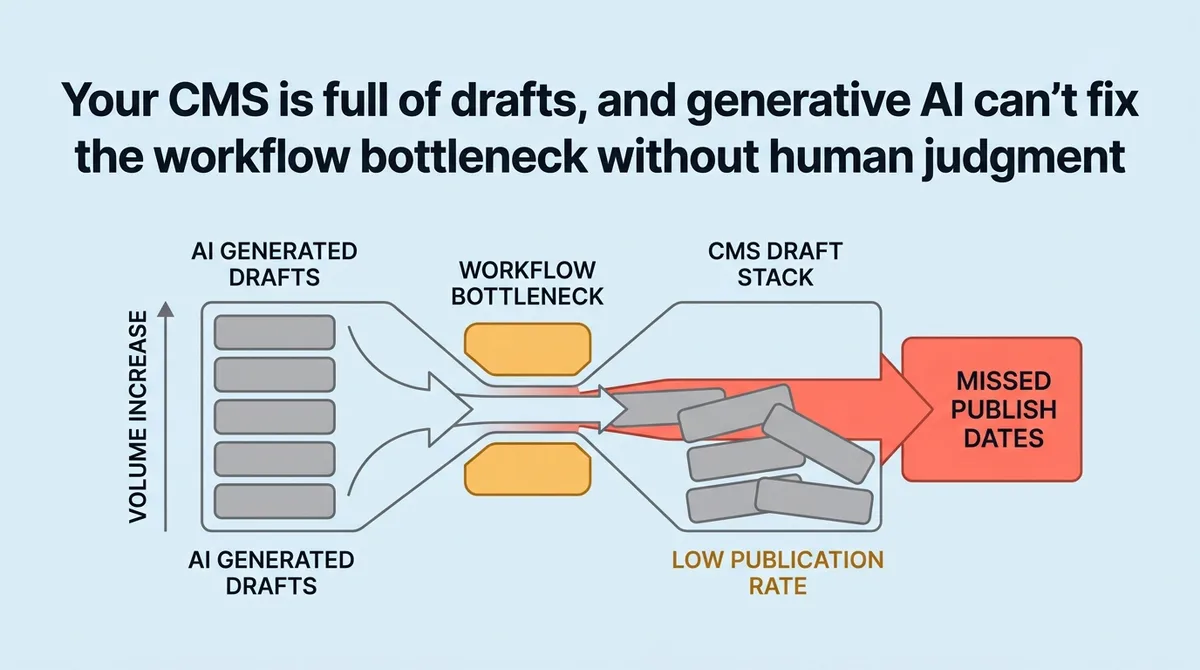
You opened your CMS dashboard this morning. Twelve drafts are sitting in review. Three were due last week. One freelancer is waiting on feedback. One ChatGPT draft needs a complete rewrite before it can go to editing.
Most teams respond by hiring another writer or buying another tool. That adds cost without fixing the actual problem: the workflow itself breaks under volume. AI writing tools layered on top of a slow approval chain produce faster drafts that still miss publish dates.
The AI-Human Content Split is a stage-by-stage framework that maps exactly what AI handles and what humans must own, from ideation through distribution. Content leads and agency founders use it to stop accumulating tools and start building a pipeline that ships on cadence.
Why Your Current Content Workflow Is Already Breaking Under Volume
Your team is not too small. Your process is too manual for the volume you are now expected to produce.
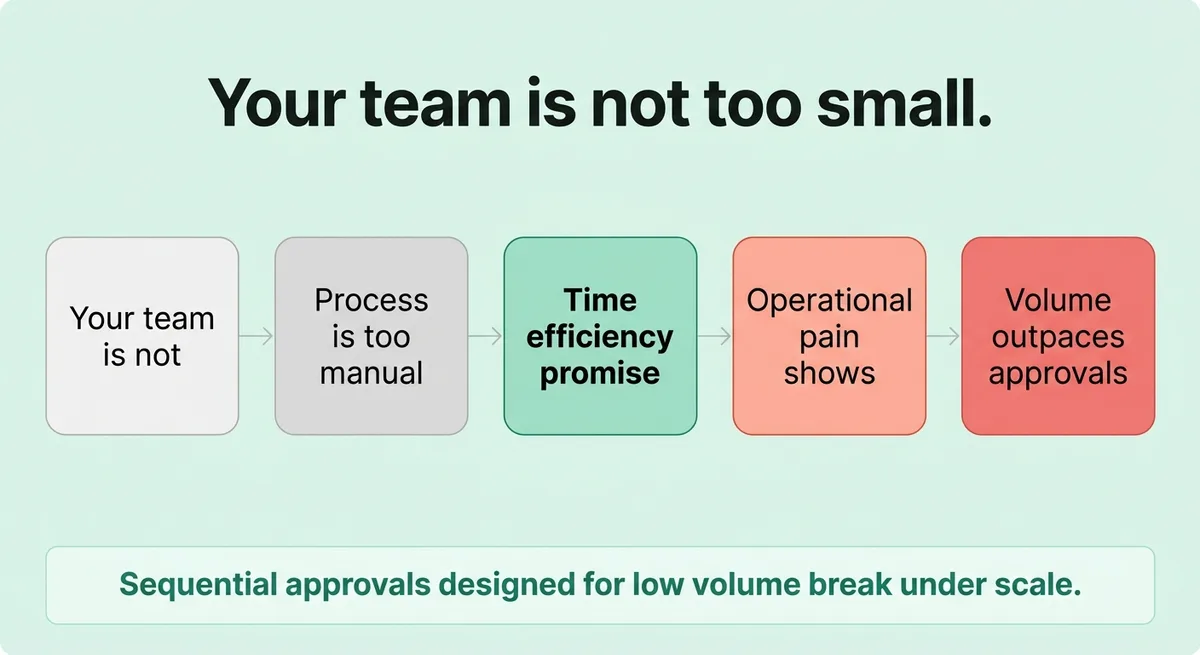
Forty-nine percent of marketing leaders cite time efficiency as the primary benefit of generative AI adoption [1]. That number reflects a real operational pain. Teams are being asked to publish across more channels with the same headcount and the same sequential approval steps they designed when one blog post per week was the target.
There are now 15,384 AI marketing solutions available [4]. That number creates its own problem. Teams spend weeks evaluating tools instead of auditing the process those tools would plug into.
A two-person content team producing one post per week manually is not slow because of the writing. The slowdown lives in the handoffs: brief to writer, draft to editor, edit to approval, approval to CMS, CMS to publish. Each step waits on a person. Add a second channel and you double the wait time, not the output.
Stop blaming headcount. Start mapping every handoff that requires a human to move a file.
This is the volume trap. More channels arrive. The same process absorbs them. The same people stretch thinner. The fix is not another hire. It is a process redesign that separates the steps a machine can run from the steps that require a person.
Old workflow triggers vs. redesigned workflow triggers:
- Old: writer receives a rough topic idea and builds the brief themselves
- Old: editor reviews a full draft before any structure feedback is given
- Old: publishing requires a manual CMS login and category assignment
- Redesigned: brief is generated from a keyword cluster and approved in one pass
- Redesigned: structure review happens at outline stage, before drafting begins
- Redesigned: publishing is triggered from a single approved document state
The distinction matters because redesigned triggers remove waiting. Old triggers create it.
The Stage-by-Stage Split: What AI Runs and What You Must Own
Most teams apply AI at the drafting stage. That is the least leveraged entry point available.
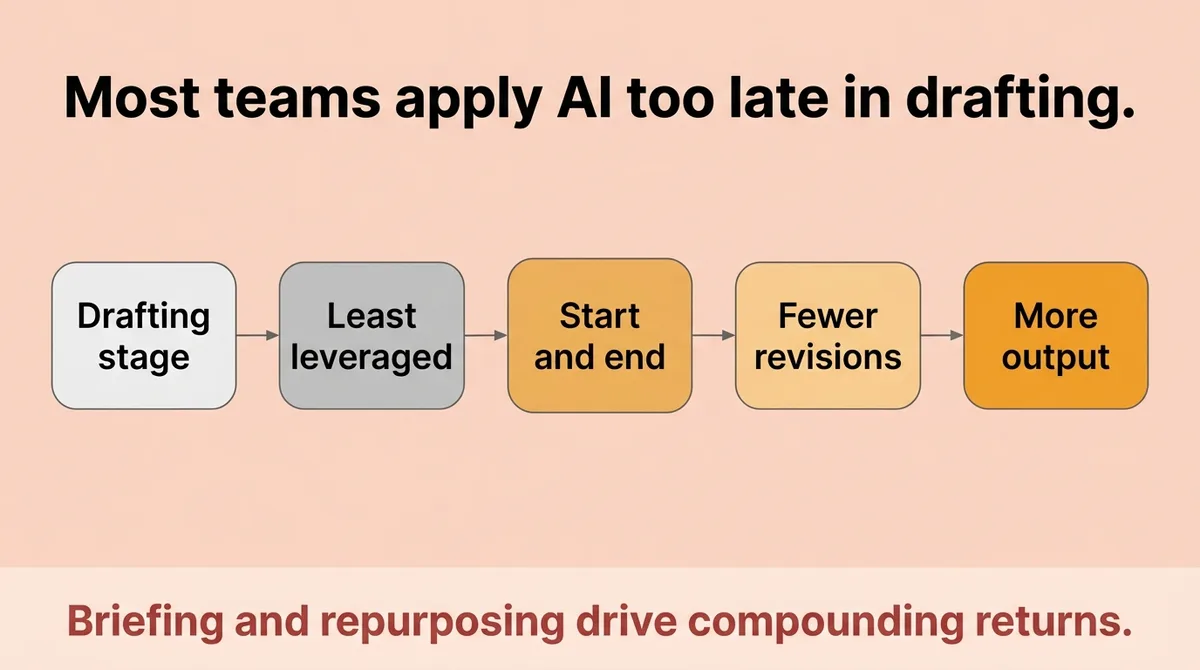
Briefing and repurposing produce more compounding return because they sit at the start and end of the production cycle. A better brief reduces revision cycles. Systematic repurposing multiplies output per piece without adding new research time. AI may improve marketing productivity by 5 to 15 percent of total marketing spend [1], but that range depends entirely on where in the workflow the automation is placed.
The framework for making that decision has a name: the AI-Human Content Split.
The AI-Human Content Split maps six content stages. For each stage, it defines what AI handles automatically and what a human must own. The goal is a clear decision rule at every step, not a general instruction to “use AI more.”
Hornby Hobbies reduced analytics design time by 70 percent by applying this kind of stage-level thinking [1]. They did not automate everything. They identified one stage where manual work was creating drag and redesigned it.
There are at least nine documented use cases for automated AI workflows in marketing [2]. The teams that benefit from more than one or two of them share a common approach: they map the stage before they select the tool.
Stage | AI Role | Human Role |
|---|---|---|
Ideation | Generate topic clusters from keyword data | Select topics based on audience trust signals |
Briefing | Draft brief structure from target keyword and intent | Add brand context, competitive angle, specific claims |
Drafting | Produce full draft from approved brief | None at this stage if brief is precise |
Editing | Flag passive voice, sentence length, repetition | Apply judgment on tone, accuracy, and argument |
Repurposing | Break post into social snippets, email copy, script | Select which formats serve which channel audience |
Publishing and Distribution | Schedule, tag, and post across connected channels | Confirm final version and approve trigger |
One concrete example: AI generates 20 headline variants in seconds. A human selects based on brand voice and the specific trust signals that matter to that audience. The human is not writing headlines. The human is making a judgment call that AI cannot make reliably.
That distinction is the entire point of the AI-Human Content Split. Speed comes from AI handling volume. Quality comes from humans owning judgment. The two roles do not compete. They sequence.
Challenge the default: if your only AI integration is at the drafting stage, you are getting a fraction of the available return. Redesign from the brief forward.
What Happens to Teams That Automate Without Redesigning the Process
Adding AI tools to a broken workflow does not fix the workflow. It accelerates the breakage.
A team that adds three AI writing tools without changing approval chains can add 11 hours of review cycles per week instead of saving time [3]. The tools produce more drafts. The same two editors review all of them. The queue grows faster than it clears.
Gartner reports that 81 percent of marketing technology leaders are piloting or have already implemented AI agents [1]. Adoption is high. Consistent results are not. The gap between those two facts is process.
United Fashion Group saw a 43.75 percent increase in conversion rates and a 57.31 percent increase in average order value [1]. Those results came from redesigned workflow integration. The tools they used were not exceptional. The process they built around the tools was.
The mistake is specific: teams treat AI as a productivity layer placed on top of existing steps. They add a drafting tool but keep the same brief format. They add a scheduling tool but keep the same manual approval chain. Each tool creates a new handoff instead of removing one.
Teams currently juggle three to five tools across their content stack [4]. Each tool was added to solve a single problem. None were added as part of a connected system. That fragmentation means content moves between tools manually, which reintroduces the exact friction the tools were bought to remove.
The question to ask before adding any tool: which manual handoff does this replace? If the answer is none, the tool adds to the stack without reducing the drag.
How to Connect Your Tools, Content Systems, and Team Into One Operating System
The AI-Human Content Split does not work as six isolated decisions. It works as a connected pipeline where each stage triggers the next without a manual handoff.
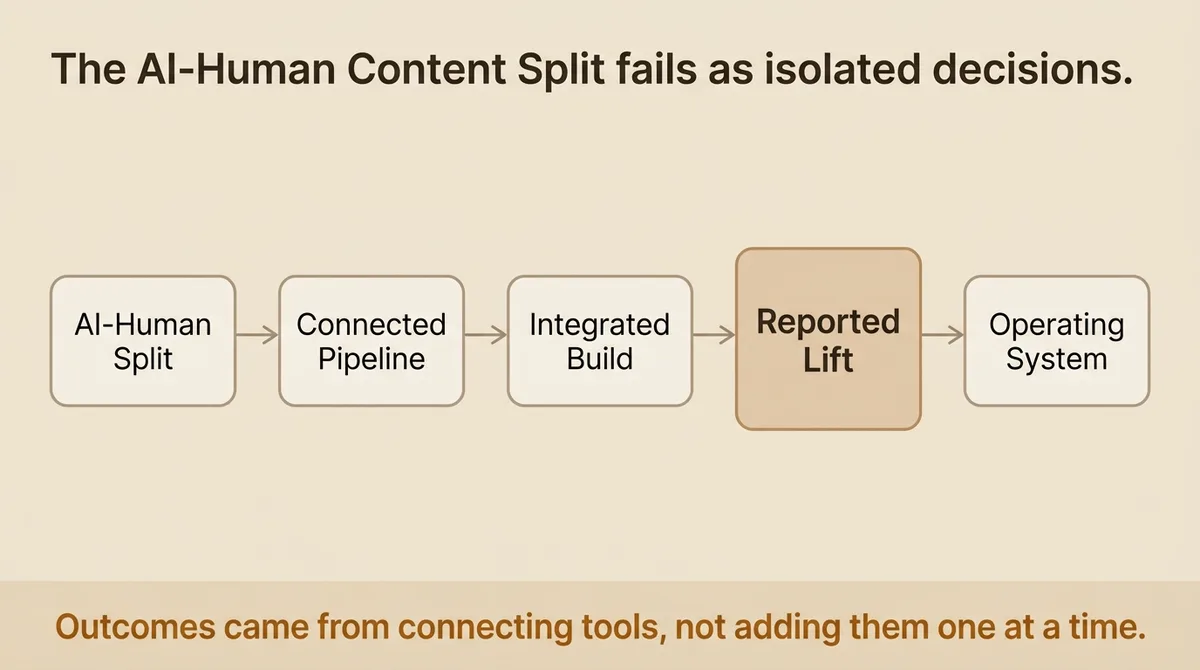
HMV built that kind of integrated pipeline and reported a 14 percent lift in campaign revenue, a 34 percent increase in impressions, and a 425 percent increase in landing page views [1]. That outcome was not produced by adding tools one at a time. It came from connecting tools into a single operating system that ran from brief creation through distribution.
Here is a concrete example of what that connection looks like in practice.
A content brief created in Notion triggers an AI draft in a connected drafting tool. The draft routes to a Slack channel where the assigned editor receives a direct notification with a review link. The editor approves the final version. WordPress publishes automatically from the approved document state. Distribution to email and social channels fires from the same trigger.
No file is moved manually. No person is chased for an update. The pipeline runs.
Facts #5, #6, and #7 from HMV represent a real-world result of integrated workflow, not isolated tool use [1]. The distinction matters because the tools HMV used exist in most marketing stacks already. The integration between them is what most teams skip.
Audit your current tool stack this week. Identify the one manual handoff that creates the most delay. That is your starting point, not a full stack replacement.
Reject the advice to try AI tools one at a time. Sequential experimentation means you are optimizing individual stages while leaving the connections between them broken. Compounding output comes from a connected system, not a collection of point solutions.
Implementation caveat: Integration requires your tools to share data cleanly. If your CMS does not accept API connections from your drafting tool, the pipeline breaks at that joint. Check API compatibility before you build the approval chain around it. A workflow that depends on a copy-paste step in the middle is not a workflow. It is a workaround with extra steps.
The operational sequence is clear: map your six stages, assign AI and human roles at each one, connect the tools so each stage triggers the next, and publish from a single approved state. That sequence produces a content operation that scales without adding headcount.
Build the System First, Then Let AI Fill the Stages
The teams shipping content on cadence are not using better AI tools. They built a process that AI fits into cleanly.
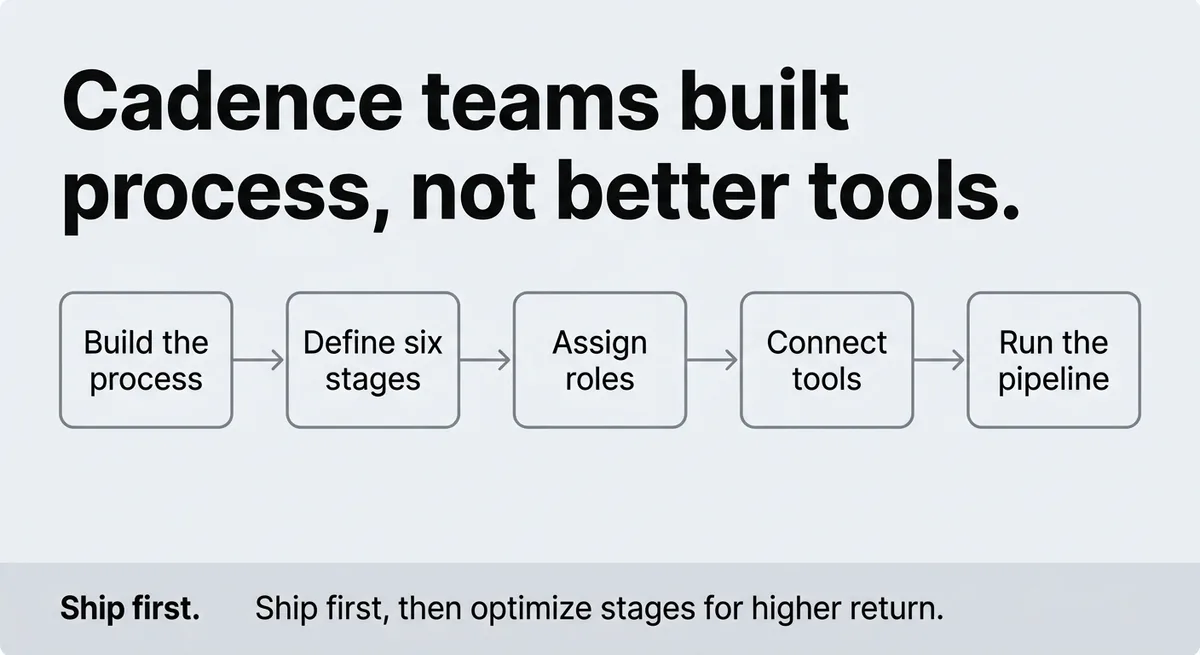
Define your six stages. Assign roles at each one using the AI-Human Content Split. Connect your tools so handoffs run automatically. Then run the pipeline.
Ship the first piece through the new system before you optimize any stage of it.
References and Citations
[1]https://www.bloomreach.com/en/blog/agentic-orchestration-the-marketing-workflow-revolution
[2]https://www.jasper.ai/blog/ai-workflows
[3]https://www.marketermilk.com/blog/ai-marketing-workflow
[4]https://www.marketingmary.ai/blog/marketing-workflow-automation-guide
FAQ
The highest-return entry points for generative AI in a content workflow are briefing and repurposing, not drafting, because they sit at the start and end of the production cycle and compound across every piece produced. A precise AI-generated brief reduces revision cycles downstream, while systematic AI-driven repurposing multiplies output per article without adding new research time. Platforms like Zelitho are built around exactly this logic, connecting keyword discovery, brief confirmation, draft generation, and CMS publishing into one pipeline so the automation compounds at every stage rather than helping at just one.
AI writing tools layered on top of an unchanged approval chain produce faster drafts that still queue behind the same manual handoffs, so publish dates keep slipping. The slowdown is almost never the writing itself: it lives in the sequential steps between brief, draft, editor, approval, CMS entry, and publish, where each step waits on a person. Adding more AI tools without redesigning those handoffs can actually increase review burden, with some teams adding more than ten hours of extra review cycles per week instead of saving time.
The AI-Human Content Split is a six-stage framework that defines exactly what AI handles automatically and what a human must own at each step of content production, from ideation through distribution. At the ideation stage, AI generates topic clusters from keyword data while a human selects based on audience trust signals; at the drafting stage, AI produces a full draft from an approved brief while the human role is minimal if the brief is precise; at the editing stage, AI flags mechanical issues while a human applies judgment on tone, accuracy, and argument. The framework’s core principle is that speed comes from AI handling volume and quality comes from humans owning judgment, and the two roles sequence rather than compete.
A connected content pipeline works by having each stage trigger the next automatically: a brief created in a planning tool fires an AI draft, the draft routes to an editor via a direct notification, and the approved version publishes to the CMS without anyone moving a file manually. The critical prerequisite is API compatibility between every tool in the chain, because a single copy-paste step in the middle breaks the pipeline into a workaround with extra steps. Zelitho is designed around this principle, covering keyword selection, title and scope confirmation, research-backed draft generation, and direct publishing to WordPress or Webflow inside one system so the handoffs between those stages are eliminated rather than just accelerated.
Real-world results from integrated AI content workflows include a 43.75 percent increase in conversion rates and a 57.31 percent increase in average order value at United Fashion Group, and a 14 percent lift in campaign revenue, 34 percent more impressions, and a 425 percent increase in landing page views at HMV. Hornby Hobbies reduced analytics design time by 70 percent by identifying a single stage where manual work was creating drag and redesigning it. Across these examples, the consistent pattern is that the tools used were not exceptional: the process built around those tools was what drove the result.