
What Are AI Keyword Clustering Tools? How They Work for SEO

TL;DR
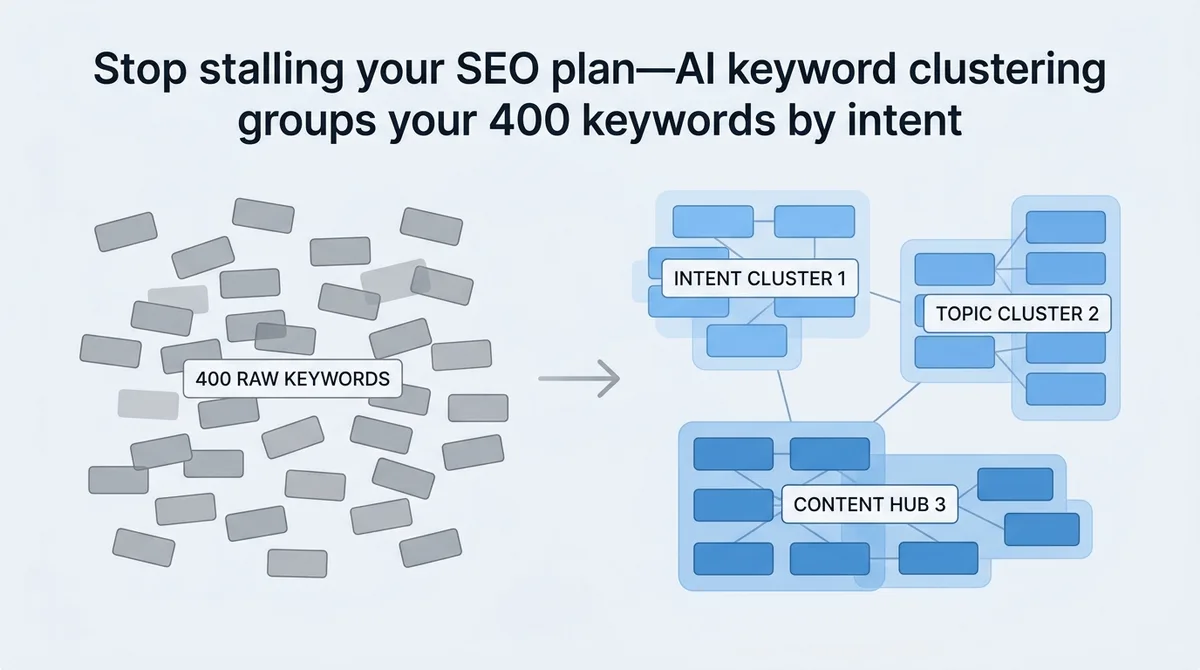
You exported 400 keywords from a research tool. Now they sit in a spreadsheet, sorted by volume, waiting for someone to decide what to write. That decision never gets made cleanly, so the blog stalls again.
Most teams respond by creating more pages. One keyword, one article. The spreadsheet shrinks, the site grows, and nothing ranks because every page competes against a sibling page targeting the same intent.
AI keyword clustering tools solve this by grouping search terms that share confirmed SERP overlap, not just topic similarity. Two keywords belong in one cluster when Google returns the same URLs for both. The output maps directly to page assignments, word count targets, and internal linking structure. Content leads, agency operators, and SEO planners use this to convert a raw keyword list into a buildable content plan before writing a single word.
What Is an AI Keyword Clustering Tool?
An AI keyword clustering tool takes a raw list of search terms and groups them by shared search intent, confirmed through SERP co-occurrence. The output is a structured content plan: which keywords belong on the same page, what type of page to build, and how pages should link to each other.
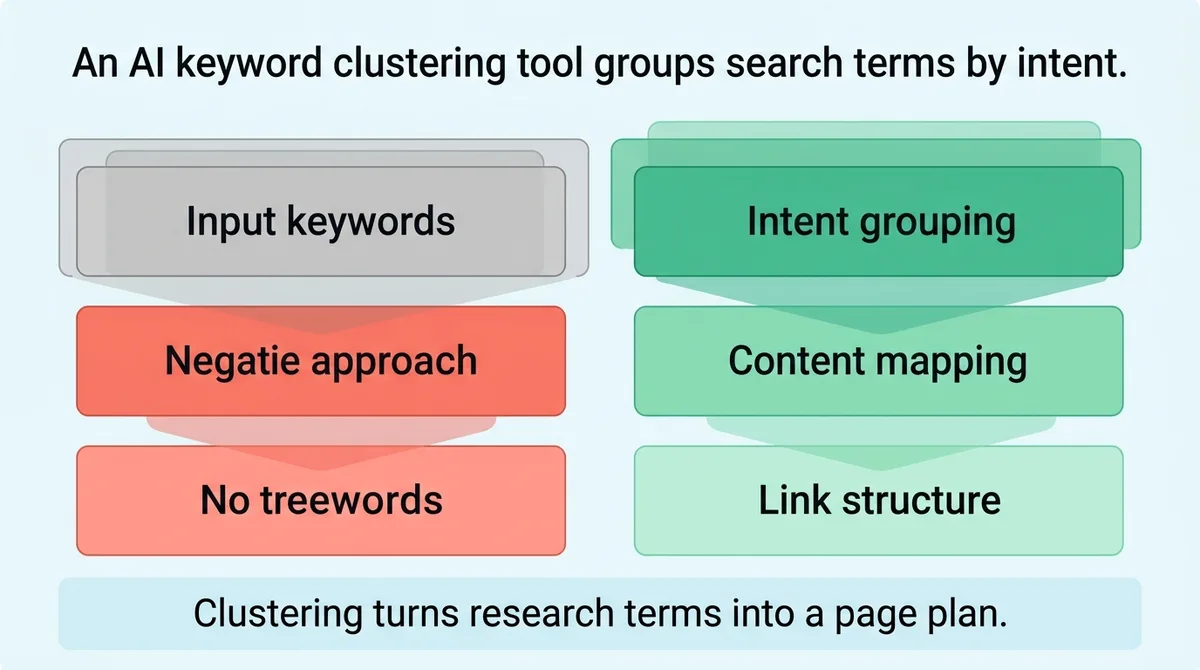
This is not keyword research. Research finds terms. Clustering decides how those terms map to pages.
What Keyword Clustering Actually Does (And What It Has Nothing to Do With)
Clustering is not a filing system for keywords. It is a content architecture decision.
The method works like this: two keywords belong in the same cluster when their search results share the same URLs. If “best CRM software” and “top CRM tools” both surface the same pages in the top 6 positions, Google already treats them as the same intent [1]. One page covers both terms. Two pages waste crawl budget and split ranking signals.
Stop sorting keywords by topic label. Start letting SERP overlap confirm which terms actually belong together.
Manual grouping by theme feels productive. A content lead drops keywords into buckets named “CRM features,” “CRM pricing,” and “CRM reviews,” then assigns one article per bucket. The problem is that those buckets are built on assumptions. SERP-based clustering is built on evidence. Google’s results confirm which queries compete for the same user, regardless of how a human would label them.
Clustering also differs from keyword research in its output. Research hands you a list. Clustering hands you a page-level map. A cluster is not just a group of related words. It is a confirmed unit of content: one URL, multiple keyword intents, one coherent topic that Google treats as a single answer [2].
The practical consequence of skipping this step is a site that expands without concentrating authority. More pages, thinner signals per page, lower average position across all of them.
The Five-Step Clustering Workflow: From Raw List to Content Plan
A raw keyword list becomes a content plan through five steps. Each step removes a decision that would otherwise stall publishing.
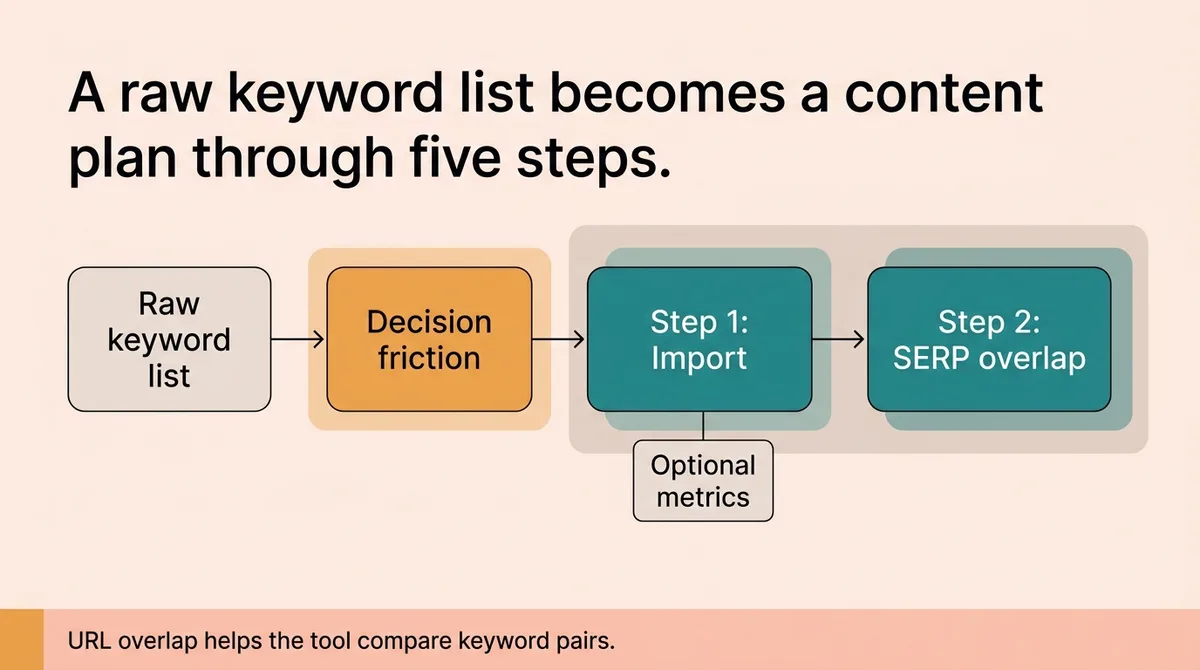
Step 1: Import keywords. Pull your full keyword list into the clustering tool. Volume, CPC, and difficulty data can come with it, but the clustering engine does not sort by those numbers.
Step 2: The tool crawls SERPs and records URL overlap. For each keyword pair, the tool checks how many of the same URLs appear in the top results. High overlap means shared intent. This step separates SERP-based clustering from semantic grouping.
Step 3: Clusters form around a seed keyword. The highest-volume or most representative term anchors each cluster. Supporting terms orbit around it, confirmed by overlap.
Step 4: Each cluster receives a content type and a target length. Pillar pages covering broad topic hubs typically require 3,000 or more words [1]. Supporting posts sit around 1,500 words [1]. Lightweight pages targeting narrow or transactional terms can land near 1,000 words [1]. These are not arbitrary targets. They reflect the competitive depth already present in the SERPs for each cluster tier.
Step 5: An internal linking map is generated. The tool identifies which supporting pages should point to which pillar pages, and in what direction authority should flow.
After step five, the output is a content brief template. Not a list of ideas. A page-level assignment with a keyword set, a word count target, and a linking directive.
Hub pages typically support 3 to 5 clusters before the topic structure becomes unwieldy [1]. Larger topic hubs covering broader subjects can branch into 5 to 8 subtopics while maintaining coherent internal linking [1]. Beyond that range, the pillar page loses focus and the supporting pages lose context.
Cluster Tier | Content Type | Recommended Word Count | Internal Link Direction |
|---|---|---|---|
Pillar / Hub | Long-form topic overview | 3,000+ words | Receives links from supporting posts |
Supporting Post | Focused subtopic article | ~1,500 words | Links up to pillar page |
Lightweight Page | Narrow or transactional term | ~1,000 words | Links up to supporting post or pillar |
One clarification: word count targets come from the competitive landscape of each cluster, not from a universal content formula. A 3,000-word pillar target reflects what already ranks, not what someone decided sounds authoritative.
You Are Probably Using Cluster Output Wrong: Here Is What It Actually Tells You
Here is the hidden worry most content leads carry: “Am I creating too many pages, or not enough?”
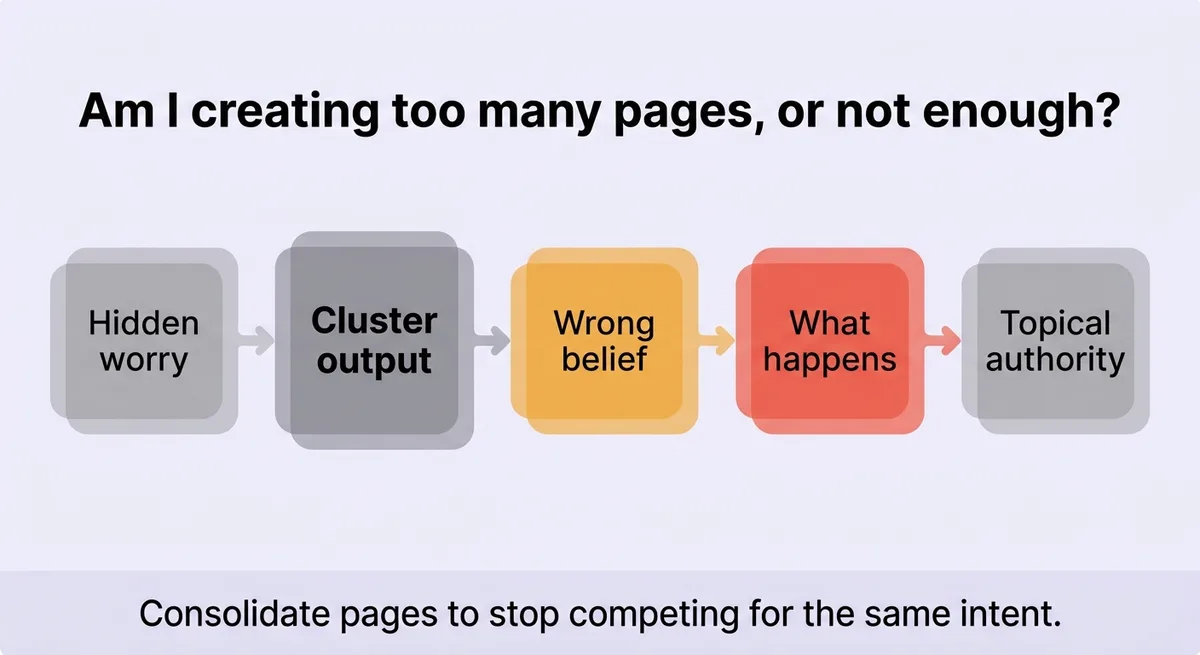
The answer is almost always too many, and the cluster output tells you exactly which pages to consolidate.
The wrong belief is that more keyword variations require more pages. A site with 50 keyword variations spread across 20 thin pages, all ranking between positions 21 and 30, is not covering more ground. It distributes a fixed amount of topical authority across too many URLs. Each page competes against the others for the same searcher.
Splitting one cluster into two separate pages can mean roughly 30% of your content competes against itself in the same SERP [1]. The pages cannibalize each other’s click potential and dilute the signals that would otherwise concentrate on one URL. Consolidating correctly can concentrate up to 70% of topical authority onto a single page [1], shifting it from page 3 noise into a page 1 candidate.
One team had 18 articles covering variations of “project management software for small teams.” Every article was between 800 and 1,100 words. None ranked above position 24. After clustering, those 18 articles mapped to three clusters. Three consolidated pages replaced eighteen thin ones. Within one crawl cycle, two of the three pages moved to positions 6 through 11.
The cluster output is also a site audit tool. Before writing anything new, run your existing page list against the cluster map. Match URLs to clusters. If one cluster has four or more existing pages assigned to it, consolidation is the next action, not new content.
The practical step: open your CMS, pull a list of published URLs, and map each one to a cluster from the output. Pages that share a cluster assignment are candidates for merging. This audit takes less time than writing a single new article, and it produces faster ranking movement.
How to Evaluate a Clustering Tool Without Getting Distracted by Feature Lists
Most tool comparisons fixate on keyword volume limits. That is the wrong filter.
Three criteria actually determine whether a tool fits your workflow.
Criterion 1: Clustering method. SERP-based clustering confirms intent through URL co-occurrence. Semantic clustering groups terms by language similarity. Hybrid tools use both. SERP-based is more reliable for content decisions because it reflects what Google already treats as equivalent. Semantic clustering can group terms that sound related but compete for different intents.
Criterion 2: Output format. A flat CSV requires manual interpretation. That interpretation step is where content plans stall. Look for tools that output a cluster map with content type assignments and internal linking suggestions. The output should be assignable to a writer or a CMS entry without a translation step.
Criterion 3: Ecosystem coverage. Keyword visibility is no longer limited to Google. Modern tools track ranking signals across Google, Bing, Yandex, ChatGPT, Perplexity, AI Mode, and Claude [2]. Brand monitoring now extends across ChatGPT, Gemini, Claude, and Perplexity [2]. A tool that only reports Google rankings misses a growing share of how people find answers. For content leads managing brand presence across AI-generated responses, this gap becomes expensive.
Collaboration output matters too. Some tools export formats built for internal teams, while others produce client-facing reports [2]. An agency operator managing six client blogs needs both formats on demand. A tool that only outputs one format adds manual reformatting to every client delivery.
Criterion | What to Look For | Red Flag |
|---|---|---|
Clustering method | SERP-based or hybrid confirmation | Semantic-only grouping with no SERP validation |
Output format | Cluster map with content type and linking direction | Flat CSV with keyword list only |
Ecosystem coverage | Google, Bing, ChatGPT, Perplexity, AI Mode, Claude [2] | Google-only visibility reporting |
Tool A outputs a CSV with keyword groups and monthly volume. A content lead opens it, stares at 300 rows, and spends 90 minutes deciding which rows become articles. That 90 minutes happens before a single brief is written.
Tool B outputs a tiered cluster map with pillar assignments, supporting post targets, word count ranges, and a linking structure. A content lead opens it and assigns rows directly to writers. The decision work is already done.
The difference is not features. It is whether the tool’s output removes a decision or creates one.
This is the exact decision-removal test worth applying past the clustering step too. A tool that hands you a clean cluster map still leaves you with a second decision gap: turning that map into 15 briefed articles, then getting each one drafted, formatted, and onto your CMS. Zelitho is built to remove that second gap the same way — clusters flow directly into research-backed drafts with word count and internal linking already matched to the tier, so the plan doesn’t stall at the handoff between “we know what to write” and “someone wrote it.”
Cluster First, Write Second, Link With Purpose
The sequence matters. Clustering before writing means every page has a confirmed reason to exist. It belongs to a cluster, covers a defined intent, sits at a specific tier, and links in a specific direction.
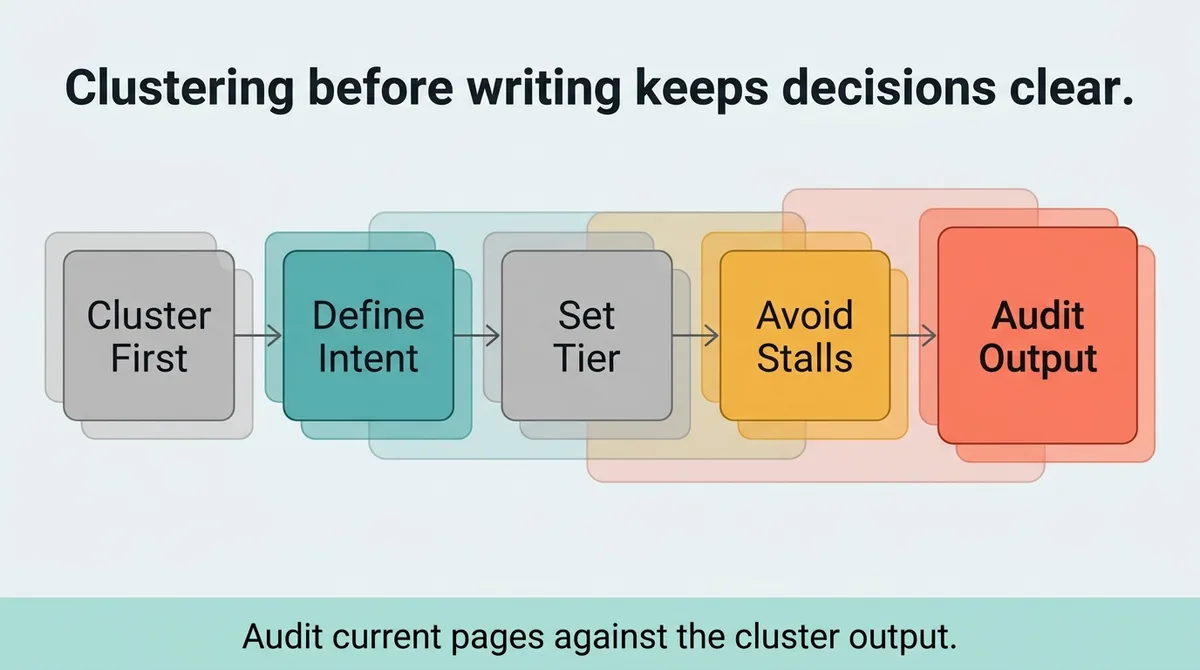
Most blog stalls happen at the decision point between “we have keywords” and “we know what to write.” Clustering closes that gap with a structured method, not a judgment call.
Run the cluster workflow on your existing keyword list. Audit current pages against the output. Consolidate before you publish. Then write into confirmed gaps, not assumptions.
The content plan builds itself. Your job is to execute it.
References and Citations
[1]https://infranodus.com/docs/keyword-clustering-seo
[2]https://keywordly.ai/features/keyword-clustering
FAQ
Keyword research finds terms you could target, while keyword clustering decides how those terms map to specific pages on your site. Research hands you a list; clustering hands you a page-level content plan where each cluster represents one URL, multiple keyword intents, and a confirmed topic that Google treats as a single answer. Skipping clustering after research is why teams end up with dozens of thin pages all competing against each other for the same searcher.
SERP-based keyword clustering groups search terms by checking how many of the same URLs appear in the top results for each keyword pair, not by how similar the words sound. If two queries consistently surface the same pages, Google already treats them as the same intent, so one page can rank for both instead of two pages splitting authority. This method is more reliable than semantic clustering because it reflects actual search behavior rather than language similarity.
Run your existing published URLs against the cluster map, and any cluster with four or more pages already assigned to it is a consolidation target, not a new content opportunity. Spreading one cluster across multiple thin pages can cause roughly 30% of your content to compete against itself in the same SERP, while consolidating correctly can concentrate up to 70% of topical authority onto a single URL and push it from page 3 into page 1 contention. Platforms like Zelitho that combine clustered topic selection with a full publishing workflow make this audit easier because keyword groupings and content assignments live in the same system, so you can act on consolidation decisions without switching tools.
The three criteria that actually matter are clustering method, output format, and ecosystem coverage. A tool should use SERP-based or hybrid confirmation rather than semantic grouping alone, produce a cluster map with content type assignments and internal linking direction rather than a flat CSV, and track visibility across Google, Bing, ChatGPT, Perplexity, and AI Mode rather than Google only. If you also need to move from cluster output to a published article without switching tools, Zelitho connects clustered topic selection directly to draft generation, on-page editing, and CMS publishing in one workflow, which removes the manual handoff where most content plans stall.
Sites rank poorly despite large post counts because they distribute a fixed amount of topical authority across too many thin, competing URLs instead of concentrating it on a smaller number of well-structured pages. When multiple articles target the same search intent without clustering to confirm they belong on separate pages, they cannibalize each other’s click potential and none of them accumulates enough signal to reach page one. The fix is not more content but a cluster audit that identifies which existing pages should merge and which confirmed gaps still need a new page written into them.