
How to Cite ChatGPT in an Academic Paper

TL;DR
You used ChatGPT to draft a section. Now you’re staring at your reference list, unsure whether that counts as something you need to document. It does.
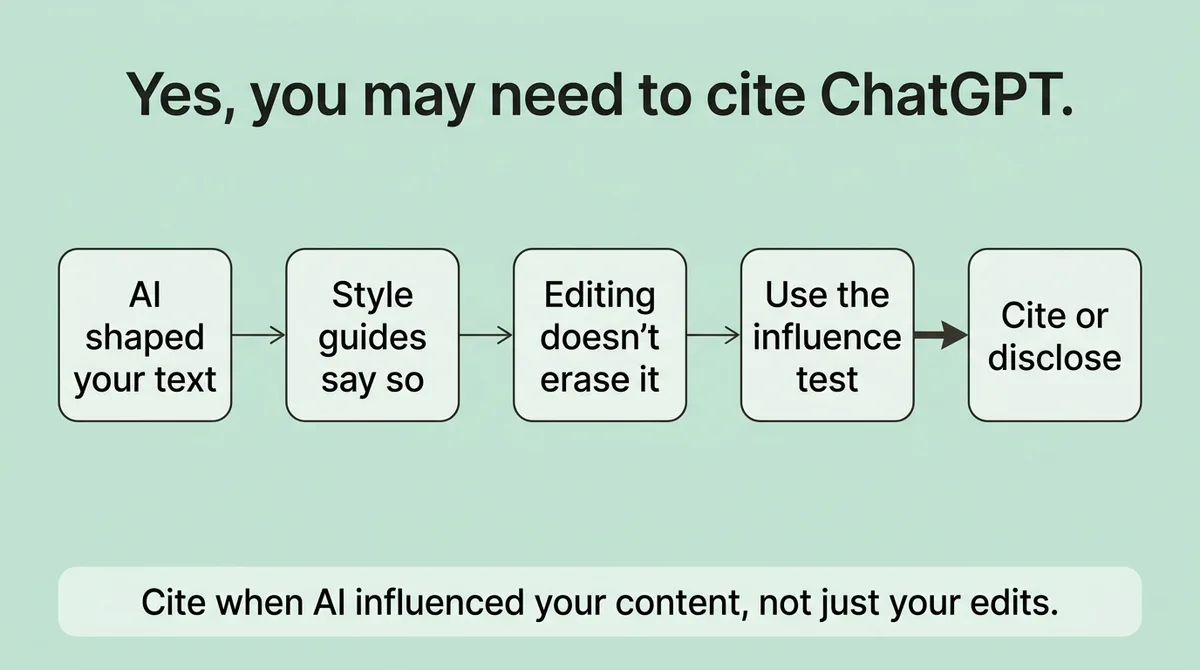
Most writers assume paraphrasing AI output removes the citation obligation. It doesn’t. Style guides don’t exempt content based on how many times you rewrote it. They care whether an external source shaped the work.
The CITE-AI Framework (Citation by Intent, Template, and Evidence) gives you a concrete path forward. It splits AI use into two tracks: generative content requiring a full reference entry, and editing assistance requiring only a disclosure note. APA, MLA, and Chicago each have fill-in templates below. This guide is for students, researchers, and writers who have already decided to use AI and need to document it correctly before submission.
Do you need to cite ChatGPT in an academic paper?
Yes. If ChatGPT generated, drafted, or substantially shaped any passage in your paper, a citation or disclosure is required. Most major style guides published explicit AI citation rules in 2023. Paraphrasing the output does not remove the obligation. The threshold is whether an AI source influenced the content, not whether you edited it afterward.
Why You Probably Need a Citation Even When You Think You Don’t
A student submits a literature review paragraph. ChatGPT drafted it. The student paraphrased it, changed the sentence order, and submitted without attribution. During examination, a committee member asks about a source the paragraph implies. The student can’t produce it. The review gets flagged for academic integrity concerns.
That scenario plays out more often than most students expect.
The wrong assumption is that paraphrasing creates distance between you and the source. It doesn’t, not for AI output and not for any other source. Style guides don’t track your editing process. They track whether external material shaped the work.
Stop treating AI output as your own raw thinking. Start treating it the way you’d treat a quote from a journal article you heavily summarized.
Institutional guidance already exists. As of May 18, 2023, Embry-Riddle Aeronautical University’s library published two citation examples specifically for ChatGPT [2]. That signals something important: academic institutions are not waiting for consensus. They are already applying citation standards to AI-generated content.
Before you submit any paper, run this check. Did AI generate any passage? Did it suggest a structure you kept? Did it produce claims you incorporated? If yes to any of those, a citation or a disclosure note is required. The next section tells you exactly which format to use.
The Style-by-Style Citation Framework: APA, MLA, and Chicago Templates
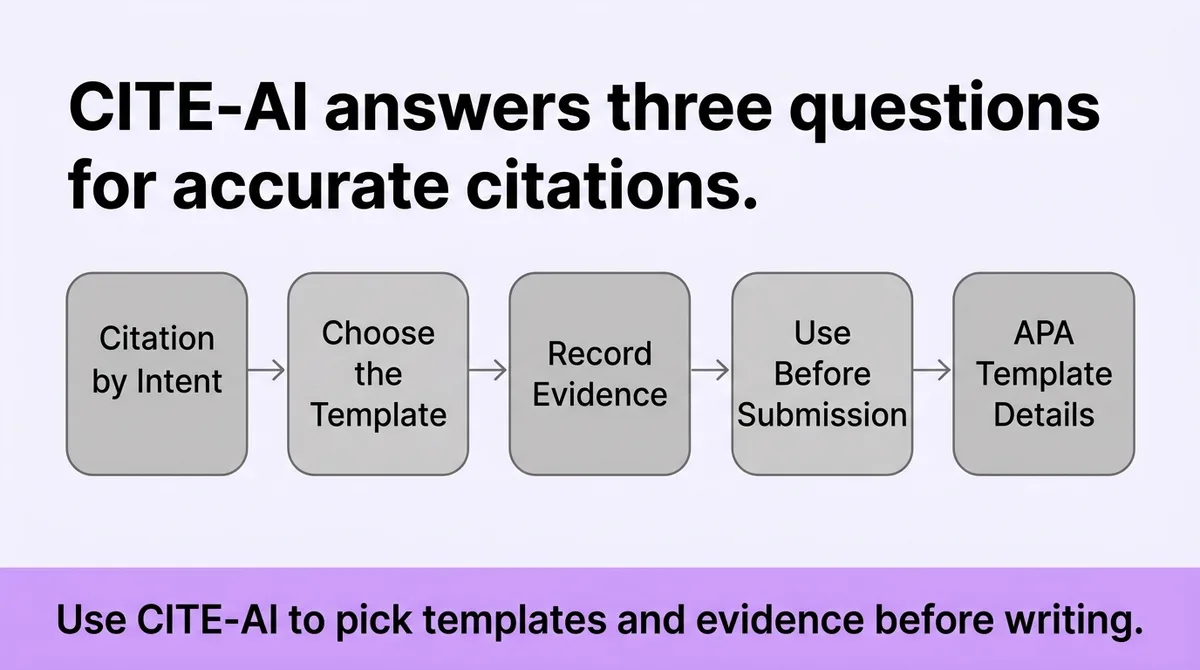
The CITE-AI Framework (Citation by Intent, Template, and Evidence) organizes citation decisions around three questions: what was the AI’s role, which template applies, and what evidence do you record? Use it before you write, not after you submit.
Here are the fill-in templates for each major style guide, followed by a comparison table.
APA
APA treats ChatGPT as a recoverable source with a named author (OpenAI), a year, a version identifier, and a URL [1]. Two version entries appear in Purdue’s documented examples: one for a February 13 version and one for a March 14 version [1]. The version matters because different model releases can produce materially different outputs.
Fill-in template:
OpenAI. (YEAR). ChatGPT (VERSION) [Large language model]. https://chat.openai.com
In-text: (OpenAI, YEAR)
MLA
MLA requires the prompt itself as part of the citation entry [1]. The date format uses day-month-year with abbreviated months, for example, 10 Mar. 2026 [1]. This format signals session-level specificity, meaning MLA treats each exchange as a discrete source event.
Fill-in template:
"Prompt: [your exact prompt]." Response from ChatGPT, [DAY MON. YEAR], OpenAI, chat.openai.com.
In-text: Cite within the sentence by describing the prompt context.
Chicago
Chicago requires an access date [1]. The documented example uses March 31, 2023 as the citation date [1]. Chicago style typically uses footnotes or endnotes, so the AI citation appears there rather than in a standalone reference list.
Fill-in template:
OpenAI. "ChatGPT Response to [TOPIC]." Accessed [MONTH DAY, YEAR]. https://chat.openai.com.
Style | In-Text Format | Reference Entry Key Fields |
|---|---|---|
APA | (OpenAI, 2023) | Author, year, version, bracketed descriptor, URL |
MLA | Described in prose | Prompt text, date (day month year), platform |
Chicago | Footnote/endnote | Topic description, access date, URL |
Copy the template for your required style before you start writing. Retrofitting citations at submission creates errors in version numbers and access dates.
What Skipping Attribution Actually Costs You
A graduate student submits a thesis with three AI-assisted sections, none of them disclosed. The examination committee flags two passages during the review. The revision cycle adds six weeks to the graduation timeline. The violation goes into the student’s institutional record.
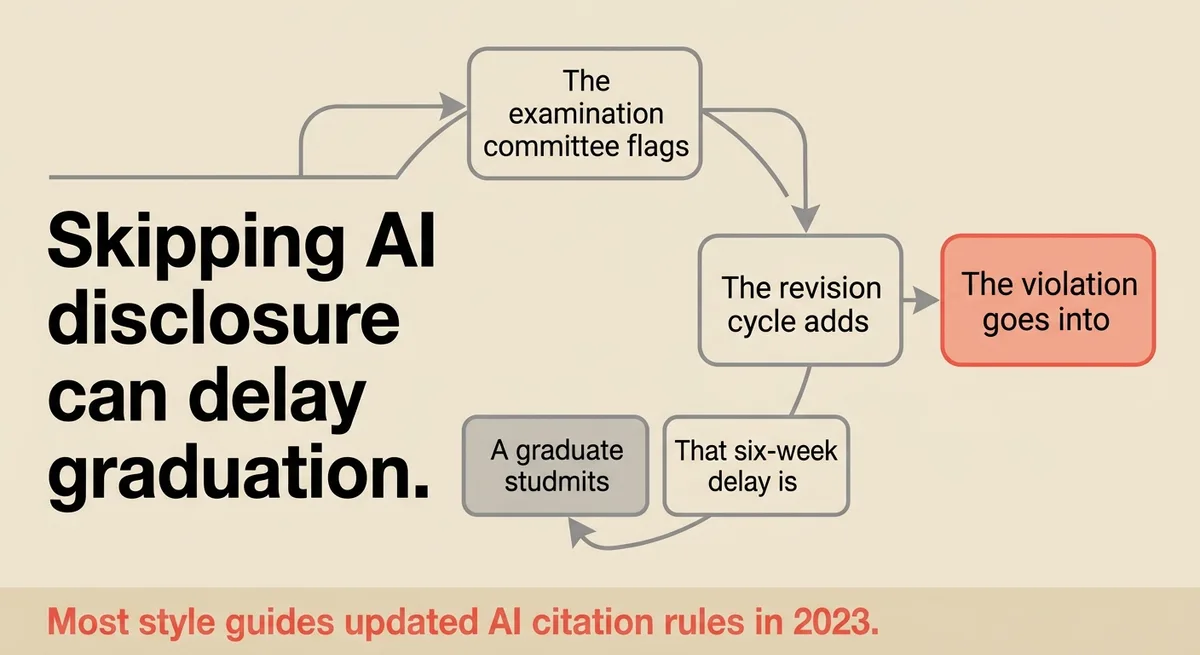
That six-week delay is a concrete, recoverable cost. The record entry is not.
Most style guides updated their AI citation rules in 2023 [1]. A paper written in early 2023 that cited a February 13 version of ChatGPT without recording the version number would already be non-compliant under those updated standards. The rules moved faster than most writers expected.
This article is not arguing whether using AI in academic work is ethical. That debate belongs elsewhere. This article tells you how to document AI use correctly once you have decided to proceed.
Add a citation placeholder the moment you use AI assistance. A placeholder takes ten seconds. Reconstructing an access date three weeks later is often impossible, because ChatGPT does not store session histories indefinitely.
The practical rule: if you can’t reproduce the output in a shareable form, you still need to record what you can. Version, date, and prompt context are your minimum viable metadata.
Metadata Requirements, Prompt Visibility, and Disclosure Edge Cases
Most writers assume the URL is enough. It isn’t. Version, access date, and prompt context are equally required metadata, and each style guide handles them differently.
MLA’s requirement to include the prompt text in the citation entry [1] reflects a specific editorial logic: the prompt is part of the source. Two people with the same prompt on the same day can get meaningfully different outputs. MLA treats the prompt as the identifier.
Chicago’s requirement for an access date [1] reflects a different logic: AI outputs are not permanently archived. The access date signals when the output existed in the form you used.
Here are three edge cases the templates above don’t cover on their own.
Private or unshareable sessions. If your session is not accessible via a public link, you cannot provide a working URL. Use a disclosure note in your footnotes or acknowledgments section. State the date, the model version, and the general nature of the prompt. Do not leave a broken link in your reference list.
AI used only for grammar or copyediting. A full reference entry is not appropriate here. Use a disclosure note only, placed in the acknowledgments section. State that AI tools assisted with editing and not with generating content or claims.
AI used to suggest structure or outlines. This sits between the two tracks. If the structure shaped which arguments appeared in the paper, treat it as generative. If you discarded the structure and kept only your own thinking, a disclosure note is sufficient.
The CITE-AI Framework covers both tracks. Generative use requires a full reference entry in your style’s format. Editing assistance requires a disclosure note only. Classify the use first. Then select the format.
One practical habit: open a running footnote file alongside your draft. Every time you use AI assistance, log the date, version, and what you asked. Thirty seconds per session eliminates most citation problems before they start.
The Exact Citation Format Your Style Guide Requires Right Now
The CITE-AI Framework reduces the citation decision to two steps. First, classify the AI’s role: generative or editorial. Second, apply the matching template from your required style guide.
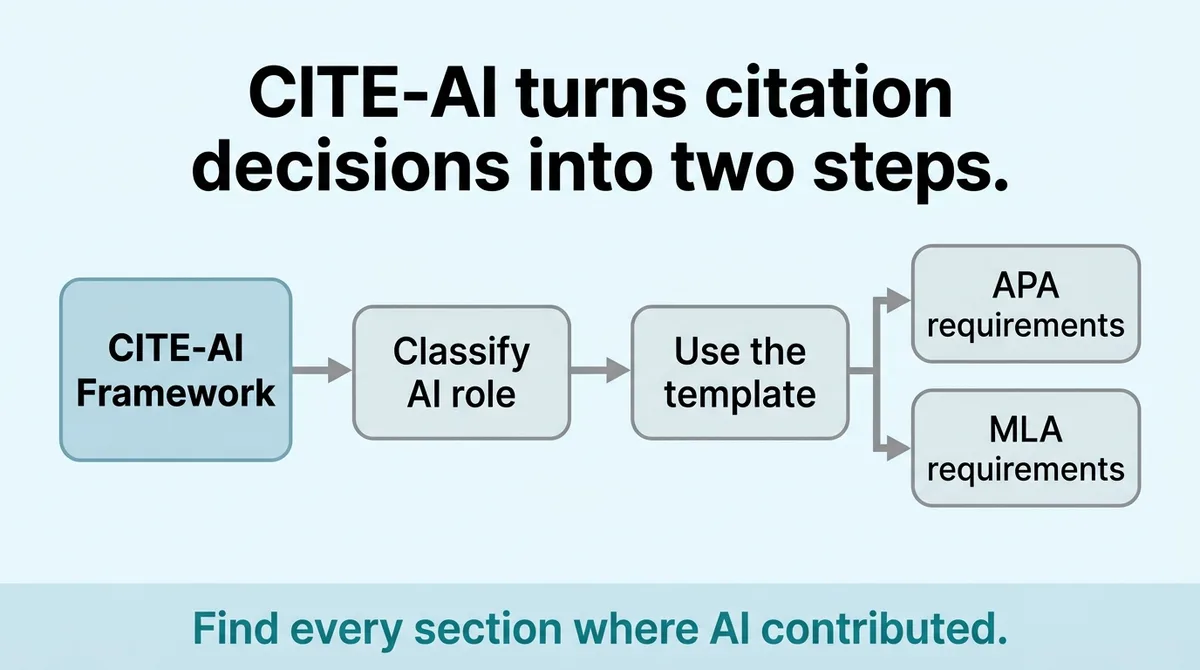
APA needs the version number and year. MLA needs the prompt and the date. Chicago needs the topic description and access date. None of them accept a bare URL as a complete citation.
Pull up your paper right now. Find every section where AI contributed. Assign each one to a track: full reference entry or disclosure note. Then paste the appropriate template and fill it in before you close the document.
Institutional guidance exists [2]. Style guide rules exist [1]. The only remaining variable is whether you apply them before submission or explain their absence after.
Copy the template. Fill it in now.
References and Citations
[1]https://guides.lib.purdue.edu/c.php?g=1371380&p=10135074
[2]https://erau.libguides.com/citing-sources/chatgpt
FAQ
Yes, you must still cite ChatGPT even if you paraphrased its output, because style guides track whether external material shaped the work, not how many times you rewrote it. Paraphrasing creates no legal or academic distance between you and an AI source. The threshold is whether ChatGPT influenced the content, not whether you edited it afterward.
In APA format, cite ChatGPT as: OpenAI. (YEAR). ChatGPT (VERSION) [Large language model]. https://chat.openai.com, with the in-text citation formatted as (OpenAI, YEAR). APA treats ChatGPT as a recoverable source with a named author, a year, and a version identifier, because different model releases can produce materially different outputs. The version number is required, so record it at the time you use the tool rather than trying to reconstruct it later.
MLA requires the exact prompt text as part of the citation entry, treating each exchange as a discrete source event, while Chicago requires an access date and places the citation in a footnote or endnote rather than a standalone reference list. The MLA fill-in template reads: “Prompt: [your exact prompt].” Response from ChatGPT, [DAY MON. YEAR], OpenAI, chat.openai.com. The Chicago template reads: OpenAI. “ChatGPT Response to [TOPIC].” Accessed [MONTH DAY, YEAR]. https://chat.openai.com. Neither style accepts a bare URL as a complete citation.
At minimum, you need to record the model version, the access date, and the prompt you used, because each style guide treats at least one of these as a required citation field. ChatGPT does not store session histories indefinitely, so reconstructing an access date weeks after the fact is often impossible. A practical habit is to open a running log alongside your draft and record those three data points within thirty seconds of each AI session. Platforms like Zelitho that generate research-backed drafts with citations built in can reduce this bookkeeping burden for content teams producing articles at scale.
If ChatGPT assisted only with grammar or copyediting and did not generate or substantially shape any content, a full reference entry is not required; a disclosure note in your acknowledgments section is sufficient. The note should state that AI tools assisted with editing and not with generating content or claims. This distinction matters because the citation obligation is tied to the AI’s role, not its mere involvement. For teams producing blog content rather than academic papers, Zelitho separates these tracks by design, generating research-backed drafts with citations so writers can see clearly what the AI contributed versus what editorial judgment they applied.