
Article Submission: A Step-by-Step Guide to Getting Published

TL;DR
You finished the draft. You open a new tab to find somewhere to submit it. That moment, right there, is where most writers lose weeks they never get back.
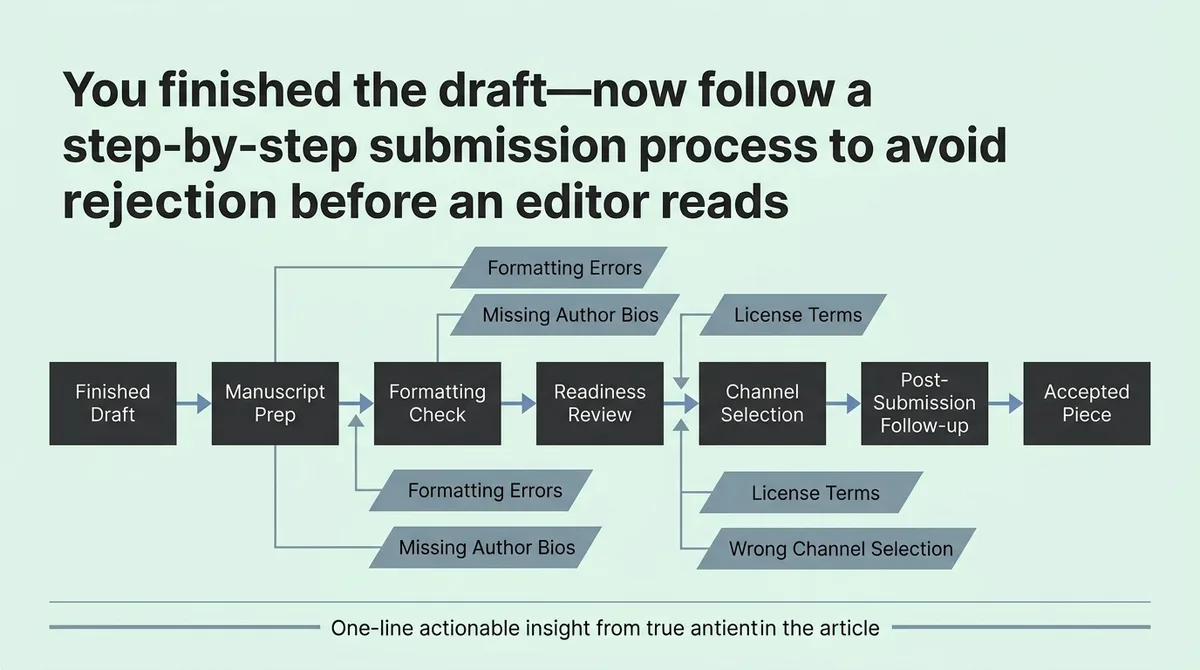
The common approach treats submission as a single action: write, find a site, send. What breaks this is everything that happens between a finished draft and an accepted piece. Formatting errors, missing author bios, license terms no one read, and wrong channel selection all trigger rejection before an editor ever opens the file.
This guide uses a four-stage sequence called the Submission Route Matrix to walk writers through preparation, compliance, route selection, and post-submission follow-up. Each stage includes a concrete checklist. The sequence applies to content marketers managing stalled blogs, agency founders clearing backlogs, and any writer who has sent a piece and heard nothing back for months.
What does article submission actually involve from start to finish?
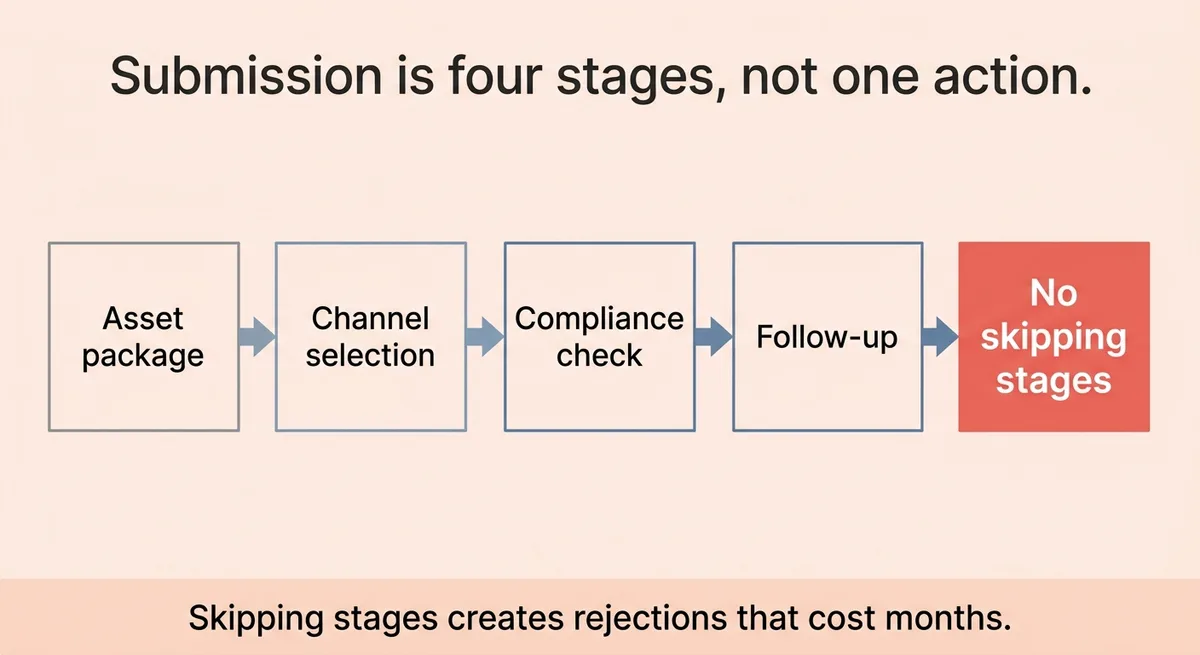
Article submission is a four-stage process: building your asset package, selecting a channel, running a compliance check, and managing follow-up. Skipping any stage does not accelerate publication. It creates rejections that cost you months of runway.
What You Actually Need Before You Write a Single Cover Letter
Finishing a draft does not mean you are ready to submit.
Most writers treat a completed document as the starting line for submission. It is actually the starting line for preparation. Formatting failures and missing assets reject more pieces than weak writing does. That is the uncomfortable part most guides skip.
Before you approach any outlet, you need a complete submission asset package. This is not about polish. It is about compliance. Editors at structured publications work against fixed cycles. An incomplete submission does not get flagged for follow-up. It gets passed over.
Here is what a submission-ready package contains:
- Manuscript file in the outlet’s required format (Word, Google Doc, or plain text)
- Word count verified against the target outlet’s range
- Author bio (typically 50–100 words, third person)
- Headshot if required
- Keywords or topic tags if the platform requires them
- Abstract if the outlet is academic or editorial
- Rights statement confirming you hold original copyright
The word count requirement varies significantly by channel. General article directories typically accept pieces in the 600 to 800 word range [2]. Editorial platforms and columnist arrangements expect 1,000 to 1,800 words [3]. Submitting a 700-word piece to a platform that requires 1,200 gets you rejected before a human reads line one.
Stop thinking of writing as the hard part. Start treating format compliance as the gate it actually is.
Choosing Your Submission Route Before You Default to the Wrong One
Most writers default to the first directory they find with a decent search ranking. That is a route decision made by accident.
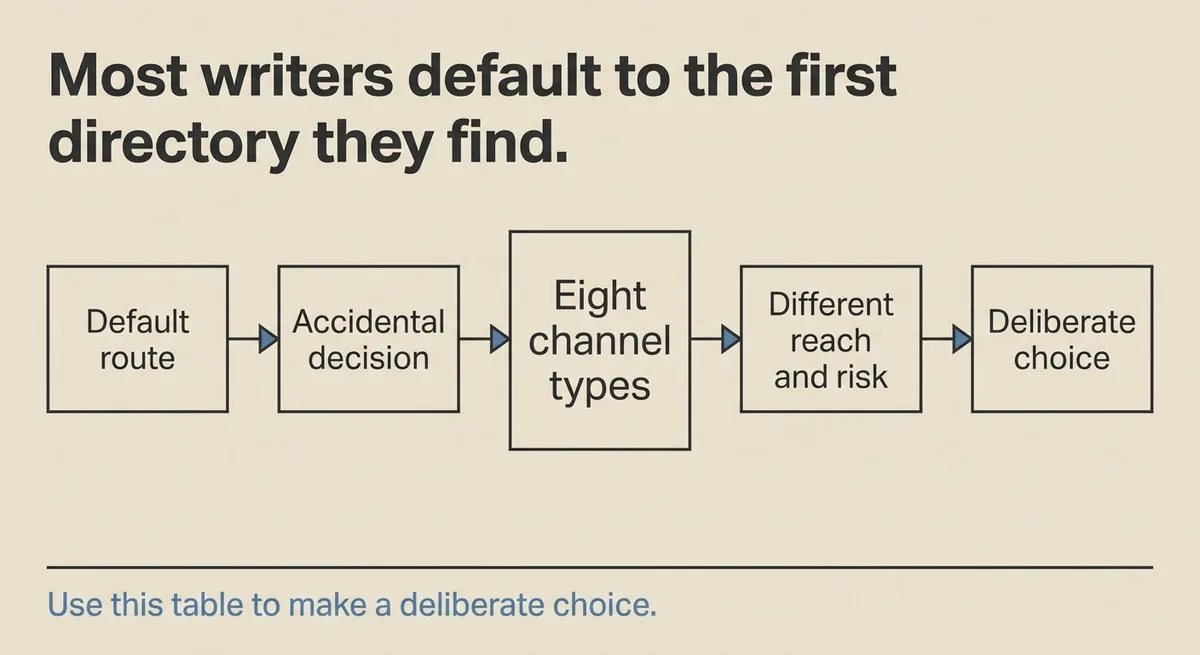
There are eight distinct submission channel categories [2]: general article directories, niche directories, guest posting sites, blog platforms, social publishing platforms, press-release networks, Web 2.0 sites, and PDF distribution platforms [2]. Each serves a different purpose. Each carries different reach and risk.
Use this table to make a deliberate choice before you submit anywhere.
Submission Route Matrix
Channel Type | Best Use Case | License Risk |
|---|---|---|
General article directories | Broad visibility, backlink volume | Low, but verify terms |
Niche directories | Targeted audience, domain relevance | Low to medium |
Guest posting sites | Brand authority, referral traffic | Medium, varies by outlet |
Blog platforms | Owned content, SEO control | Low if self-hosted |
Social publishing platforms | Fast distribution, engagement signals | Medium, platform-dependent |
Press-release networks | News-style announcements | Low |
Web 2.0 sites | Secondary distribution, link diversity | Low |
PDF distribution platforms | Long-form reference, document indexing | Low |
The column most writers ignore is license risk.
Some outlets issue international, perpetual, irrevocable, royalty-free, non-exclusive licenses upon acceptance [3]. Read that carefully. Perpetual means they hold rights indefinitely. Irrevocable means you cannot take it back. You cannot resell the piece, retract it, or re-pitch it to a higher-authority outlet after the fact.
This is the blind spot that costs writers real opportunity. Choosing a channel based on domain authority score alone, without reading the license terms, is the single most common and costly mistake at this stage.
The Submission Route Matrix exists to make this a deliberate decision, not a default one. Run it before you submit. Reference it again when you receive a response and evaluate your acceptance terms.
The Readiness Check Most Writers Skip That Kills Their Acceptance Rate
Here is the math most writers do not think about: review or publication can take up to six months [3]. A submission rejected for a fixable formatting error costs you half a year of potential exposure from that outlet.
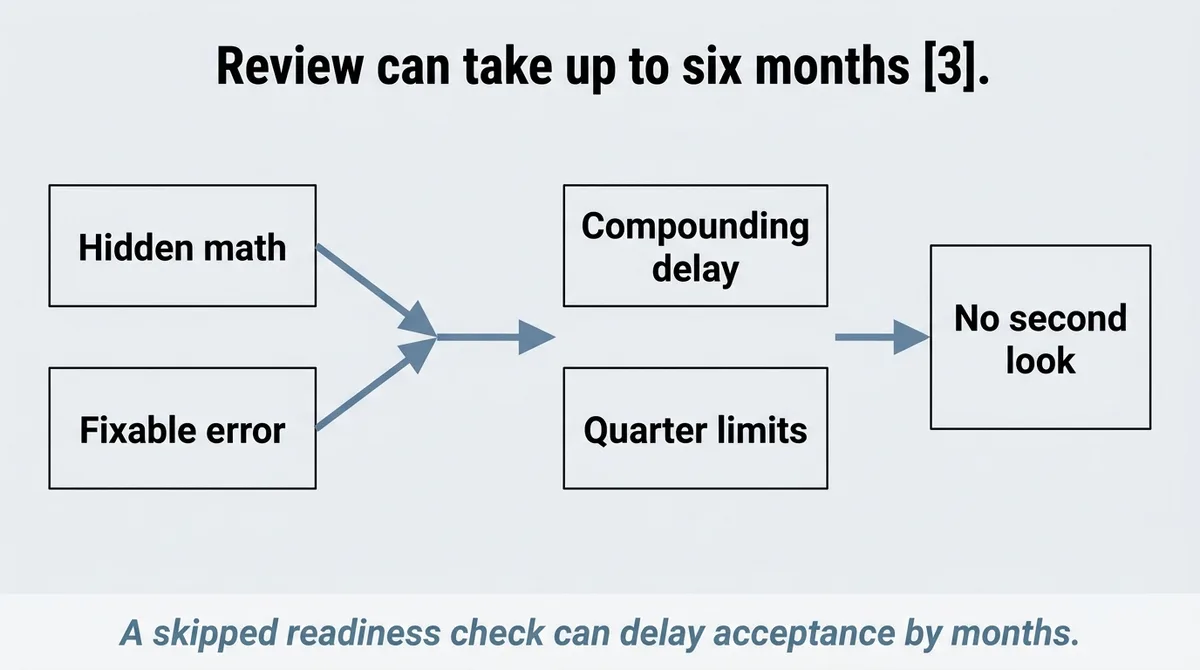
That is not a soft consequence. That is a compounding schedule problem.
Some structured editorial platforms select only six featured writers per quarter [3]. If your submission fails a compliance check, you do not get a second look until the next cycle. Four more months gone.
For columnists under contract, the math compounds further. A structured outlet may require a columnist to publish at least six articles within a contractual year [3]. Miss a submission window due to non-compliance, and you fall behind a schedule that does not flex.
Run this readiness check before every submission:
- Word count verified against outlet guidelines
- File format confirmed (not just saved, but confirmed against requirements)
- Author bio attached and within required length
- Keywords or tags included if required
- License terms read and accepted with full understanding
- Simultaneous submission policy checked (many outlets prohibit it)
- Abstract prepared if required
Most writers believe editorial review is the bottleneck. It is not. The bottleneck is the compliance step that happens before an editor ever opens the file. A rejected submission from a compliance failure means no editor read your argument, your structure, or your byline. The piece failed a checklist, not a quality bar.
One practical note: if you are submitting to an outlet that targets a defined demographic, read their editorial brief carefully. Some publish audience data directly. Knowing who reads the outlet shapes how you frame the piece, which reduces revision requests after acceptance.
Run the checklist once. It takes fifteen minutes. Missing it costs months.
What Happens After You Submit and What to Do While You Wait
Sending the submission is not the end of the process. It is the start of a defined waiting period with four possible outcomes.
Know each one before you submit, because each one requires a different next action.
Acceptance. Counter-sign any agreement, confirm publication timeline, and ask for the live URL once posted.
Acceptance with revisions. Read every note before responding. Respond with a revised file, not inline comments. Confirm whether the revision resets the publication queue.
Desk rejection. This means the piece did not reach peer or editorial review. The reason is almost always a compliance or fit issue, not content quality. Fix the specific problem and re-route to a better-matched outlet.
Peer or editorial rejection. You receive feedback. Use it. This is the most valuable outcome after acceptance. A piece that survives editorial review and gets rejected on substance is closer to publishable than most writers realize.
On route outcomes: if you selected an open-access channel in your Submission Route Matrix, the post-submission upside is measurable. Over 600 journals operate as fully open access [1]. Open-access articles receive 1.6 times more citations than subscription-gated equivalents [1]. Downloads run six times higher [1]. The average Altmetric attention score for open-access articles is 4.9, compared to 2.1 for subscription articles [1].
These numbers matter at the follow-up stage. They tell you whether an acceptance offer is actually favorable given your goals. An acceptance with restrictive license terms from a subscription-only outlet may deliver less measurable reach than an open-access placement with clean terms.
The Submission Route Matrix you built in step two determines which of these outcomes are even possible. A PDF distribution platform cannot offer citation tracking. A niche directory cannot offer Altmetric scores. The route shapes the ceiling.
On follow-up timing: most outlets expect no contact for at least four to six weeks after submission. After that window, one polite status inquiry is appropriate. One. Send it to the editorial contact named in the submission guidelines. Keep it to two sentences. State your name, the piece title, and the submission date.
Going passive after submission is the most common mistake in this stage. Set a calendar reminder for week five. Draft the follow-up note now, before you forget the submission date.
Your next submission should take half the time this one did
The four-stage sequence in this guide is not a framework for cautious writers. It is a production system for anyone who has lost time to a rejected submission they did not see coming.
Build the asset package before you approach any outlet. Run the Submission Route Matrix before you default to a channel. Complete the readiness checklist before you hit send. Then set a follow-up reminder and stay active in the process.
The writers who move faster are not the ones who skip steps. They are the ones who ran the sequence once, correctly, and internalized it.
Run it once. The second submission takes half the time.
References and Citations
[1]https://www.springernature.com/gp/authors/publish-an-article
[2]https://www.digivendtechnologies.com/blog/article-submission-websites/
[3]https://elitefts.com/pages/article-submission-services?srsltid=AfmBOopyvzT3wcmu6u-JTmi3I1ipoCkEIYe8T-HbFiTbAXQTxThC91iVk
FAQ
Before submitting an article, you need a complete asset package: your manuscript in the outlet’s required format, word count verified against their range, an author bio of roughly 50 to 100 words in third person, a headshot if required, any keywords or topic tags the platform requests, and a rights statement confirming you hold original copyright. Formatting failures and missing assets reject more pieces than weak writing does, so treat compliance as the gate rather than an afterthought. Completing this package before you approach any outlet is the single step that most reduces unnecessary rejections.
The most common reasons an article submission gets rejected before an editor reads it are formatting errors, word count mismatches, missing author bios, and unread license terms that disqualify the piece on compliance alone. Submitting a 700-word piece to a platform that requires 1,200 words triggers an automatic pass-over before any human evaluates the content. The bottleneck in most submission pipelines is the compliance step, not editorial quality, so a pre-submission readiness checklist prevents rejections that cost months of runway at structured outlets that review only quarterly.
There are eight main article submission channel types: general article directories, niche directories, guest posting sites, blog platforms, social publishing platforms, press-release networks, Web 2.0 sites, and PDF distribution platforms, each serving a different reach and risk profile. The right choice depends on your goal, your target audience, and the license terms each outlet imposes, not just its domain authority score. For teams publishing at scale, a platform like Zelitho that handles topic selection, draft generation, and direct CMS publishing reduces the operational overhead of managing submissions across multiple channels, keeping your publishing cadence consistent rather than stalled.
A perpetual irrevocable license means the outlet holds rights to your article indefinitely and you cannot retract it, resell it, or re-pitch it to a higher-authority outlet after submission. Perpetual means the license never expires, and irrevocable means you have no mechanism to cancel it even if the platform changes ownership or editorial direction. Choosing a channel based on domain authority alone without reading these terms is the most costly mistake at the route-selection stage, because it permanently limits what you can do with the piece.
Open-access articles receive 1.6 times more citations than subscription-gated equivalents, generate six times more downloads, and carry an average Altmetric attention score of 4.9 compared to 2.1 for subscription articles. More than 600 journals operate as fully open access, making them a measurable reach advantage when your goal is visibility rather than prestige gating. For content teams using a platform like Zelitho to produce research-backed, citation-supported articles at volume, routing finished pieces to open-access channels is a practical way to maximize return on each published article.