
How to Cite ChatGPT Output Correctly

TL;DR
You opened a document, pasted a ChatGPT response, and now a reviewer is asking where the citation goes. Most style guides updated their rules in 2023, but finding a clear format still takes longer than it should.
The common mistake is trusting ChatGPT to cite its own sources. Research shows GPT-4 gets 4 to 5 of 6 citation elements right on average [2]. Authors and page numbers are the fields that break most often.
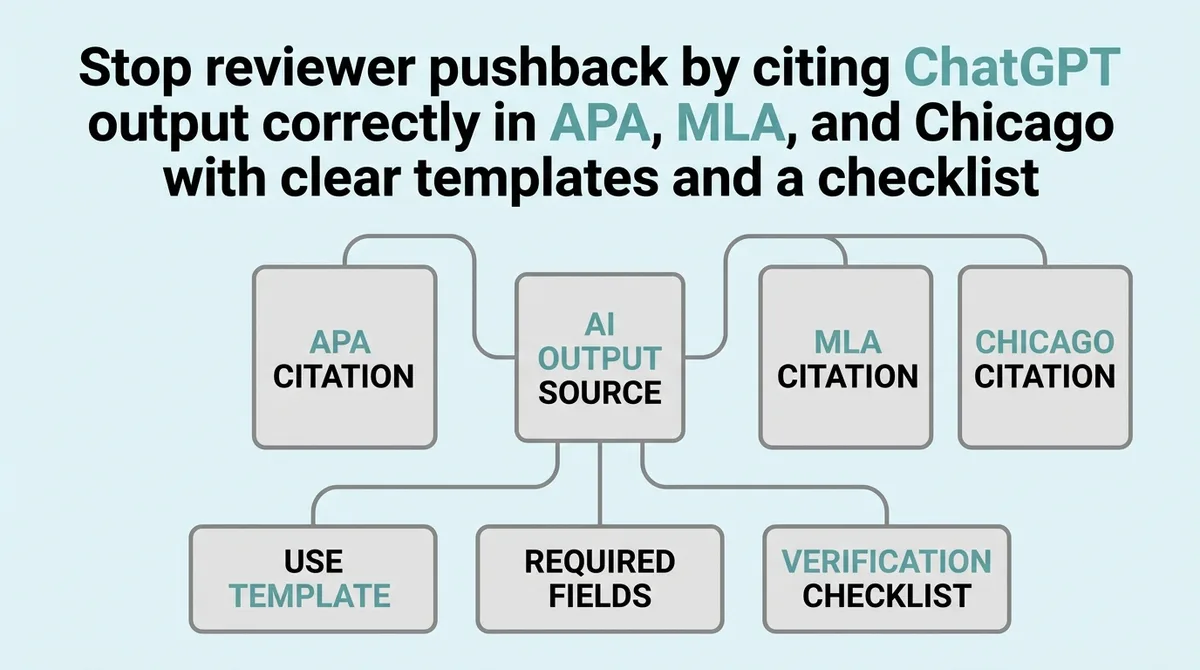
This guide gives you the four required fields every AI citation needs, side-by-side style templates for APA, MLA, and Chicago, a verification checklist for any citation ChatGPT generates about other sources, and the placement rules most guides skip. Academic writers, students, and content professionals who cite AI output will finish this with a working citation and a process they can repeat.
What format do I use to cite ChatGPT in APA, MLA, or Chicago?
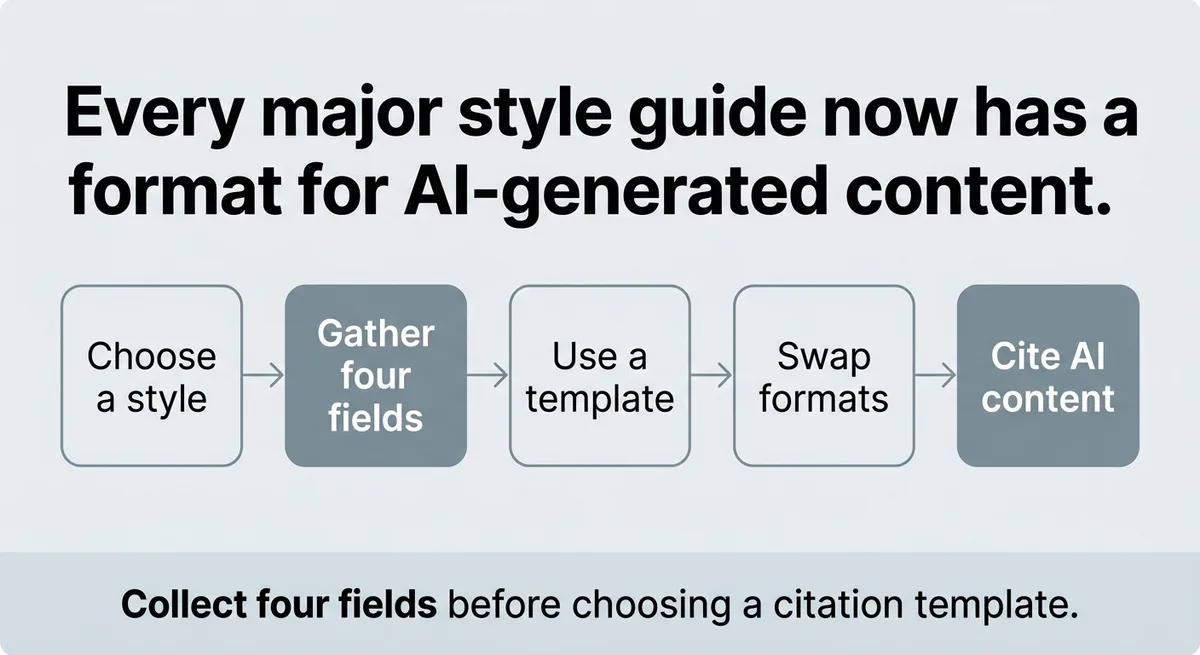
Every major style guide now has a format for AI-generated content. The required elements are consistent across APA, MLA, and Chicago: an author label, a date, a version identifier, and a source location. Collect those four fields before you pick a style template, and filling in any format becomes a straightforward swap.
What Every Citation of ChatGPT Output Must Include Before You Pick a Style
A citation of ChatGPT output is not the same as citing a webpage or a book. The source is a generative system, not a stable document. That distinction changes what fields you need.
Four fields appear in every style guide that has addressed AI content [1][3]:
1. Author or creator label ChatGPT is the name of the system. OpenAI is the organization behind it. Both appear in citations, though the order varies by style.
2. Date of the output This is the date you received the response, not a publication date. The output you got on March 14 is different from what someone else got on a different day. Style guides such as APA specify the exact date [1].
3. Version or model GPT-4 and GPT-3.5 produce different outputs. Record the version you used. OpenAI displays this in the interface during your session.
4. Source location For ChatGPT, this is the URL of the conversation if you have a shareable link, or a description of the platform if you do not. APA uses the URL. MLA uses a description of the prompt [3].
Collect all four before you open your style guide. Missing one field means going back to the session later, and that session may no longer be retrievable.
One practical note: keep a running log in a plain text file as you work. Paste the response, note the date, note the model version, and save the URL if the interface generates one. This takes 30 seconds per session and prevents citation reconstruction later.
Stop copying ChatGPT responses without logging the session metadata. Start treating each AI interaction like a source you will need to defend in a review.
APA, MLA, and Chicago Templates Side by Side With Filled Examples
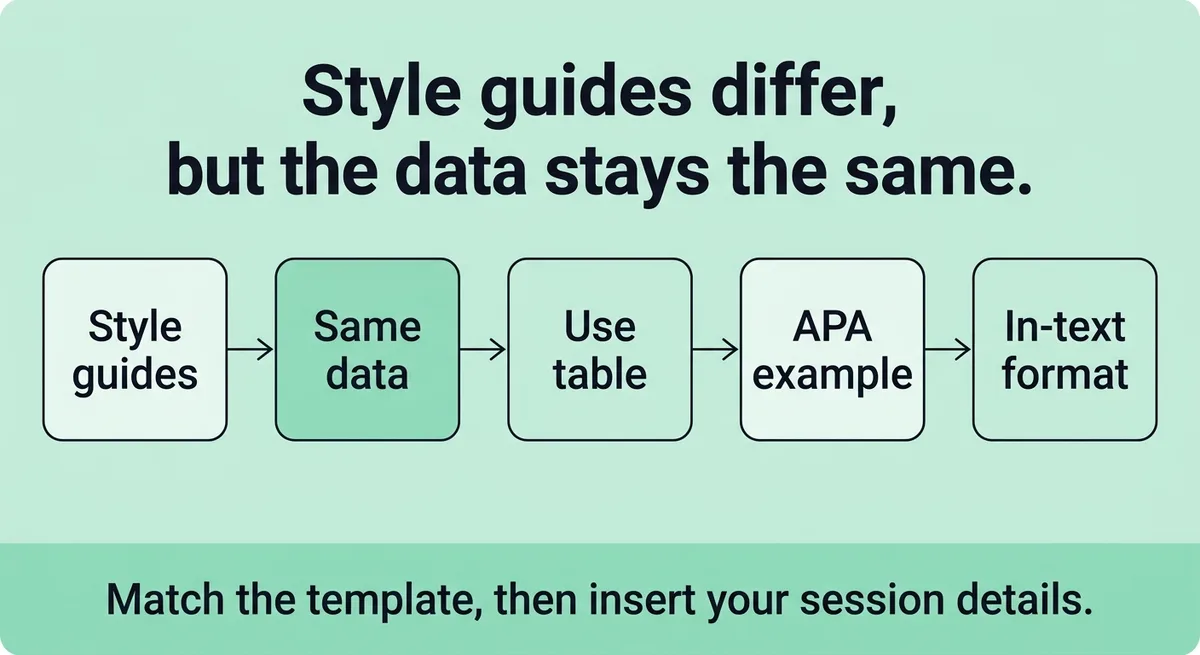
Style guides differ mostly in punctuation and field order [3]. The underlying data is the same. Use the table below to match your required format, then fill in your session details.
Style | Reference List Format | In-Text Format |
|---|---|---|
APA | OpenAI. (2024, January). ChatGPT (GPT-4) [Large language model]. https://chat.openai.com | (OpenAI, 2024) |
MLA | “Describe the nature of the output.” ChatGPT, version GPT-4, OpenAI, 2 March 2023, chat.openai.com. | (OpenAI) |
Chicago (Notes) | OpenAI, “ChatGPT,” GPT-4, response generated March 14, accessed [your access date], https://chat.openai.com. | Footnote with full entry on first use |
Two major citation styles, APA and MLA, handle AI authorship differently [3]. APA treats OpenAI as the corporate author. MLA places the prompt description first because MLA prioritizes the reader’s access point, not the creator.
Filled APA example: OpenAI. (2024, January). ChatGPT (GPT-4) [Large language model]. https://chat.openai.com
Filled MLA example: “Summarize the key arguments in favor of open-source AI development.” ChatGPT, version GPT-4, OpenAI, 2 March 2023 [1], chat.openai.com.
Filled Chicago example: OpenAI, “ChatGPT,” GPT-4, response generated March 14 [1], accessed April 3, 2024, https://chat.openai.com.
MLA lists at least five example categories for AI-generated content in current guidance, covering direct quotation, paraphrase, a specific prompt, a general tool description, and image generation [3]. If your use case falls outside a direct text response, MLA gives you the most granular options.
Chicago footnote style suits long-form academic writing where the same source gets cited repeatedly. The first footnote carries the full entry. Subsequent footnotes use a shortened form: OpenAI, “ChatGPT,” GPT-4.
Why You Cannot Let ChatGPT Cite Its Own Sources Without Checking Every Field
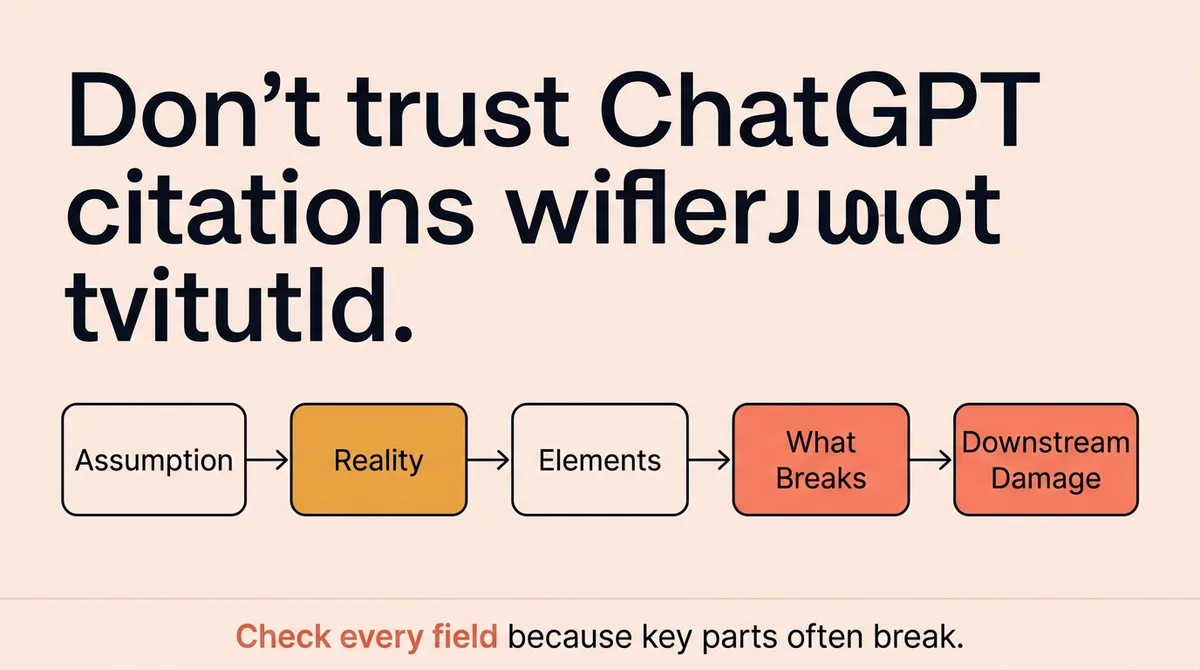
Here is the assumption that causes the most downstream damage: if ChatGPT can write a citation, that citation is ready to use.
It is not.
GPT-4 gets 4 to 5 of 6 standard citation elements correct on average [2]. The six elements are authors, journal name, article title, volume, page numbers, and DOI [2]. That sounds adequate until you look at which fields break.
Author names are frequently wrong or invented [2]. Page numbers and volume numbers are often incorrect [2]. The DOI is more likely to be accurate, but a correct DOI attached to a wrong author is still a fabricated citation [2].
GPT-3.5 and earlier models performed worse. They rarely produced fully accurate scientific citations [2]. GPT-4 improved the accuracy rate, but the failure pattern stayed the same: surface fields like title and journal name look right, while the fields that require precise indexing data break quietly.
A real scenario: a graduate researcher used ChatGPT to generate a bibliography for a literature review. The DOIs checked out on first pass. The faculty reviewer caught three author names that did not match the actual papers those DOIs pointed to. The researcher had to reconstruct the entire section. That cost roughly six hours of rework on citations that took 20 minutes to generate.
The verification step is not optional. Run it before you submit or publish anything that includes AI-generated citations about other sources.
Verification checklist for any ChatGPT-generated citation:
- Search the DOI in a database such as CrossRef. Confirm it resolves.
- Open the actual paper or source. Match the author names field by field.
- Check the volume and page numbers against the resolved document.
- Confirm the journal title matches the database entry exactly.
- Check the publication year against the source record.
- If any field does not match, pull the citation data directly from the database instead of from the ChatGPT output.
This checklist takes two to four minutes per citation. That is the correct trade-off against submitting fabricated source data.
The sharpest way to state this: ChatGPT is useful for formatting a citation you already verified. It is not a substitute for the verification itself.
That verification gap is the same reason AI-written blog content struggles to earn real citations in AI search: a fluent draft with unverified sources doesn’t hold up any better than a fabricated academic citation does. Zelitho builds the research step in before the writing step — pulling real, checkable sources first, then drafting from them — so the citations inside the published article are grounded from the start instead of needing a separate verification pass after the fact.
The Citation Placement Rule Most Guides Skip: Where AI Attribution Actually Goes in Your Work
Getting the fields right is one problem. Placing the citation correctly is a separate one.
Most style guides address reference list formatting in detail. Fewer are explicit about where AI attribution appears within the body of your work.
The rule across APA, MLA, and Chicago follows the same logic as any other source [1]. Two placements are required:
In-text attribution appears at the point of use. If you quote or paraphrase ChatGPT output, the in-text marker goes at the end of the sentence or passage, before the period in MLA and after in APA.
The reference list entry appears at the end of the document. Every in-text marker must correspond to a full entry in your references, works cited, or bibliography section.
Where writers most commonly skip a step: they add the reference list entry and skip the in-text marker, or they attribute AI use in a footnote without a corresponding entry. Both leave gaps that reviewers and editors catch.
For paraphrased AI output in APA [1], the in-text form is: (OpenAI, 2024)
For a direct quote, APA recommends including the date: (OpenAI, 2024, January)
MLA does not use page numbers for AI output because there are no stable pages [3]. The in-text marker is the author name alone: (OpenAI)
Chicago places the full citation in a footnote on first reference. Subsequent references use a short form. If you use Chicago author-date style rather than notes, the in-text format mirrors APA: (OpenAI 2024).
One implementation detail that matters in professional publishing: some journals and institutions require a disclosure statement in addition to a standard citation. This is separate from the reference list entry. Check submission guidelines before you finalize your document. A citation in the reference list does not automatically satisfy a disclosure requirement if the journal specifies a separate AI use statement.
Place the in-text marker first. Build the reference list entry from the same four fields. Confirm the two entries match before submitting.
The four fields that make every AI citation usable
Every format covered here runs on the same four fields: author label, output date, model version, and source location. Collect those before you choose a style template.
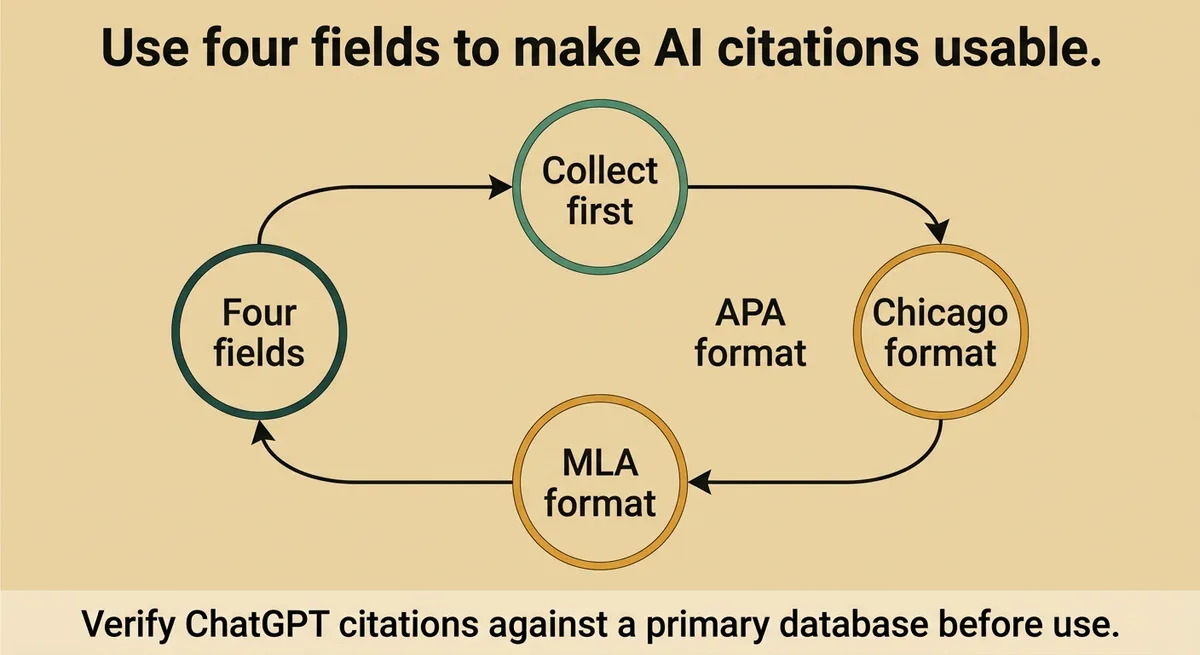
APA uses OpenAI as corporate author and requires the exact date [1]. MLA starts with your prompt description and notes the date of the response [1]. Chicago uses footnotes and shortens on repeat references.
ChatGPT-generated citations about other sources need verification against a primary database before use [2]. GPT-4 accuracy on citation elements sits at 4 to 5 of 6 fields on average, with author names and page numbers as the fields most likely to be wrong [2].
In-text attribution and the reference list entry are both required. One without the other is an incomplete citation.
Run the four fields. Pick your style. Verify anything ChatGPT cites about other sources field by field.
References and Citations
[1]https://saddleback.libanswers.com/faq/419943
[2]https://community.openai.com/t/can-chatgpt-respond-with-citations/23744
[3]https://tamu.libguides.com/c.php?g=1289555&p=9679433
FAQ
Every major style guide requires the same four fields to cite ChatGPT output: an author or creator label (ChatGPT and OpenAI), the exact date you received the response, the model version used (such as GPT-4), and a source location such as a shareable URL or platform description. These four fields stay constant regardless of which style guide you are using; only the punctuation and field order change between APA, MLA, and Chicago. Collect all four before you open your style template, because missing one field often means returning to a session that may no longer be retrievable.
No, you cannot rely on ChatGPT-generated citations without manual verification: GPT-4 gets 4 to 5 of 6 standard citation elements correct on average, with author names and page numbers being the fields most likely to be fabricated or wrong. Surface fields like journal title and DOI often look correct while the author name attached to that DOI does not match the actual paper. The safest practice is to use ChatGPT only to format a citation you have already verified against a primary database such as CrossRef, never as a substitute for that verification.
APA treats OpenAI as the corporate author and places it first, requires the exact date of the output, and uses the conversation URL, while MLA places your prompt description first because MLA prioritizes the reader’s access point over the creator. In APA the in-text citation reads (OpenAI, 2024), whereas MLA uses (OpenAI) alone because AI output has no stable page numbers. Chicago footnote style differs from both by placing the full citation in a footnote on first reference and using a shortened form, such as OpenAI, ‘ChatGPT,’ GPT-4, on subsequent references.
The in-text citation for ChatGPT output goes at the end of the sentence or passage where you quote or paraphrase the AI response, and a matching full entry must also appear in your reference list, works cited section, or bibliography. The most common mistake is adding the reference list entry but omitting the in-text marker, or attributing AI use only in a footnote without a corresponding reference list entry. In APA the in-text form is (OpenAI, 2024); in MLA it is (OpenAI); in Chicago notes style it is a full footnote on first use and a short form on repeat references.
A repeatable process starts with a plain-text session log: paste the AI response, record the exact date, note the model version, and save the shareable URL immediately after each session, before the window closes. This 30-second habit per session prevents the citation reconstruction that can cost hours later when sessions are no longer retrievable. For teams producing blog content at scale, platforms like Zelitho that generate research-backed drafts with citations built into the workflow reduce the gap between content creation and source accountability, since citation metadata is tracked alongside the draft rather than assembled after the fact.