
What Is the APA Citation Format for ChatGPT?

TL;DR
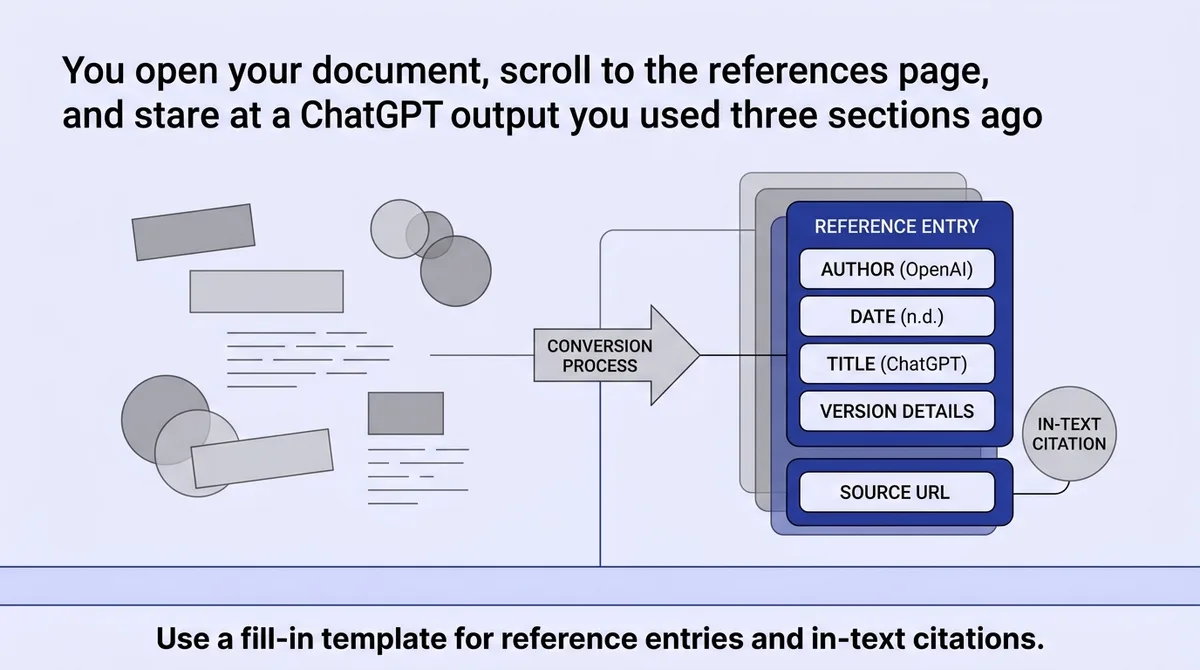
You open your document, scroll to the references page, and stare at a ChatGPT output you used three sections ago. You know you need to cite it. You type something that looks plausible and move on.
Most people borrow a citation format from a blog post that has not been checked against the actual APA manual. The result is a reference entry that mixes full dates with year-only rules, drops the version number, or points to the wrong URL.
APA citation for ChatGPT follows four core elements: author, date, title with version, and source URL. The reference entry and the in-text citation are two separate formats with different rules. This guide gives you a fill-in template for each format. It is written for students, researchers, and content professionals who need a correct entry on the first attempt, not a guess they have to fix later.
What is the correct APA citation format for ChatGPT?
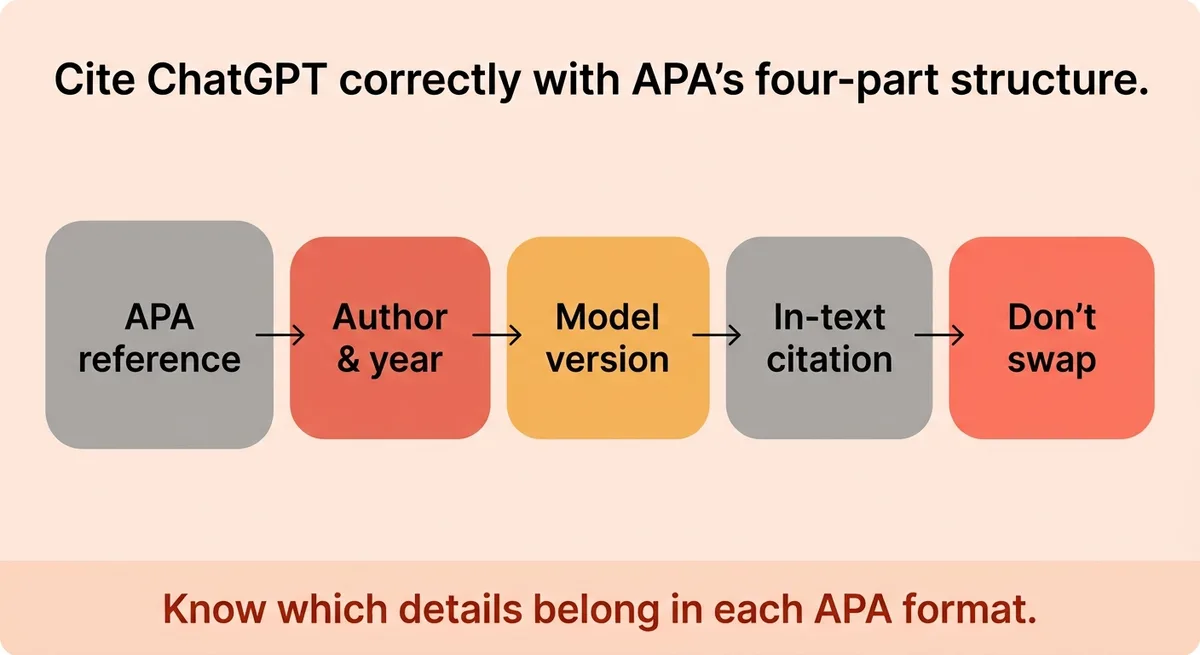
The APA format for citing ChatGPT uses a four-part structure: author (OpenAI), year of the conversation, a titled description with the model version in parentheses, and the source URL pointing to the tool. The reference entry and the in-text citation follow different rules and cannot be swapped or shortened into each other. Getting both formats right requires knowing which details belong in each and in what order.
The Four-Part APA Reference Entry Template for ChatGPT
Stop guessing at the order. The reference entry has exactly four positions, and each one carries a specific piece of information.
APA reference format includes author, date, title, version in parentheses, a bracketed description, and source [3]. That structure comes from Section 10.10 of the 2020 APA manual, which governs software reference templates [3]. ChatGPT fits that category because it is a software-based tool, not a webpage or a journal article.
Here is the fill-in template:
OpenAI. (YEAR). ChatGPT (MODEL VERSION) [Large language model]. https://chat.openai.com/chat
Each bracket below maps to a real decision:
Position | What Goes Here | Common Mistake |
|---|---|---|
Author | OpenAI | Listing the chatbot as the author |
Date | Year only, in parentheses | Writing the full date with month and day |
Title + Version | ChatGPT (GPT-4), for example | Omitting the version number entirely |
Source | Using the OpenAI homepage instead |
The model version belongs in parentheses directly after the title, before the bracketed description [3]. A published APA example uses a Feb 13 version label in one entry and a Mar 14 version label in another. The specific version name goes in the title field, not the date field [1].
The cited URL for the tool is https://chat.openai.com/chat, not the general OpenAI domain [3]. That distinction matters because the reference must point to the actual interface where the content was generated.
A filled-in example for a GPT-4 conversation from 2023 looks like this:
OpenAI. (2023). ChatGPT (GPT-4) [Large language model]. https://chat.openai.com/chat
One implementation caveat: if you used GPT-3.5, the version label changes accordingly. The structure stays identical. Only the version name inside the parentheses changes.
How to Write the In-Text Citation Separately from the Reference
The in-text citation is not a shortened version of the reference entry. That assumption causes the most consistent formatting errors.
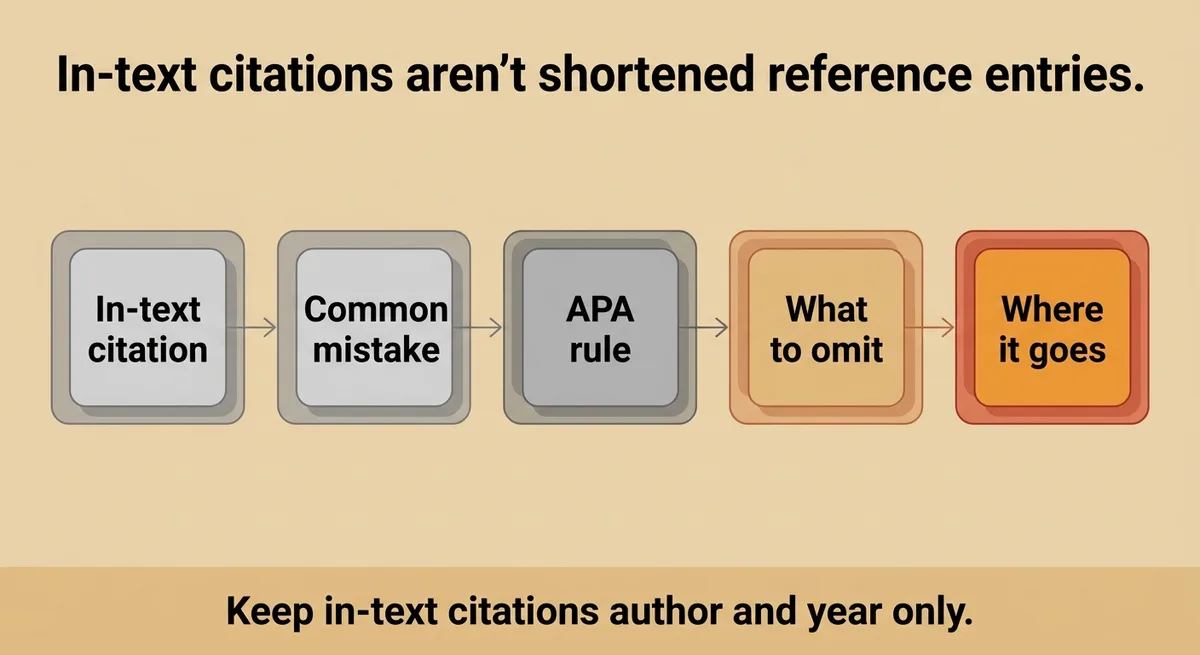
For APA, the in-text citation uses the author name and year only. It does not include the model version, the URL, or the bracketed description [1]. Those elements live exclusively in the reference list at the end of the document.
The format looks like this:
(OpenAI, 2023)
That is the complete in-text citation. Nothing else belongs there.
A real-world APA example uses a 2023 reference for ChatGPT, confirming that the year is the only date element carried into the in-text format [1]. Some writers try to add the version number or a date range inside the parentheses. That is incorrect under APA rules.
Place the in-text citation at the end of the sentence where you reference the ChatGPT output, before the period. If you mention OpenAI by name in the sentence itself, drop the author from the parentheses and keep only the year.
Example with author named in sentence:
OpenAI’s ChatGPT generated an outline that organized the argument into three sections (2023).
Example without author named:
The outline organized the argument into three sections (OpenAI, 2023).
Both are correct. The rule is that the in-text citation must match the first element of the corresponding reference entry. Because the reference entry starts with “OpenAI,” the in-text citation always uses “OpenAI” as well.
Stop trying to compress the reference entry into the parentheses. Start treating the in-text citation as a pointer, not a summary.
You Probably Think a Full Date Belongs in the Citation , It Does Not
This is the false assumption most people carry into the format: that because ChatGPT conversations happen on a specific day, that specific day should appear in the citation.
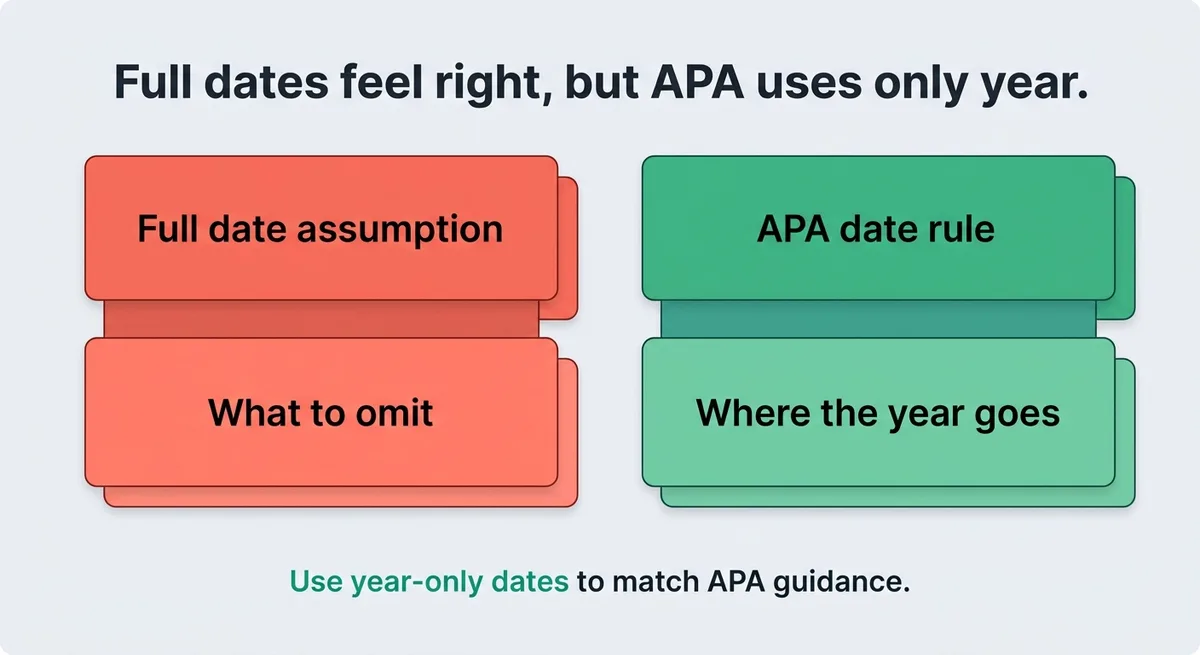
APA uses only the year for the date element, not the full date [3]. The year goes inside parentheses immediately after the author. The month and day do not appear anywhere in either the reference entry or the in-text citation.
Section 10.10 of the 2020 APA manual provides the basis for this rule [3]. Software references, which ChatGPT falls under, follow year-only date formatting. This differs from formats like MLA, which uses a full access date such as “10 Mar. 2026,” or Chicago, which records a date like March 31, 2023 [1]. The formats are not interchangeable.
Here is why this matters in practice: a student submitting to a journal that requires APA style will have their citation flagged if a full date appears in the reference entry. A content team building a source list for a published report faces the same issue. The correction takes seconds once you know the rule, but the mistake is invisible until a reviewer catches it.
The correct date field looks like this:
(2023)
Not “(March 14, 2023).” Not “(2023, March 14).” Just the year.
One detail that causes confusion: APA does allow you to note the specific version of ChatGPT you used, and that version label may contain a date-like string. A reference entry citing the Mar 14 version, for example, places that label inside the title parentheses, not in the date field [1]. The two positions serve different purposes. The date field tells the reader when the content was generated. The version label tells the reader which model produced it.
Keep those two pieces of information in their assigned positions. Moving either one breaks the format.
When to Cite ChatGPT Formally Versus When a Disclosure Note Is Enough
Not every use of ChatGPT requires a full APA reference entry. Knowing the difference saves you from over-citing work that does not need it and under-citing work that does.
A full APA citation applies when you directly quote or closely paraphrase content that ChatGPT generated and that content appears in an academic paper, formal report, or published document with a reference list [1]. If the output is reproduced as evidence, as a source of information, or as the basis for a claim you are making, cite it with the full four-part format.
A disclosure note is enough when you used ChatGPT as a drafting or editing tool rather than as a source. If you asked it to rewrite a paragraph you wrote, suggest a headline, or check grammar, you are not citing a source. You are disclosing a process. In those cases, a brief acknowledgment in a methods section, author note, or footer handles the requirement [1].
The practical test is this: could the reader need to verify or trace what ChatGPT said? If yes, use the full citation. If the reader only needs to know that AI assisted in the work process, use a disclosure note.
Some academic institutions and journals have added their own rules on top of APA guidelines. Check the specific submission requirements before assuming APA alone is sufficient. A journal may require disclosure regardless of whether the content is cited, or it may prohibit AI-generated content entirely.
A common mistake is citing every instance of ChatGPT use with a full reference entry out of caution. That approach clutters the reference list and signals to reviewers that the writer does not understand the distinction between a source and a tool. Cite the output. Disclose the process. The two are not the same action.
The Exact Citation Details That Separate a Correct APA Entry from a Rejected One
The four-part structure is not negotiable: author, year, title with version, source URL. Each position carries one piece of information, and none of them double up.
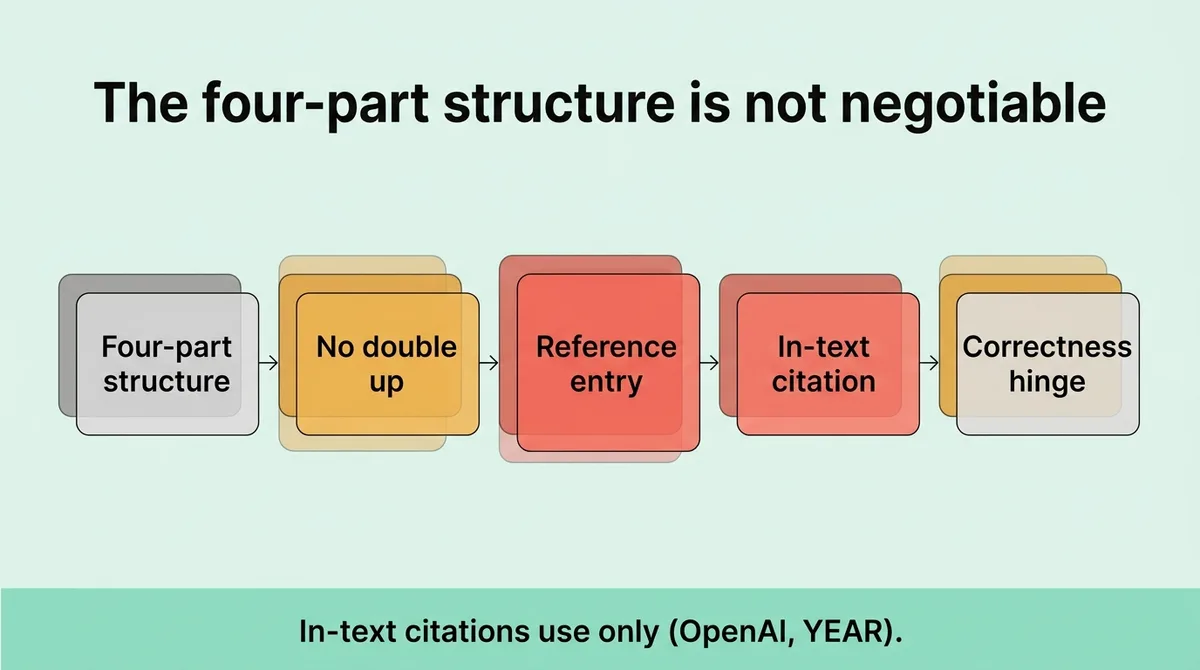
The reference entry uses “OpenAI” as the author, the year only in the date field, the model version inside parentheses after the title, the bracketed label “[Large language model]” after the version, and the URL https://chat.openai.com/chat as the source [3]. The in-text citation uses only “(OpenAI, YEAR)” and nothing else [1].
Getting one position wrong does not ruin the meaning of the citation. It does flag the entry for correction in any peer-reviewed or formally evaluated document. The version number tells the reader which model generated the content. The year-only date follows the software template from the APA manual. The specific URL points to the tool itself, not the company’s main site.
Two separate formats. Four fixed positions. One URL. Get those details in the right place, and the citation passes review.
References and Citations
[1]https://guides.lib.purdue.edu/c.php?g=1371380&p=10135074
[2]https://saddleback.libanswers.com/faq/419943
[3]https://guides.franklin.edu/APA/chatgpt
FAQ
The correct APA reference entry for ChatGPT follows this template: OpenAI. (YEAR). ChatGPT (MODEL VERSION) [Large language model]. https://chat.openai.com/chat. The four required positions are author (OpenAI), year only in parentheses, title with model version in parentheses, and the specific tool URL, not the general OpenAI homepage. This structure comes from Section 10.10 of the 2020 APA manual, which governs software references.
APA citations for ChatGPT use the year only, never the full date with month and day. The date field in both the reference entry and the in-text citation contains only the four-digit year inside parentheses, such as (2023). If a specific version label includes a date-like string, that label belongs inside the title parentheses after the model name, not in the date field.
The APA in-text citation for ChatGPT is simply (OpenAI, YEAR), placed at the end of the sentence before the period. It does not include the model version, the URL, or the bracketed description; those elements belong only in the reference list. If you name OpenAI in the sentence itself, drop it from the parentheses and use only the year, for example: OpenAI’s ChatGPT generated the outline (2023).
Use a full APA citation when you directly quote or closely paraphrase ChatGPT output that appears as evidence or a source of information in an academic paper, formal report, or published document with a reference list. A brief disclosure note in a methods section or author note is sufficient when ChatGPT was used only as a drafting or editing tool and the reader has no need to trace or verify what it said. The practical test is whether the reader could need to verify the specific output; if yes, cite it formally. For teams producing structured, research-backed blog content at scale, platforms like Zelitho generate articles with citations built in, which reduces the manual work of source attribution across large content pipelines.
The correct URL for an APA ChatGPT citation is https://chat.openai.com/chat, not the general OpenAI homepage at openai.com. The reference must point to the actual interface where the content was generated, so using the homepage breaks the format and can cause the entry to be flagged in a formal review. For content teams managing many cited sources across multiple articles, Zelitho’s workflow includes citation handling during draft generation, which keeps source URLs accurate and consistently formatted without requiring a manual check on every entry.