
LinkedIn’s “Seems Like AI Slop” Button, Explained: What We Know, What We Don’t, and What It Means for Creators

TL;DR
LinkedIn has rolled out a new “Seems Like AI Slop” reporting option, and it’s already fueling reach-panic across the creator community. Here’s what’s actually confirmed: reported posts may see reduced distribution – similar to a “Not Interested” signal – and the original poster may get a private notification in their analytics dashboard. LinkedIn has also called reducing AI slop a top product priority and is quietly retiring its own AI rewrite tool.
What’s not confirmed: permanent AI penalties, an account-level “AI score,” or that using ChatGPT alone hurts your reach. Most of the scarier claims circulating online are speculation, not fact.
The bigger story isn’t about AI detection at all – it’s about how every major platform (Google, YouTube, LinkedIn, ChatGPT, Perplexity) is converging on the same goal: recommending content that’s genuinely useful, not just well-written. This article separates the confirmed facts from the noise, and explains what that shift means for how you should be creating content going forward.
What Just Happened on LinkedIn
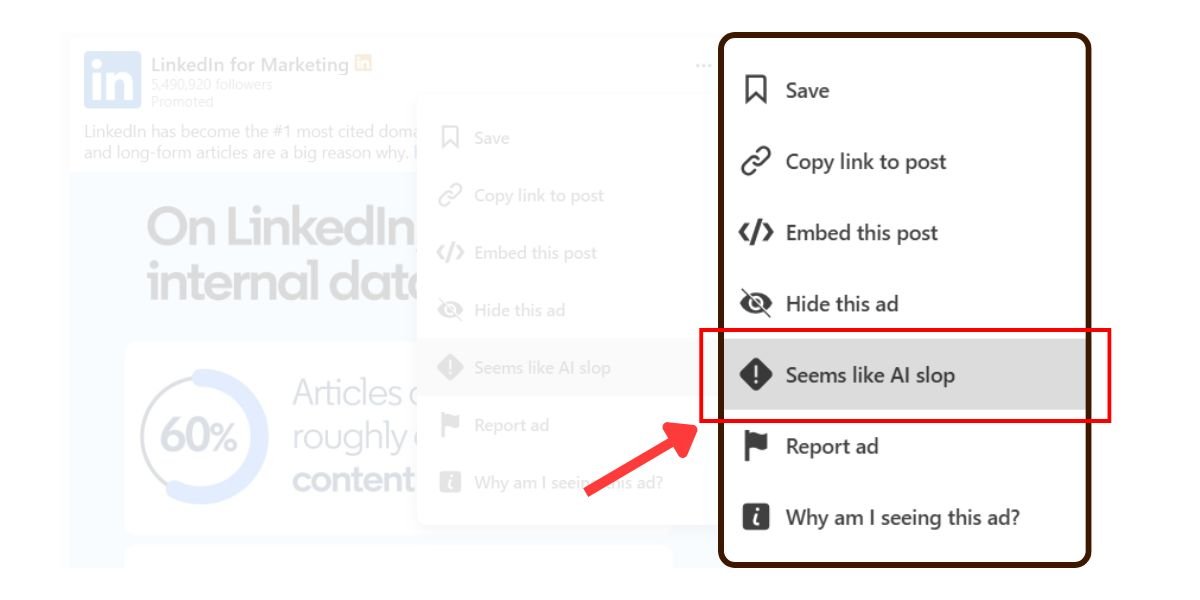
A few days ago, LinkedIn quietly introduced a new reporting option called “Seems Like AI Slop.” Hidden inside the Report Post menu, the feature lets users flag content they believe is generic, low-quality, or overly AI-generated (TechCrunch).
The reaction was immediate. Within hours, creators were asking:
- Does LinkedIn now penalize AI-generated content?
- Will using ChatGPT reduce my reach?
- Can competitors report my posts to hurt my visibility?
- Should I stop using AI to write on LinkedIn altogether?
Unfortunately, a lot of the answers circulating online were based on assumption, not evidence.
That’s not unusual. Every major platform update follows a similar pattern: an announcement lands, screenshots start circulating, theories spread across social feeds, and within a day or two, speculation starts sounding like established fact.
That’s exactly why this article exists – to separate what LinkedIn has actually confirmed from what the internet has decided to believe.
What LinkedIn Has Officially Confirmed
As of August 2026, LinkedIn has confirmed several specific details about the feature through statements reported by multiple outlets.
| ✅ Confirmed by LinkedIn | 🤔 Frequently Assumed Online |
|---|---|
| Users can report posts using a “Seems Like AI Slop” option. | LinkedIn can perfectly detect AI-written content. |
| Reported posts may receive reduced distribution, similar to a “Not Interested” signal (Engadget). | Every reported post automatically loses reach. |
| Creators may be notified in their analytics dashboard if their content is flagged (Engadget). | Accounts receive a permanent “AI score.” |
| LinkedIn’s Chief Product Officer has described reducing AI slop as a top product priority (TechCrunch). | Using ChatGPT automatically violates LinkedIn’s guidelines. |
| LinkedIn is replacing its AI rewrite tool with a lighter proofreading feature (Engadget). | LinkedIn is completely against AI-assisted writing. |
Notice the difference between the two columns.
The left side traces directly back to LinkedIn or its spokespeople. The right side reflects ideas that spread rapidly across creator communities, but were never actually confirmed.
That distinction matters. In algorithm discussions, assumptions have a habit of becoming “accepted truth” long before there’s real evidence behind them.
What We Still Don’t Know
LinkedIn has confirmed the feature exists and that it can influence distribution. But several important mechanics remain unpublished.
| Open Question | Current Status |
|---|---|
| How many reports are required before reach is affected? | Not publicly confirmed |
| Does every single report reduce visibility? | Not publicly confirmed |
| Are reports reviewed by a human at any stage? | Not publicly confirmed |
| Does this apply to LinkedIn Articles and Newsletters, or just posts? | Not publicly confirmed |
| How heavily does this signal weigh against other ranking factors? | Unknown |
These gaps are exactly why so much speculation exists. The feature is real. Its purpose is real. But many of the finer mechanics are still unknown – and that’s fairly normal.
No major platform hands out a full blueprint of its ranking system. Google doesn’t disclose every search signal. YouTube doesn’t publish every recommendation factor. LinkedIn is unlikely to be the exception. The important thing is knowing exactly where confirmed information ends, and where interpretation begins.
This Isn’t Really About AI – It’s About Recommendation Systems
Most conversations about this feature start with the same question: “Can LinkedIn detect AI-generated content?”
It’s an understandable question. It’s just not the most useful one.
A better question is: “How does LinkedIn decide what deserves to be recommended?”
Those are two very different problems. One is about how content was created. The other is about whether it creates value for the reader.
Recommendation systems don’t exist to reward or punish specific writing tools – they exist to decide which tiny fraction of today’s content deserves someone’s limited attention. That’s true for LinkedIn. It’s true for YouTube. It’s true for Google. And it’s increasingly true for AI-powered search tools like ChatGPT, Perplexity, and Gemini.
Every one of these platforms is facing the same underlying challenge: there is now far more content published than anyone could ever consume. When publishing becomes almost effortless, distribution – not creation – becomes the real bottleneck.
The difficult question is no longer “can people create content?” It’s “which content actually deserves to be recommended?”
Viewed through that lens, LinkedIn’s new reporting feature makes a lot more sense. The company likely isn’t trying to identify whether ChatGPT wrote a specific paragraph – it’s gathering another signal to help figure out whether readers actually found that content valuable. That’s a recommendation problem, not an AI-detection problem.
AI Didn’t Create the Problem. It Accelerated It.
One reason the phrase “AI slop” is misleading is that it implies AI itself is the root problem. It probably isn’t.
Long before ChatGPT existed, LinkedIn already had repetitive motivational posts, recycled career advice, and engagement bait. AI didn’t invent generic content – it just made it dramatically cheaper to produce.
Today, almost anyone can generate a polished-looking LinkedIn post in under a minute. But polished language isn’t the same thing as original thinking. Experience still takes years. Expertise still takes years. Judgment still takes years.
AI can help organize ideas, tighten grammar, and improve clarity. It can’t replace the lived experience that makes those ideas worth reading in the first place.
That’s why the real scarcity on today’s internet isn’t content. It’s insight.
The Question Every Creator Should Be Asking
Imagine two LinkedIn posts landing in your feed tomorrow.
The first was drafted with AI. A founder shares the biggest product mistake they made this year – real numbers, uncomfortable lessons, practical takeaways. AI simply helped structure and clarify the writing.
The second was written entirely by a human, no AI involved. It opens with “Nobody talks about this enough…” and lists five generic productivity lessons that have already appeared thousands of times before.
Which post deserves to reach more people?
For most readers, the answer is obvious. The value of content isn’t determined by who or what, typed the words. It’s determined by whether someone learns something they didn’t already know.
That’s a much harder thing for a recommendation system to measure. It’s also a far more useful thing to optimize for.
What This Means for Creators
If you’re a creator, founder, or marketer, the biggest takeaway here isn’t “stop using AI.” It’s that AI stopped being a competitive advantage a while ago.
For the past couple of years, much of the conversation has revolved around whether AI should be used at all. That debate is quickly becoming outdated, most professionals already use AI somewhere in their workflow, whether it’s brainstorming, editing, research, or outlining.
The real question is no longer “did you use AI?” It’s “did you contribute something only you could have contributed?”
That’s the difference between publishing content and publishing expertise.
A Simple Framework for Using AI Responsibly
Instead of debating whether AI is “good” or “bad,” it’s more useful to think about which parts of the creative process should stay human.
| AI Is Great For… | Humans Should Own… |
|---|---|
| Organising messy notes | Original opinions |
| Improving grammar and clarity | Personal experience |
| Brainstorming ideas | Professional judgement |
| Summarising research | Critical thinking |
| Finding gaps in an argument | Unique insights |
| Structuring long-form content | Stories, experiments, and lessons |
When AI supports your thinking, it becomes a genuinely useful tool. When AI replaces your thinking, your content starts sounding like everyone else’s and that’s where the real risk lives, “Seems Like AI Slop” button or not.
Why This Matters Far Beyond LinkedIn
Although this article is framed around LinkedIn, this isn’t really a LinkedIn story. It’s part of a much larger shift happening across the internet.
Every major recommendation system is trying to solve the same problem:
- Google wants to recommend the most helpful pages.
- YouTube wants to recommend the most engaging videos.
- ChatGPT and Perplexity want to cite the most trustworthy sources.
- LinkedIn wants to recommend the most valuable professional content.
Different platforms, different interfaces, the same underlying challenge: when millions of pieces of content are published every day, recommendation systems have to make hard decisions about what actually deserves attention.
That’s why it’s worth shifting how you think about optimization. Instead of optimizing exclusively for keywords, algorithms, or AI tools, optimize for the one thing every recommendation system is ultimately trying to identify: would this content genuinely help someone?
If the answer is yes, you’re already moving in the same direction as the platforms themselves.
What This Means for AI Search Visibility
At Zelitho, we spend a significant amount of time studying how recommendation systems surface content – not just in Google, but across ChatGPT, Claude, Gemini, and Perplexity.
One pattern keeps showing up: the algorithms may differ, but they’re increasingly rewarding the same qualities – original expertise, first-hand experience, helpful explanations, clear structure, credible sources, and content that actually answers real questions.
In other words, the future isn’t about producing more content. It’s about creating content that deserves to be recommended.
That’s the idea behind AI Search Visibility. Traditional SEO focused on helping websites rank in search engines. AI Search Visibility focuses on helping your content become a source AI assistants trust enough to reference and recommend directly.
As AI becomes a bigger part of how people discover information, that distinction is only going to matter more.
Want to understand how visible your website actually is across AI platforms? Zelitho helps businesses analyze, improve, and grow their visibility across AI search engines like ChatGPT, Gemini, Claude, and Perplexity — not by chasing algorithms, but by creating content worth recommending.
Recommendation Is Becoming the New Search
For years, the internet worked like this: Search → Click → Read.
Increasingly, it works like this instead: Recommendation → Trust → Read.
Sometimes that recommendation comes from LinkedIn. Sometimes from Google. Sometimes from YouTube. Increasingly, it comes directly from an AI assistant.
That shift changes how content competes. Publishing another article is no longer difficult. Publishing something that actually earns a recommendation is. The creators who win over the next few years won’t necessarily be the ones producing the most content – they’ll be the ones producing the most useful content.
Learn more about : What Makes Content Visible in AI Search Results?
Key Takeaways
- LinkedIn has officially introduced the “Seems Like AI Slop” reporting feature.
- Reported posts may receive reduced distribution, but many details about how the system actually works remain undisclosed.
- There’s currently no public evidence that simply using ChatGPT or other AI writing tools automatically reduces your reach.
- The broader shift isn’t about detecting AI – it’s about improving recommendation quality across the board.
- AI can improve your writing, but it can’t replace expertise, experience, or original thinking.
- Every major platform is increasingly rewarding content that teaches, solves problems, and contributes something genuinely useful.
- The future belongs to creators who combine AI efficiency with human insight.
Frequently Asked Questions
Not exactly. LinkedIn has confirmed that users can report content as “Seems Like AI Slop” and that reported posts may receive reduced distribution. However, the company hasn’t said that simply using AI automatically results in a penalty.
It’s a reporting option, accessible from a post’s menu, that lets users flag content they believe is generic, low-quality, or heavily AI-generated.
LinkedIn hasn’t shared details about a specific AI-detection system or how it works. Publicly, the company has focused more on improving overall content quality than identifying specific writing tools.
No. AI can be an excellent writing assistant for brainstorming, editing, and improving clarity. What matters is making sure the ideas, experience, and expertise behind the post remain genuinely yours.
No. “AI slop” typically refers to generic, low-effort content that adds little value, regardless of whether AI wrote it. Plenty of AI-assisted posts are thoughtful and original; plenty of fully human-written posts are generic. The tool used matters far less than the thinking behind it.
There’s no public evidence explaining how LinkedIn prevents misuse, or how individual reports are evaluated before they influence recommendations.
Sources
- TechCrunch — LinkedIn adds a button to report AI-generated “slop”
- Engadget — LinkedIn is testing a “Seems Like AI Slop” reporting tool
- 404 Media — LinkedIn Introduces a “Seems Like AI Slop” Button
- Gizmodo — LinkedIn Adds New “Seems Like AI Slop” Button to Report All the AI Slop
- Bloomberg — LinkedIn is Cracking Down on “AI Slop” With New Reporting Tool
- Thurrott — LinkedIn Now Lets Users Report Suspected “AI Slop”
- Futurism — LinkedIn Adds Button on Every Post to Report “Seems Like AI Slop”
- PetaPixel — “Seems Like AI Slop” Button Added to LinkedIn
This article reflects publicly reported information as of August 2026. LinkedIn’s rollout is described by multiple outlets as still in progress, so some details particularly around report thresholds, human review, and scope across content types may be clarified or changed as the company shares more.