
What Makes Content Visible in AI Search Results?

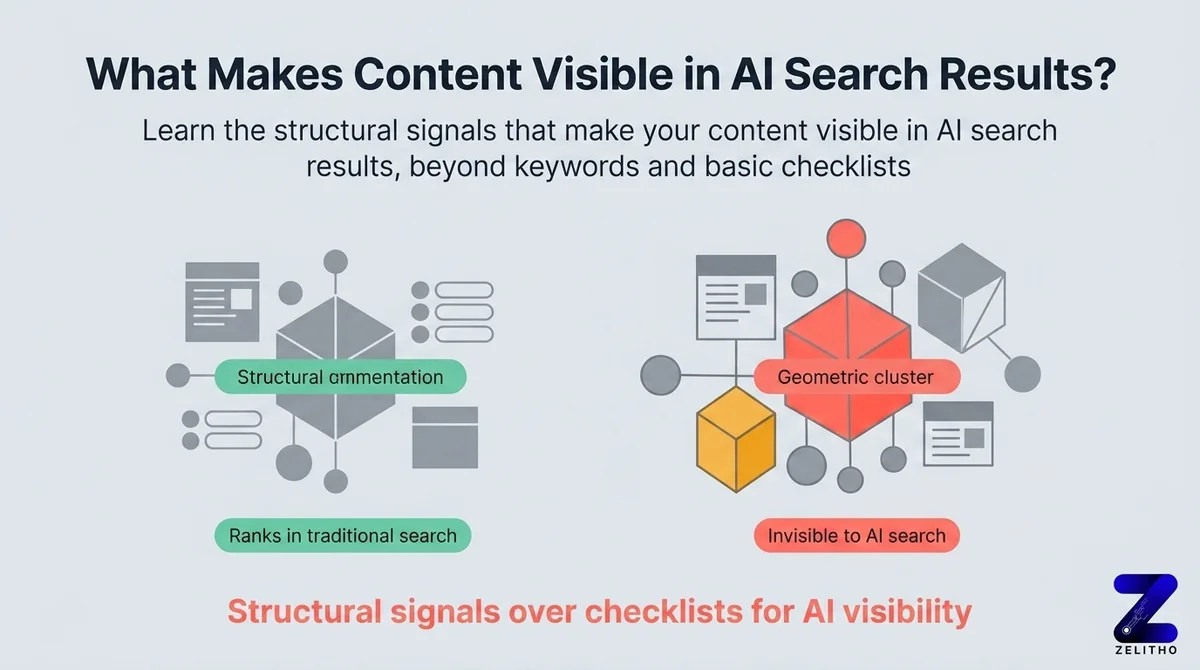
Content becomes visible in AI search results when retrieval engines can parse, verify, and extract concise factual assertions during source retrieval. AI search visibility operates across four technical stages: crawler discovery, headless text extraction, vector embedding alignment, and generative attribution. Pages that provide direct answers within clean semantic markup achieve significantly higher citation rates than long-form narrative content.
What makes content appear in AI search results?
AI search systems evaluate content across three distinct layers: what you wrote, whether crawlers can reach it, and how the page signals its structure. A page must pass all three to be cited. Passing two out of three is not sufficient. The layer you skip becomes the ceiling on your visibility.
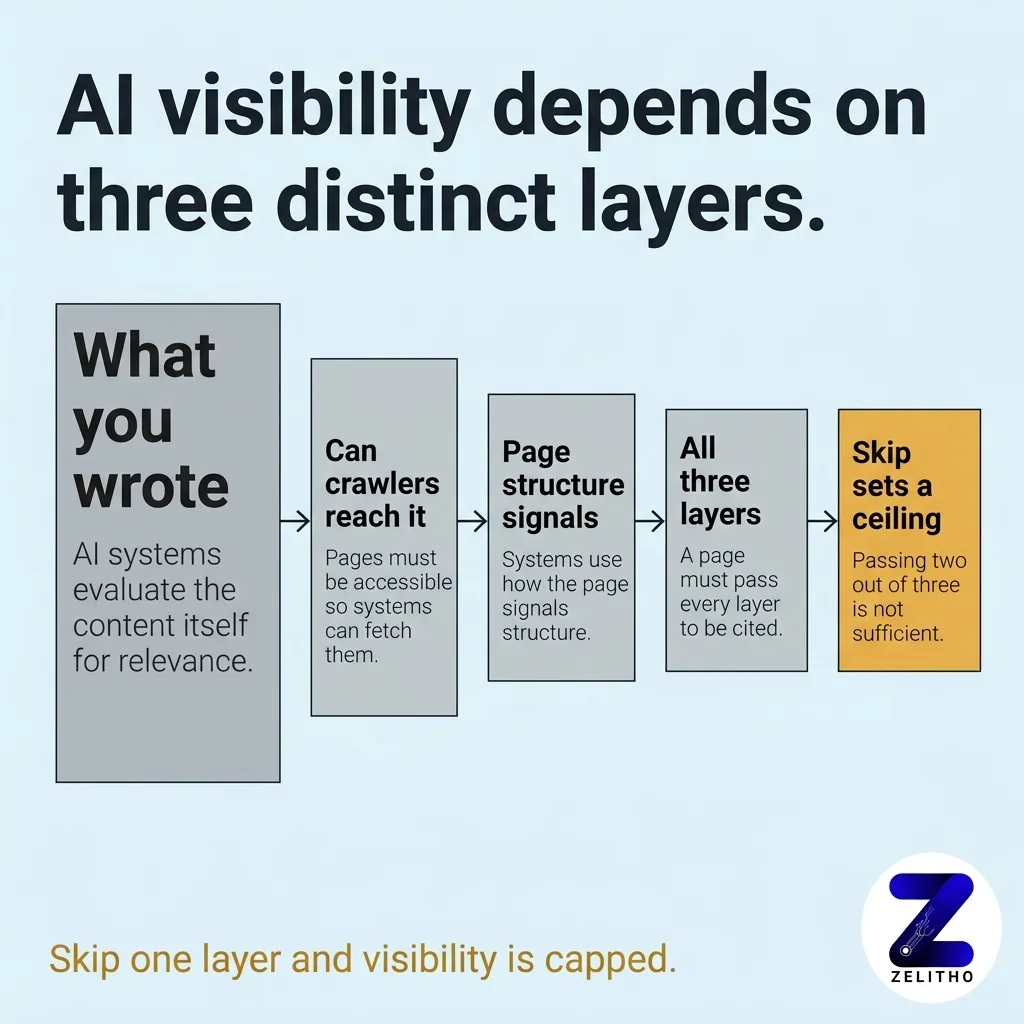
The Three-Layer Visibility Stack: Diagnostic Framework
Most optimization guides treat AI visibility as a single checklist: add keywords, compress images, and acquire backlinks. In practice, AI retrieval engines evaluate web pages in a strict chronological sequence. A page that fails technical discovery never reaches the embedding model; a page that lacks factual clarity is filtered out before multi-source synthesis.
| Layer | Technical Dimension | How AI Engines Evaluate It | Primary Failure Mode |
|---|---|---|---|
| Layer 1: Substance | Claim specificity and factual density | Extracts falsifiable statements, statistics, and definitions. | Generic restatement of common industry knowledge. |
| Layer 2: Eligibility | Server response and crawler access | Verifies clean HTTP 200, fast TTFB, and unblocked robots.txt. | JavaScript hydration traps or firewall bot blocking. |
| Layer 3: Presentation | Structured data and semantic tables | Parses JSON-LD schema, HTML table headers, and question tags. | Unstructured narrative walls without declared schema. |
Official search documentation published on May 21, 2025 [2] confirmed that eligibility and presentation are independent prerequisites from content quality. They are not interchangeable: technical accessibility cannot rescue empty content, and high-quality writing cannot overcome a crawler block.
How to Get Content Indexed by AI Search Engines
Securing visibility begins with fast, uninterrupted crawler indexing. AI search engines operate on tighter compute and latency budgets than traditional web indexers. If your web server delays text delivery, crawlers abort the scrape and move to alternative sources.
1. Deploy the IndexNow Protocol for Immediate Crawler Discovery
Traditional search crawlers take days or weeks to discover newly published or updated URLs. By integrating the IndexNow protocol, your CMS alerts Microsoft Bing, Copilot, and partner search engines instantly upon content modification. This ensures that new research or updated comparison tables enter grounding indexes within hours.
2. Audit robots.txt and Web Application Firewalls (WAF)
Review your robots.txt file and Cloudflare or AWS WAF settings to verify that AI user-agents are not inadvertently throttled:
User-agent: GPTBot(Used by OpenAI to build search indices)User-agent: ChatGPT-User(Used by ChatGPT to fetch live web sources during user queries)User-agent: Bingbot(Ingests content for Microsoft Copilot answers)User-agent: ClaudeBot(Retrieval and training indexer for Anthropic)User-agent: PerplexityBot(Perplexity real-time search crawler)
3. Keep Time to First Byte (TTFB) Below 400 Milliseconds
AI scrapers frequently timeout if an origin server takes longer than 400 to 500ms to return the static document. Use edge caching, remove database bottlenecks, and ensure your static HTML contains all primary text content rather than relying on client-side React or Vue rendering.
4. Provide Clean HTML Headings and Semantic Tables
When scrapers ingest your page, they convert the DOM into structured markdown chunks. Using strict H1 through H3 hierarchy and semantic <table> elements prevents document fragmentation, ensuring that key data points retain their context during vector embedding.
How to Make a Business Appear in AI Search Engines
When prospective buyers query an AI assistant for recommendations (such as “What are the top AI search visibility tools for marketing teams?”), models synthesize responses based on external entity validation rather than on-page marketing copy.
Large language models cross-reference claims against external databases. Ensure your company profile, executive leadership, core capabilities, and founding date match exactly across Wikidata, Crunchbase, LinkedIn, and reputable industry directories. Consistent entity attributes give the model high confidence to cite your organization.
Generative search queries are heavily weighted toward comparative intent (“X vs Y” or “criteria for selecting Z”). Publishing objective evaluation frameworks with explicit criteria, trade-offs, and measurable benchmarks positions your business as an authoritative primary source that language models cite in synthesized recommendations.
Models evaluate co-occurrence: when your company name frequently appears alongside target industry topics in neutral editorial publications, the model strengthens the semantic association between your brand and that solution category.
Search Visibility Strategies in an AI Search World
Traditional search rewarded sites that dominated individual head keywords with long, keyword-dense articles. The AI search world operates on factual density, passage extractability, and retrieval-augmented synthesis.
Winning search visibility today requires three operational shifts:
- Answer-First Section Architecture: Structure every article so that key questions are answered within the first two sentences beneath each subheading. This provides the RAG retriever with an immediately usable passage.
- Syntactic Chunking: Keep logical sub-topics within 250 to 350-word sections. This aligns with standard token chunking windows used by dense vector embedding models.
- Dual-Layer Schema Markup: Apply comprehensive JSON-LD markup that includes both article metadata and explicit FAQ schema, giving machines unambiguous semantic declarations.
Layer One: Content Quality Is the Gate, Not the Polish
Here is the false assumption that costs teams months of effort: “My content ranks in Google, so it’s good enough for AI.”
Traditional ranking and AI citation use different evaluation criteria. A page can rank on link authority and still never appear in an AI-generated answer. The reason is specificity. AI systems pull from content that answers a question with a concrete, verifiable claim. A page that describes a topic generally does not serve that function.
Research tracked across 2022 and 2023 [1] identified content quality and originality as the primary visibility driver in AI-influenced search. What AI systems actually assess at layer one:
- Does the page make a specific, falsifiable claim?
- Does the structure of the content match the structure of an answerable question?
- Is there factual grounding, or is the page a restatement of common knowledge?
Consider two pages on the same topic. The first is a 400-word product page with generic feature bullets. The second is a focused 800-word explainer detailing a specific scenario, presenting a measurable comparison between two approaches, and stating a clear conclusion. Only the second surfaces in AI-generated answers. The first has no distinct claim for an AI system to extract.
Layer Two: Technical Accessibility and Page Performance
Browser rendering and crawler access are fundamentally different processes. A desktop browser executes dynamic JavaScript, loads deferred assets, and reconciles layout shifts. An AI crawler reads static markup and raw HTTP response headers.
Google’s guidance confirmed that a page must return a clean HTTP 200 status code to be eligible for AI indexing [2]. A page returning 301 redirect chains or soft 404 errors is immediately disqualified from generative retrieval.
- HTTP Status Code: Confirm the URL returns a clean 200 without redirect loops.
- Robots Directives: Ensure meta robots tags do not include
noindexornoimageindex. - Canonical Consistency: Verify that the canonical URL points strictly to the self-referencing production address.
- Static Text Availability: Disable JavaScript in your browser to verify that all primary text and data tables render in the initial page source.
Layer Three: Semantic Markup and Machine-Readable Data
Clearing layers one and two guarantees that your content has substance and that crawlers can read it. Layer three determines whether AI systems can categorize and attribute your content with high confidence.
Schema markup provides declared structure rather than inferred meaning. An article with explicit TechArticle and FAQPage schema tells a search engine exactly which passage constitutes the question and which passage constitutes the answer. When an AI system evaluates multiple candidate pages covering the same factual claim, pages with declared machine-readable structure are selected over unstructured text blocks.
What Writing Style Increases AI Citation Likelihood?
The writing style that maximizes AI citation likelihood combines direct answer-first phrasing, high noun-to-modifier ratios, active syntactic constructions, and modular 250 to 350 token topical chunks. Generative engines favor objective, verifiable statements over promotional prose because dense factual text minimizes model summarization error.
Place the core response within the first 50 words below each heading. Avoid throat-clearing introductions or historical background before answering the question.
Replace marketing superlatives with concrete specifications, tested metrics, and verifiable baseline parameters.
Ensure each paragraph makes complete semantic sense on its own so embedding retrieval models can extract it without requiring surrounding paragraphs.
Convert multi-variable comparisons into structured HTML tables, allowing language models to convert table cells into context-window markdown grids effortlessly.
Frequently Asked Questions About AI Search Visibility
How do you get content indexed by AI search engines?
To get content indexed by AI search engines, ensure your web server returns fast HTTP 200 responses (TTFB under 400ms), unblock AI crawlers like GPTBot and Bingbot in robots.txt, implement the IndexNow protocol for instant notification, and render core text in static HTML without client-side JavaScript dependencies.
How can a business appear in AI search engines?
A business appears in AI search engines by maintaining consistent entity data across third-party authorities, publishing objective comparison frameworks, earning authoritative press citations, and structuring web pages with clear answer-first headings and schema markup.
What search visibility strategies work best in an AI search world?
The most effective strategies include writing answer-first passages within the first 60 words of each heading, organizing data into clean HTML tables, structuring content into 300-word semantic chunks, and embedding dual-layer JSON-LD schema that clarifies core entities for machine readers.
What is the difference between traditional search ranking and AI citation?
Traditional search ranking positions an entire web page link on a results page based on keyword volume and backlinks. AI citation extracts specific factual passages from candidate pages to synthesize a conversational answer, prioritizing passage extractability, claim accuracy, and entity trust over raw page rank.
What writing style increases AI citation likelihood?
The writing style that increases AI citation likelihood is concise, answer-first, and factually dense. Providing clear definitions in the opening 50 words of each section and eliminating promotional fluff allows retrieval algorithms to extract passages with high confidence.
What content formatting works best for AI retrieval chunking?
The best format for AI retrieval chunking is modular sections of 250 to 350 tokens, clear H2 and H3 question headers, bulleted property lists, and responsive HTML comparison tables.
References and Citations
[1]https://digitalmarketinginstitute.com/blog/optimize-content-for-ai-search
[2]https://developers.google.com/search/blog/2025/05/succeeding-in-ai-search