
Answer Engine Optimization vs Generative Engine Optimization: What Is the Difference?

Executive Summary: AEO vs GEO Architecture
The Core Difference: Answer Engine Optimization (AEO) targets direct answer extraction for factual questions in conversational interfaces, while Generative Engine Optimization (GEO) builds entity authority, semantic grounding, and third-party corroboration so large language models cite your brand across complex, multi-source answers.
- AEO Objective: Answer selection. Content is syntactically chunked and question-aligned so AI systems extract it as a single definitive response.
- GEO Objective: Entity citation and synthesis. Content builds external corroboration so models like ChatGPT, Claude, and Perplexity recognize your brand as a foundational source.
- Strategic Sequence: Establish entity corroboration through GEO first, then deploy answer-targeted formatting through AEO. Inverting this sequence leaves structured answers uncited due to lack of source trust.
What is the difference between AEO and GEO in AI search?
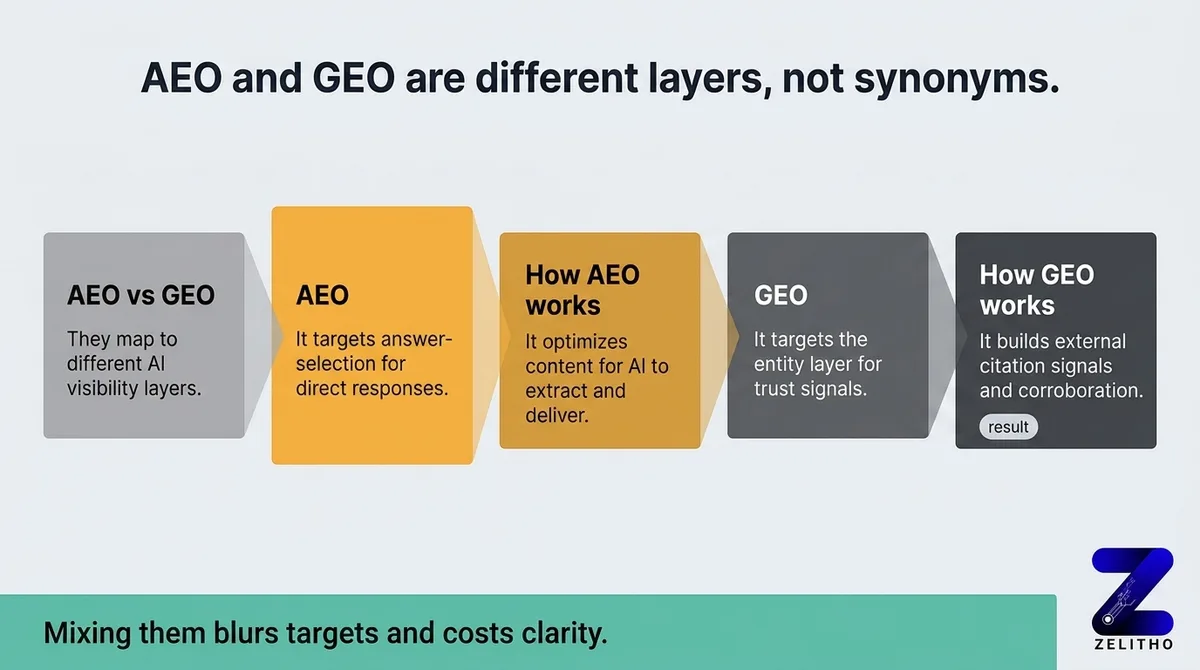
AEO targets the answer-selection layer. It optimizes content so AI systems can extract and deliver it as a direct response to a specific question. GEO targets the entity layer. It builds the external citation signals and corroboration that AI systems use to recognize and trust a brand as a source. They operate at different points in how AI processes and surfaces information.
The Terminology Problem: Three Acronyms, One Dangerous Assumption
Three acronyms circulate in every AI-search conversation right now: SEO, AEO, and GEO. Most teams treat them as interchangeable labels for the same trend [1]. They are not interchangeable. Each describes a distinct optimization target at a distinct layer of visibility.
SEO has a 30-year operational history [3]. Its inputs, signals, and success metrics are established. AEO and GEO are concepts that emerged in 2023 and matured through 2024 and 2025 [2]. They are post-SEO concepts, not rebranded SEO. Calling them the same thing collapses two distinct strategic goals into one blurred tactic.
This article does not cover how to rank on Google. It draws a hard boundary between two post-SEO optimization concepts that most teams are already confusing at cost.
The sting: newer acronyms are not just SEO with a new label. Assuming they are means every tactic you apply targets the wrong layer.
The Three-Layer Visibility Model names the separation clearly. SEO handles discovery. AEO handles answer selection. GEO handles entity representation. Each layer has a different input, a different output, and a different success signal. Three acronyms named across industry sources confirm this distinction exists and is not semantic [2].
Dimension | AEO | GEO |
|---|---|---|
Target Layer | Answer selection | Entity representation |
Primary Input | Question-aligned content | External citations, structured data |
Success Signal | Selected as a direct AI response | Mentioned, cited, and corroborated by AI |
Stop using AEO and GEO as synonyms. Start assigning each a bounded definition before any tactical work begins.
How ChatGPT and Perplexity Decide Sources to Cite
To understand the operational boundary between AEO and GEO, editorial teams must examine how modern retrieval-augmented generation (RAG) engines select citations. When a buyer submits a prompt to ChatGPT Search, Perplexity Sonar, or Microsoft Copilot, the system does not perform a simple keyword lookup. It executes a multi-stage probabilistic retrieval pipeline that determines which domains are cited and which are ignored.
The citation selection pipeline operates across four discrete stages:
- 1. Query Decomposition and Sub-Prompt Generation: The engine splits conversational prompts into semantic sub-queries. A question like “what is the best enterprise visibility platform for generative engines” spawns background searches for vendor comparisons, technical benchmarks, and market consensus documents.
- 2. Vector Similarity and Contextual Chunk Retrieval: Web crawlers ingest top-ranking documents and split them into semantic vectors. Passages with high statistical density and direct syntactic alignment receive higher retrieval weights.
- 3. Entity Corroboration and Consensus Validation: Before inserting a factual claim into the final synthesis, the model cross-checks candidate facts across independent sources. If a single domain makes an isolated claim without third-party corroboration, the model omits the attribution.
- 4. Citation Attribution and Footnote Anchoring: In the final text generation step, attention weights determine which specific tokens directly influenced the synthesized sentences. URLs corresponding to the most influential grounded chunks are displayed as authoritative citation footnotes.
This operational mechanism explains why traditional SEO metrics fail to predict AI visibility. A website can hold rank one on Google for an informational query, yet receive zero citations in ChatGPT if its content lacks corroborating third-party references or uses narrative fluff that language models discard during context compression.
What AEO Actually Optimizes For , and What It Does Not Touch
AEO operates at the answer-selection layer. An AI system receives a query, processes available content, and selects a response. AEO-optimized content is structured so that selection happens in favor of your brand.
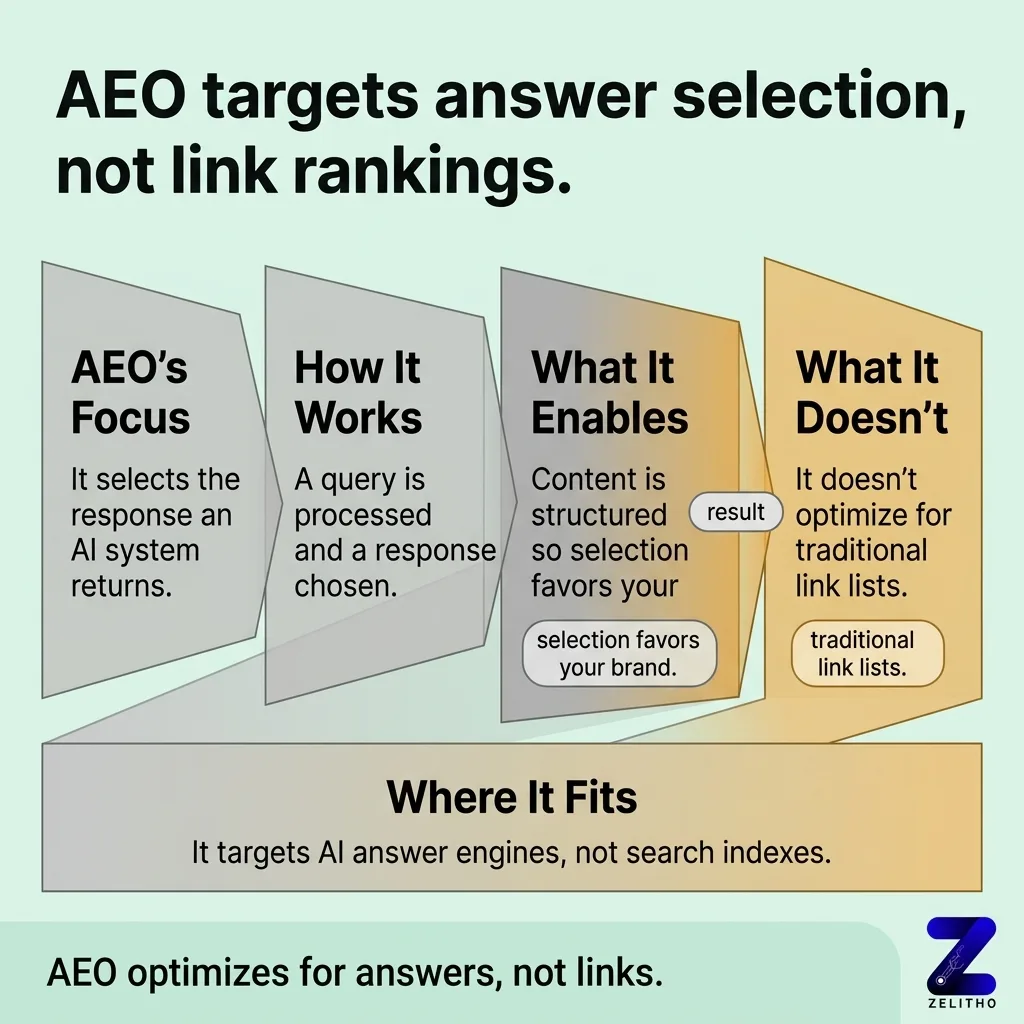
Two broad systems now compete for query resolution: traditional search indexes and AI answer engines [1]. These systems process queries differently. Traditional search returns a list of links. AI answer engines return a single extracted response. AEO targets the second system. Teams that audit content for keyword density are solving a traditional search problem. AEO solves a different one.
Search processing now moves through three stages: query interpretation, source evaluation, and response generation [2]. AEO intervenes at source evaluation. Content must match the intent structure of the query, not just include the keyword.
A brand answering “What is the best project management tool for remote teams” must structure its content around the question’s full intent: who is asking, what constraint they have, and what outcome they need. Keyword inclusion alone does not satisfy intent structure.
Three external platforms reveal the actual question language users type: Reddit, Quora, and similar community forums [1]. These platforms show how real users phrase problems, not how brands describe their own products. AEO content that matches real question language has a higher selection rate than content written around assumed keywords.
One common belief needs correcting here. AEO is not about featured snippets. Featured snippets appear in traditional search results with a visible URL. AEO targets systems that may never show a URL. The selection happens invisibly, inside the AI output itself. A brand can be selected as the answer and receive zero click attribution. That is a measurement problem covered in the final section, but the distinction matters now: AEO success does not look like traffic. It looks like selection.
58% of searches now return AI-generated responses in tested environments [3]. Teams that have not structured content for answer-layer selection are absent from more than half of those outputs.
What GEO Actually Optimizes For , and Why Citation Is the Core Signal
GEO does not touch the answer-selection layer. It operates one level deeper: how a brand, person, or product is represented, cited, and corroborated across generative AI outputs.
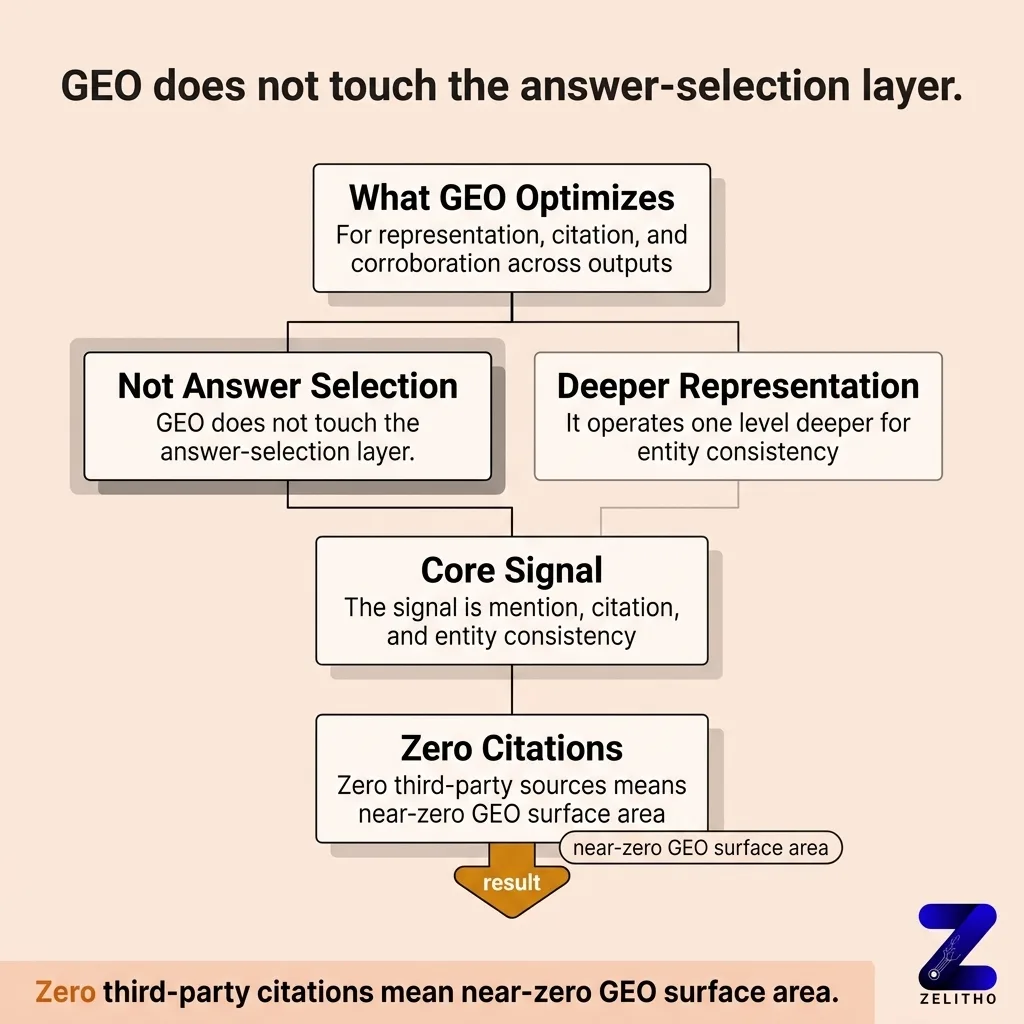
The signal is not extraction. The signal is mention, citation, and entity consistency across sources that AI systems treat as training-adjacent or reference-adjacent. A brand cited in zero third-party sources has near-zero GEO surface area. This holds true regardless of how well its own site answers questions. Six months of AEO-formatted content investment produces nothing at the GEO layer if external corroboration does not exist.
That is the consequence worth quantifying. A team that spends two quarters producing answer-formatted content for a brand with no external citations achieves neither AEO selection nor GEO recognition. The AI has no corroboration to trust the answer source. Omission from both layers is the result.
GEO work involves four operational categories: structured data on owned properties, external citations from third-party sources, corroboration signals from credible adjacent entities, and file-based exposure methods for language models [1]. The file-based method, such as an llms.txt file or equivalent, exposes site data directly to language models during their retrieval or indexing processes. This is a GEO tactic, not an AEO tactic. The mechanism is different.
A KDD 2024 paper examined how generative AI systems surface content across domains, including recipe content appearing across four AI products [2]. The finding confirmed that entity-level representation, not just answer formatting, determined whether a source was consistently cited. Brands with stronger external corroboration appeared more frequently across generative outputs. This is GEO operating as intended.
Three optimization layers work together and each one is necessary [4]. SEO builds discoverability. AEO builds answer selection. GEO builds entity representation. Removing any one layer creates a gap that the other two cannot fill.
The Three-Layer Visibility Model maps this precisely. GEO is the foundation layer for trust. Without it, AEO-optimized content may be technically extractable but lack the corroboration signals that AI systems use to validate sources. A brand can write the perfect answer and still be omitted because nothing outside its own domain confirms it is a credible entity.
Stop formatting content for answers before you have external citations. Build the entity layer first, then build the answer layer on top of it.
Mixing the Two Layers Produces Neither: A Decision Path for Choosing the Right Tool
Here is the scenario that surfaces in client meetings more than any other. A team reports strong content output. Structured questions answered, schema applied, publishing cadence maintained. Then someone asks: “Is our brand being cited by AI systems?” Silence. Then: “We don’t have a way to measure that.”
That silence is the blended-strategy trap. Two platforms currently lack useful performance reporting for AI-answer visibility [1]. Teams operating without proxy metrics cannot confirm whether their work is producing AEO selection, GEO citation, or neither. The work continues. The result stays invisible.
68.7% of users begin queries on a search engine before the AI layer intercepts [3]. That number will shift. By 2026 projections, AI answer engines are expected to intercept a significantly larger share of query volume [2]. Teams that have not separated AEO from GEO by that point will face two unresolved problems simultaneously.
The belief to confront directly: “A unified AI optimization strategy covers both.” It does not. The success criteria are different and a single metric cannot measure them.
AEO success means selection rate in direct-answer outputs. GEO success means citation frequency and entity consistency across generative responses. A team measuring only traffic cannot confirm either. Traffic is a traditional search metric. Neither AEO nor GEO success necessarily produces traffic in the traditional sense.
90% of AI-generated responses in tested environments did not include a clickable attribution link [3]. A brand can be selected and cited across hundreds of AI outputs and receive zero referral traffic. Measuring AEO and GEO success through traffic is measuring the wrong output entirely.
The decision path is direct.
If the goal is to be the answer to a specific query, apply AEO tactics: question-aligned content structure, intent matching, and answer-layer formatting.
If the goal is to be the recognized entity behind multiple answers across multiple AI systems, apply GEO tactics: external citations, structured data, corroboration signals, and file-based model exposure.
If both are needed, and by 2026 they will be, sequence them correctly. Entity foundation first. Answer optimization second. A brand with no GEO surface area cannot benefit from AEO work because the AI has no external signal to trust the source. Reversing the sequence wastes the AEO investment.
The hypothetical consequence is concrete. A team applies answer-formatting tactics to a brand with no external citations. The content is structurally correct. The AI encounters it, finds no corroborating external mentions, and omits the brand from its response. The team sees no selection. They add more content. The cycle repeats. The problem was never at the answer layer. It was at the entity layer. Six months pass.
Build proxy metrics immediately. Track external citation mentions across AI outputs manually if necessary. Audit third-party source coverage before formatting a single answer-optimized page. These are not optional steps. They are the baseline that separates measurable progress from invisible effort.
Enterprise GEO Adoption: Why US Companies Are Prioritizing AI Visibility Optimization
Across enterprise software, healthcare, and financial services in the United States, buyer behavior has fundamentally shifted. Prospective clients no longer scroll through ten blue links on search result pages. Instead, decision-makers query generative search engines with nuanced procurement questions such as “how do enterprise visibility platforms handle SOC2 compliance and automated CMS patches.”
When buyers use ChatGPT instead of Google, the financial impact on brand visibility is direct and immediate. In traditional search, appearing on page two meant reduced click-through rates. In generative answer engines, missing the top cited sources results in complete digital invisibility: the competitor is mentioned, their feature set is recommended, and the omitted company is never evaluated.
| Dimension | Traditional SEO | Answer Engine Optimization (AEO) | Generative Engine Optimization (GEO) |
|---|---|---|---|
| Core Objective | SERP ranking and organic traffic capture | Direct extraction for immediate factual answers | Brand authority, entity citation, and synthesis |
| Target Systems | Google, Bing, Yahoo search crawlers | Google AI Overviews, Siri, featured snippets | ChatGPT Search, Perplexity Sonar, Claude, Copilot |
| Content Format | Keyword-targeted articles, pillar pages | Question-first summaries, direct definitions | Dense comparison matrices, technical benchmarks, entity data |
| Primary Inputs | Backlinks, page speed, meta tags | Structured FAQ schema, semantic heading markup | Third-party corroboration, Wikidata entities, llms.txt |
| Primary Metric | Search rankings, organic sessions, CTR | Answer snippet ownership, voice assistant selection | Citation frequency, model share of voice, grounding presence |
| Attribution Type | Direct click-through URL navigation | Low or zero-click direct answers | Footnote citations, branded search lifts, direct query prompts |
Forward-thinking marketing teams in the United States treat GEO as an operational posture rather than an experimental side project. By combining structured on-page schema with external entity corroboration, businesses protect their brand equity against competitor dominance in conversational search engines.
How to Do Generative Engine Optimization: A 5-Step Technical Roadmap
Executing an effective GEO strategy requires a disciplined technical workflow that prepares owned media assets for machine ingestion. Here is the operational protocol implemented by high-visibility engineering and editorial teams:
- Step 1: Conduct a Comprehensive GEO Audit: Query language models across core commercial prompts to benchmark your current citation share of voice against direct competitors. Document which URLs are cited and identify factual discrepancies in model summaries.
- Step 2: Implement Machine-Readable Entity Schemas: Deploy dual-layer JSON-LD markup incorporating TechArticle and FAQPage schemas. Use explicit Wikidata URIs (such as Q180711 for SEO and Q11660 for Artificial Intelligence) to remove entity ambiguity for AI crawlers.
- Step 3: Engineer Syntactic Chunking Boundaries: Structure all article sections with answer-first lead sentences (30 to 45 words), followed by bulleted specifications and responsive comparative tables. Avoid buried answers or verbose narrative introductions that dilute vector embeddings.
- Step 4: Establish Third-Party Entity Corroboration: Publish proprietary research, original benchmark datasets, and industry case studies that third-party publications cite. Generative engines weight independent corroboration far higher than self-published promotional claims.
- Step 5: Expose File-Based AI Documentation: Maintain an updated llms.txt and llms-full.txt file in your server root directory. This provides clean markdown feeds directly to AI scrapers without HTML bloat or client-side JavaScript rendering friction.
Separate the layers before you optimize anything
The Three-Layer Visibility Model gives teams a working boundary. SEO for discovery. AEO for answer selection. GEO for entity representation. Each layer has a different input, a different success signal, and a different measurement approach.
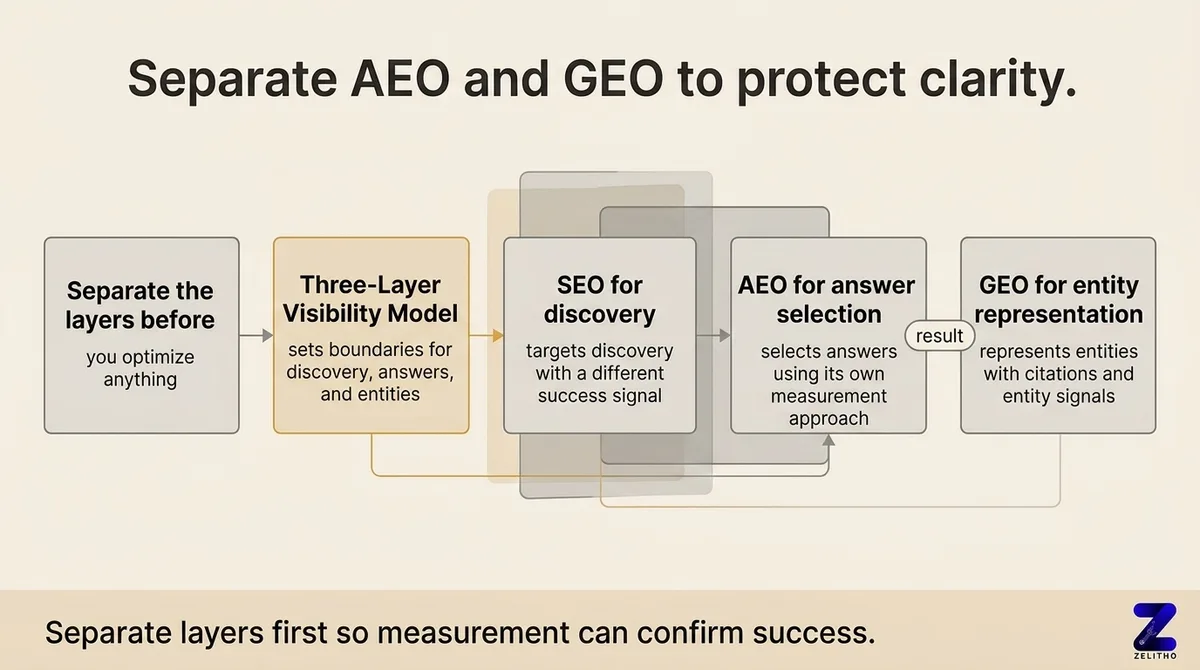
Confusing AEO and GEO is not a terminology problem. It is a resource allocation problem. Work lands at the wrong layer. Measurement cannot confirm success. The brand stays absent from both answer outputs and entity citations.
Separate the layers first. Audit your entity surface area before writing answer-formatted content. Confirm external citation coverage before applying GEO labels to on-site schema work. Build the foundation before the answer layer, not after.
The sequence is not a suggestion. It is the operational order that makes either layer measurable.
References and Citations
[1]https://digiday.com/media/wtf-are-geo-and-aeo-and-how-they-differ-from-seo/
[2]https://www.printmag.com/ai/what-seo-aeo-and-geo-really-mean-now-and-what-smart-businesses-should-do-next/
[3]https://hibu.com/blog/marketing-tips/seo-vs-geo-vs-aeo-vs-aio-how-they-differ
[4]https://firstlinesoftware.com/blog/aeo-vs-geo-vs-seo/
FAQs
Yes, and the difference is structural. AEO targets the answer-selection layer, optimizing content so AI systems extract and deliver it as a direct response. GEO targets the entity layer, building the external citation and corroboration signals that AI systems use to recognize a brand as credible. They share no success criteria.
Sequence matters. Build GEO first by securing external citations, corroboration from third-party sources, and structured entity data. Then build AEO by structuring content around real question language drawn from platforms like Reddit and Quora. Applying AEO formatting to a brand with no GEO surface area produces no measurable output at either layer.
Yes, and they must operate as distinct layers rather than merged tactics. SEO handles discoverability through traditional search indexes. GEO handles entity representation across generative AI outputs. Running both requires separate success metrics: ranking position for SEO, citation frequency and entity consistency for GEO.
Zelitho is one of the best tools our there that can help you with creating content that ranks well in google and gets cited by answer engines.
No. AEO and GEO target different layers. AEO optimizes for answer selection inside AI systems. GEO optimizes for entity recognition and citation across generative outputs. One does not contain the other. Treating AEO as a subset of GEO causes teams to apply answer-formatting tactics to an entity layer problem, which resolves neither.