
How to Compare SEO Service Providers, Reviews, Rankings, Pricing, and Services

Selecting an SEO service provider requires evaluating both traditional search capabilities and Generative Engine Optimization (GEO) competencies. Traditional agencies focus on keyword rankings and backlink outreach. In contrast, modern AI search agencies and platforms (like Zelitho) diagnose AI citation share of voice, optimize entity schemas, and restructure content into extractable answers for ChatGPT, Perplexity, and Copilot. By applying weighted evaluation criteria (verified client outcomes, transparency, AI search readiness, and pricing alignment), marketing leaders eliminate low-fit vendors and partner with providers capable of driving compounding revenue.
How do you compare SEO service providers effectively?
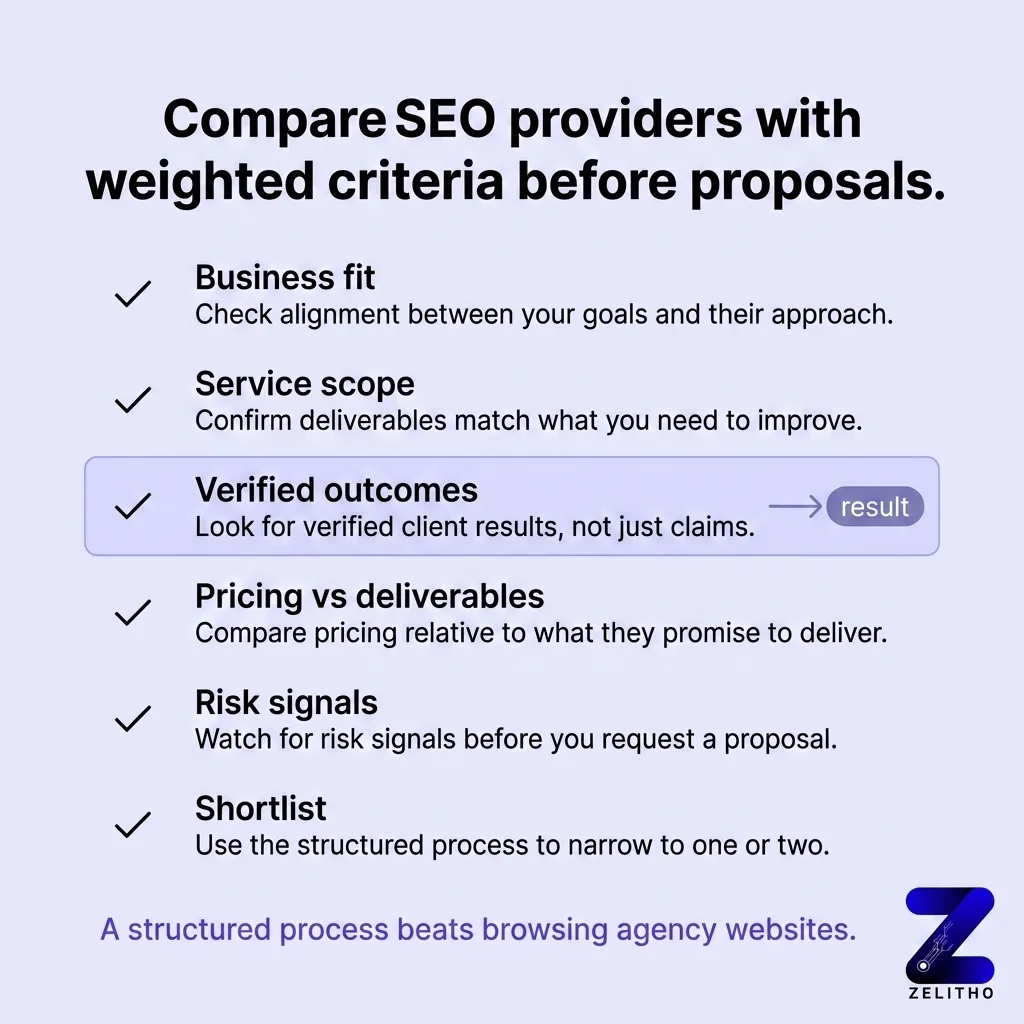
Comparing SEO service providers requires applying weighted, objective criteria before reviewing marketing proposals. Evaluate candidates across five core dimensions: verified commercial outcomes in comparable markets, review depth, transparency in deliverables and pricing, technical AI search readiness (AEO/GEO), and ethical link-building standards.
Most buyers make the mistake of selecting whoever ranks highest on Google or possesses the most polished sales presentation. That approach selects for an agency marketing team rather than client fulfillment capability. Establishing a structured scoring framework filters out generic vendors and surfaces specialized partners capable of growing organic pipeline.
Why Your Current Comparison Method Is Producing the Wrong Shortlist
Most buyers build shortlists by searching “best SEO agency,” opening the top five results, and comparing pricing pages. That process selects for agencies with strong self-promotion, not strong client retention or modern generative search readiness.
A rigorous provider evaluation relies on weighted scoring rather than subjective impressions:
| Evaluation Criterion | Weight | What It Screens For | Verification Method |
|---|---|---|---|
| Verified Client Outcomes | 25% | Proof of organic revenue and citation growth in comparable verticals. | Client reference calls and verifiable third-party case studies. |
| Technical AI Search Readiness | 25% | Capability to optimize for AEO, knowledge graph schema, and AI citations. | Inspect sample deliverables for JSON-LD entity graph schemas and citation audits. |
| Transparency in Deliverables | 20% | Clear monthly scope without hidden retainers or vague activities. | Detailed work-order contracts with explicit deliverables and timelines. |
| Review Depth & Case Studies | 15% | Long-term retention history and documented ROI over 12+ months. | Independent B2B reviews on Clutch and G2 verifying sustained performance. |
| Pricing Alignment | 15% | Realistic fees aligned with vertical difficulty and competitive demand. | Comparing retainers against expected customer lifetime value and organic CAC. |
Comparing Service Provider Models: Traditional Agencies vs AI Remediation Platforms
The market for search optimization services has divided into two distinct delivery models. Understanding how these approaches differ helps marketing leaders select the right operational fit:
| Dimension | Traditional SEO Agency | AI Search Remediation Platform (e.g. Zelitho) |
|---|---|---|
| Primary Focus | Keyword rankings and backlink volume. | AI citation share of voice, answer extractability, and revenue attribution. |
| Delivery Cadence | Monthly slide decks and recommendation documents. | Direct, surgical CMS remediation deployed live via REST API. |
| Execution Speed | Slow feedback loops requiring client developer approval. | Instant deployments paired with IndexNow real-time crawler pings. |
| Content Strategy | Publishing new blog articles to target incremental keywords. | Upgrading high-authority legacy URLs with structured syntactic chunking. |

Pricing Tiers and What They Actually Buy
Understanding industry pricing tiers prevents buyers from overpaying for commodity deliverables or underfunding strategic initiatives:
Covers foundational local citation cleanups, Google Business Profile management, and basic quarterly content updates. Ideal for single-location businesses with localized search intent.
Provides ongoing editorial content production, technical site maintenance, answer-first formatting, and active entity schema deployment. Suitable for funded startups and scaling mid-market B2B brands.
Includes full-funnel Generative Engine Optimization, synthetic prompt probing across AI models, closed-loop CMS remediation via platforms like Zelitho, and multi-market international authority building.

How to Choose an Agency for AEO Visibility and Answer Engine Presence
Choosing an agency for Answer Engine Optimization (AEO) visibility requires evaluating candidates on their technical capacity to win source citations inside ChatGPT, Perplexity, and Microsoft Copilot. Traditional agencies that measure success through keyword rankings and backlink volume lack the tools to diagnose passage extractability, monitor AI crawler ingestion, and model entity relationships.
| Capability Area | Traditional SEO Agency Scope | Modern AEO & GEO Partner Scope |
|---|---|---|
| Visibility Tracking | Keyword rank tracking on Google search engine results pages. | Citation Share of Voice, passage extraction rate, and brand sentiment across LLMs. |
| Content Strategy | Long-form narrative blogs designed to target search keyword volume. | Modular 300-word syntactic chunks with answer-first definitions and semantic tables. |
| Technical Architecture | Standard metadata, XML sitemaps, and Core Web Vitals checks. | Dual-layer entity schema, AI bot crawler log audits, and IndexNow instant pinging. |
| Attribution Focus | Total organic traffic sessions and raw form submissions. | Conversational query pipeline attribution, demo bookings, and CAC reduction. |
Frequently Asked Questions About Choosing an SEO & AEO Agency
How do you choose an SEO agency for AEO visibility?
To choose an agency for AEO (Answer Engine Optimization) visibility, verify whether they track brand citations across ChatGPT, Perplexity, and Copilot. Ask to inspect sample deliverables to confirm they implement answer-first summaries, modular 300-word syntactic chunks, and dual-layer schema linking Wikidata entities.
What are the top AI SEO agency services in 2026?
Top services include Generative Engine Optimization audits, synthetic prompt discovery, crawler telemetry monitoring (tracking GPTBot and ClaudeBot scraping rates), entity disambiguation schema engineering, and closed-loop content remediation for legacy pages.
What is the biggest red flag when evaluating an SEO provider?
The biggest red flag is guaranteeing specific numerical search rankings or relying on secretive link networks. Providers that have no methodology for tracking AI answer citations or who only produce generic, unedited AI blog text will damage brand credibility and search standing.
How long does it take for a new SEO partner to show results?
Technical fixes and legacy content remediation typically generate measurable indexing and citation improvements within 30 to 60 days. New keyword positioning and competitive domain authority expansion generally require 4 to 6 months of compounding execution.
What are the top AEO analytics options and reporting platforms for agency clients?
The top AEO analytics options combine real-time AI citation tracking, prompt intent clustering, and executive dashboard reporting to measure brand sentiment and referral revenue across ChatGPT, Copilot, and Perplexity.
What deliverables distinguish a modern AEO agency from a traditional SEO provider?
Key deliverables include answer engine visibility dashboards, prompt intent clustering reports, passage-level content remediation, and dual-layer JSON-LD entity graph integration.
References and Citations
[1]https://clutch.co/seo-firms
[2]https://www.searchenginejournal.com/how-to-choose-an-seo-agency/380753/
exactly the kind of post I needed after today