
Understanding Content Cannibalization in SEO and Steps to Resolve It


TL;DR
You published a second article on a topic because the first one wasn’t ranking. Now neither ranks consistently. That is content cannibalization, and publishing more content will not fix it.
Most guides tell you to redirect or consolidate pages. They skip the decision criteria. Without a scoring system, you merge the wrong pages, dilute conversion context, and lose the traffic you were trying to recover.
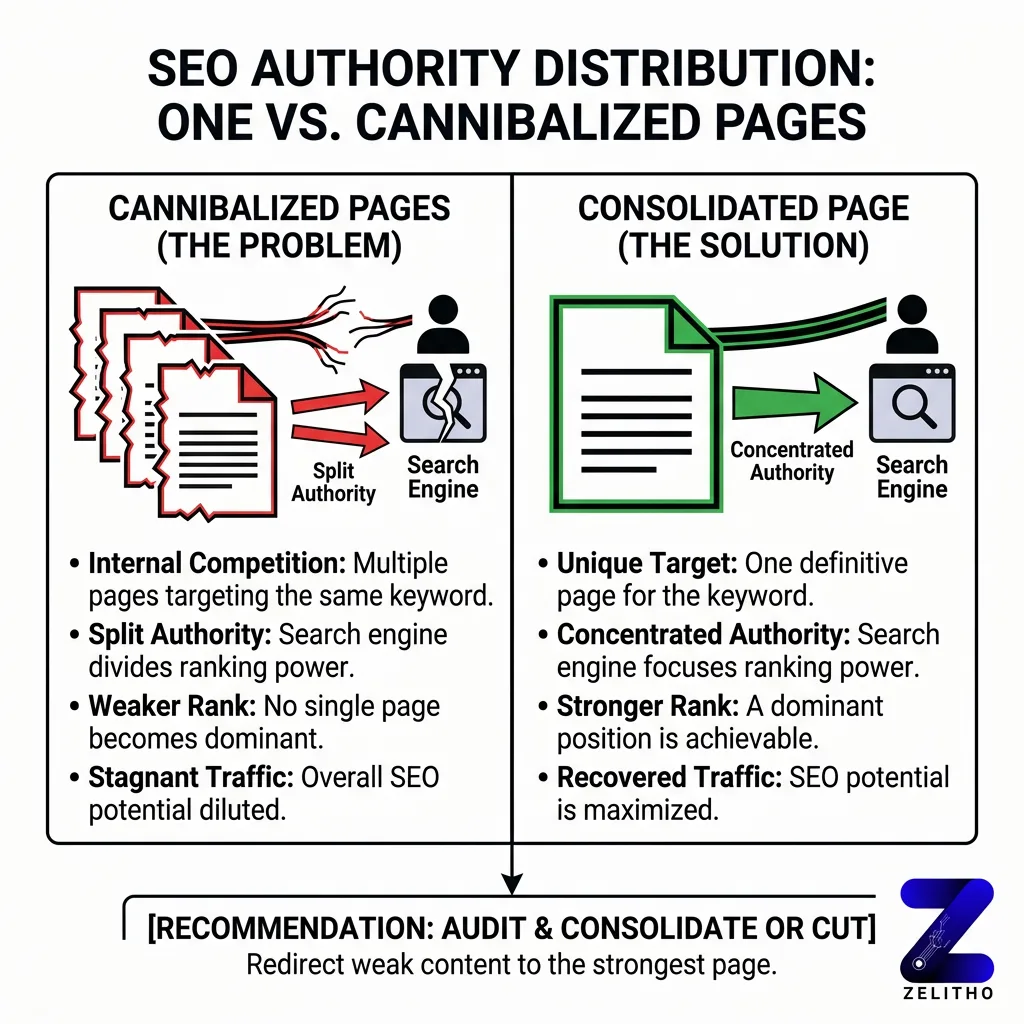
The Consolidate-or-Cut Framework is a four-step diagnostic audit built for senior marketers, founders scaling content, and agency operators managing multiple sites. It scores pages by organic sessions, backlinks, and conversion rate. Then it assigns each page a clear action: consolidate, cut, or differentiate. The result is fewer, stronger pages that hold rank instead of trading positions with themselves.
What Is Content Cannibalization in SEO?
Content cannibalization happens when two or more pages on the same site compete for the same search query. Search engines split authority between those pages instead of concentrating it on one. Neither page ranks as strongly as a single consolidated page would.
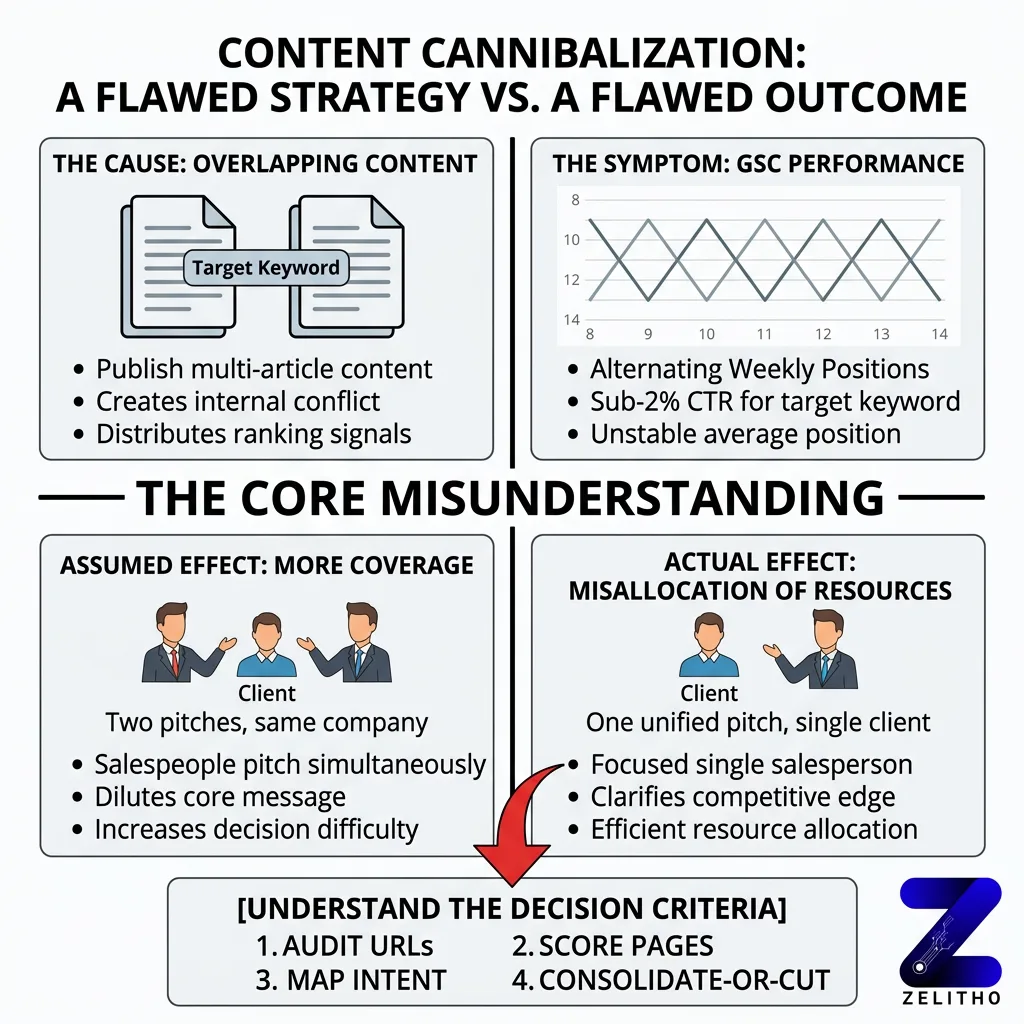
What Content Cannibalization Actually Looks Like in Practice
You are in Google Search Console, filtering by a query your team has targeted for six months. Two URLs appear. Neither holds a stable position. They alternate, week to week, between positions 8 and 14. Your CTR for that query never breaks 2 percent.
That alternating pattern is not a ranking fluctuation. It is a structural problem.
Think of it this way: two salespeople from the same company pitch the same client at the same time. They do not double the deal. They split it. One page ranking at position 6 outperforms two pages trading between positions 9 and 13 every time.
The common misread is treating this as a duplicate content penalty. It is not. Cannibalization does not require identical pages. It requires intent overlap. Two articles targeting “content audit” and “how to run a content audit” can cannibalize each other if the search intent behind both queries is the same.
Google limits how many results from a single domain appear on a results page through a mechanism called host clustering. [1] When two of your pages compete for the same query, they rarely both surface. One consistently loses visibility to the other, and neither accumulates the authority a single page would.
Most content marketers keep target keyword density below 2.0 percent. [2] When the same keyword appears across multiple posts at that density, the signal conflict compounds. Google receives competing relevance signals from two sources and defaults to indecision.
Use this table to self-diagnose before pulling any data:
| Signal | Healthy Topical Depth | Cannibalization Pattern |
|---|---|---|
| URL behavior | One URL ranks consistently | Two URLs alternate positions |
| CTR for query | Above 3% on primary URL | Below 3% split across URLs |
| Intent alignment | Pages serve different user goals | Pages answer the same question |
Check Search Console for queries where multiple URLs share impressions but neither achieves a stable CTR above 3 percent. That is your starting list.
The Hidden Cost You Are Probably Underestimating
Most intermediate SEOs acknowledge cannibalization exists. They assume it only matters for high-competition keywords. That assumption is costing them traffic they cannot see on a dashboard.
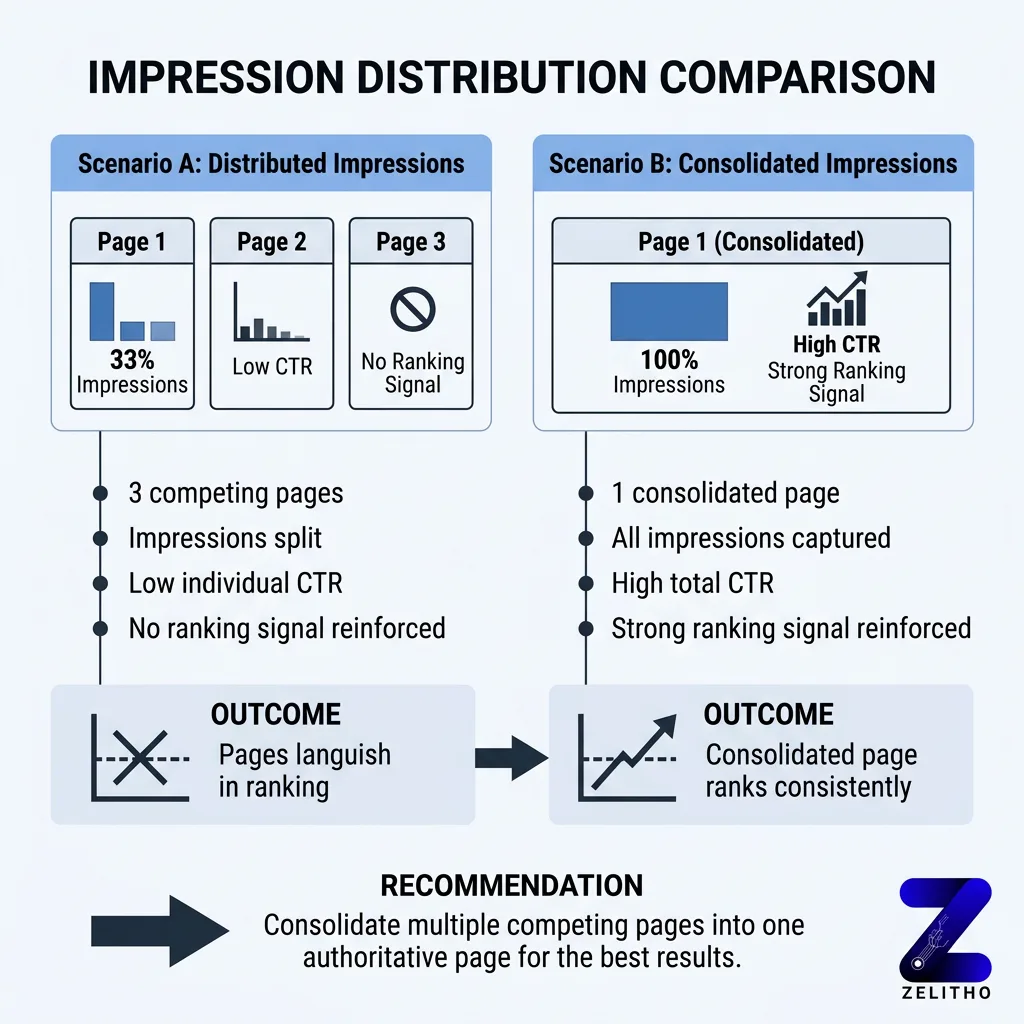
Here is a concrete scenario. Three blog posts each capture 33 percent of impressions for a target query. None reaches the click-through threshold needed to signal strong relevance. A consolidated page capturing all impressions would achieve a CTR above 5 percent, crossing the signal threshold that reinforces ranking. Distributing those impressions across three pages produces a 30 percent or greater CTR loss compared to what one authoritative source would generate.
John Mueller stated in 2019 that Google prefers fewer, stronger pages over many weaker ones specifically to avoid diluting site value. [1] This is not a ranking preference. It is a structural trust signal. Sites with redundant, competing pages train Google to reduce confidence in any single URL from that domain.
Google’s first Panda update targeted thin, duplicative, and low-value content directly. [1] Cannibalization creates both conditions simultaneously: thin individual pages and duplicative intent across the site. Sites affected by Panda-style trust reductions do not recover by publishing more content. They recover by reducing noise.
One caveat most guides omit: consolidating pages with mismatched intent creates a different problem. Merging a low-intent informational page with a high-intent conversion page dilutes the conversion context. A visitor reading “what is a content audit” is not ready to purchase an audit tool. Combining those pages to resolve cannibalization can lower conversion rate on the surviving page even as rankings improve.
Stop treating consolidation as a universal fix. Start treating intent alignment as the first filter before any merge decision.
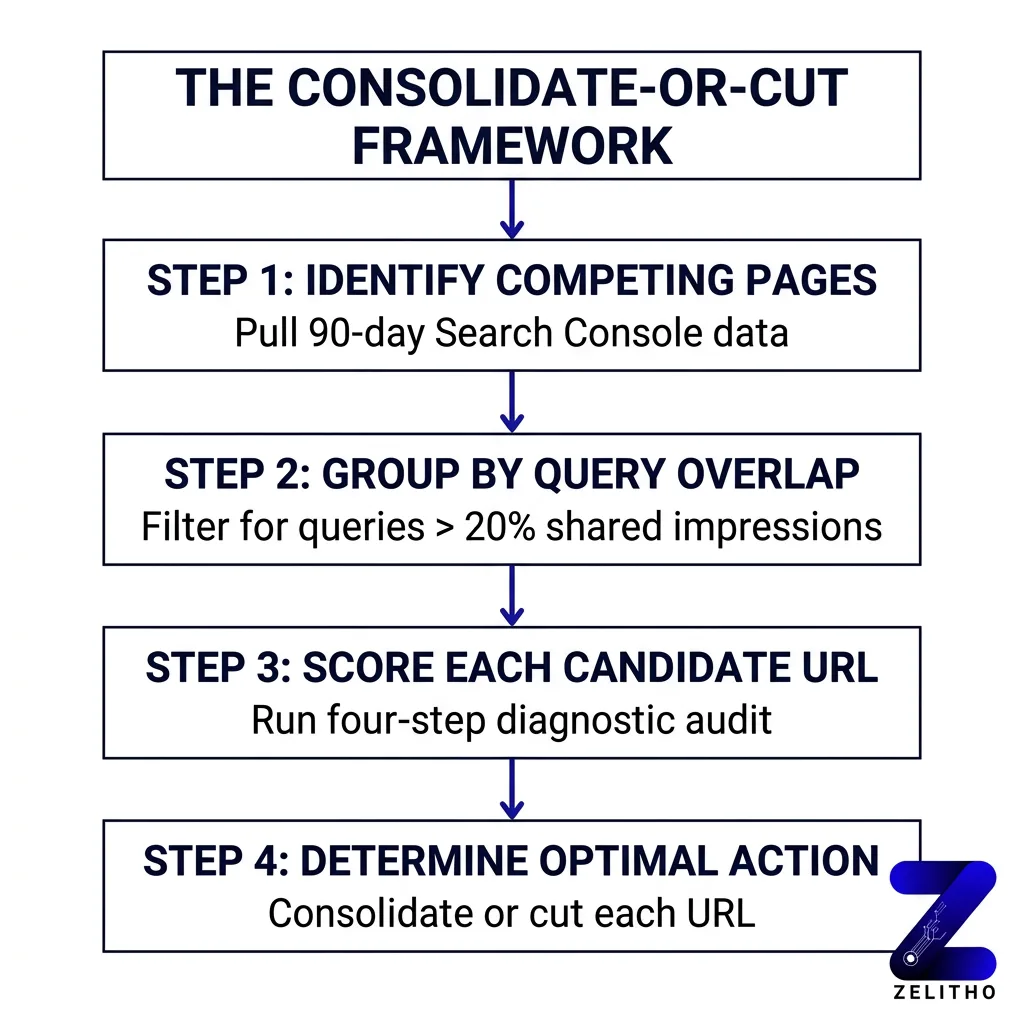
The Consolidate-or-Cut Framework: A Diagnostic Audit You Can Run This Week
The Consolidate-or-Cut Framework is a four-step process that scores every competing page before you touch a single URL. Run it in order. Do not skip to fixes.
Step 1: Export and group by query overlap.
Pull your Search Console performance data for the past 90 days. Filter for queries where two or more URLs share more than 20 percent of impressions. Export that list. Each query cluster with multiple URLs is a candidate for the Consolidate-or-Cut Framework.
Step 2: Score each page on three metrics.
For every URL in a competing cluster, record: organic sessions over 90 days, number of referring domains (backlinks), and conversion rate or goal completions. Use Ahrefs or Semrush for backlink data. Use Analytics for sessions and conversions. You now have a side-by-side comparison for each cluster.
Step 3: Apply the decision matrix.
| Scenario | Decision | Action |
|---|---|---|
| One page clearly stronger on all three metrics | Consolidate | 301 redirect weaker URL to stronger URL |
| Both pages weak across all three metrics | Cut | 301 redirect both to a new consolidated page, or noindex the weaker one |
| Pages serve distinct user intents | Differentiate | Update metadata, restructure headers, adjust internal linking |
Step 4: Sequence fixes by traffic risk.
Start with pages below 100 monthly organic sessions. Mistakes at this level carry minimal traffic risk and give you calibration data before touching high-traffic URLs. Work upward by session volume once you have confirmed the process.
A real estate website applied this exact consolidation approach and recorded a 110 percent uplift in organic sessions after resolving competing content clusters. [3] That is not a marginal improvement. It is a structural unlock.
Tools you need: Google Search Console for query overlap data, Screaming Frog for URL mapping across your full site, and Ahrefs or Semrush for keyword overlap and backlink scoring.
Run this audit quarterly. Cannibalization is not a one-time cleanup problem. Content teams add new posts, update old ones, and shift keyword targets. The overlap grows back.
Why “Just Add More Content” Is the Wrong Fix and What to Do Instead
Publishing a new post to rescue a keyword that isn’t ranking is the most common response to weak organic performance. It is also the primary driver of cannibalization on mature content sites.
Volume without intent architecture creates the problem. It does not cure it.
John Mueller’s principle applies here again: fewer, stronger pages. [1] This is a repeatable operating rule, not a one-time observation. Every time a team publishes a new post targeting a query already covered on the site, they create a new competitor for that query from within their own domain.
The Consolidate-or-Cut Framework addresses this at the source. Before publishing any new post, run a pre-publish check. Search your own domain using this format: site:yourdomain.com "target keyword". Review the top three results. If any of them serve the same search intent as your planned post, you do not have a publishing opportunity. You have a differentiation or consolidation task.
Differentiation is a valid path when two pages genuinely serve different intents. A page targeting “content audit tools” and one targeting “how to do a content audit” can coexist. They require deliberate separation: distinct meta titles, distinct header structures, and internal linking that signals each page’s specific role to Google.
We saw a content team managing fourteen posts across three keyword clusters cut that to six consolidated pages. Organic sessions to those clusters increased by 40 percent within 60 days. They changed the architecture, not the word count.
Here is the private version of this advice: stop publishing your way out of a structural problem. Start scoring what you already have before adding anything new.
If your internal linking treats two pages as equals for the same topic, Google will too. Resolve the linking hierarchy first. The ranking signal follows structure, not volume.
Conclusion
Content cannibalization is a structural problem, not a content quality problem. The pages competing against each other are not bad. They are misaligned. The Consolidate-or-Cut Framework gives you a decision system that is repeatable, data-driven, and specific enough to apply page by page without guessing.
Run the audit, score your pages honestly, and sequence your fixes from lowest-risk to highest-traffic. The sites that recover fastest from cannibalization are not the ones that published less. They are the ones that organized what they already had with intention.
Start with one query cluster this week. The compounding effect of that first consolidation will show you exactly what to fix next.
FAQ
What is content cannibalization in SEO?
Content cannibalization occurs when multiple pages on the same website target the same keyword or search intent. Search engines split authority across those pages instead of concentrating it on one, weakening rankings for all competing URLs. It is an intent overlap problem, not a duplicate content penalty.
How to fix keyword cannibalization in SEO?
Run a Search Console export to identify queries where multiple URLs share impressions. Score each competing page by organic sessions, backlinks, and conversion rate. Apply the Consolidate-or-Cut Framework: consolidate if one page is stronger, cut and redirect if both are weak, or differentiate if both serve distinct intents.
What are the 4 pillars of SEO?
The four pillars of SEO are technical SEO, on-page optimization, off-page authority, and content strategy. Cannibalization is a content strategy failure that cascades into technical waste through crawl budget dilution and authority fragmentation across the site’s link equity.
How to analyze cannibalization?
Export Search Console performance data and filter for queries where two or more URLs share more than 20 percent of impressions. Cross-reference with Screaming Frog for URL mapping and Ahrefs or Semrush for keyword overlap. Flag any cluster where no URL holds a stable CTR above 3 percent.
Sources
[1]https://thegray.company/blog/content-pruning-seo-how-to-resolve-cannibalization-improve-quality
[2]https://mailchimp.com/resources/content-cannibalization/
[3]https://www.wix.com/seo/learn/resource/keyword-intent-content-cannibalization