
How SEO Content Management Works: Roles, Skills, and Tasks You Need to Know

TL;DR
You published a batch of optimized articles last quarter. Rankings moved, then stalled. Now you’re staring at a Search Console report that shows 40 URLs dropping simultaneously, and no one on your team owns the diagnosis.
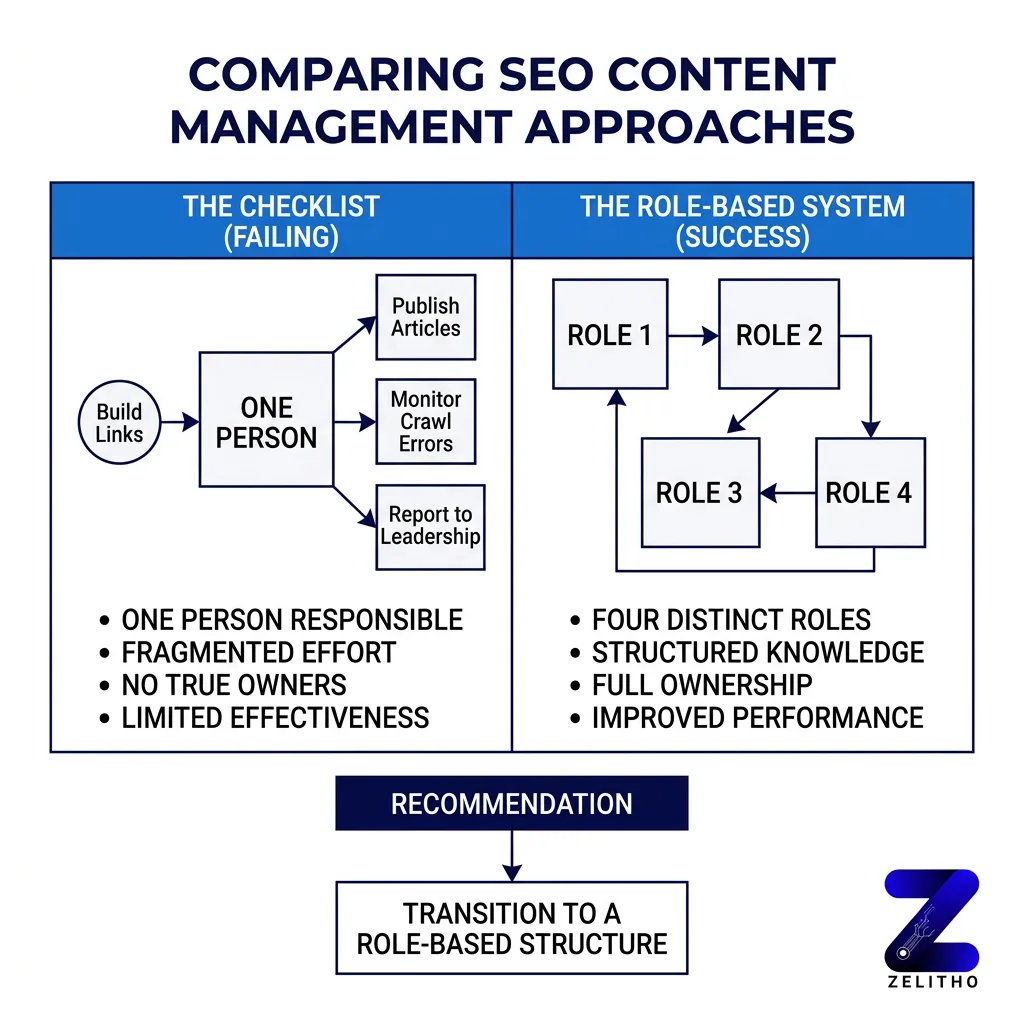
Most teams treat SEO as a checklist attached to content production. That framing fails because it assigns one person to a system that requires four distinct roles, each with non-overlapping responsibilities.
This guide maps those roles, names the skills each one requires, and connects both to the SEO Task Stack. The SEO Task Stack is a three-layer weekly rhythm separating monitoring from optimization from strategy. It is built for senior marketers, founders scaling content, and agency owners who need structure, not more tools.
What Is SEO Content Management?
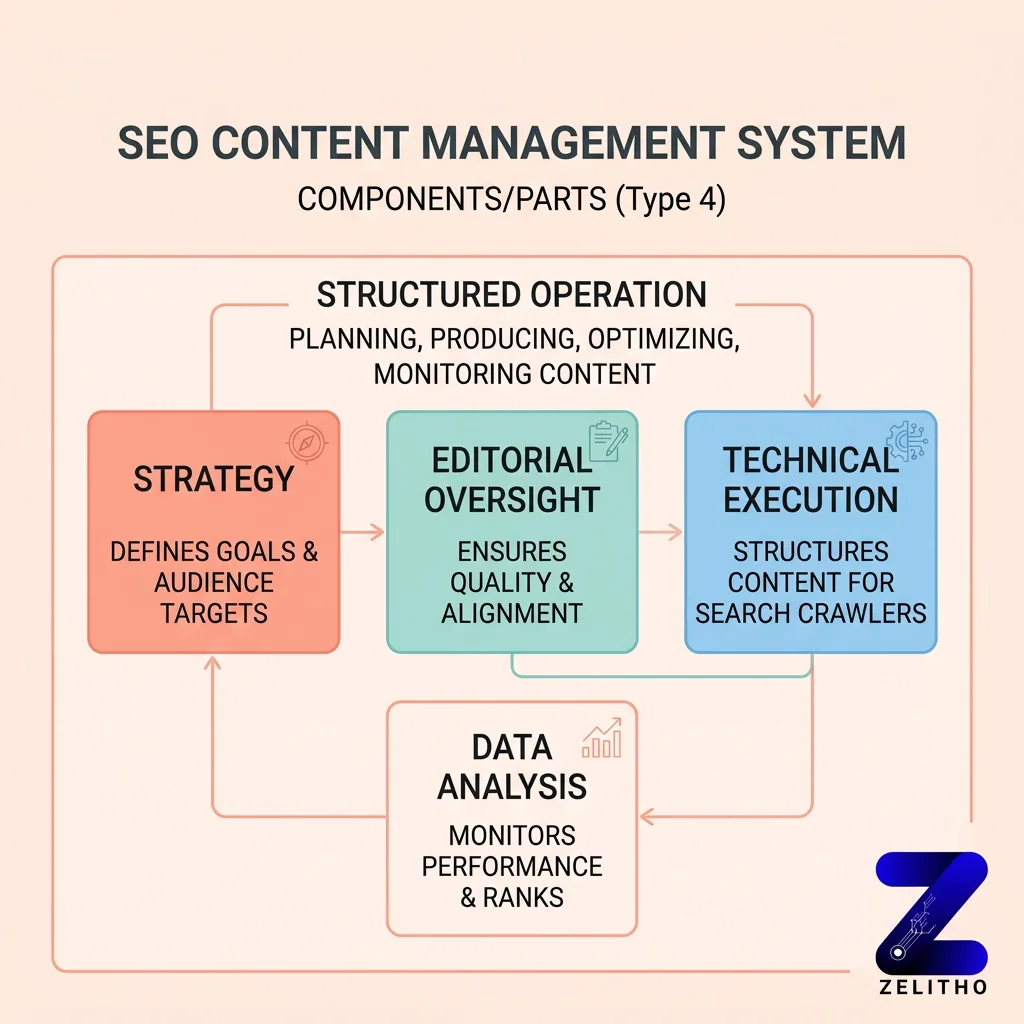
SEO content management is the structured operation of planning, producing, optimizing, and monitoring content so it ranks and holds position. It is not a single job function. It is a system of roles working across strategy, technical execution, editorial oversight, and data analysis.
Teams that define this system outperform teams that assign it to one generalist.
The Core Roles Inside an SEO Content Operation (And What Each One Actually Owns)
Every underperforming SEO operation shares one trait: too many tasks assigned to one person.
That single person publishes articles, monitors crawl errors, builds links, and reports to leadership. None of those tasks get done well, because none of them have a real owner.
Nearly 70 percent of SEO specialists hold a bachelor’s degree [1]. That signals the field expects structured knowledge, not just tool familiarity. The roles below reflect that expectation.
| Role | Primary Focus | Key Output |
|---|---|---|
| SEO Strategist | Keyword mapping, search intent, site architecture | Content roadmap, topic clusters |
| Content Manager | Editorial production, briefing writers, publishing | Optimized, published content |
| Technical SEO Specialist | Crawlability, indexation, Core Web Vitals | Site audit reports, fix documentation |
| SEO Analyst | Traffic data, rank tracking, performance reporting | Weekly dashboards, anomaly flags |
| Link Builder | Backlink acquisition, digital PR, outreach | Domain authority growth, link reports |
Each role owns a distinct output. When those outputs overlap without clear assignment, work gets duplicated or skipped entirely.
Here is a concrete scenario. A content manager publishes 60 optimized articles over three months. No analyst reviews crawl data during that period. By month four, keyword cannibalization has spread across 50-plus URLs. Two articles targeting the same query split ranking signals, and neither reaches page one. Fixing it requires a full content audit and redirect mapping that takes six weeks.
That outcome is not a content quality problem. It is an ownership problem.
This article does not rank these roles by importance or suggest org chart templates. It maps ownership so teams can assign work clearly and stop losing ground to preventable gaps.
The Skills That Separate Functional SEO Teams from Ones That Plateau
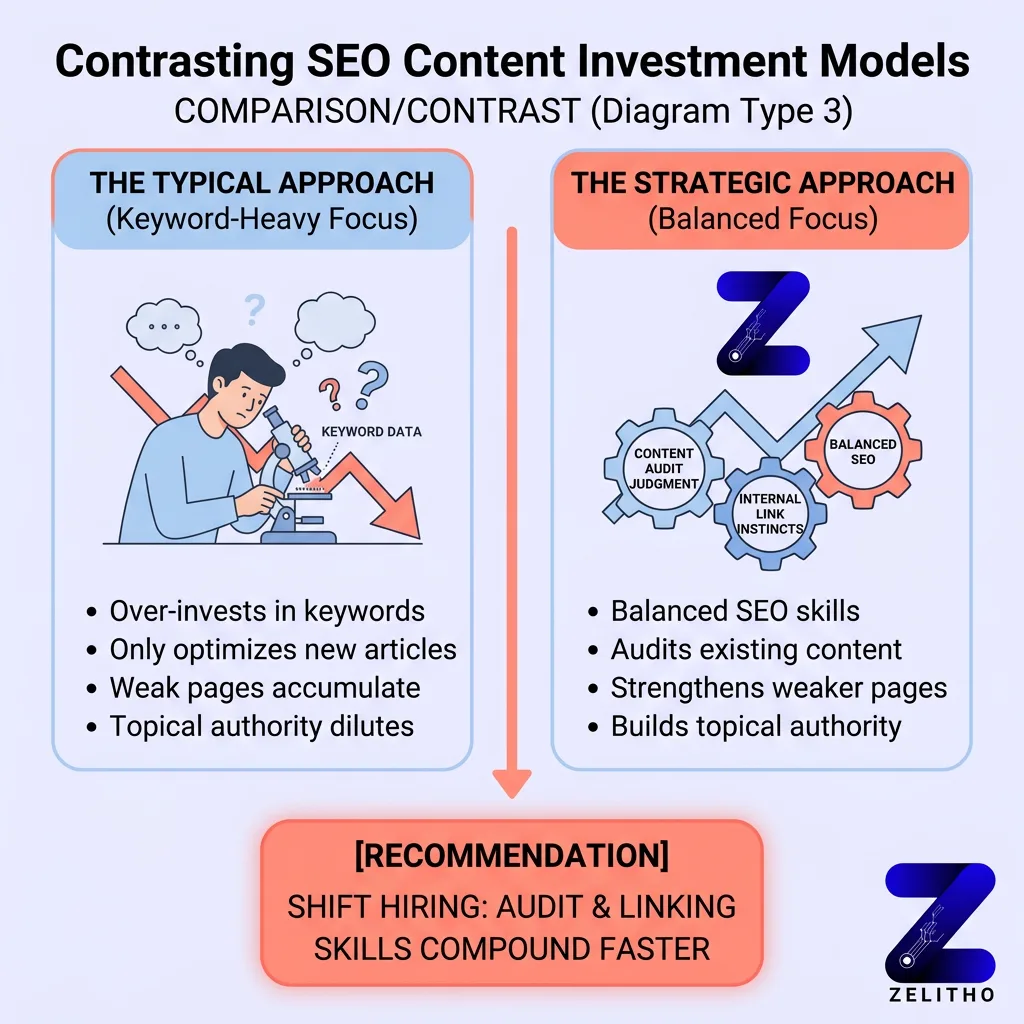
Stop hiring for keyword research fluency alone. Start auditing for content audit judgment and internal linking instincts.
Most teams over-invest in keyword research skills. They under-invest in content auditing and internal linking, two tasks that compound faster than new content production. A team that publishes 20 new articles per month but never audits existing content will outpace itself within a year, accumulating weak pages that dilute the site’s topical authority.
Segment the required skills into three categories.
Technical skills include crawl analysis, schema markup implementation, and Core Web Vitals diagnostics. These skills live primarily with the Technical SEO Specialist but should be understood at a functional level by the Content Manager. A Content Manager who cannot read a crawl report will publish pages that never get indexed.
Analytical skills include GA4 interpretation, Search Console diagnostics, and rank tracking. These belong to the SEO Analyst. The gap most teams feel here is not tool access. It is the ability to distinguish a traffic drop caused by algorithm updates from one caused by a competitor refreshing a single high-volume article.
Interpersonal skills are the least discussed and the most limiting. Briefing writers clearly, aligning with developers on technical fixes, and communicating SEO value to a skeptical CFO are skills that determine whether the SEO operation gets resources or gets cut.
The median US salary for SEO specialists is $86,000 per year [1]. That compensation reflects specialization. It also reflects the expectation that these professionals influence decisions across departments.
The operational implication is direct. Run a quarterly skill audit across these three categories before adding new tools or headcount. Most teams discover they are missing analytical skills, not technical ones. That gap usually explains a plateau faster than any tool limitation does.
Daily and Weekly Tasks That Keep an SEO Content System Running
Vague SEO to-do lists do not hold. A list that reads “monitor rankings, update content, fix errors” assigns nothing to anyone and creates no rhythm.
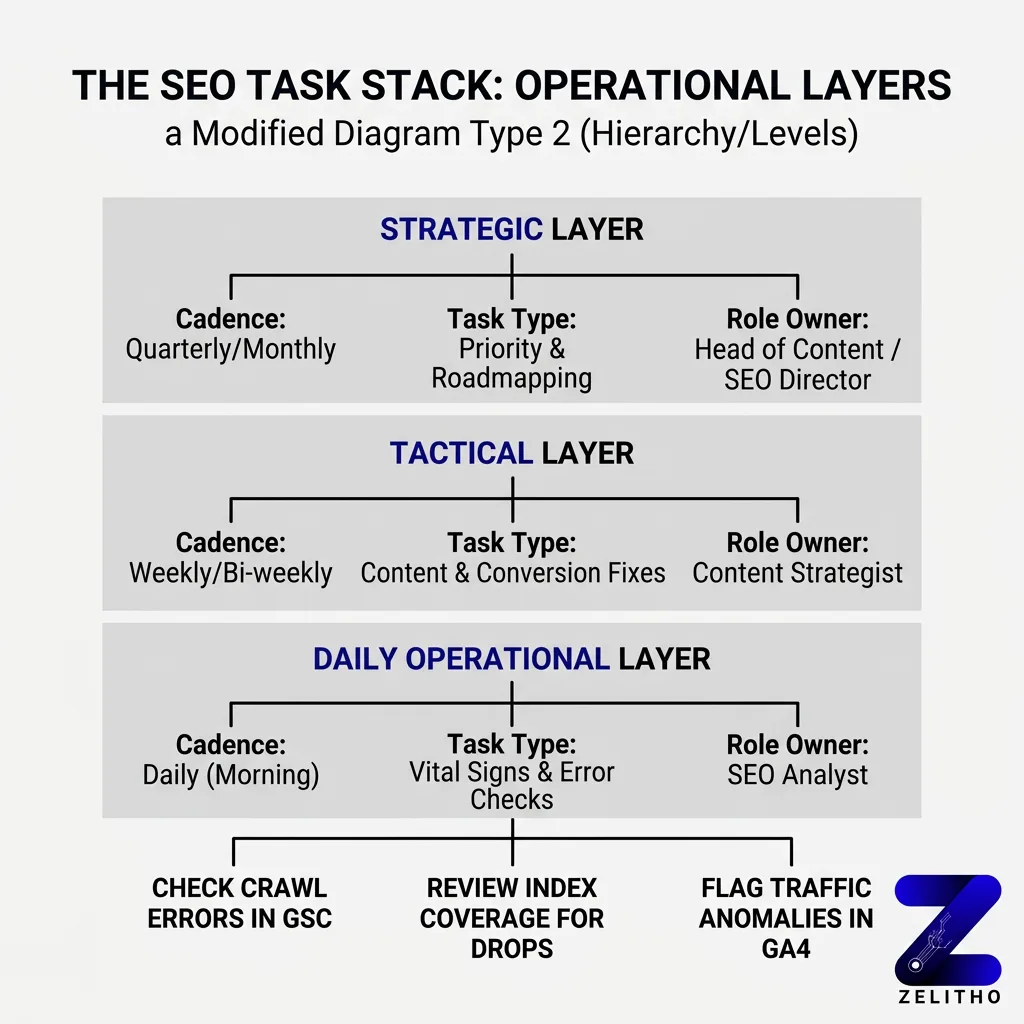
The SEO Task Stack replaces that list with three operational layers. Each layer has a cadence, a task type, and a role owner.
Daily monitoring tasks belong to the SEO Analyst.
- Check crawl errors in Google Search Console
- Review index coverage for new drops or spikes
- Flag traffic anomalies in GA4 before they compound
- Monitor Core Web Vitals for any degradation after deploys
These tasks take 20 to 30 minutes. They are not optional. A crawl error left undiagnosed for five days can mean a newly published article never gets indexed during its highest momentum window.
Weekly optimization tasks belong jointly to the Content Manager and SEO Analyst.
- Update underperforming posts based on rank tracking data
- Refresh meta titles and descriptions on pages with low click-through rates
- Run internal link audits to identify orphaned pages
- Review competitor content updates on shared keyword targets
Skipping weekly optimization for six weeks produces a measurable outcome. Pages where competitors are actively refreshing content typically see a 15 to 25 percent traffic decline over that window. That is not speculation. That is the compounding effect of static content in a field where freshness signals matter.
Monthly strategy tasks belong to the SEO Strategist.
- Run a content gap analysis against top three competitors
- Benchmark rank movement across priority keyword clusters
- Align the content calendar with search trend shifts
- Audit internal linking structure against the site’s topic cluster model
The SEO Task Stack works because it separates task types. Monitoring tasks require speed and consistency. Optimization tasks require judgment. Strategy tasks require pattern recognition across longer time horizons.
Mixing those into one undifferentiated list guarantees the urgent monitoring tasks crowd out the high-value strategy work. Assign each layer to a specific role. No task in the SEO Task Stack should be orphaned.
How AI and Automation Are Reshaping SEO Roles Without Eliminating the Need for Judgment
The worry underneath most AI conversations in SEO is direct: will these tools make the roles redundant?
They will not. Here is why.
AI handles volume. It does not handle judgment. Those are different functions, and conflating them is how teams end up with programmatically generated content that passes no quality threshold and ranks for nothing.
Specific AI use cases that add genuine leverage to an SEO content operation:
- Automated content briefs: AI tools can scan top-ranking pages and generate structural briefs in minutes. A human strategist still reviews intent alignment and edits for brand voice.
- Programmatic meta description generation: Useful at scale for large sites. Requires human spot-checking for accuracy and click-worthiness.
- AI-assisted internal linking suggestions: Tools can surface link opportunities across hundreds of pages. A Content Manager decides which suggestions serve the reader and which create noise.
- Anomaly detection in rank tracking: AI can flag ranking drops faster than manual review. An analyst interprets the cause.
| Task | AI Handles | Human Review Required |
|---|---|---|
| Content brief structure | Aggregates top-ranking page data | Intent alignment, brand fit |
| Meta description drafts | Generates at scale | Accuracy, tone, click-through quality |
| Internal linking suggestions | Surfaces anchor text opportunities | Reader relevance, link equity logic |
| Rank anomaly detection | Flags statistical outliers | Diagnoses root cause |
The marketing industry is projected to grow at 6 percent between 2023 and 2033 [1]. That growth is not happening because AI is simplifying SEO into fewer roles. It is happening because search complexity is increasing. More content, more competition, more algorithm surface area.
AI accelerates specific tasks within that complexity. It does not reduce the number of judgment calls required. Each role in the SEO content operation needs a defined list of tasks where AI assists and tasks where human review is mandatory.
Without that list, teams default to using AI everywhere, skipping review, and publishing content that accumulates without compounding.
Conclusion
SEO content management works when roles are defined, skills are matched to those roles, and tasks are organized into a repeatable system. The SEO Task Stack introduced here, covering daily monitoring, weekly optimization, and monthly strategy, only holds if ownership is clear. Without that clarity, teams duplicate effort, miss technical issues, and publish content that competes against itself. The field is not shrinking. With the marketing industry growing at 6 percent through 2033 [1] and AI adding complexity rather than removing it, demand for structured SEO operations will increase. The teams that compound fastest are not the ones with the most tools. They are the ones with the clearest task ownership and the discipline to run the same system every week.
FAQ
What skills do SEO managers need?
SEO managers need skills across three categories: technical (crawl analysis, schema, Core Web Vitals), analytical (GA4 interpretation, rank tracking, Search Console diagnostics), and interpersonal (briefing writers, aligning with developers, communicating value to stakeholders). The interpersonal layer is the most overlooked and the most limiting. Without it, even strong technical work fails to get resourced or implemented.
Is SEO a hard skill?
Yes. SEO is a hard skill with measurable, learnable components: crawl analysis, keyword research, schema implementation, rank tracking, and data interpretation. Nearly 70 percent of SEO specialists hold a bachelor’s degree [1], and the median US compensation sits at $86,000 per year [1], both indicators of a specialized technical field rather than a general marketing function.
What is an SEO checklist?
An SEO checklist is a structured list of tasks organized by frequency and function. A functional version separates daily monitoring tasks (crawl errors, index coverage), weekly optimization tasks (content updates, meta refresh, internal link audits), and monthly strategy tasks (content gap analysis, competitor benchmarking). A checklist without assigned role ownership produces no consistent results.
What are the 5 C’s of content?
The 5 C’s of content are clarity, conciseness, consistency, credibility, and call to action. Clarity ensures readers understand the point without rereading. Conciseness removes filler that dilutes the message. Consistency builds topical authority over time. Credibility ties claims to data or direct experience. A clear call to action directs the reader’s next move.
What are the 3 C’s of SEO?
The 3 C’s of SEO are content, code, and credibility. Content covers what you publish and how well it matches search intent. Code covers the technical infrastructure that allows search engines to crawl and index it. Credibility covers the external signals, primarily backlinks, that signal trust to search engines. All three must function together for rankings to hold.