
How to Identify Keywords in Content Analysis

TL;DR
You open a content audit spreadsheet. There are 200 rows of terms, volume numbers, and color codes. Nothing tells you which terms actually reflect what the page is about.
Counting word frequency pulls surface patterns, not meaning. A term that appears twelve times may carry zero strategic weight. Chasing frequency alone leaves you with a list that looks complete but cannot drive a ranking decision.
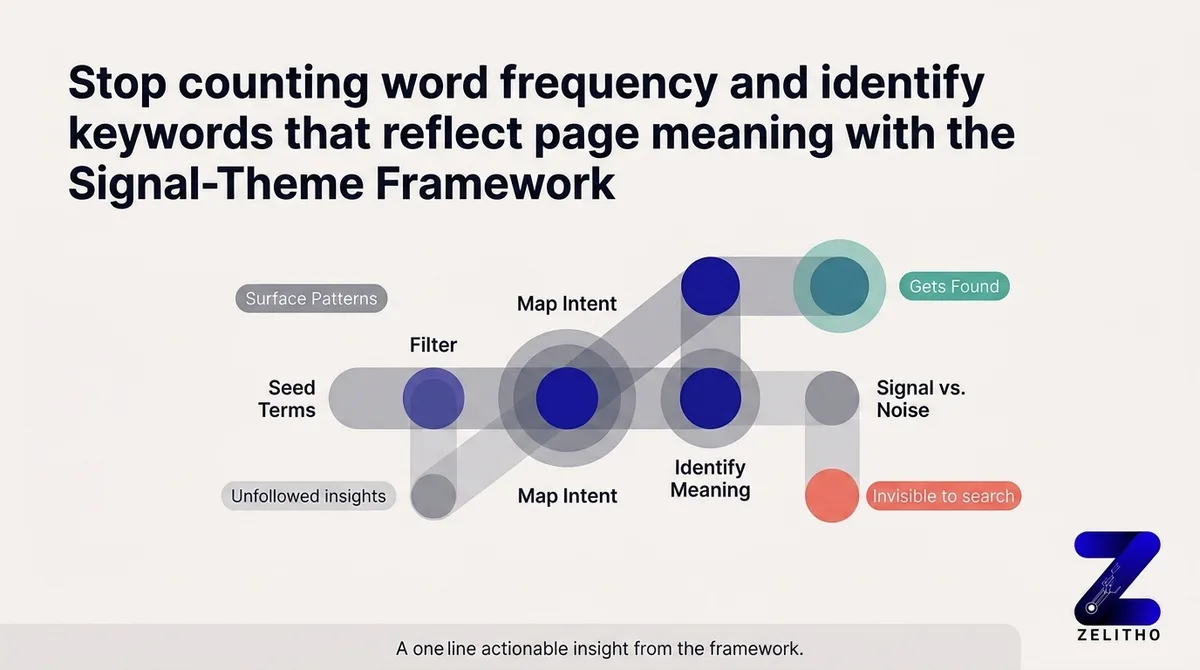
The Signal-Theme Framework fixes this. It runs four steps in sequence: collect seed terms, filter by relevance, align each term to intent, then group survivors into prioritized themes. Senior marketers at scaling companies use this method to stop rebuilding keyword lists from scratch every quarter. Founders use it to evaluate content before it publishes. Agency owners use it to audit client pages without guessing.
How do you identify keywords in content analysis?
Keyword identification in content analysis means extracting terms that reflect the page’s core purpose, not every word that appears frequently. You evaluate each candidate against relevance, intent alignment, and topic fit before keeping it. The Signal-Theme Framework gives you a repeatable four-step process to do that consistently across any piece of content.
Why Spotting Words Is Not the Same as Finding Keywords
Word frequency is a counting exercise. Keyword identification is a judgment exercise.
That distinction matters more than most content workflows acknowledge. Short-tail keywords run one to two words [4]. Long-tail keywords run three or more words [4]. Both types can appear on your page without being the terms that actually define what the content is about. Frequency does not tell you that. More than 85% of Google searches resolve through long-tail queries [6]. The meaningful signal in most content is buried in multi-word phrases, not in the high-frequency single terms that show up at the top of a word cloud.
Stop treating keyword identification as a mechanical scan. Start treating it as a meaning-extraction task.
Here is the false assumption that trips up most content teams: if a word appears often, it must matter. A page about “content strategy” might use the word “process” thirty times. “Process” is not a keyword for that page. It is a function word that moves sentences forward. The real keyword might be “editorial workflow,” which appears twice but carries the intent the reader typed into Google.
One agency owner ran a content audit for a SaaS client with 50 flagged terms per page. A tighter signal-based pass cut each list to under 20 terms. The removed terms were not wrong; they simply did not map to any rankable intent. The pages that received the trimmed, intent-aligned lists outperformed the bloated-list pages in crawl clarity within six weeks.
That gap between 50 terms and 20 actionable ones is not a vocabulary problem. It is a filtering problem. The next three steps solve it.
Step 1 and Step 2 , Collect Seed Terms, Then Filter Out the Noise
Seed collection starts before any tool opens.
Read the content once. Write down every phrase that could describe the topic to a stranger. Do not edit. Do not filter. A typical seed pass for a single article produces 13 candidates [1]. That number is not arbitrary. It reflects how many distinct conceptual angles a focused piece of content typically covers before ideas start repeating.
After collection, apply a structured filter. Each seed term gets evaluated against five criteria [1]: topical relevance, search intent alignment, specificity, competition fit, and content match. Any term that fails two or more of these criteria leaves the list before you move further.
Terms with fewer than 10 monthly searches [5] rarely return meaningful signal during analysis. That threshold is a practical floor, not a rule about quality. A term below that floor does not have enough search behavior data to tell you what kind of reader it attracts or what that reader expects to find. Keeping it wastes a prioritization slot.
One practical filter: separate terms that describe the content from terms that appear in the content. “Content analysis” describes the page. “Word frequency” appears in the page. Those are different relationships. Only terms that describe the content’s primary purpose pass through to intent alignment.
The signal-to-noise problem also shows up in list size. A starting pool of 50 unfiltered terms versus a curated list of 200 terms is not a volume win [7]. More terms mean more noise. Keeping 150 low-signal terms in your pool costs you positioning clarity on the 50 that actually matter [7]. Trim early. The filter is the work.
Five terms flagged during seed collection as lower-difficulty opportunities [1] deserve a separate holding column. Do not discard them yet. They become candidates again after intent matching in Step 3.
Step 3 , Match Every Term to an Intent Category Before You Keep It
Every term that survives the seed filter now gets one more check before it stays.
Four intent categories cover all search behavior [1][2]: informational, navigational, commercial, and transactional. Each one describes what the searcher planned to do before they typed the query. A term can be topically relevant to your content and still belong to the wrong intent category for your page’s purpose.
This is where most content teams lose accuracy. They keep terms that are adjacent to their topic but serve a different action. A product comparison page should carry commercial-intent terms. Keeping informational-intent terms on that page splits the semantic signal and tells search engines the page is less focused than it actually is. A sample keyword difficulty value of 69% [2] on a commercial-intent term you cannot own serves no purpose if the page is informational anyway.
Stop keeping terms because they feel related. Keep them because the intent matches what your page delivers.
The check itself takes one question per term: what would someone who typed this phrase do next? If the answer matches what your content lets them do, the term stays. If the answer describes a different action, the term leaves, even if the topic seems close.
Seven SERP feature types [2] appear across intent categories. Featured snippets and People Also Ask boxes cluster around informational queries. Product carousels and shopping ads cluster around transactional queries. The SERP composition of any surviving term tells you which intent category Google has already assigned to it. Use that signal. Do not override it by assumption.
Four intent types govern the full classification [1]. Run every surviving seed through this filter before grouping begins. What exits this step is a list of terms that are both topically relevant and intent-aligned. That is a materially different list than what entered Step 1.
Step 4 , Group Surviving Terms into Themes and Prioritize What the Content Can Actually Own
A flat keyword list is not a strategy. A theme map is.
Once your intent-aligned terms are confirmed, group them by the question they answer or the problem they address. Terms that answer the same reader question belong in the same theme cluster. A single article can own two or three theme clusters. Trying to own more than that dilutes its topical focus.
After grouping, apply a priority filter. Three dimensions control this decision: keyword difficulty, search volume, and content fit.
Keyword difficulty runs on a 0 to 100 scale across major tools [2]. Ahrefs scores difficulty from 1 to 100 [1]. Moz uses a 0 to 100 scale [1]. SEMrush reports difficulty as a 1 to 100 percent scale [1]. The scores are not identical across tools, but the direction is consistent. Higher scores mean more competing authority is already in place. A page with limited referring domain strength should not lead with terms at the high end of that scale.
Volume numbers require context. A term with 3,600 searches per month [2] and a realistic potential traffic of 150 visitors [2] is a different bet than a term with 165,000 monthly searches [2] and a potential traffic of 332 [2]. The math on a 60,500-volume term [2] that delivers an estimated 22,300 actual visitors [2] changes the picture entirely. Volume is not the priority signal. Potential traffic against realistic ranking position is.
Look at the data from live content to calibrate this. One term with 22,200 monthly searches holds rankings at positions 1, 2, and 3 simultaneously [1]. Another term at 8,100 monthly searches sits at position 76 [1]. Both have identical search volume potential. Their actual traffic contribution differs by an order of magnitude. Position determines delivery. Keyword selection determines whether a position is reachable.
Use this table to map your surviving terms during prioritization:
| Term | Potential Traffic | Difficulty Score |
|---|---|---|
| High volume, low fit | Low | High |
| Medium volume, strong fit | Moderate | Medium |
| Low volume, exact fit | Realistic | Low |
The third row is where new or mid-authority content wins. A term at 7,100 monthly searches holding positions 1 and 2 [1] did not get there through volume targeting alone. It got there because the page fit was precise. That precision starts at the theme-grouping step, not at publication.
One data point worth holding: a term ranked at position 39 [1] with 5,400 monthly searches represents a recoverable opportunity if the intent alignment is corrected and the theme cluster is tightened. That is not a lost keyword. It is a signal that the content is partially indexed for something it has not fully committed to. Theme grouping exposes those gaps.
Terms that ranked in positions 1 through 10 [7] belong in your primary theme cluster. Terms that rank between positions 11 and 30 represent your secondary cluster. Terms below position 30 either need a standalone content play or should be removed from the current page’s keyword set entirely.
The Signal-Theme Framework ends here with a structured output: two to three named theme clusters, each containing three to five intent-aligned terms, ranked by potential traffic against realistic difficulty. That output is actionable in a way a flat 200-row spreadsheet is not.
Signal over surface , how the Signal-Theme Framework changes what you keep
The Signal-Theme Framework does not add terms. It removes the wrong ones with a reason.
Seed collection gives you candidates. The five-criteria filter removes low-signal noise before it wastes your time in later steps. Intent matching removes topically close but purpose-misaligned terms before they dilute your content’s semantic focus. Theme grouping converts a flat list into a structure that reflects what the content actually covers. Priority scoring tells you which terms are reachable given your current authority and content fit.
What changes when you run this process is not your keyword count. What changes is your confidence in the terms that remain. Every item on the final list has passed a relevance filter, an intent check, a theme placement, and a priority screen. That is four decision points. A term that survives all four is worth building or optimizing content around.
The framework applies to any content type: audit, new production, or refresh. Run it once per piece of content and the guesswork about which terms matter stops.
Zelitho runs this entire pipeline from Keyword discovery, title generation to content SEO optimised content that you can directly push to your website in a single workplace.
FAQ
How to find keywords for content?
Start by reading the content and writing down every phrase that describes the topic. Then cross-reference those phrases against search data using a tool like SEMrush, Ahrefs, or Moz. Filter by relevance and intent before committing to any term. Volume alone is not a reliable selection criterion.
How do you identify keywords?
Keyword identification starts with seed collection and ends with intent alignment. You collect candidate terms, filter them against topical relevance and search behavior, then match each survivor to an intent category. A term that is topically adjacent but intent-misaligned does not qualify as a keyword for that page.
References and Citations
[1]https://www.pageonepower.com/linkarati/keyword-analysis
[2]https://www.semrush.com/blog/keyword-analysis/
[3]https://www.digitalassassin.co/blog/keyword-analysis-demystified
[4]https://www.thisisgain.com/post/mastering-keyword-research-for-effective-content-marketing
[5]https://alicerowancontentmarketing.com/blog/keyword-research-finding-meaning-data
[6]https://www.marketingexamined.com/blog/tips-for-finding-and-using-keyword-opportunities-in-your-content
[7]https://www.clickrank.ai/identify-missing-keywords-in-content/