
What Is the Keywords Project?


TL;DR
You ran content research and pulled a list of terms. The list looked useful. You built around it. But the framework you were working from had a defined scope, and you were outside it.
Most researchers treat keyword frameworks as neutral inventories. They extract terms, assign meaning, and move forward. That misses the point entirely. A structured research initiative is not a vocabulary list. It has boundaries, methods, and a specific intellectual lineage. Ignoring those limits produces citations that don’t hold and analysis that drifts.
The Keywords Project traces how specific words shift meaning across cultural and historical periods. It connects Raymond Williams’s 1976 foundational work to volumes developed through the 2020s. Scholars, content strategists, and research teams who understand its actual structure get sharper historical analysis. Those who don’t waste time applying the wrong tool to the right question.
A Bounded Inquiry, Not a General Language Resource
Here is the false assumption worth naming early: a keyword list is not a vocabulary reference.
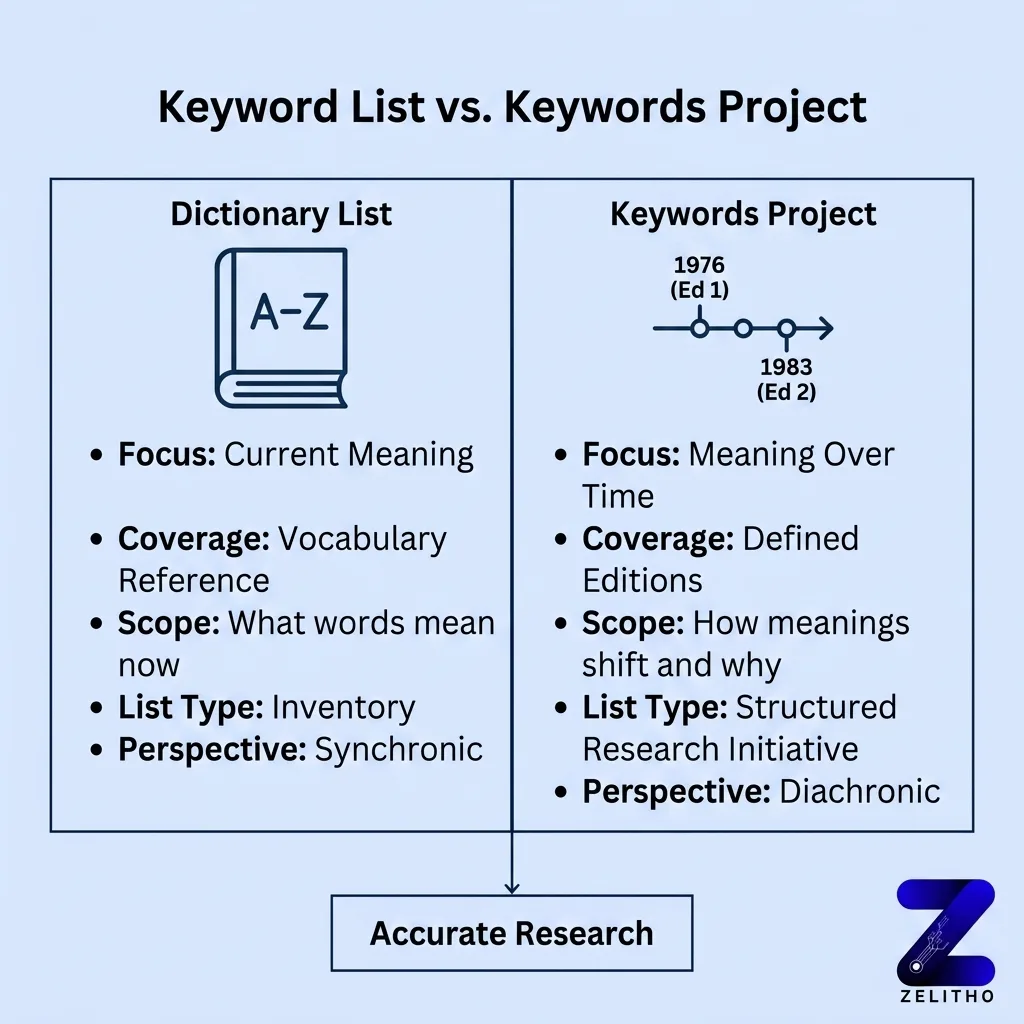
A vocabulary reference tells you what a word means now. The Keywords Project tells you how a word has meant different things across time and why those shifts happened. That distinction changes how you use it.
The project maintains specific lists tied to defined editions. The keyword lists cover Raymond Williams’s first edition from 1976, his second edition from 1983, and a related volume from 2005 [1]. Each list is anchored to a publication and a moment. They do not update automatically as language changes.
A proposed keyword list was assembled by the project team between 2007 and 2009 [1]. A second proposed list came from a presentation in January 2011 [1]. Those are fixed reference points, not ongoing feeds. If you treat them as current, you will misread the data.
Resource Type | What It Tracks | What It Does Not Do |
|---|---|---|
General dictionary | Current definitions | Historical meaning shifts |
The Keywords Project | Semantic change across time | Prescribe correct word use |
Open corpus tool | Frequency and co-occurrence | Interpret cultural context |
Stop mining keyword lists for definitions. Start reading them as records of contested meaning at specific historical moments.
The practical consequence of misuse is not minor. A researcher building an argument around a term like “culture” or “welfare” without checking its position in the project’s framework may be arguing against a meaning that no longer applies, or citing a meaning that the project explicitly disputes.
That is time lost to re-work. It is also a credibility gap that reviewers will catch.
What Is the Keywords Project, and How Does It Work?
The Keywords Project is a structured academic initiative. It maps how specific words acquire, shift, and lose meaning across distinct historical and cultural contexts.
It is not a general dictionary. It does not define words in their current form. It traces how meaning changes, and why those changes matter for understanding culture.
The project connects directly to Raymond Williams’s 1976 work, which is treated as the foundational reference point for all subsequent keyword research [3]. Later volumes and lists extend that lineage into contemporary scholarship.
How the Project Tracks Semantic Ambiguity and Shifting Meaning
Words enter the Keywords Project because they are contested, not because they are common.
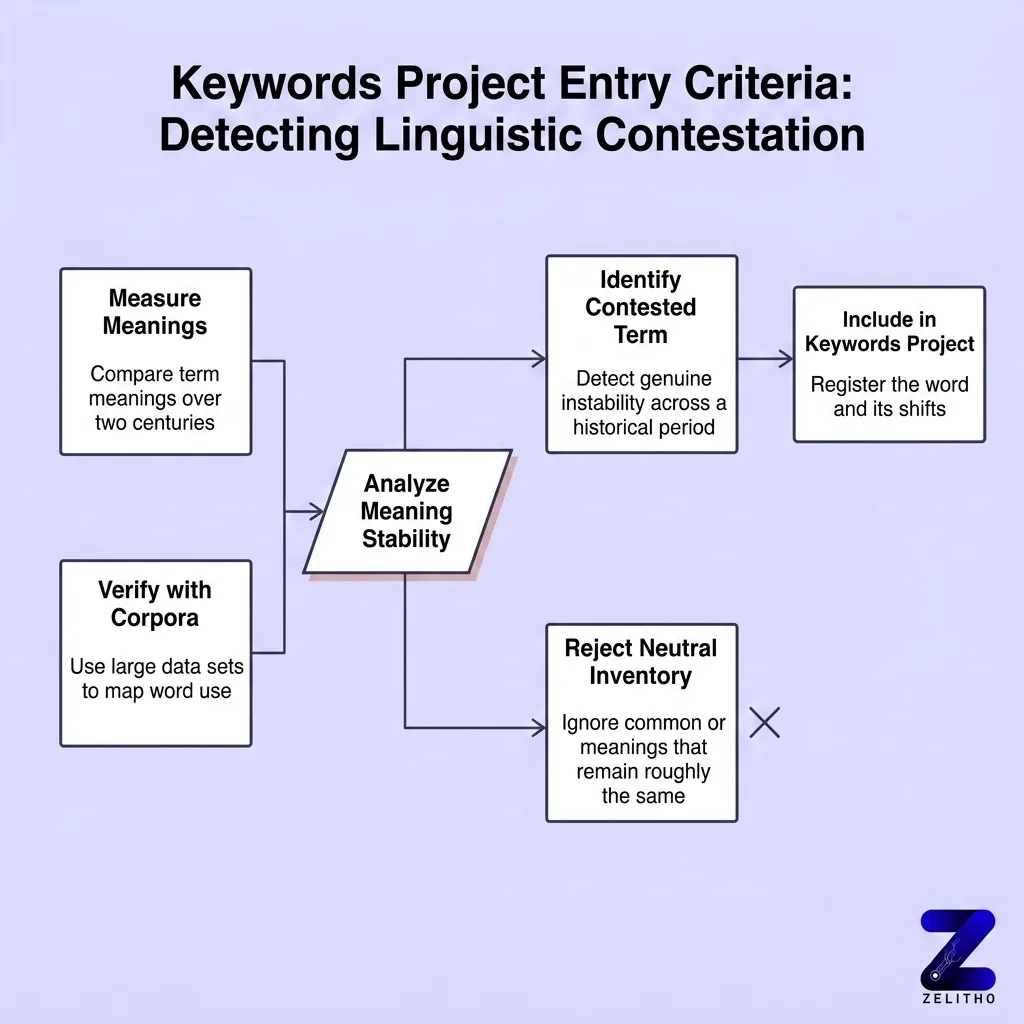
The selection logic matters. A term qualifies for inclusion when its meaning has been genuinely unstable across a historical period. That instability is the signal. If a word means roughly the same thing across two centuries, it is not a candidate. If it has shifted meaning under pressure from social, political, or economic change, it belongs.
The project draws on large corpora to verify and map those shifts. One Google Books study describes a digitized corpus containing about 4% of all books ever printed [1]. That corpus includes 155 billion words of US English and 34 billion words of British English [1]. Scale like that allows researchers to track frequency changes across decades and spot when a word’s usage pattern breaks from its prior trajectory.
Scale alone does not produce interpretation. The historical thesaurus referenced in the project’s resources contains 800,000 words and meanings across 235,000 entry categories [1]. That depth provides the semantic scaffold. Researchers can place a word inside a meaning cluster and see how the cluster evolved over time.
The mechanism works in three steps. First, identify a word with documented instability. Second, locate it within a corpus large enough to show longitudinal patterns. Third, interpret those patterns against a structured category framework rather than treating frequency as meaning.
Stop counting how often a word appears and start asking when its meaning broke from what came before.
That break point is what the Keywords Project is designed to find.
What You Lose When You Treat Word Lists as Neutral Inventories
Neutral inventories do not exist.
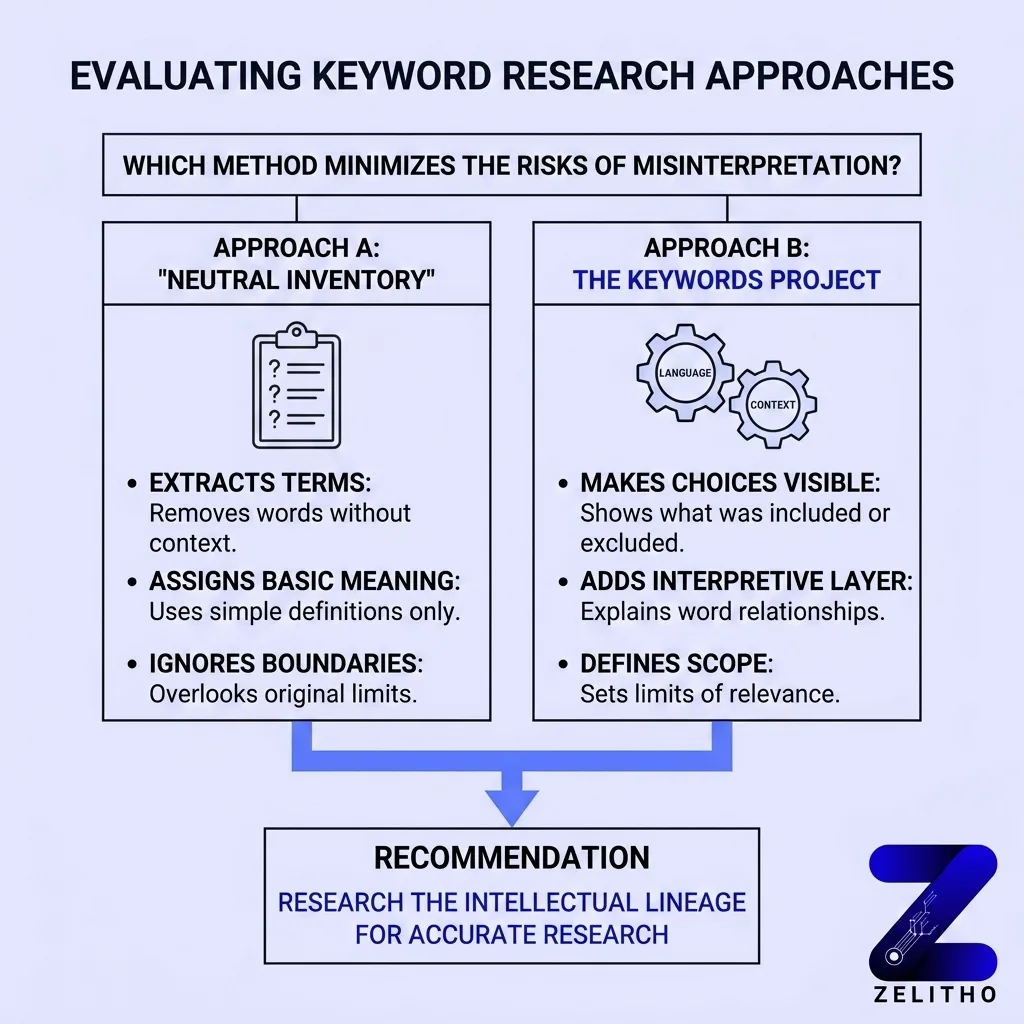
Every word list reflects a set of choices: which words were included, which were excluded, and what framework justified those decisions. The Keywords Project makes those choices visible. That is part of its value. A researcher who ignores that framing loses the interpretive layer and keeps only the terms, which is the least useful part.
The risk is specific. Williams’s first edition in 1976 carried an explicit theoretical argument about the relationship between language and culture [3]. That argument shaped which words made the list. If you extract the list without the argument, you have a set of terms with no selection logic. You will not know why “class” appears and “nation” does not, or why “creative” is treated as analytically significant when many researchers assume it is stable.
This error appears in practice. A research team used a keywords list to code primary sources in a content audit. They tagged terms based on presence alone. When they tried to interpret patterns, the codes did not hold because the same word carried two different meanings across the source period. They had to recode the entire set. That took three weeks they had not planned for.
The correction is structural, not cosmetic. The keyword lists from 1976, 1983, and 2005 are not interchangeable [1]. Each reflects the state of the argument at that moment. A word that appears in the 1983 list may have been excluded from 1976 for a documented reason. That reason is part of the data.
The second proposed keyword list, presented in January 2011, introduced additional terms that reflected scholarship developed after the 2005 volume [1]. Treating the 2011 list as a simple extension of 1976 erases twenty-five years of interpretive development.
The interpretive layer is not decoration. It is the product.
Where the Project’s Scope Begins and Ends Across Time and Volume
The Keywords Project has a start point, and it has edges.
The foundational moment is 1976 [3]. That is when Williams published the first edition that the entire framework references. Everything built after that either extends his argument or responds to it. No part of the project operates outside that lineage.
The keyword lists developed between 2007 and 2011 represent the primary scholarly expansion during that period [1]. Those lists were produced through a structured process, not assembled informally. They are tied to the project’s institutional work and should be cited accordingly.
The project extended further in late 2019 [2]. A pandemic-focused volume was developed around that period, with publication following in 2022 [2]. That volume shows the project’s capacity to address contemporary crises through the same framework. It does not replace earlier volumes. It runs alongside them with a defined thematic scope.
The active timeline currently extends through 2024 to 2025, with related work projected into 2026 [3]. That means the project is live. New volumes and institutional programs are still producing material within this framework.
The project does not cover all language change across all periods. It focuses on specific contested terms within a cultural tradition rooted in English-language scholarship. Researchers working outside that tradition, or working with scientific or technical vocabulary, are likely outside the project’s scope.
The institutional home matters too. The project connects to university presses and humanities programs with named annual topics [3]. Citing “the Keywords Project” without specifying which volume, which list, and which institutional context produces citations that reviewers cannot verify.
Precision here is not pedantry. It is the condition for the work to hold.
Why Bounded Keyword Frameworks Produce Sharper Historical Analysis Than Open Corpora
Open corpora give you scale. Bounded frameworks give you position.
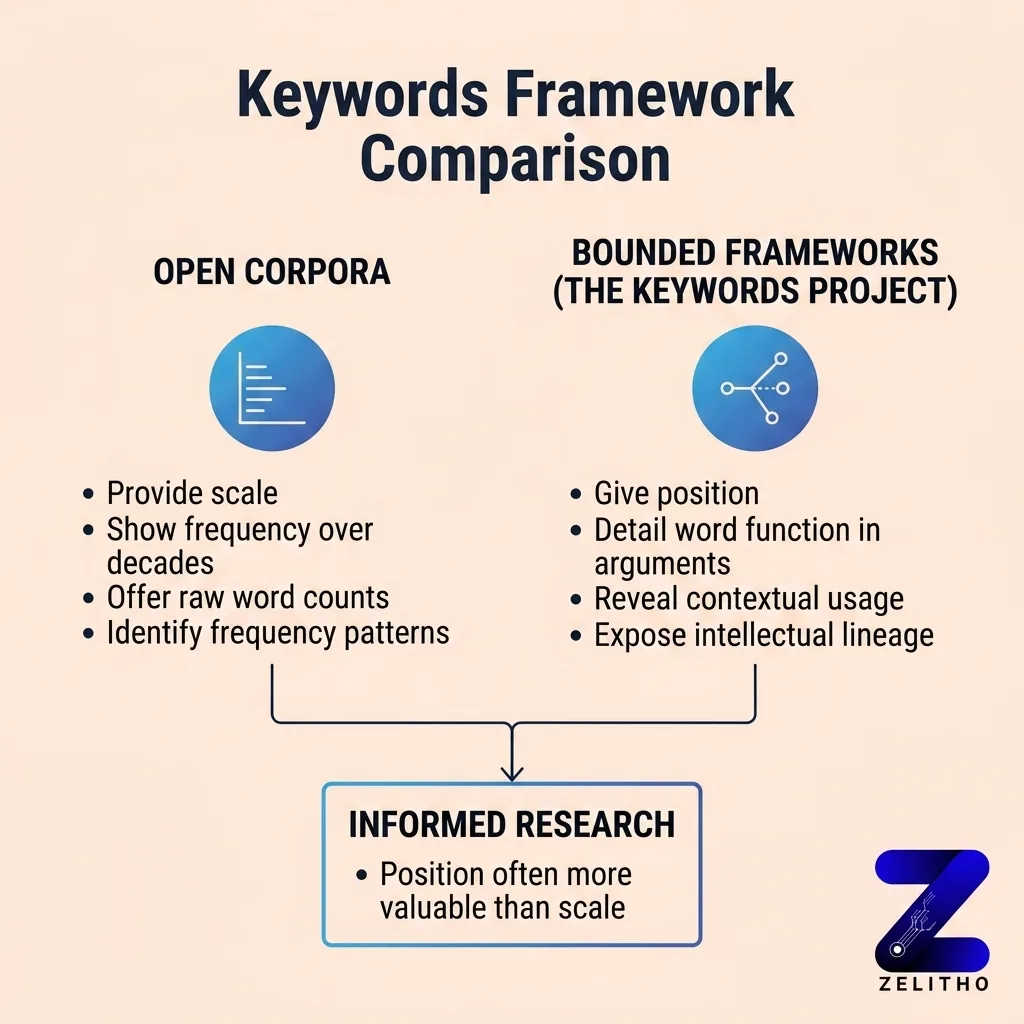
Scale tells you how often a word appeared in a given decade. Position tells you what that word was doing in a contested cultural argument, and who was using it against whom. Those are different questions, and most research needs the second one more than the first.
The Keywords Project works as a bounded inquiry because its limits are explicit. You know which editions anchor the lists [1]. You know the timeline of expansions, from the foundational 1976 publication through the 2022 volume and into the current 2024 to 2026 activity [2][3]. You know the selection logic: words are included because they are contested, not because they are frequent.
That explicitness makes citations defensible. A researcher who cites an open corpus finding can only say “this word appeared more often after 1950.” A researcher who cites the Keywords Project can say “this word entered a documented period of semantic instability and here is the framework that maps it.”
One argument is descriptive. The other is analytical. Editors, reviewers, and research teams can tell the difference immediately.
The bounded framework also resists scope creep. Knowing where the project ends tells you when to stop drawing from it and when to switch to a different tool. That discipline tightens the analysis. It stops you from building arguments on analogies the framework does not support.
Stop treating broader coverage as a research advantage. A scoped framework with clear entry points produces results you can defend, and that separates productive research from expensive re-work.
FAQ
In the Keywords Project context, examples include contested cultural terms like “class,” “culture,” “creative,” and “welfare.” These words appear because their meanings shifted significantly across historical periods, not because they are the most common words in use. Each example carries an interpretive record, not just a definition.
The main purpose of keywords in this framework is to mark sites of contested meaning. A keyword signals that a word has carried different, often conflicting meanings across cultural and historical contexts. The goal is not to define the word but to map how its meaning changed and why.
The Keywords Project does not use a four-type classification. In broader research practice, keywords are sometimes grouped by function: descriptive, contested, disciplinary, and operational. The Keywords Project focuses primarily on contested terms where meaning has shifted across cultural and historical periods.
References and Citations
[1]https://keywords.pitt.edu/resources.html
[2]https://keywords.nyupress.org/pandemic/essay/introduction/