
How Content Readability Impacts SEO Performance and Ways to Improve It

TL;DR
You published content that ranked. Traffic arrived. Then it left. Bounce rates climbed, time-on-page dropped, and conversions stayed flat. The keyword targeting was right. The structure looked clean. The problem was readability.
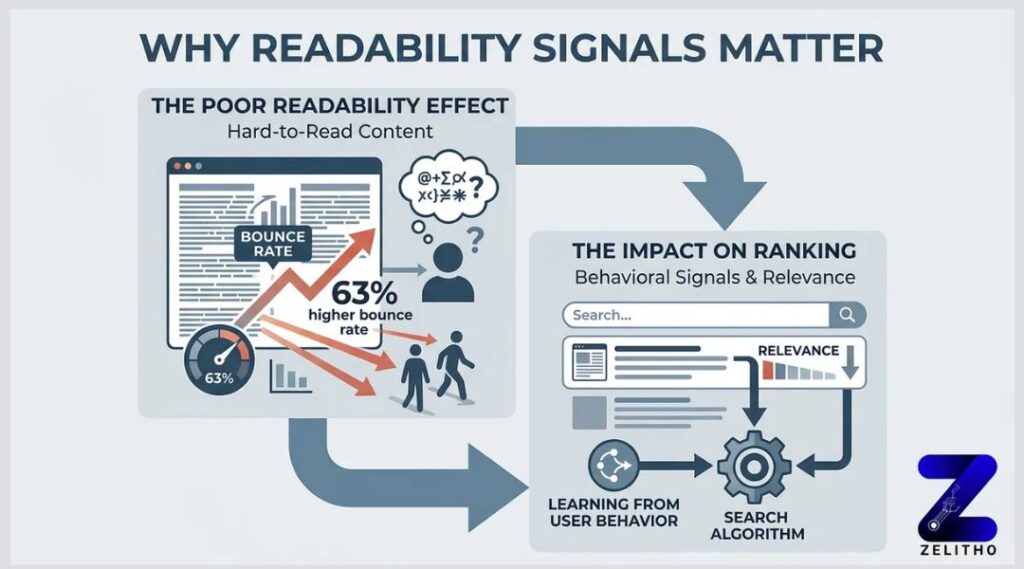
Most teams treat readability as a style preference. They edit for tone, not for measurable friction. Meanwhile, sites with poor readability experience 63% higher bounce rates, and those behavioral signals feed directly into how search algorithms interpret content value. Fixing keywords will not fix that.
The Clarity-Ranking Alignment System presented here gives senior marketers, founders, and agency operators a diagnostic-first framework. It measures reading level against audience targets, applies structured formatting changes, and preserves existing SEO work. The outcome: content that holds the reader long enough for behavioral signals to do the ranking work.
Does Readability Affect SEO Rankings?
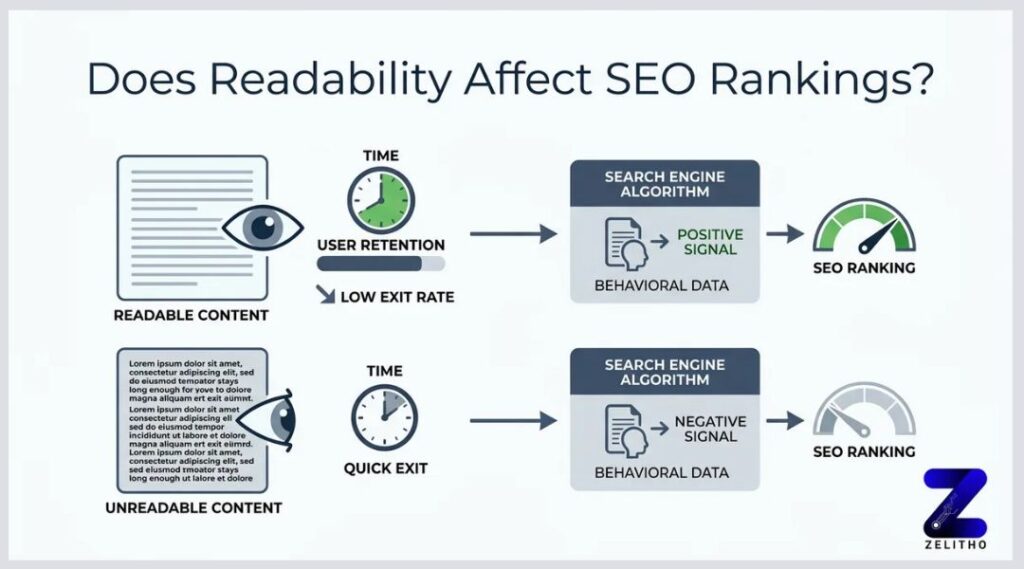
Readability does not earn you a ranking directly. It controls whether the reader stays long enough for your page to signal value to search engines. Sites with low readability lose users fast. Those exits register as behavioral data. That data shapes rankings.
Why Readability Signals Matter to Search Algorithms, Even When Google Doesn’t Score Sentences
Here is the false assumption most content teams carry: because Google has no official readability score, readability has no ranking impact.
That is wrong. And the data makes it measurable.
Sites with poor readability experience 63% higher bounce rates than those written clearly. [3] Bounce rate is not invisible to search algorithms. It is a behavioral signal. When users leave fast, the page loses its case for relevance. Readability directly controls whether that case gets made.
Sentence length alone shifts this dynamic. Shorter sentences produce a 40% increase in content engagement. [3] That is not a stylistic footnote. That is a structural lever that controls how long a reader stays with your content.
The demand side confirms the same pattern. 86% of users actively prefer websites with readable content. [3] That preference expresses itself as time-on-page, scroll depth, and return visits, which are exactly the behavioral signals that feed into ranking strength.
Stop treating readability as an editorial opinion. Start treating bounce rate and dwell time as readability’s report card.
One honest caveat belongs here. A study analyzing over 750,000 pieces of ranked content found no direct correlation between reading level and Google ranking position. [3] That finding is real, and it matters. But it describes correlation, not causation. Readability does not rank you. It keeps users on the page long enough for behavioral signals to do the work. Confusing those two things leads teams to ignore readability entirely, then wonder why traffic converts at 1%.
The operational implication is specific: before assuming any content problem is a keyword problem, audit bounce rate and time-on-page by individual piece. If high-traffic pages show short session durations, the issue is likely readability, not targeting.
The Gap Between What Ranks and What Most Readers Can Actually Process
Content can rank well and still fail its readers. Those two outcomes are not mutually exclusive, and the data makes that uncomfortable.
An analysis of 756,297 pieces of ranking content found that the top 30 results across searches averaged an 11th-grade reading level. [2] A separate crawl evaluating 5,813,565 web pages confirmed the same average. Flesch Reading Ease scores for those top 30 pages ranged from 51.8 to 53.1, placing them at the 10th to 12th-grade reading level. [2]
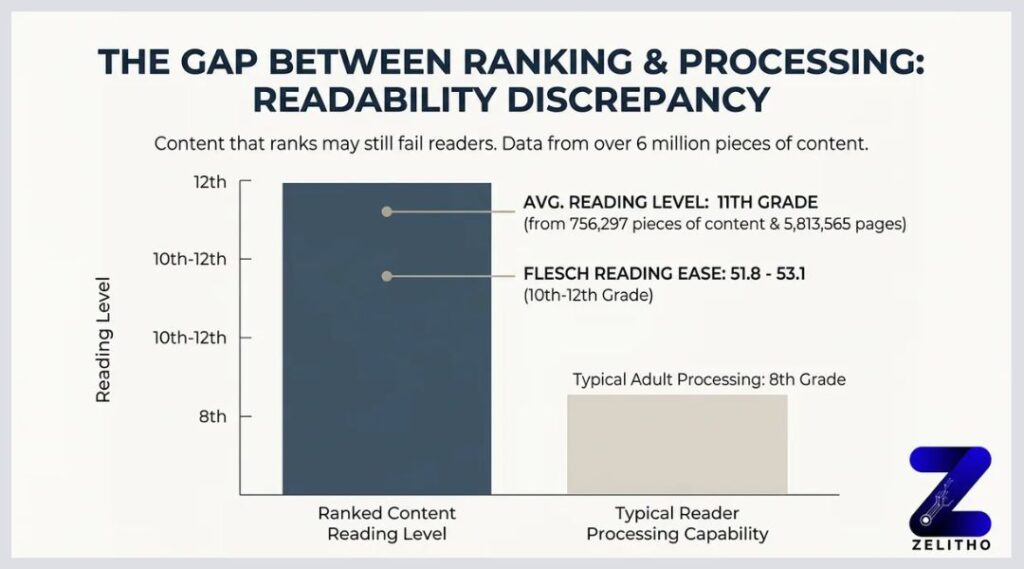
Now hold that against the reader. 50% of US adults read at or below a 9th-grade level. [2]
That gap is structural. A B2C brand publishing 11th-grade content to a general consumer audience may rank well and still see low conversion and high exit rates. Not because SEO failed. Because the content excluded the majority of the people it was written for.
The consequence is measurable. When reading level exceeds audience capacity, users do not push through. They leave. That exit depresses conversion rates even when traffic numbers look healthy. Strong traffic plus weak conversion is often a readability mismatch, not a targeting miss.
The following table maps Flesch Reading Ease scores to grade levels and practical use cases.
Flesch Reading Ease Score | Corresponding Grade Level | Recommended Use Case |
|---|---|---|
90–100 | 5th grade | Consumer apps, SMS, simple FAQs |
70–80 | 6th–7th grade | General consumer blogs, email |
60–70 | 8th–9th grade | B2C content, news articles |
50–60 | 10th–12th grade | Where most ranked content sits |
30–50 | College level | Technical documentation, legal |
The middle row is where most ranked content lives. The second row is where most readers process comfortably. Closing that distance is the work.
How to Measure Readability Before You Rewrite a Single Word
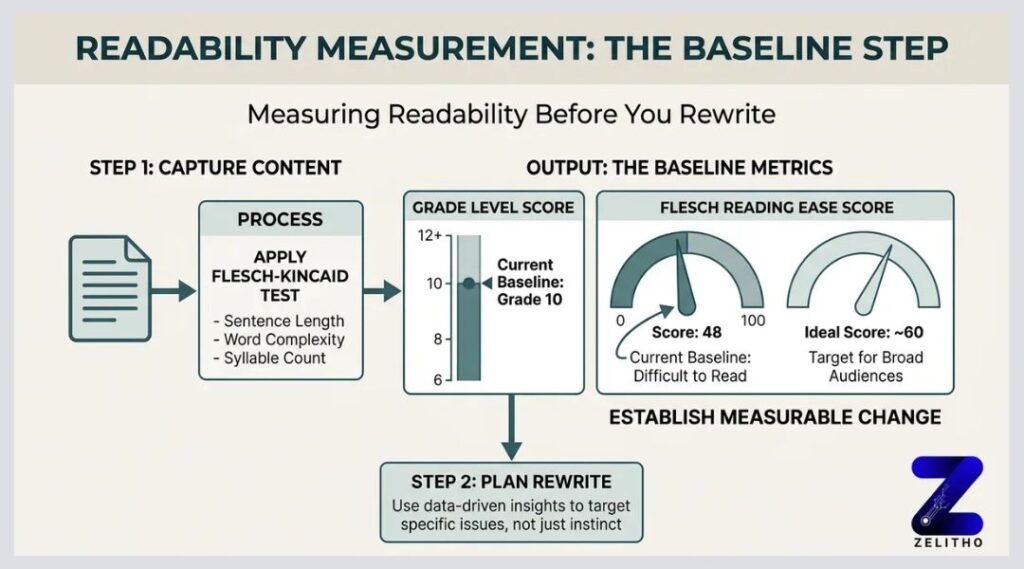
Measurement comes before editing. Teams that skip this step rewrite content by instinct and produce no measurable change.
The Flesch-Kincaid test is the standard starting point. It scores content based on sentence length, word complexity, and syllable count per word. The output is a grade level and a Flesch Reading Ease score. Both numbers give you a baseline before any changes are made.
The scoring benchmarks are specific. An ideal Flesch Reading Ease score sits around 60, which corresponds to a 7th to 8th-grade reading level. [4] Scores between 60 and 70 indicate content suitable for 8th to 9th-grade readers. The highest scores correspond to a 5th-grade level, understood by readers aged 10 to 11. For general audience content, a Flesch-Kincaid Grade Level between 7.0 and 8.0 is the practical target.
One formatting detail intersects with perceived readability: optimal font size for reading comfort is approximately 16 pixels. [4] This will not change your grade level score, but it affects how readers process the page before they read a single sentence.
Three tools handle most readability audits without requiring custom setup:
Hemingway Editor: highlights long sentences and passive constructions at the sentence level. Paste draft content and get immediate feedback.
Yoast SEO: integrates Flesch-Kincaid scoring directly into WordPress. It flags readability issues during the publishing workflow.
FK Grade Level calculators: free, batch-capable tools for auditing multiple pages at once without a CMS dependency.
Here are five diagnostic steps a team can run in under 30 minutes:
Pull the top 10 traffic-driving pages from Google Search Console.
Paste each into Hemingway Editor or a FK calculator.
Record the grade level and Flesch Reading Ease score for each.
Note the target audience’s average education level or reading context.
Flag any page where grade level exceeds the audience benchmark by more than two grades.
That audit gives you a ranked list of readability gaps before a single word is rewritten. Do not conflate this step with editing. Measuring is not improving. Keep them separate.
The Clarity-Ranking Alignment System: Practical Edits That Improve Readability Without Undermining SEO
The most common mistake in readability editing is treating simplicity as a loss of authority.
Teams shorten a sentence and feel like they’ve removed something. They haven’t. They’ve redistributed cognitive load. When readers spend less effort decoding sentence structure, they spend more effort engaging with the idea inside it. That is not a weakening of content. It is a transfer of attention toward what the content is actually trying to say.
The Clarity-Ranking Alignment System treats readability and SEO as reinforcing priorities. Here is how each layer works in practice.
Sentence structure. The target is 20 words or fewer per sentence, on average. [3] Sentences over 25 words consistently slow processing speed. When a sentence runs long, split it. The second sentence usually becomes the stronger one.
Paragraph structure. Three to four sentences per paragraph is the formatting target for scannability. [3] Readers do not read web content linearly. They scan, then dip in. Short paragraphs signal entry points. Long blocks signal friction.
Reading level target. The recommended readability level for online content is 8th grade or below. [3] That does not mean removing complexity. It means putting complex ideas inside simple sentence structures.
Here is what that looks like with the same content rewritten:
Before (11th-grade level): “The implementation of sentence-level simplification across existing content assets has demonstrated the capacity to produce substantial increases in organic search visibility over compressed timeframes, as evidenced by documented cases of traffic volume doubling within months of execution.”
After (8th-grade level): “Simplifying blog content sentence by sentence can double organic traffic within months. One documented case confirmed exactly that.” [1]
The factual content is identical. The second version takes less cognitive effort to process. That effort savings is what keeps readers on the page.
A pre-publish checklist using the Clarity-Ranking Alignment System should include:
Flesch-Kincaid Grade Level at or below 8.0
Average sentence length at or below 20 words
Paragraph length at 3 to 4 sentences
Keywords placed naturally within simplified sentence structures
No passive voice in the first three paragraphs
Run this check alongside standard SEO checks, not instead of them. Readability edits should never require removing keywords. They require restructuring the sentences around those keywords.
Explore more: How Content Marketing Strategies Drive Business Growth and How to Implement Them
Readability and SEO Require the Same Outcome
Readability and SEO are not a trade-off. They are inputs into the same outcome: content that earns attention, holds it, and converts behavioral signals into ranking strength. The Clarity-Ranking Alignment System presented here is not about writing for the lowest common denominator. It is about removing the friction between your content and the reader it was written for. Measure first. Edit with targets. Format for scanning. The writers and teams who treat readability as a diagnostic metric, not an afterthought, are the ones whose traffic numbers tell a different story six months later.
Sources
[1]https://seopressor.com/blog/the-importance-of-content-readability-for-seo-and-how-to-improve-it/
[2]https://www.portent.com/blog/content/study-how-content-readability-affects-seo-and-rankings.htm
[3]https://www.marketingillumination.com/blogs/readability-important-for-seo
[4]https://seoscout.com/learn/seo-writing/readability