
How Content Marketing Strategies Drive Business Growth and How to Implement Them

TL;DR
You just watched a piece of content rank. Now you are staring at your content calendar wondering why the rest of it is not doing the same thing.
Most teams respond by publishing more. That does not fix the problem. Publishing without strategic alignment produces content that fills a calendar but never fills a pipeline. Budget increases without a mapped objective create noise, not compounding results.
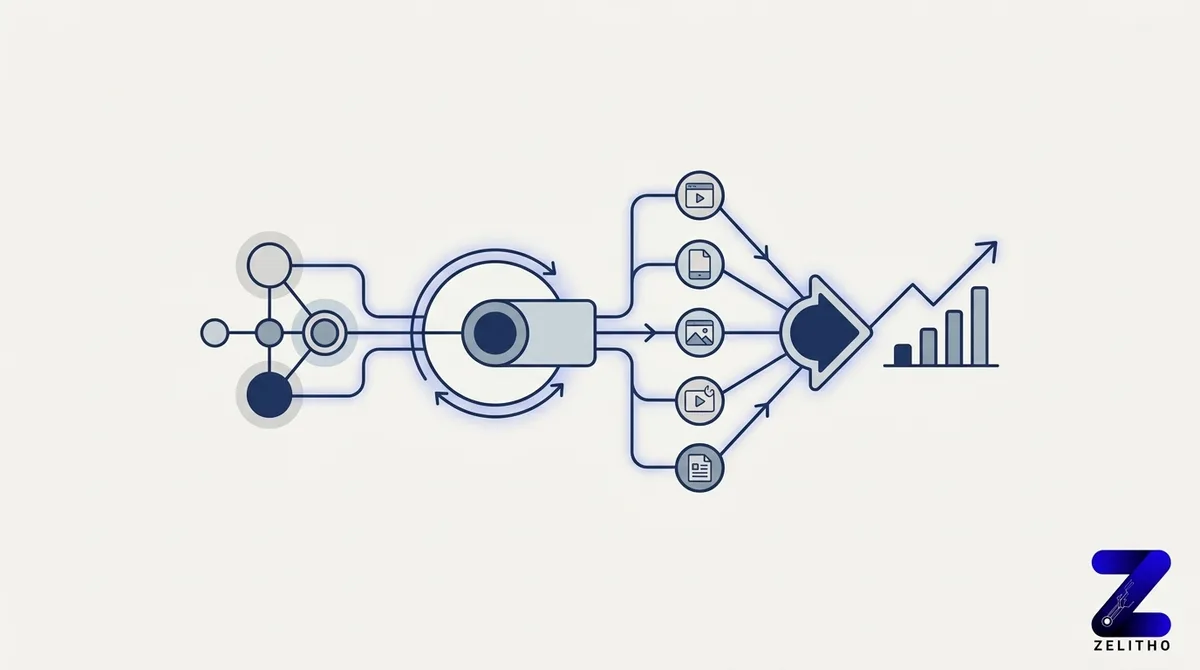
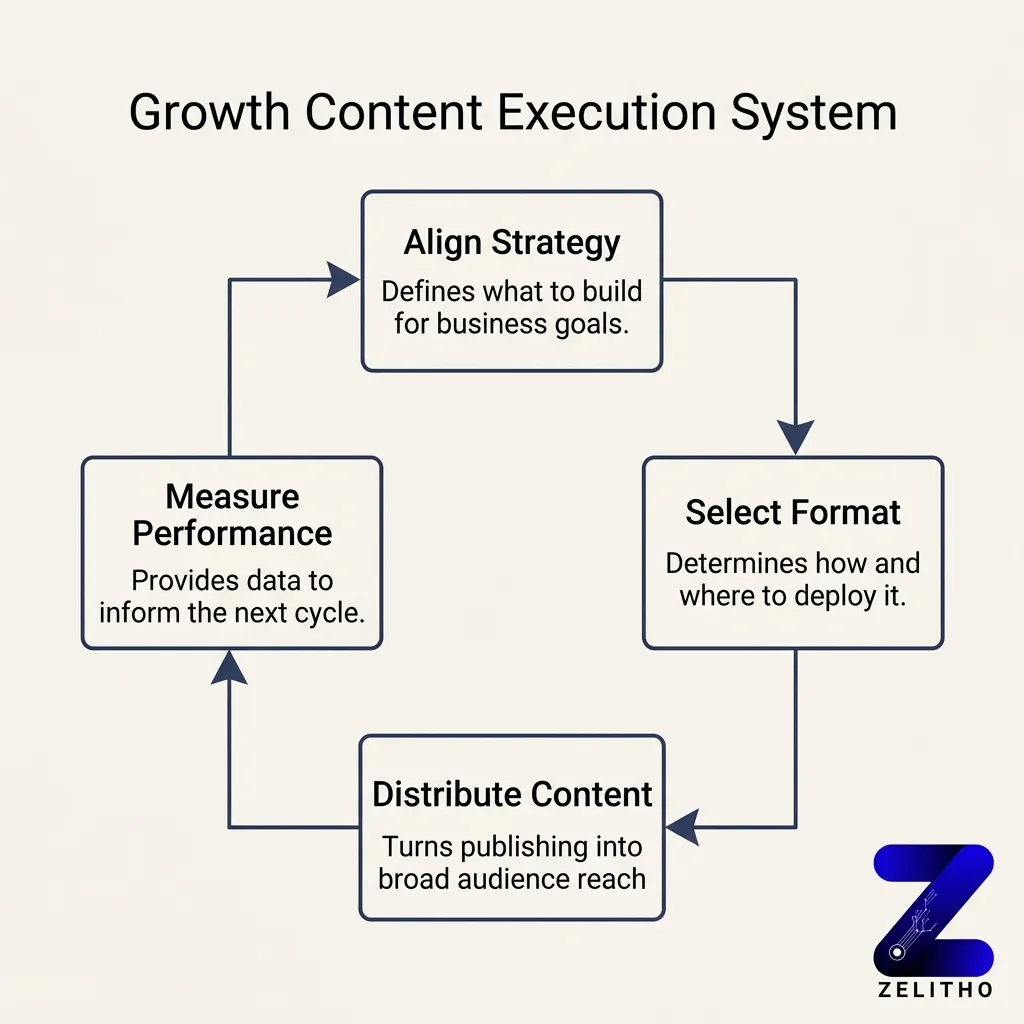
The Growth Content Execution System is a four-stage operational process: strategic alignment, format and channel selection, distribution, and performance refinement. Each stage feeds the next. Senior marketers, founders scaling content, and agency owners managing client programs use this system to connect publishing decisions to measurable business outcomes. This article walks through each stage with tactical steps you can apply immediately.
What Is a Content Marketing Strategy and Why Does It Affect Revenue?
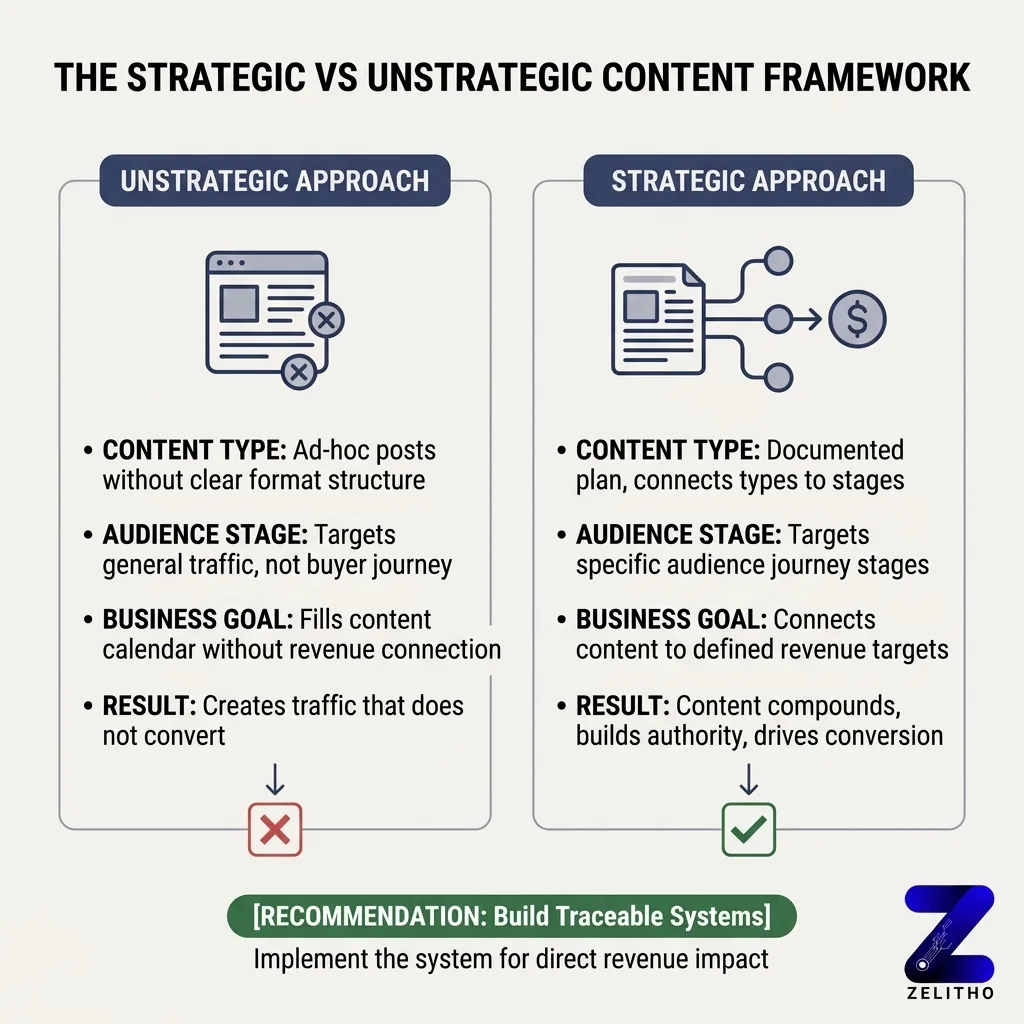
A content marketing strategy is a documented plan that connects specific content types to defined audience stages and business goals. Without that connection, content produces traffic that does not convert. With it, content compounds: each piece builds authority, attracts qualified readers, and moves them toward a decision. The revenue impact is not indirect. It is traceable when you build the system correctly.
Why Most Content Fails Before It Is Published: The Alignment Problem
Publishing more is not the solution. That is the belief this section is here to correct.
You have probably sat in a planning meeting where someone said, “We need to post three times a week.” No one asked what each post was supposed to do. No one mapped a post to a funnel stage. The calendar got filled. The pipeline did not move.
Nearly 50% of global decision-makers planned to increase content marketing budgets in early 2024, with 86% maintaining or increasing spending [1]. Budget going up does not mean results go up. It means the cost of misalignment goes up. More content without a defined objective produces more noise at a higher price.
Here is the sting: companies with active blogs generate 67% more leads monthly [1], but that number only holds when content targets a defined audience at a defined funnel stage. Publishing a thought piece aimed at no one, at no stage, earns you indexed pages, not leads.
One SaaS team published three blog posts per week for six months. Lead attribution from content was near zero. They cut to one targeted post per week, mapped to mid-funnel decision-makers, and doubled qualified inquiries within 90 days. Less content. Clearer intent. Measurable result.
The Growth Content Execution System starts here, at alignment. Before format, before channel, before distribution: define the business goal, name the audience segment, and assign a funnel stage to every piece you plan to build.
Funnel Stage | Content Type | Business Goal |
|---|---|---|
Awareness | Blog post, short video, social post | Build audience and indexed reach |
Consideration | Case study, comparison guide, webinar | Move informed readers toward evaluation |
Decision | Demo page, ROI calculator, testimonial | Convert ready buyers |
Every piece of content you produce should fit exactly one cell in that table. If it does not, you do not have a strategy. You have a publishing habit.
Stop producing content for the calendar. Start producing content for a conversion path.
Building the Growth Content Execution System: Format and Channel Decisions That Actually Scale
Being on every channel is not a strategy. It is a budget drain with a content calendar attached.
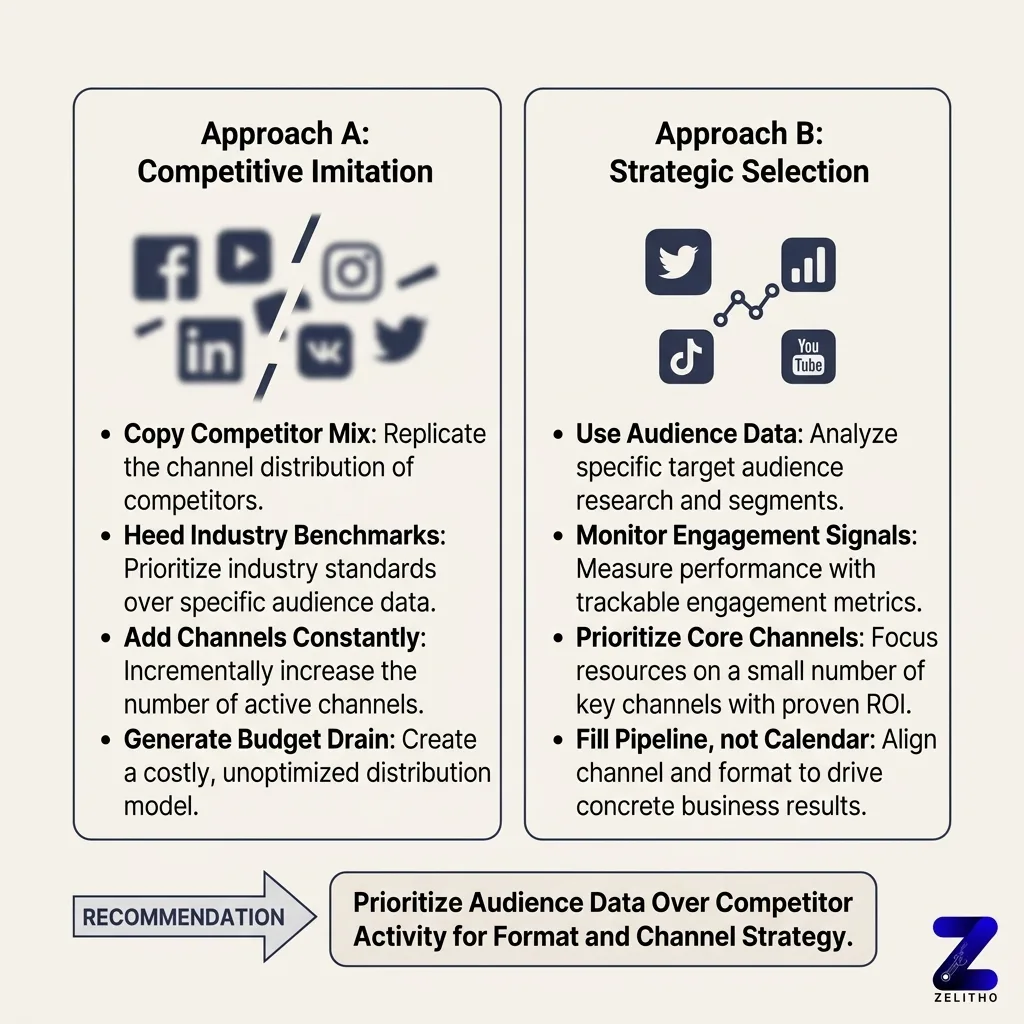
Format and channel decisions are where most teams make a confident-sounding mistake. They look at what competitors are doing, copy the mix, and wonder why results differ. The format and channel you select must come from audience data and measurable engagement signals, not industry benchmarks.
91% of content marketers use video, with 78% planning to increase production [1]. That number signals adoption, not fit. If your audience is mid-level procurement managers reading during commutes, video is not your primary format. If your audience is early-career founders consuming content on LinkedIn between meetings, short video clips may outperform every other format you produce.
Content with images and graphics can see up to 650% higher engagement than text-only posts [1]. That is a format signal. It does not mean add a stock photo to every blog post. It means visual structure, whether charts, annotated screenshots, or comparison tables, holds attention longer and drives more interaction than unbroken paragraphs.
The average person uses 7.1 social media platforms monthly [1]. That is not an invitation to post on all seven. It is a reminder that your audience is reachable in multiple places, and you need to choose the two where they are most likely to act.
Here is the operational rule: dominate two channels before expanding to a third. Measure a conversion path on both within 90 days. If you cannot trace a reader from content to a downstream action on a given channel, that channel is not earning its place.
Format | Best Channel Fit | Performance Logic |
|---|---|---|
Long-form blog post | Organic search, email | Compounds over 90-180 days via indexed reach |
Short-form video | LinkedIn, YouTube Shorts | High initial reach, faster decay |
Infographic | LinkedIn, Pinterest, email | Visual recall drives resharing and saves |
Webinar | Email, LinkedIn event | Captures high-intent mid-funnel leads |
Podcast episode | Spotify, Apple, email | Builds trust over repeated listening sessions |
Audit your current channel mix now. For any channel where you cannot identify a conversion path in the last 90 days, pause it. Redirect that production time to the channels where attribution is visible.
The Cost of Skipping Distribution: What Happens When Great Content Goes Nowhere
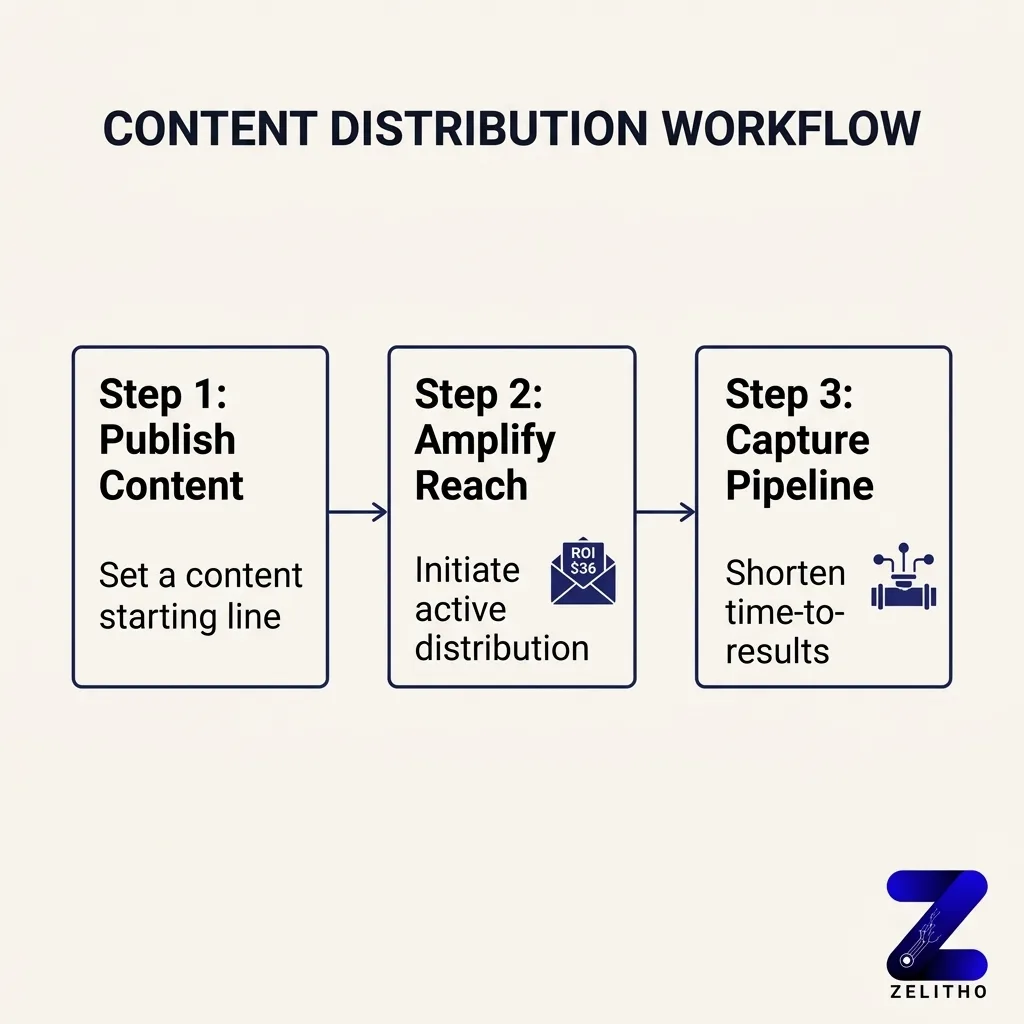
Publishing is not the finish line. It is the starting line.
Most marketers privately suspect their content is not being seen. They assume SEO will eventually catch up. Sometimes it does, on a 6-to-12-month timeline, while the content sits with 40 monthly readers and zero attributed pipeline. Organic reach is real. It is not fast, and it is not sufficient on its own at early or mid-stage growth.
Email marketing yields an average ROI of $36 for every dollar spent [1]. That makes it the most underused distribution lever in most content programs. Teams invest hours producing a post, then send it to no one.
Consider this directly: a team that publishes 40 posts per year with no email distribution reaches roughly 200 readers per post through organic alone. Adding a segmented email sequence to those same 40 posts can quadruple that reach without producing a single new piece of content. The content budget stays the same. The reach multiplies.
76.1% of internet users use social media for brand or product research [1]. Nearly 505 million podcast listeners worldwide are projected for 2024 [1]. Those numbers tell you that your audience is already consuming content across formats and platforms. Your distribution plan needs to meet them there, not wait for them to find you through search alone.
Distribution is not promotion. It is a workflow. Here is a five-step checklist you can execute within 48 hours of publishing any piece of content:
Send to your segmented email list with one clear call to action.
Post a native excerpt or key insight on LinkedIn, not just a link.
Share in two to three relevant communities where your audience is already active.
Repurpose one section into a short-form visual or pull quote for a second social post.
Update any previously published piece that links logically to the new content.
These five steps do not require new content. They require a repeatable process applied consistently. Build the checklist into your publishing workflow. Assign ownership before the piece goes live.
Stop treating distribution as an afterthought. Start treating it as the second half of every content investment you make.
Measuring What Moves: How to Optimize the Growth Content Execution System Over Time
Vanity metrics feel productive. They are not connected to revenue.
Websites with active blogs have 434% more indexed pages and 97% more inbound links [1]. Those are input metrics. They describe what your content does to search infrastructure. They do not tell you whether a reader became a lead, a trial, or a customer.
The mistake teams make is measuring content performance at 30 days. Most SEO-driven content takes 90 to 180 days to compound. Pulling the plug on a piece at four weeks because traffic is low is like canceling a sales hire after their first month of prospecting.
Set a goal like increasing website traffic by 20% or raising social media referral clicks by 30% [2], then connect those inputs to a downstream signal: demo requests, free trial signups, or email list growth. If the upstream number moves but the downstream number does not, the content is attracting the wrong audience. That is a targeting problem, not a volume problem.
Here is the contrast that matters:
Vanity Metric | Revenue-Connected Metric |
|---|---|
Total page views | Pages viewed by ICP visitors |
Social impressions | Click-through rate to a conversion page |
Indexed pages | Inbound links driving referral traffic |
Email open rate | Email click-to-demo or click-to-trial rate |
Time on page | Scroll depth on decision-stage content |
The left column tells you the content exists. The right column tells you whether it works.
Run a 90-day review cadence. At each cycle, identify the bottom 20% of performing content by revenue-connected metrics. Then make one of three decisions: update the piece with new data or better targeting, consolidate it with a stronger related piece, or retire it. No fourth option. Weak content sitting on your site dilutes your topical authority and splits crawl equity.
The Growth Content Execution System closes its loop here. Measurement is not a reporting function. It is a decision-making input that tells you what to build next, what to cut, and where to double down.
Execution Beats Ideation Every Time
The Growth Content Execution System is not a creative framework. It is an operational one. Strategic alignment tells you what to build. Format and channel selection tells you how and where to deploy it. Distribution turns publishing into reach. Measurement closes the loop and tells you what to build next.
Teams that skip any one of these stages are doing content production, not content marketing. The difference between the two shows up in qualified leads, in traffic that compounds over six months, and in the ROI your content budget actually earns.
Start with one business goal. Map it to one audience segment. Build one content type designed for that intersection. Measure it at 90 days against a revenue-connected metric. Expand only after that unit produces a traceable result.
Reference the system at each stage. Execution beats ideation every time.
Explore more: What Are the Essential Skills Needed to Succeed in Content Marketing?
FAQs
The five pillars commonly cited are: strategy, creation, distribution, measurement, and governance. Strategy defines audience and objectives. Creation produces the asset. Distribution delivers it. Measurement evaluates impact. Governance ensures consistency and quality control across a team or program.
There is no single canonical list of nine essential content marketing skills. Common groupings include: audience research, writing and editing, SEO, analytics, distribution strategy, project management, repurposing, paid amplification, and content strategy. The relative priority of each depends on your role, team size, and content goals.
The seven steps often referenced are: define your audience, set goals, audit existing content, build a content calendar, create the content, distribute across channels, and measure results. The step most commonly skipped is the audit, and the step most commonly under-resourced is distribution.
The four pillars most frequently cited are: strategy, creation, distribution, and measurement. These map closely to the C-D-O Framework with strategy as the foundation that informs all three execution layers. Without a documented strategy, the other three pillars operate without alignment.
References and Citations
[1]https://www.ama.org/marketing-news/what-is-content-marketing/
[2]https://www.park.edu/blog/effective-marketing-strategies/