
How to Create and Implement Mass SEO Content: A Step-by-Step Guide for Scaling your Content

- TL;DR
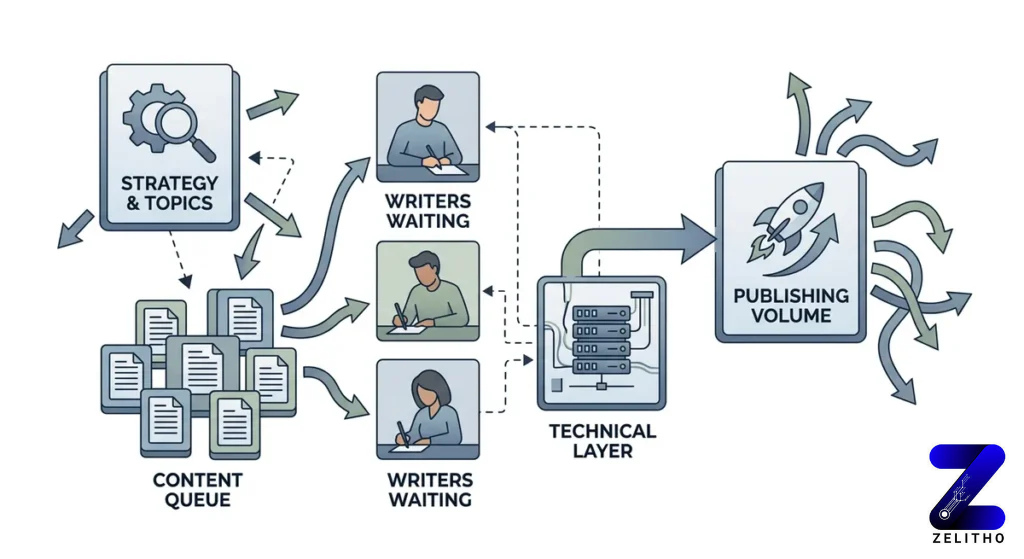
- You ranked a page. Now the calendar shows 12 more topics queued, three writers waiting on briefs, and no clear system connecting any of it. Publishing more does not fix that. It multiplies the gap.
- Most teams treat content volume as the goal. They publish, see no traction at month two, and either cut budget or flood the queue with more posts. Neither move addresses the structural problem. The strategy, workflow, and technical layer are disconnected, so each piece of content starts from zero.
- The Scaled SEO System presented here runs in four stages: strategic architecture, workflow design, technical integration, and iterative optimization. It applies to in-house teams, agency operators, and founders managing lean budgets. One site used this logic to grow from 14 organic visitors to 13,138. The mechanism was process, not output volume.
How do you scale SEO content without losing quality or wasting budget?
You build a documented system before you write anything. Scaling SEO content requires four operational stages: strategic architecture, workflow design, technical integration, and iterative optimization. Teams that skip any stage produce content that either cannibalizes itself, sits unindexed, or earns traffic that never converts. The process described here solves each failure point in sequence.
Step 1 , Build the Strategic Foundation Before You Write a Single Word
Stop treating keyword research as a pre-writing checkbox. Start treating it as the architecture that determines whether your entire content program compounds or collapses.
Most teams run keyword research in a spreadsheet, sort by volume, and hand the list to a writer. That process produces content with no connection to funnel stage, search intent, or revenue proximity. The result is a site with 50 URL variations targeting the same keyword, all suppressing each other in the index.
That is not a hypothetical. It is one of the most common ranking suppression scenarios in SEO.
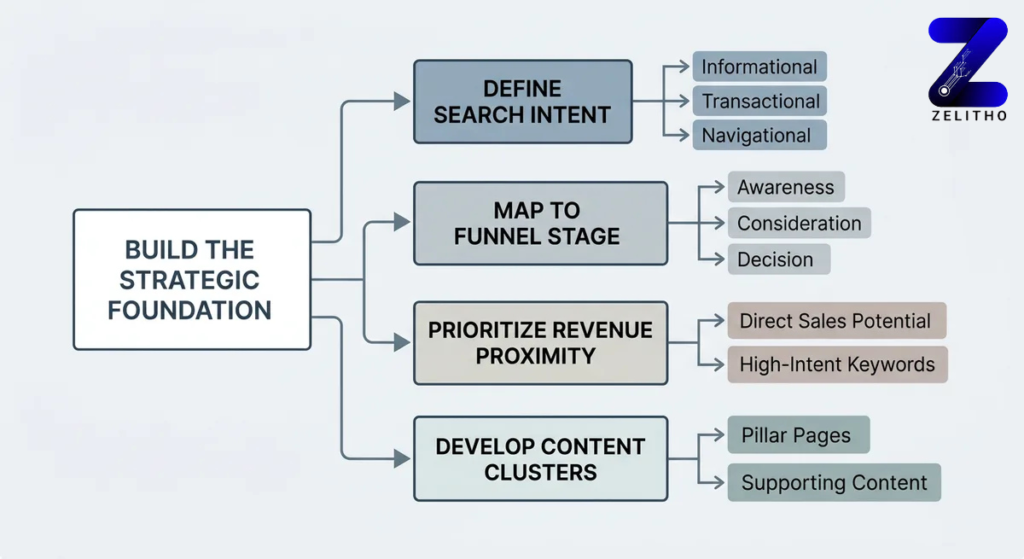
The Scaled SEO System starts here. Stage one is strategic architecture: building a prioritized topic map before any production begins.
Keyword Clustering and Intent Mapping
Cluster keywords by topic, not just volume. Group related queries under a single pillar topic. Assign each cluster a funnel stage: awareness, consideration, or decision.
Then tier each cluster by conversion proximity. A transactional keyword with 200 monthly searches will generate revenue faster than an informational keyword with 20,000. The ROI timelines are different. Treat them differently.
Keyword Type | Avg. Monthly Volume | Conversion Proximity | ROI Timeline |
|---|---|---|---|
High-volume informational | 10,000+ | Low | 9–18 months |
Mid-volume consideration | 1,000–9,999 | Medium | 4–9 months |
Low-volume transactional | Under 1,000 | High | 1–4 months |
The table above is not a ranking guide. It is a resource allocation guide. Fund your transactional clusters first. Build informational clusters to support them over time.
Publishing cadence follows architecture. Publish at least once weekly. If budget allows, two to three times weekly produces compounding returns faster [1]. But cadence without architecture produces noise, not rankings.
One common objection at this stage: “We are already publishing. Are we doing it wrong?” Often, yes. The fix is not to stop publishing. The fix is to audit what you have, identify cannibalizing URLs, and consolidate before scaling further.
Step 2 , Design the Workflow That Makes Volume Sustainable Without Destroying Quality
Quality does not drop because you publish more. It drops because your process cannot hold the volume you are attempting.
That distinction matters. Teams that believe “scaling kills quality” pull back when they should instead build structure. The belief is a symptom of absent process, not a fact about content.
The Full Production Chain
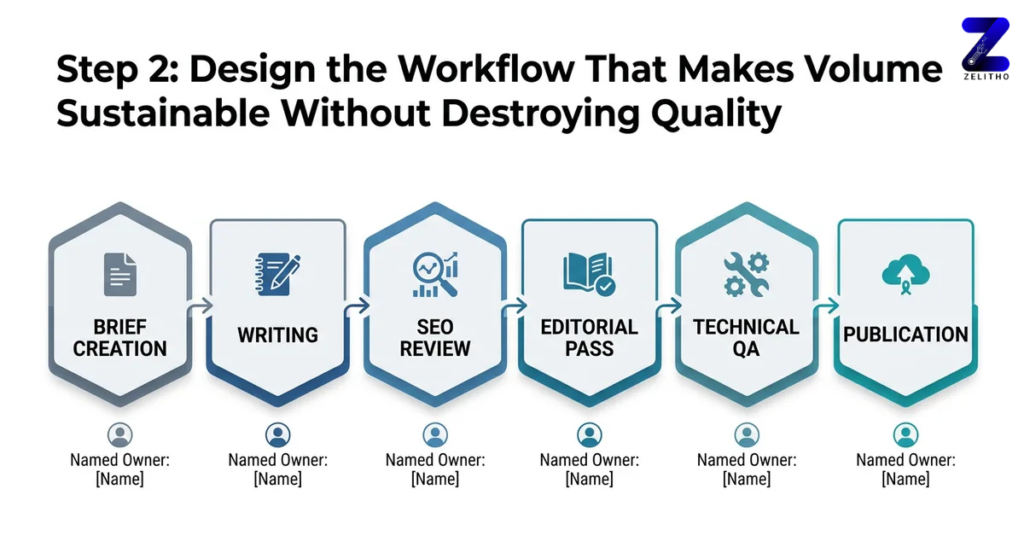
A scalable content workflow runs in six stages: brief creation, writing, SEO review, editorial pass, technical QA, and publication. Each stage needs a named owner. Without ownership, stages collapse into each other and accountability disappears.
Roles required at minimum: an SEO strategist who builds briefs, a writer who executes them, an editor who checks clarity and accuracy, and a technical SEO reviewer who confirms on-page signals before publication.
Cross-functional input must enter the brief, not the draft. Sales knows the objections buyers raise. Product knows the differentiators worth ranking for. Marketing knows the campaigns running parallel to content. All of that should shape the brief before a writer opens a document.
The Cost Reality
A quality long-form article requires five or more hours to write [1]. Hiring dedicated content staff costs approximately $6,000 to $8,000 per month[1]. Workflow inefficiency carries a direct dollar cost, not just a time cost.
Before scaling, decide your model: in-house, agency, or hybrid. Each has a break-even point. In-house makes sense above roughly 12 to 16 articles per month if you have stable editorial leadership. Agency contracts make sense for bursts or when internal bandwidth does not exist. Hybrid models work when you have an internal strategist but need external writing capacity.
“Stop hiring writers before you have a brief template. Start with the documented process and hire to fill the roles it defines.”
Workflow checkpoints prevent compounding errors:
Brief approved before writing starts
SEO review completed before editorial passT
Technical QA signed off before scheduling
Published URL confirmed indexed within 72 hours
Every checkpoint is a catch point. Remove one and errors scale with your volume.
Step 3 , Integrate Technical SEO So Your Content Can Actually Be Found
Content quality does not drive rankings if the technical layer fails. This is the part most content teams ignore until traffic stalls and they cannot explain why.
One misconfigured template applied to 200 pages creates 200 problems simultaneously. That is not an edge case. It is what happens when production scales faster than technical oversight.
Internal Linking, Crawl Budget, and Metadata Standards
Internal linking at scale requires a deliberate architecture. Every new page needs at least two internal links pointing to it from existing content. Orphaned pages drain crawl budget and receive no ranking signal from your own domain authority.
Crawl budget matters at volume. Search engines allocate a finite crawl allowance per site. Duplicate content, thin pages, and broken redirects consume that allowance without producing indexation. Clean your technical layer before scaling, not after.
Canonical tags require discipline. If you produce content across similar topics, canonical signals tell search engines which URL holds authority. Without them, you fragment ranking signals across multiple URLs.
Meta titles follow a measurable standard: 50 to 60 characters [4]. Shorter titles leave ranking signal on the table. Longer titles get truncated in search results, reducing click-through rates.
Sites With Clean Architecture vs. Sites Without
The difference is indexation rate and crawl efficiency. A site with clean internal linking, correct canonicals, and consistent metadata gets more pages indexed per crawl. A site with orphaned pages and duplicate metadata gets fewer, regardless of content quality.
One business grew from 14 organic visitors to 13,138 by combining content volume with technical correctness [1]. Neither element produced that outcome alone. The technical layer made the content discoverable. The content gave the technical layer something worth indexing.
The Scaled SEO System names technical integration as stage three because it is the infrastructure stage. Strategic architecture defines what to build. Workflow design defines how to build it. Technical integration determines whether what you built gets seen.
Read More: Top Semantic SEO Strategies to Rank Higher in 2026
Step 4 , Optimize Iteratively Because the First Publish Is Never the Final Version
Publishing is not the finish line. It is the starting point for a performance loop.
Teams that publish and move on leave compounding returns on the table. Content marketing results typically take three to six months to begin surfacing [3]. Full ROI can require up to a year. Teams that cut the process at month two never see the return on the work already done.
The Optimization Loop
The loop has five components: rank tracking, click-through rate analysis, content refreshes, internal link updates, and conversion rate monitoring.
Rank tracking tells you whether a page is moving toward the top 10 or stalling. Click-through rate analysis tells you whether your title and meta description are pulling clicks at the position you hold. Refreshes address both.
Internal link updates matter more over time. As you publish new content, older pages gain new linking opportunities. Running a quarterly internal link audit captures those gains without requiring new production.
Conversion rate monitoring closes the loop between traffic and revenue. A page driving 2,000 visits per month with a 0.2% conversion rate is underperforming. A content or CTA revision can shift that number without touching the ranking.
Aligned SEO and marketing efforts have produced 20% increases in organic traffic and 5% lifts in conversion rates when the optimization cycle runs consistently [2].
Review Cadence Table
Checkpoint | Timing | Actions |
|---|---|---|
30-day review | 30 days post-publish | Confirm indexation, check initial rank position, flag crawl errors |
90-day review | 90 days post-publish | Assess rank movement, update internal links, refresh metadata if CTR is low |
6-month review | 180 days post-publish | Full content audit, conversion analysis, consolidate underperforming pages |
Assign a named owner to this cycle. Without accountability, reviews become suggestions. And suggestions do not compound.
The Scaled SEO System closes its loop here. Stage four connects back to stage one. Data from the optimization cycle informs the next round of keyword prioritization. The system feeds itself when it runs correctly.
Scaling SEO Content Is an Operational Problem Before It Is a Creative One
The teams compounding organic growth are not writing more. They are running tighter systems.
The Scaled SEO System has four non-negotiable stages: strategic architecture, workflow design, technical integration, and iterative optimization. Remove any one stage and the remaining three underperform. They are interdependent, not sequential options.
One business applied this logic and grew from 14 organic visitors to 13,138. They reported a 50% increase in new clients as a direct result [1]. That outcome was not accidental. It was the output of a functioning process applied consistently over time.
Build the system. Run the loop. The rankings follow.
FAQ
The 80/20 rule in SEO holds that roughly 20% of your keywords and pages will drive 80% of your organic traffic. Applying it means identifying your highest-conversion, highest-intent clusters first and allocating disproportionate production resources to them. Most teams invert this by spreading effort evenly across all topics.
Start with strategic keyword clustering tied to funnel stage and conversion proximity. Build a documented production workflow with named role owners. Audit and correct your technical layer before scaling content volume. Then run a scheduled optimization cycle to track rank movement and refresh underperforming pages.
The four pillars are technical SEO, on-page optimization, content, and authority building. Technical SEO covers crawlability, indexation, and site structure. On-page covers metadata, headers, and internal linking. Content covers topical relevance and search intent alignment. Authority covers the external signal profile pointing to your domain.
The 3 C’s are content, code, and credibility. Content refers to topical relevance and intent match. Code refers to the technical implementation that makes content crawlable and indexable. Credibility refers to the authority signals, both on-page and off-page, that tell search engines the content is trustworthy.
ChatGPT can assist with brief creation, keyword research framing, meta description drafting, and content outlining. It cannot replace an SEO strategist’s keyword clustering decisions, technical audits, or conversion rate analysis. Used as a production accelerant within a documented workflow, it reduces time per output without replacing strategic judgment.
The four types are on-page SEO, off-page SEO, technical SEO, and local SEO. On-page covers content and metadata. Off-page covers backlinks and brand mentions. Technical covers site architecture, crawl health, and indexation. Local covers geographic relevance signals for location-specific searches.
Publishing content without a keyword cluster map leads to self-cannibalization. Ignoring technical issues before scaling multiplies errors across every new page. Abandoning the process at month two means forfeiting returns that require three to six months to surface. Treating publication as the endpoint instead of the starting point of an optimization loop is the most consistent compounding error.
ChatGPT can review on-page elements like title length, header structure, and keyword placement if you provide the content directly. It cannot crawl your site, identify orphaned pages, detect crawl budget waste, or pull rank data. A technical SEO audit requires dedicated crawl tools and analyst interpretation that AI assistants do not currently replace.
Yes, but the constraint is time, not capability. A solo operator can build a keyword map, write briefs, produce content, and manage a technical checklist. The challenge is that a quality long-form article requires five or more hours to produce [3], and a consistent publishing cadence of two to three times weekly compounds that demand quickly. Most solo operators do SEO effectively at lower volume or with a narrow topic focus.
Sources
[1]https://www.portlandseogrowth.com/free-seo-resources/mass-seo-content/
[2]https://monday.com/blog/marketing/seo-planning/
[3]https://solutions.technologyadvice.com/blog/stages-seo-content-strategy/
[4]https://www.321webmarketing.com/blog/everything-you-need-to-know-when-planning-an-seo-campaign/