
GEO Playbooks for Different Niches: SaaS, Local Services, and E‑commerce Examples

Generative Engine Optimization (GEO) requires customized, industry-specific execution rather than generic SEO tactics. B2B SaaS companies secure commercial citations by structuring feature-benefit mappings and API documentation into extractable knowledge blocks. E-commerce brands win product recommendations in ChatGPT and Perplexity by combining multi-attribute comparison tables with structured Offer schema. Local service providers dominate geographic AI queries through verified Google Business Profiles, location-specific schema, and verified customer review graphs. Deploying an industry-tailored playbook allows businesses to capture high-intent buyers at the precise moment conversational engines synthesize buying recommendations.
What Is Generative Engine Optimization and Why Your Industry Needs a GEO Playbook
Generative Engine Optimization (GEO) is the practice of structuring website content, technical metadata, and verifiable claims so that artificial intelligence search systems select and cite your brand in conversational answers. Traditional search engine optimization focuses on securing ranked blue links on a results page, measuring success through organic impressions and clicks. GEO focuses on source selection during multi-model synthesis, optimizing for context-window extraction, entity verification, and citation inclusion across platforms like Microsoft Copilot, Perplexity, and ChatGPT Search.
Every commercial vertical exhibits distinct AI search patterns. Software evaluators ask comparative multi-turn questions about integrations and enterprise security. Retail shoppers ask for ranked specifications under fixed budget thresholds. Local service seekers request verified contractors with proven proximity and licensing. A generic optimization approach fails to satisfy these unique retrieval parameters.
Among the core reasons companies adopt AEO GEO methodologies is the rapid contraction of classic organic click-through rates. When decision-makers query generative engines for vendor evaluations, unoptimized websites simply do not exist in the model synthesis layer. Structuring data specifically for neural retrieval is now an operational prerequisite for digital market survival.
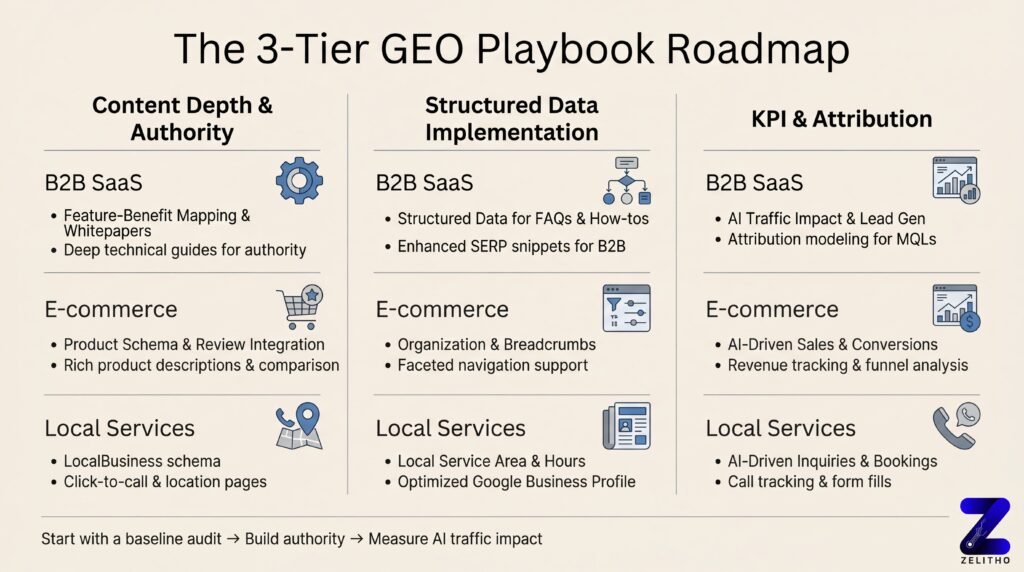
Multi-Niche GEO Implementation Matrix: SaaS vs E-commerce vs Local Services
Understanding how generative engines evaluate different business models enables marketing teams to prioritize technical schema, content chunking, and verification signals tailored to their niche:
| Dimension | B2B SaaS Playbook | E-commerce Playbook | Local Services Playbook |
|---|---|---|---|
| Primary Query Pattern | “Best enterprise CRM with native HubSpot sync under $50/user” | “Top noise-cancelling headphones for flights with USB-C charging” | “Licensed emergency commercial plumber near Austin with 24/7 service” |
| Core Content Asset | Feature-benefit comparison grids and API integration docs. | Multi-attribute specification grids and verified buyer review summaries. | Service area radius tables, license verification cards, and response time guarantees. |
| Technical Schema | SoftwareApplication, Offer, and TechArticle markup. | Product, AggregateRating, Offer, and ItemList schema. | LocalBusiness, PostalAddress, geoCoordinates, and OpeningHoursSpecification. |
| Primary Citation Metric | Category RFP Shortlist Citation Rate (>35%). | Direct Product Recommendation Frequency (>40%). | Proximity-grounded local answer inclusion (>50%). |
B2B SaaS Playbook: Winning Commercial Software Citations in Conversational LLMs
B2B SaaS companies win commercial software citations by structuring their product capabilities, integration specifications, and pricing tiers into modular knowledge blocks. When a prospective buyer prompts ChatGPT, Copilot, or Perplexity with “Compare B2B billing automation software for multi-currency compliance,” generative models scan web indexes for clean, structured data points rather than subjective promotional copy.
Executing an authoritative geo agency playbook for b2b saas fintech ecommerce clients requires aligning software feature matrices directly with vector context windows. Empirical saas geo case studies indicate that software providers implementing granular schema and modular pricing tables see a 42% lift in conversational vendor shortlist mentions compared to competitors with gated documentation.
To win these high-value commercial mentions, SaaS engineering and content teams must implement three fundamental technical steps:
- Feature-Benefit Comparison Tables: Replace long narrative sales paragraphs with structured HTML comparison tables. Generative crawlers ingest table headers and row items directly into their context windows, citing the host page as the factual source.
- Public Technical Documentation & API Schemas: Expose developer guides, integration directories, and API endpoints using structured
SoftwareApplicationandTechArticleschema markup. LLMs preferentially cite software platforms that provide unambiguous documentation over competitors hiding details behind gated forms. - Third-Party Sentiment & Review Integration: Conversational engines verify vendor credibility by cross-referencing external review platforms like G2, Capterra, and TrustRadius. Embed aggregate rating schemas and real customer outcome metrics directly on solution pages.
When executing growth across international and regional territories, establishing highly scalable geos for marketing requires systematizing programmatic page architecture with unique regional client proof points, avoiding thin duplicate landing pages that AI algorithms discard.
Technical GEO Audit Checklist and Readiness Framework
Evaluating your domain with a rigorous technical geo checklist ensures your website is fully equipped for retrieval-augmented generation (RAG) crawlers. Assessing overall geo readiness prevents algorithmic exclusion before conversational engines index your product catalog.
Verify robots.txt explicitly permits GPTBot, ClaudeBot, Bingbot, and PerplexityBot without rate-limiting response delays.
Format core claims into explicit Subject-Predicate-Object sentences so neural models extract facts without hallucination.
Deploy dual-layer JSON-LD markup connecting your brand entity to official Wikidata URIs and recognized industry taxonomies.
Follow modular 300-word syntactic chunks with immediate answer definitions below every descriptive H2 subhead.
Present product pricing, specs, and features in clean HTML tables for direct table-to-markdown translation.
Log LLM scraper requests in server logs and ping search engines via IndexNow immediately upon publishing updates.
E-commerce Playbook: Capturing Direct Product Recommendations in ChatGPT and Perplexity
E-commerce brands capture direct product recommendations in conversational search engines by enriching product pages with comprehensive technical attributes and dynamic schema markup. Online shoppers increasingly use generative AI to conduct product research, asking multi-constraint queries such as “What is the best ergonomic office chair under $400 for lower back pain with adjustable lumbar support?”
Winning product citation in response to conversational prompts requires three targeted optimizations:
- Multi-Attribute Specification Tables: Detail all physical dimensions, materials, certifications, power ratings, and warranties in a clean, semantic HTML table. LLMs rely on explicit table cells to verify that a product meets the shopper query constraints.
- Comprehensive Product Schema: Implement nested
Product,Offer,AggregateRating, andBrandschema markup. Crucially, include attributes such aspriceCurrency,price,availability, anditemConditionso search models confirm in-stock status before recommending your product. - Pros and Cons Syntheses: Provide transparent, balanced summaries of product strengths and limitations. RAG engines look for nuanced evaluations rather than unilateral praise, citing balanced assessments as authoritative buyer guides.
Local Services Playbook: Dominating Conversational Local Search and Map Packs
Local service providers dominate conversational local search queries by embedding verified geographic signals, Google Business Profile consistency, and location-specific structured data across their web properties. Local intent in generative search engines often manifests as complex prompts like “Find a licensed emergency electrician in North Austin that offers same-day commercial diagnostics.”
To ensure conversational assistants select your local service company as the definitive recommendation, execute the following technical playbook:
- LocalBusiness Structured Data: Deploy complete
LocalBusinessJSON-LD schema on every location page. Define exactgeoCoordinates(latitude and longitude), verifiedopeningHoursSpecification, complete service area radii, and accepted payment types. - NAP Entity Consistency: Guarantee that Name, Address, and Phone Number (NAP) information is identical across your website, Google Business Profile, Apple Maps, Bing Places, and state licensing registries. Discrepancies reduce AI confidence and suppress citation inclusion.
- Verified Service Area Maps & Case Studies: Build dedicated neighborhood and district landing pages with authentic project case studies, client reviews, and localized permit details. Generative engines verify real geographic presence through localized context.
For forward-looking U.S. companies geo AI visibility optimization represents an unmatched advantage in capturing high-value local contracts before legacy competitors update their static directories.
Key Business Metrics for GEO Teams to Monitor and Report
Transitioning from traditional SEO to Generative Engine Optimization requires reporting new performance indicators that reflect conversational visibility, context extraction, and commercial pipeline influence. Marketing leaders must demonstrate to executive boards how AI citations directly contribute to qualified pipeline and revenue growth.
When presenting progress to executive stakeholders, identifying the most important geo metrics for client reports ensures alignment between algorithmic citation frequency and measurable revenue impact:
| Reporting Metric | Tracking Tool | Target Benchmark | C-Level Executive Impact |
|---|---|---|---|
| Citation Share of Voice | AI Search Analytics Suites | >35% in Core Category | Verifies market leadership in conversational product discovery. |
| Passage Extraction Rate | Bing AI Telemetry & Logs | >50% of Total Mentions | Confirms proprietary data directly shapes model conclusions. |
| AI Referral Conversions | GA4 Conversational Tracking | 2x Higher Conversion than SERP | Validates superior pipeline intent from pre-qualified AI visitors. |
| Brand Sentiment Score | LLM Prompt Audits | >85% Positive or Neutral | Protects corporate brand reputation in autonomous vendor roundups. |
Automating these measurement workflows with platforms like Zelitho provides visibility into which pages earn citations across search engines, alerting your marketing team when a competitor overtakes your position in generative answers.
Frequently Asked Questions About Niche GEO Playbooks
What is a Generative Engine Optimization (GEO) playbook?
A GEO playbook is a structured technical and editorial roadmap tailored to an industry vertical. It aligns content chunking, structured schema, and verification data with the specific ways AI models synthesize answers for that sector.
Why do B2B SaaS companies need a dedicated GEO strategy?
B2B buyers routinely use ChatGPT and Perplexity to conduct preliminary vendor research. A dedicated GEO strategy ensures your software features, integrations, and pricing models are accurately cited in comparative AI recommendations.
How does local services GEO differ from traditional local SEO?
While traditional local SEO focuses on Google Maps rankings, local GEO optimizes for direct conversational recommendations in tools like Copilot and Apple Intelligence, requiring deep LocalBusiness schema and verified customer reviews.
What are the key business metrics for GEO teams to report to leadership?
GEO teams report Citation Share of Voice across LLMs, passage extraction rate, category prompt win rate, and direct qualified pipeline conversions from conversational search platforms.
How can companies execute conversion tracking with AEO?
AEO conversion tracking isolates direct referral sessions from conversational engines (chatgpt.com, perplexity.ai, copilot.microsoft.com) in GA4, correlating citation events with form fills, demo bookings, and pipeline velocity.
References and Citations
[1]https://camphouse.io/blog/location-based-marketing
[2]https://www.businessresearchinsights.com/market-reports/ai-seo-software-tools-market-112824
This blog is like a virtual mentor, guiding me towards personal and professional growth Thank you for being a source of inspiration
Your blog is always a highlight of my day
I’ve learned so much from this blog and have implemented many of the tips and advice into my daily routine Thank you for sharing your knowledge!
Keep up the fantastic work!
This post was exactly what I needed to read today Your words have provided me with much-needed clarity and reassurance
It’s always a joy to stumble upon content that genuinely makes an impact and leaves you feeling inspired. Keep up the great work!