
Why Are AEO and GEO Very Important in Today’s SEO Landscape?


Answer Engine Optimization (AEO) and Generative Engine Optimization (GEO) are strategic disciplines designed to secure brand citations inside conversational AI models like ChatGPT, Perplexity, and Microsoft Copilot. Traditional SEO optimizes for position in a list of ten blue links. In contrast, AEO structures content into extractable direct answers, while GEO establishes brand authority across AI knowledge bases. As search engines synthesize direct answers and reduce click-through rates on traditional rankings, mastering AEO and GEO ensures your brand is cited by name where purchasing decisions are formed.
What Are AEO and GEO in SEO?
Answer Engine Optimization (AEO) is the practice of structuring website content so conversational AI engines select it as the definitive, direct answer to a user query. Generative Engine Optimization (GEO) is the broader discipline of establishing brand authority, verifiable entity relationships, and multi-source credibility so large language models cite your brand within synthesized responses.
Traditional search engine optimization assumes that achieving a top ranking leads to organic clicks. Modern generative engines break that connection by synthesizing answers directly in the search interface. AEO and GEO do not replace SEO; they build upon technical foundations to ensure content is both indexable by traditional crawlers and retrievable by neural embedding models.
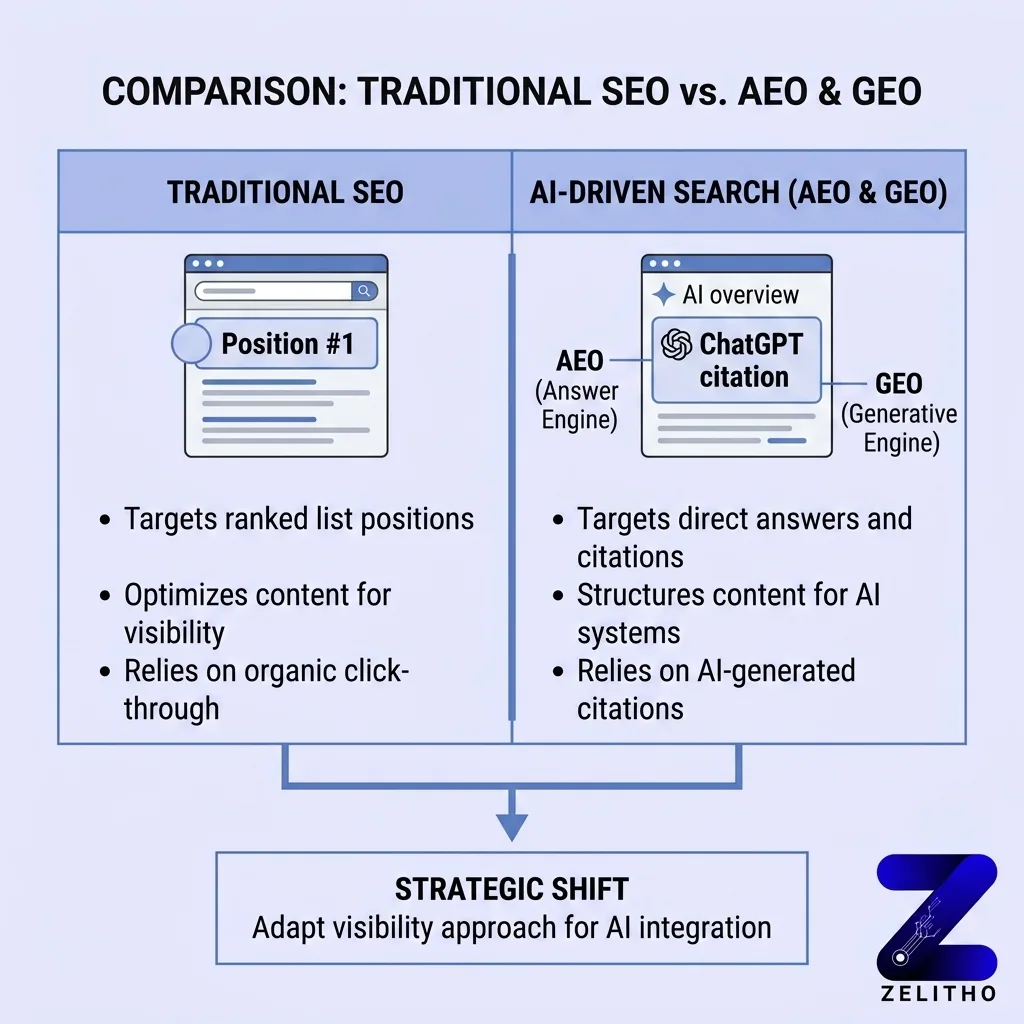
The Search Visibility Shift: Why Ranking First No Longer Means Being Found
Marketing teams frequently monitor dashboards showing stable organic rankings while total website traffic steadily drops. This divergence occurs because Google AI Overviews and conversational answer engines resolve buyer queries directly inside the results page, causing click-through rates on top positions to decline by over 34% [1].
Independent research into AI citation behavior demonstrates that 88% of citations in AI assistant answers come from URLs outside Google top 10 rankings. Holding a first-page ranking does not guarantee that your content will be cited by ChatGPT or Perplexity. AI search engines evaluate retrieval friction, semantic entity linkage, and factual density rather than legacy backlink volume alone.
Traditional SEO Schema vs GEO Schema: Structural Differences in the United States
A critical divergence between traditional search optimization and generative engine visibility lies in technical schema markup. While traditional SEO schema focuses on rich snippet displays, GEO schema is engineered for neural disambiguation, entity linking, and RAG vector store ingestion:
| Dimension | Traditional SEO Schema | GEO & AEO Knowledge Schema |
|---|---|---|
| Primary Objective | Win SERP visual enhancements (review stars, recipe cards, sitelinks). | Disambiguate brand entities and provide explicit machine grounding. |
| Entity Linkage | Basic Organization and WebPage types with domain-level sameAs links. | Deep Wikidata URIs, Wikipedia topic mappings, and explicit about/mentions arrays. |
| Schema Composition | Single-layer Article or BlogPosting tags. | Dual-layer TechArticle + FAQPage graph linking author, publisher, and entity nodes. |
| Machine Retrieval | Parsed by search engine crawlers during regular indexing. | Extracted by AI agents, synthetic crawlers, and real-time grounding scrapers. |
The Visibility Stack: A Layered Path from SEO into AEO and GEO
Transitioning to generative search does not require abandoning established SEO investments. Organizations build sustainable authority by treating visibility as a four-layer stack:
Fast page response times, clean sitemaps, open robots.txt policies for AI crawlers (like GPTBot, ClaudeBot, and Bingbot), and active IndexNow protocols. Without crawlability, no downstream optimization functions.
Formatting content into concise 45 to 65-word answer blocks placed directly beneath question-focused H2 headings. Semantic comparison tables and bulleted criteria enable machines to extract facts without context loss.
Building consistent digital co-occurrences between your brand and core industry topics. Maintaining accurate listings on authoritative third-party directories, industry associations, and Wikipedia/Wikidata entities.
Using platforms like Zelitho to continuously monitor citation share of voice, detect topic opportunities in Bing Webmaster Tools, and deploy citation-engineered content patches directly to the CMS.
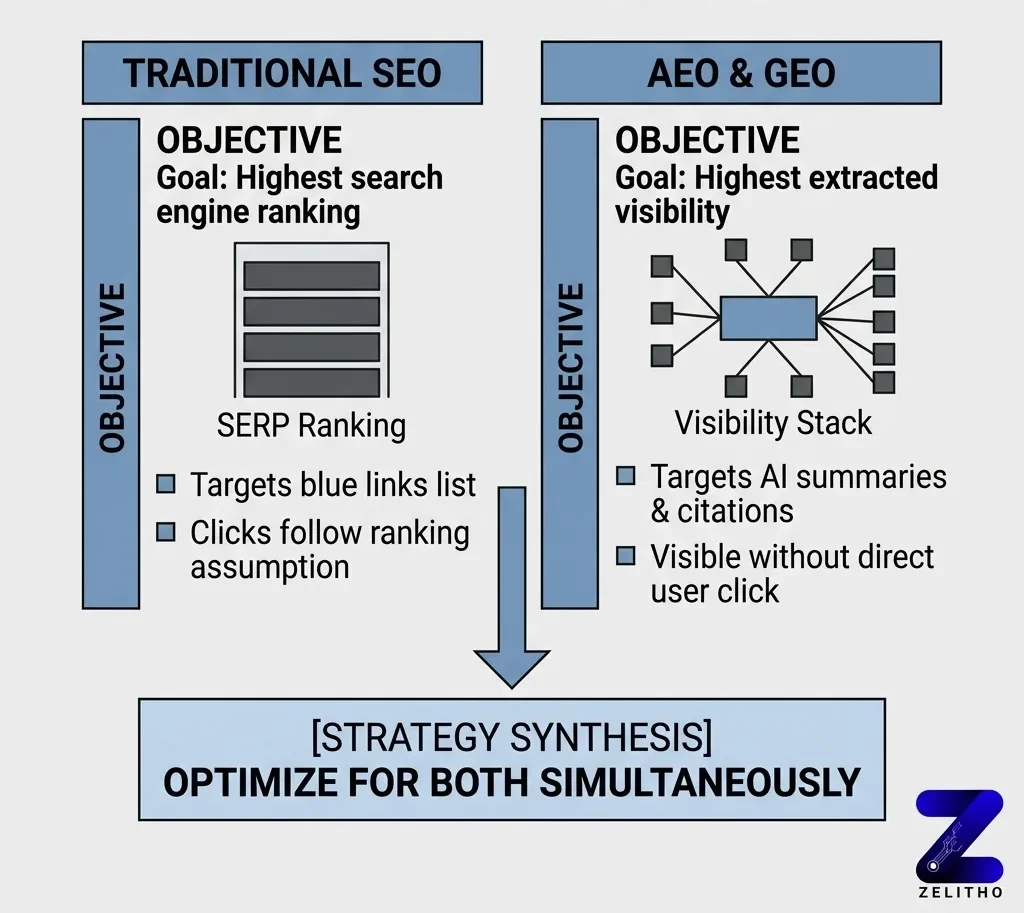
Reasons Companies Adopt AEO and GEO: Business Rationale for U.S. Companies
Enterprise organizations and forward-thinking U.S. companies adopt Answer Engine Optimization (AEO) and Generative Engine Optimization (GEO) to capture high-intent buyer discovery, protect brand citation share of voice, and generate qualified revenue pipeline. When conversational models synthesize product evaluations, cited companies gain decisive commercial advantages over competitors relying exclusively on legacy search tactics.
Enterprise buyers ask complex comparison prompts in ChatGPT and Perplexity during vendor research, where only cited brands enter consideration lists.
Establishing clear, machine-verifiable claims across authoritative knowledge graphs prevents generative models from repeating outdated pricing or inaccurate competitor comparisons.
Visitors arriving from AI citations convert at over twice the rate of traditional organic search traffic because conversational answers pre-qualify the buyer before the click occurs.
As Google AI Overviews and conversational answer engines absorb top-of-funnel clicks, AEO ensures your proprietary data and benchmarks remain prominently attributed.
Important GEO Metrics for Client Reports
When reporting generative engine optimization progress to executive leadership and agency clients, focus on three primary verification metrics:
- Citation Share of Voice across LLMs: The percentage of generative responses in your product category that cite your domain.
- Passage Extraction Frequency: How often models directly quote your specific benchmarks, definitions, and pricing tables.
- Net Recommendation Sentiment: Whether conversational engines recommend your solution as a primary option or a secondary alternative.
Frequently Asked Questions About AEO and GEO
Why are AEO and GEO very important in today’s SEO landscape?
AEO and GEO are essential because search engines are evolving from link directories into conversational answer engines. Users increasingly receive synthesized responses that answer queries immediately. Brands that fail to optimize for extractability and entity authority lose visibility even when their legacy Google rankings remain unchanged.
How does SEO schema differ from GEO schema?
Traditional SEO schema is designed to generate rich snippets in search results (like review stars or recipe cards). GEO schema focuses on machine comprehension and vector retrieval, using dual-layer TechArticle and FAQPage structures with explicit Wikidata entity linkages to prevent neural hallucination.
How do companies optimize websites for AI search engines (GEO)?
Companies optimize for AI visibility by placing concise answer-first summaries below headings, structuring data into responsive HTML tables, publishing modular 300-word syntactic chunks, embedding Wikidata schema, and keeping legacy content regularly updated.
Can a brand rank #1 on Google and still have zero AI visibility?
Yes. Studies demonstrate that 88% of sources cited in generative AI answers sit outside Google top 10 results. AI retrieval systems prioritize concise, highly chunked, and entity-dense content over pages that merely hold high legacy backlink authority.
Why do enterprise companies adopt AEO and GEO strategies?
Enterprise companies adopt AEO and GEO to secure brand visibility in conversational answer engines, protect market share against competitor citations, and capture high-intent commercial buyers who conduct solution research inside AI interfaces.
How do proven AEO partners secure brand citations in AI-generated answers?
Proven AEO partners secure brand citations by restructuring web content into modular, answer-first syntactic chunks, implementing comprehensive JSON-LD knowledge graphs, establishing multi-source consensus, and actively tracking citation share of voice across LLMs.
References and Citations
[1]https://ridgemarketing.com/blog/seo-vs-aeo-vs-geo/
[2]https://www.360livemedia.com/news/geo-and-aeo