
What Is Keyword Research for Content and SEO?

TL;DR
You ran your site through a content audit. You have a spreadsheet with hundreds of keywords. Now it sits open in a tab you haven’t touched in two weeks.
Most guides treat this process as a discovery task. Find terms, export a list, move on. The problem: discovery without a decision framework produces data, not direction. Teams keep targeting high-volume terms they cannot realistically rank for, and the traffic never comes.
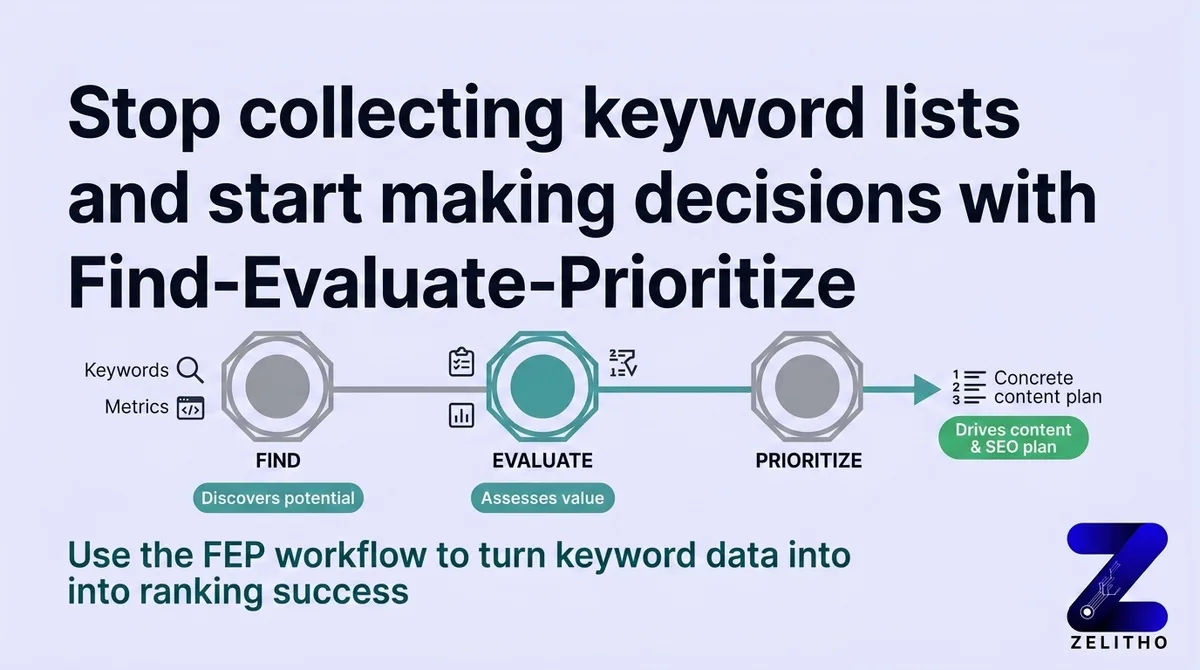
The Find-Evaluate-Prioritize (FEP) Workflow changes that structure. It treats keyword research as three sequential decisions: which terms exist, which ones are worth chasing, and which ones map to actual pages. Senior marketers at funded companies, founders scaling content, and agency owners managing multiple clients all benefit from a process that ends with page-level action, not a spreadsheet row.
What is keyword research used for in SEO?
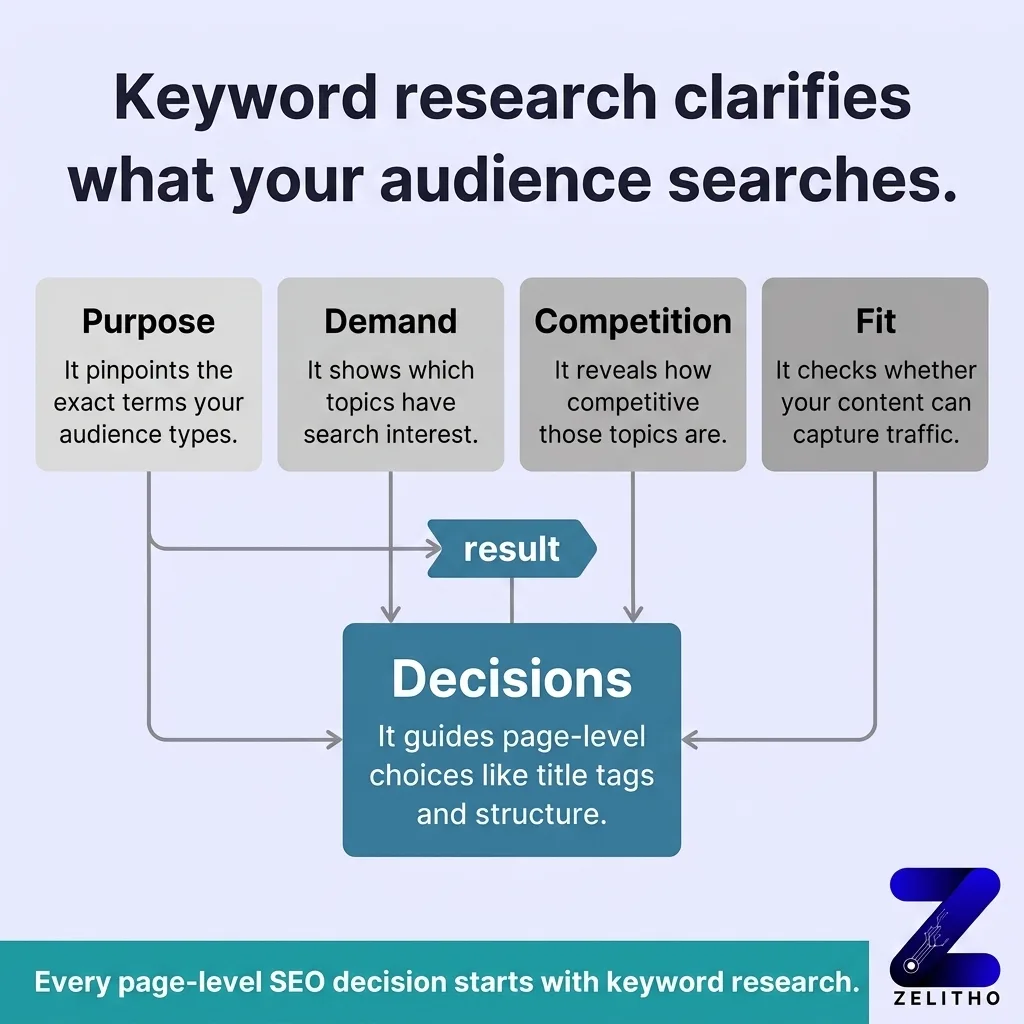
Keyword research identifies the exact terms your audience types into search engines. It tells you which topics have demand, how competitive those topics are, and whether your existing or planned content can realistically capture that traffic. Every page-level SEO decision, from title tags to content structure, starts here.
What Keyword Research Actually Is , And What It Is Not
Keyword research is a decision process. Most teams treat it as a list-building exercise.
That gap is where content budgets disappear.
A team that exports 400 terms from a tool and calls it “done” has completed the smallest part of the job. The list means nothing until every term gets evaluated, ranked, and mapped to a specific page or brief. Research without that step produces the same outcome every time: a file that collects dust while the team publishes content based on gut feeling anyway.
Here is the sting line: more keywords do not mean a better strategy. A tighter list of 20 well-chosen terms beats 200 loosely gathered ones.
The FEP Workflow (Find, Evaluate, Prioritize) runs through three sequential stages. Each stage produces a decision, not a dataset. By the end, every surviving keyword maps to an action. Nothing floats in a spreadsheet without a destination.
Short-tail versus long-tail: why this distinction shapes every choice
Short-tail keywords carry one to two words [3]. Think “email marketing” or “SEO tools.” They attract broad traffic, but the competition is steep and the intent behind any given search is unclear. Someone typing “email marketing” might want a definition, a platform comparison, a pricing page, or a beginner tutorial. You cannot write one page that satisfies all of those.
Long-tail phrases carry four or more words [1]. “Email marketing for small nonprofits with limited budgets” is one example. The search volume drops. The competition drops further. The intent becomes specific enough to write directly to. Conversion likelihood rises because the reader already knows what they want.
A team targeting “marketing” as a primary keyword faces a completely different battlefield than a team targeting “email marketing for small nonprofits.” One competes with every major publication and software company on earth. The other competes with a handful of niche guides and wins a sharply defined audience.
Attribute | Short-Tail (1–2 words) | Long-Tail (4+ words) |
|---|---|---|
Monthly Search Volume | High | Lower |
Competition Level | Very high | Manageable |
Intent Clarity | Vague | Specific |
Conversion Likelihood | Lower | Higher |
The table above is not theoretical. It is the reason a blog targeting “software” will never rank while a blog targeting “volunteer management software for small teams” can hit page one within months.
Stop chasing volume as a proxy for value. Start matching terms to the intent of a reader who is one step away from taking action.
How to Find Keywords Your Audience Is Already Using
The hidden worry at this stage: “Am I picking terms nobody actually searches?”
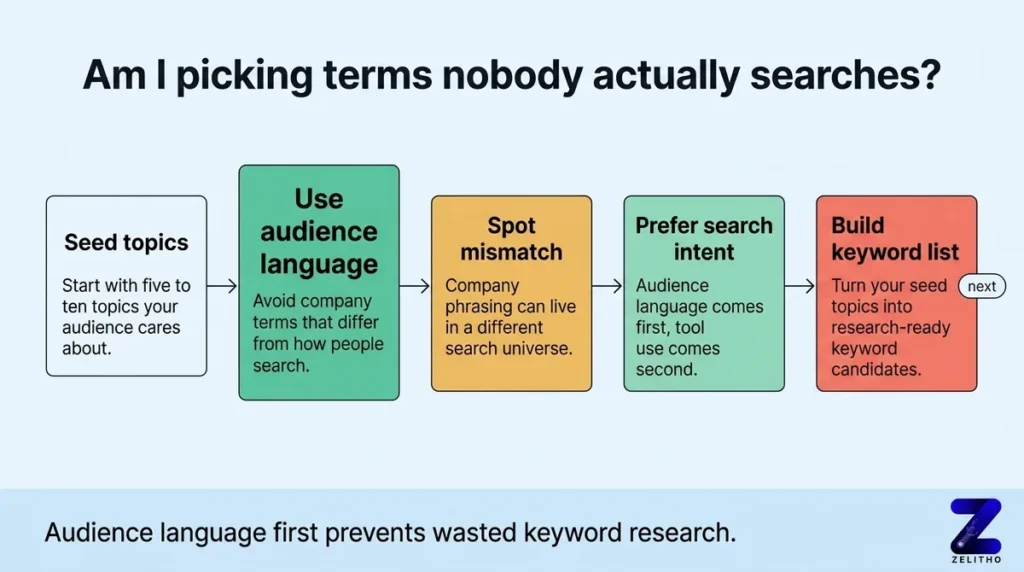
It is a fair concern. Internal teams almost always default to company language. A nonprofit calls its system a “staff coordination platform.” Its audience types “volunteer management software.” Those two phrases live in different universes for search behavior.
Audience language comes first. Tool use comes second.
Before opening any research platform, build a seed list of five to ten topics your audience actually cares about. Pull language from support tickets, sales call transcripts, onboarding emails, and community forums. This is where real search behavior lives, not in a product glossary.
Building a seed list before touching a tool
Take those five to ten topics and write them as your audience would type them at 9pm on a Tuesday, under time pressure, without knowing your product’s internal vocabulary. Then expand each one into five to ten related questions or phrases. This gives you a raw input set before any tool enters the picture.
This step prevents the most common discovery mistake: entering your own jargon into a keyword tool and assuming the output reflects what real people search for.
Using tools to expand and validate
Google Keyword Planner gives you three data points per term: average monthly search volume, a three-month percentage change, and year-over-year change [1]. Those three signals together tell you whether a term is growing, shrinking, or holding steady. A term with 800 monthly searches and 40% year-over-year growth is more valuable than a term with 2,000 searches and a declining trend.
AnswerThePublic pulls question-based and preposition-based variations of any seed term. Its free access caps at three searches per day [1]. Plan which seeds you enter carefully. Do not burn a search on a term you could validate through Google Keyword Planner first.
Across the sources that inform this guide, five keyword research tools are named as the core toolkit [3]. The tools matter less than the order of operations. Seed list first. Tool expansion second. Evaluation third.
The scenario above about the nonprofit is not hypothetical. A team that enters “staff coordination platform” into a keyword tool gets back data for a phrase nobody searches. A team that enters “volunteer management software” finds a real audience asking real questions. The difference is where you start, not which tool you use.
How to Evaluate Whether a Keyword Is Worth Targeting
Finding a keyword and targeting a keyword are two separate decisions.
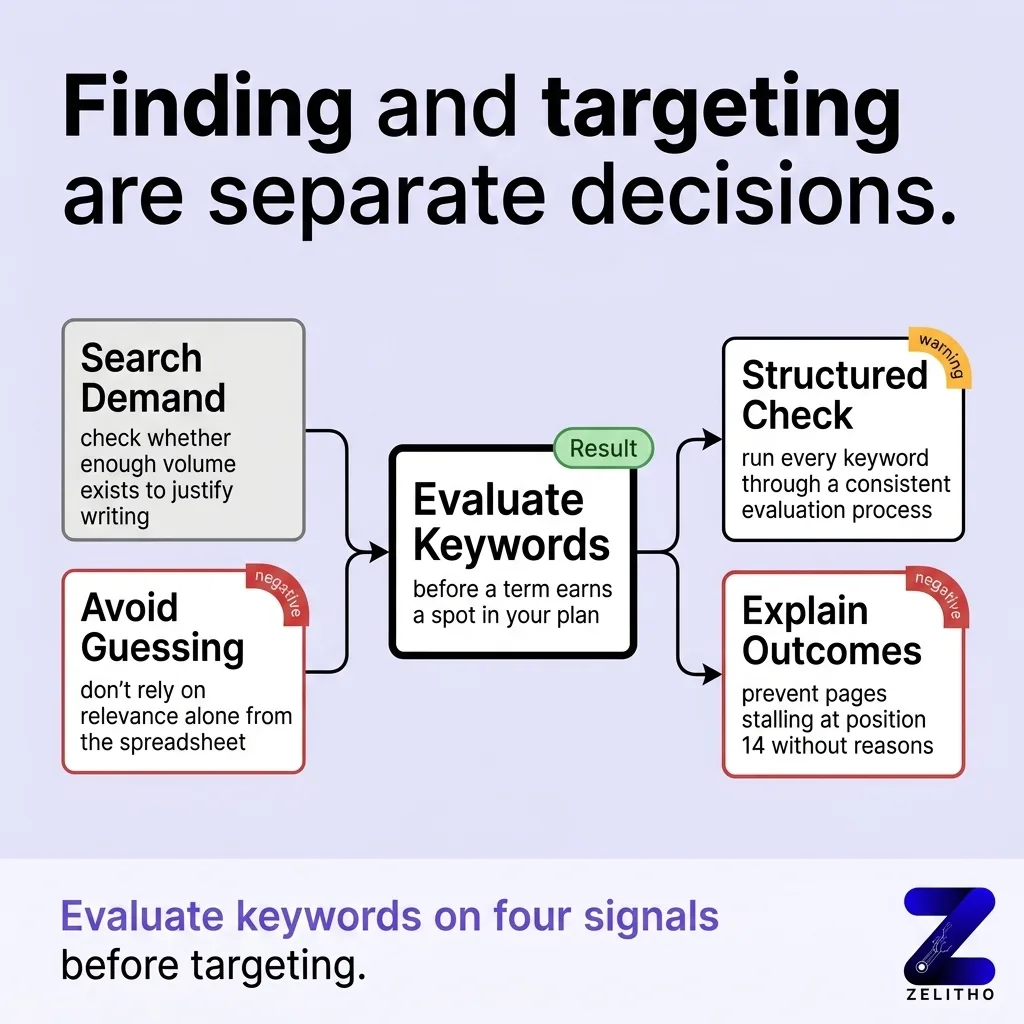
This section is where most teams skip a step. A term lands in the spreadsheet because it looks relevant. Nobody runs it through a structured check. Three months later, the page sits at position 14 and nobody can explain why.
Evaluate every keyword on four signals before it earns a spot in your content plan.
The four evaluation signals
First: search demand. Does enough volume exist to justify writing the page? A term with 20 monthly searches is not necessarily worth a full content brief.
Second: competition level. What does the current page one look like? If every result comes from a domain with 10 years of authority and 50,000 backlinks, this keyword belongs in a future bucket, not a current one.
Third: relevance to your content. Does the term connect to something your site is actually about? Ranking for tangentially related terms produces traffic that exits immediately. That traffic does not convert.
Fourth: content fit. Does your team have the expertise, data, or angle to write something worth ranking? A term is only valuable if you can produce a page that earns its position.
Why position matters more than volume
Here is where the math makes the decision concrete.
A keyword with 90,000 monthly searches sounds like a priority [4]. At position four, the average organic click-through rate is 0.2% [4]. That is 180 clicks per month. At position three, the average organic CTR climbs to 5.42% [4]. That is 4,878 clicks per month from the same keyword.
Moving up one position on a 90,000-volume term could produce a 96% lift in organic traffic [4]. Not from publishing more content. From targeting a term where ranking at position three is realistic instead of chasing a term where position four is your ceiling.
The common belief is that high volume equals the best target. The correct framing: a keyword you can realistically rank for at position three beats a keyword you will hold at position four indefinitely.
Evaluation checklist (apply to every keyword)
- Search volume: is it sufficient for the page’s goal?
- Competition score: is ranking at position one to three realistic within your domain’s authority?
- Audience match: does this term reflect language your actual buyer uses?
- Content fit: do you have the material to produce something that earns this position?
- Score every keyword on all four signals. A term that scores weak on two or more goes into a “revisit later” column, not a content brief.
How to Prioritize Keywords and Turn Research Into a Content Plan
You now have a filtered list. The next problem is that a filtered list is still not a plan.
A team with 200 keywords in a spreadsheet and no prioritization system faces the same paralysis as a team with zero keywords. Data volume does not equal clarity.
The final stage of the FEP Workflow converts your evaluated list into three types of action: new content creation, existing page optimization, and topic cluster building. Every keyword must map to one of these three before the research session ends.
Collapsing a list into page targets
Keyword research runs through three phases [2] and six main application steps [3]. The prioritization phase is where the volume shrinks fast.
The workflow targets three to five related keywords per page [1]. Not one, because a single keyword leaves page intent too narrow. Not fifteen, because a page that tries to rank for fifteen terms usually ranks for none. Three to five related terms let you write with natural depth while maintaining a clear topical focus.
A team with 200 keywords can usually collapse them into 12 to 15 page targets by clustering terms with matching intent. “Best email tools for nonprofits,” “top email platforms for small nonprofits,” and “nonprofit email marketing software” all belong on the same page. They do not each need their own URL.
The tiered priority system
Place keywords into three tiers before assigning them to a content calendar.
Tier one goes first: high volume, low competition, high relevance to your current domain authority. These terms are winnable now. Assign each one to either an existing URL for optimization or a new content brief.
Tier two goes next: medium volume, moderate competition, high relevance. These take longer but build authority over time.
Tier three is the watchlist: high volume, high competition, or terms your domain cannot realistically rank for yet. Do not ignore them. Revisit them as your authority grows.
Connecting keywords to specific URLs
Every keyword in your final list must map to either an existing URL or a planned content brief before the research session closes [3]. This is the operational rule that separates a working content system from a spreadsheet archive.
If a keyword has no URL and no brief assigned to it, it is not part of your strategy. It is noise.
“We saw a content team with 14 blog posts, a 300-keyword spreadsheet, and no clear mapping between the two. We ran them through intent clustering and collapsed 300 terms into 11 page targets. Eight mapped to existing posts that needed optimization. Three required new briefs. Twelve weeks later, four of the eight optimized posts moved from page two to page one.”
That is the FEP Workflow applied: Find, Evaluate, Prioritize. Three stages. Clear output at each stage. No floating data.
From keyword list to content plan , close the gap that matters
The gap between finding keywords and acting on them is where most content programs stall.
The FEP Workflow closes that gap by treating each stage as a decision point, not a data collection exercise. Finding terms without audience language mapping produces jargon-heavy lists. Evaluating terms without the four-signal checklist produces optimistic targets nobody can rank for. Prioritizing without URL mapping produces a document that expires the moment the next meeting starts.
Run the three stages in order. Score every keyword before it earns a place in a brief. Map every surviving term to a URL or a planned page. Revisit your tier-three list every quarter as your domain authority shifts.
Every keyword that stays in your plan should be there because it passed a test, not because it felt right.
FAQ
Keyword research identifies terms your audience already types into search engines. It informs which pages to create, which existing pages to update, and how to structure content so it connects to real search demand. Without it, content planning defaults to assumption.
A beginner can start with keyword research using free tools like Google Keyword Planner and AnswerThePublic. The core skill is matching content to real audience language, not mastering every technical signal at once. Starting with long-tail phrases and low-competition terms gives a beginner realistic early wins. Zelitho’s Content Automation Platform is also very beginner friendly and easy to get started with.
No single channel replaces SEO for durable, compounding search traffic. Paid search produces faster results but stops when budgets stop. Content designed for search intent builds an asset that compounds over time. The channels that work best run alongside SEO, not instead of it.
References and Citations
[1]https://www.carnegiehighered.com/seo-basics-for-colleges-and-universities-how-to-perform-keyword-research/
[2]https://dxstudio.msu.edu/website-technology/seo/keywords
[3]https://www.thisisgain.com/post/mastering-keyword-research-for-effective-content-marketing
[4]https://www.botify.com/blog/keyword-research-for-seo-how-to-create-a-killer-keyword-strategy