
What Are Keywords in SEO, and Why Do They Matter?

TL;DR
You published the article. You checked the box. Ninety days later, Google Search Console shows zero impressions for that page. Not low clicks. Zero. The content was good. The problem was that no one at your company confirmed what phrase a real person would type to find it.
Most teams treat keyword selection as a creative decision. They pick words that sound right for their brand. That approach skips the step that actually connects a page to search demand. Brand language and search language are rarely the same thing.
The Select-Evaluate-Place Framework fixes this. It runs in three steps: match the keyword to what the searcher actually wants, confirm the difficulty is winnable, then place the term in the seven locations where search engines and readers both look. Senior marketers, founders scaling content, and agency owners managing multiple client sites can apply this sequence to every page before writing begins.
What are keywords and why are they important in SEO?
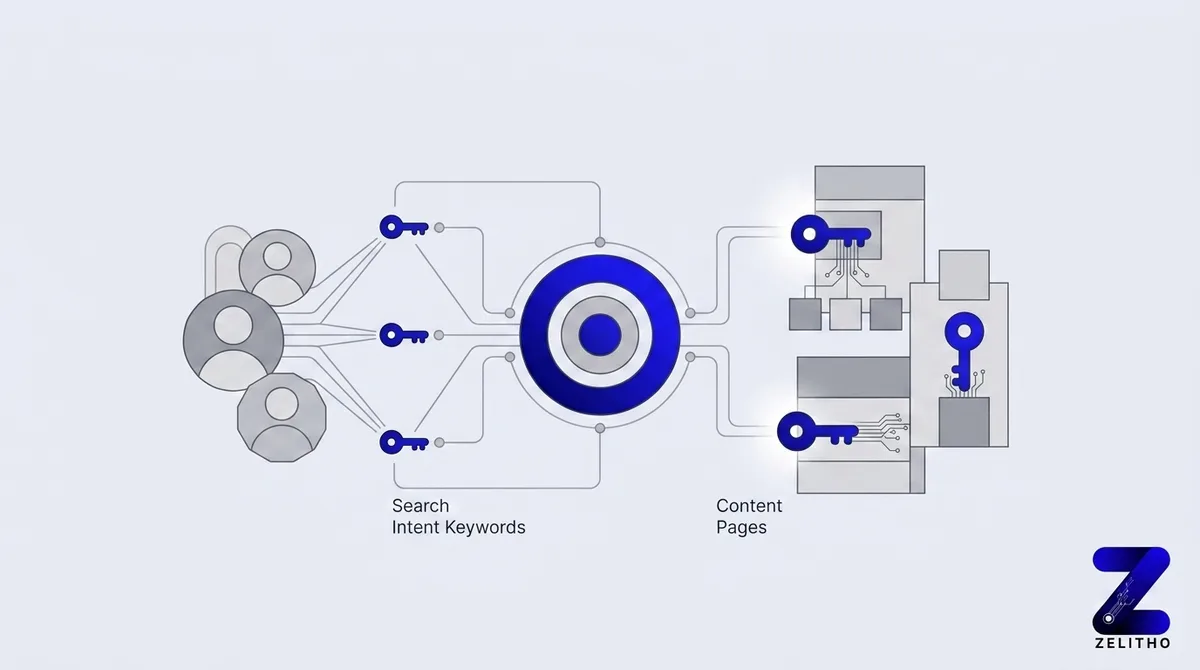
A keyword in SEO is the phrase a person types into a search engine. Your page either matches that phrase or it does not. If it does not match, the page does not appear, regardless of how well it is written.
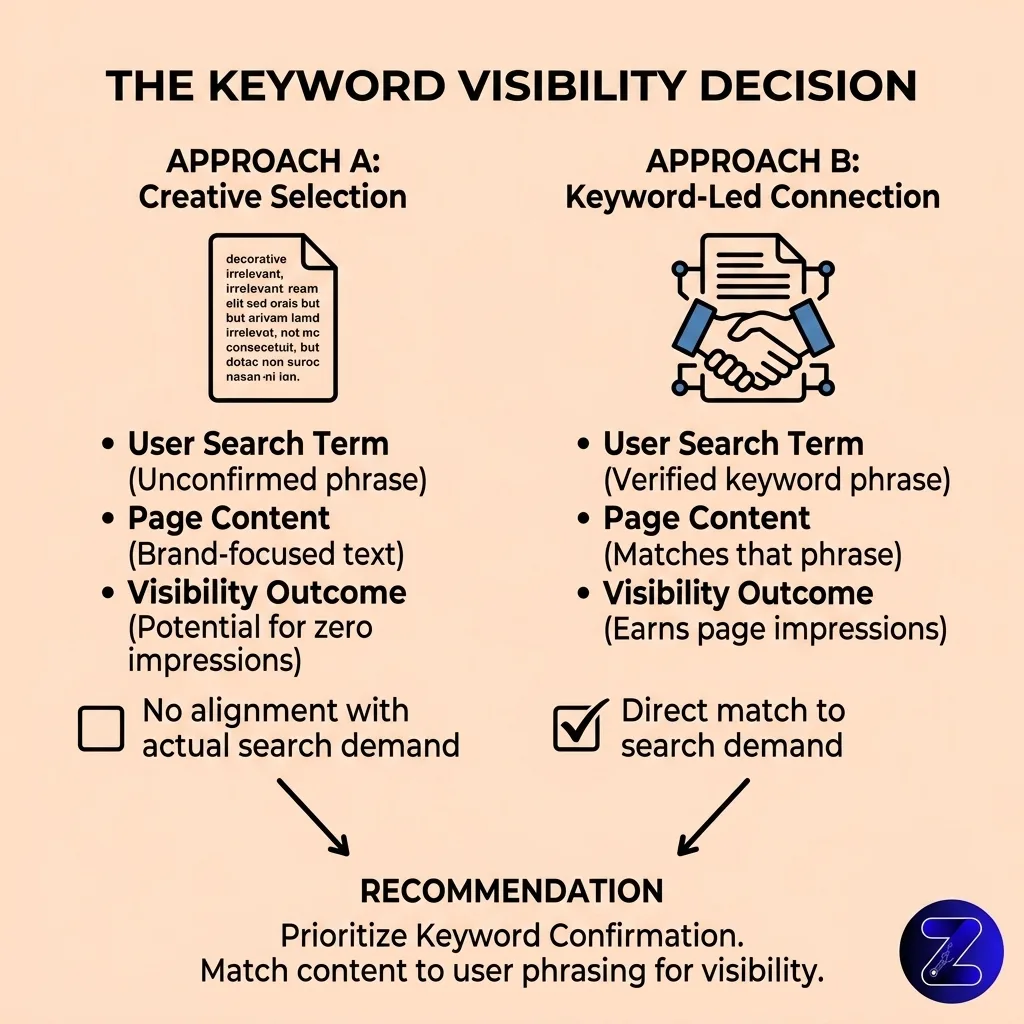
Keywords connect search demand to your content. They are the mechanism that determines whether a page earns impressions, not just whether it earns clicks.
What a Keyword Actually Is (and What Most Beginners Get Wrong)
Most beginners think of a keyword as a single power word. They target “marketing” or “shoes” and expect traffic to follow. That belief produces invisible pages.
A keyword is a phrase that signals intent. It tells you what a person wants, not just what topic they are browsing.
Short-tail keywords, like “running shoes,” are broad. They attract high search volume, but they also attract every major retailer, brand, and publisher in the category. Short-tail keywords make up almost 20% of all searches [1], which sounds significant until you realize that 20% is split across thousands of competing pages.
Long-tail keywords change the equation. A phrase like “best lightweight running shoes for flat feet” is longer, more specific, and far less contested. Long-tail keywords are defined as phrases with three or more words [1]. They attract fewer visitors per query, but those visitors are closer to a decision. They convert at higher rates and are easier to rank for.
Stop targeting the shortest version of your topic. Start targeting the phrase your actual buyer would type at 10pm when they are ready to act.
The practical shift is this: a keyword is not vocabulary. It is a signal. It tells you what stage of thinking the searcher is in, what format they expect to find, and what problem they are trying to solve. Matching that signal is the job.
This article is not a glossary. Every section moves from concept to decision. By the end, you will have a repeatable sequence, not a list of definitions.
Why Search Engines Stopped Caring About Keywords the Way You Think They Do
Here is the false assumption that costs teams the most time: repeating a keyword more often improves ranking. That was never reliably true, and it is actively counterproductive now.
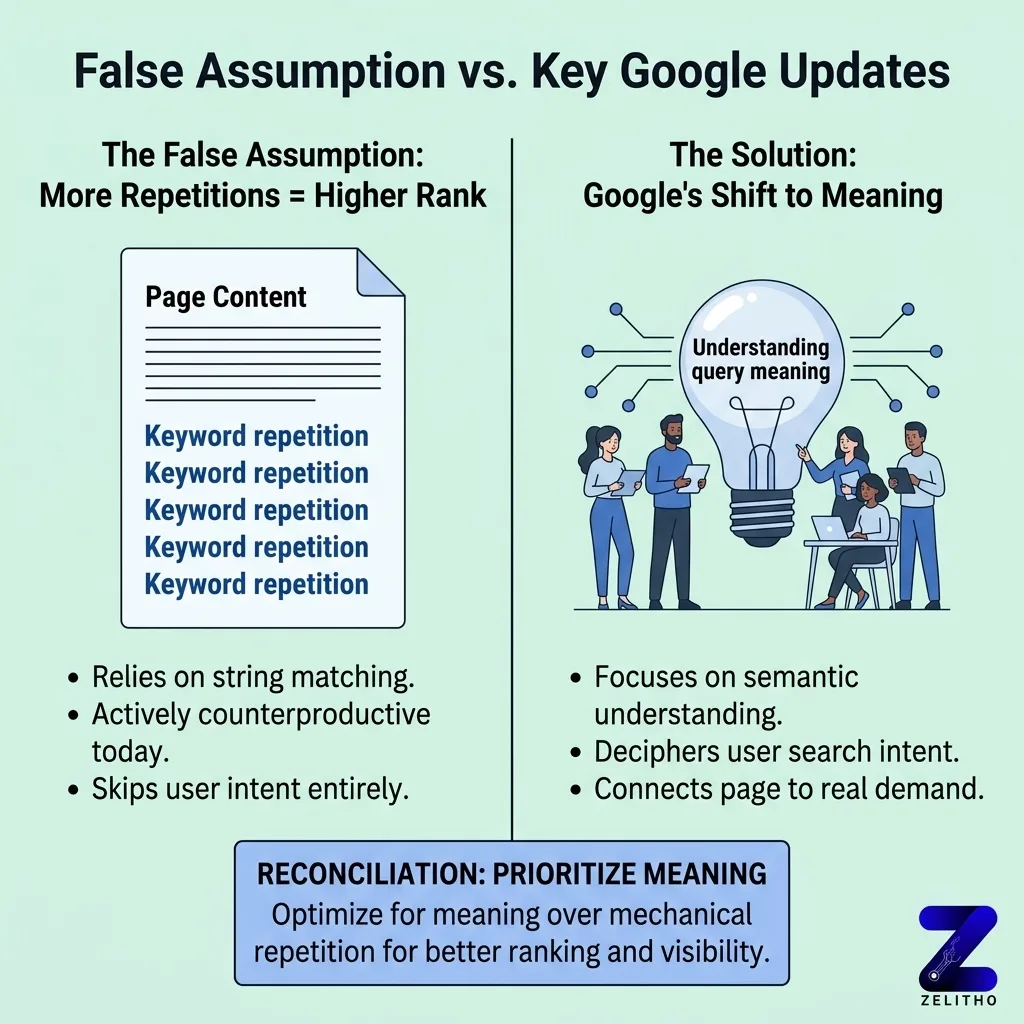
Google has spent over a decade building systems that understand meaning, not just string matching. Three updates changed how keyword interpretation works at a technical level.
Algorithm Update | Announced | What It Changed |
|---|---|---|
Hummingbird | September 2013 | Shifted Google toward understanding query meaning over matching exact words |
RankBrain | October 2015 | Added machine learning to interpret ambiguous or novel queries |
BERT | October 2019 | Allowed Google to read context at the sentence level, not just keyword level |
Hummingbird was the structural shift. Before it, Google matched words. After it, Google read queries as questions with meaning. RankBrain extended that by handling queries it had never seen before. BERT went further, reading the relationship between words in a sentence to understand context .
The operational consequence is direct: writing for a topic is not the same as writing for a term. A page about “running shoe support” that also addresses arch problems, gait correction, and orthopedic recommendations will outrank a page that repeats “running shoe support” fourteen times in three paragraphs.
Keyword stuffing, the practice of repeating a term at an unnatural density, can lead to index exclusion or ranking loss [2]. Google does not need to see a phrase ten times to understand what a page covers. It needs to see the full context of the topic addressed clearly.
Cover the topic with depth. Use the primary phrase where it fits naturally. Use related terms, questions, and supporting concepts throughout. That is what signals relevance to a modern search engine.
What Happens to Pages That Ignore Keyword Targeting Entirely
The hidden worry for most marketers is this: “I wrote good content. Why is no one finding it?”
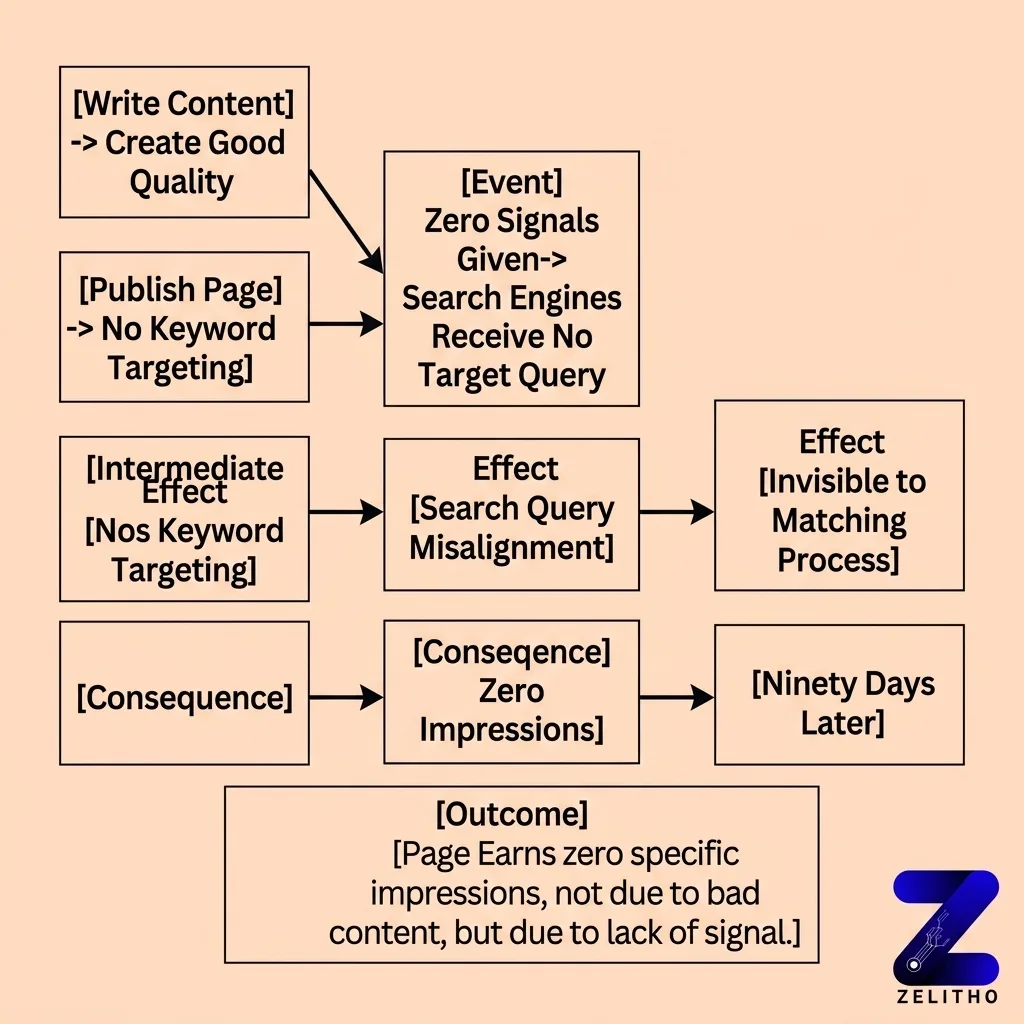
The answer is usually not quality. It is signal.
A page without keyword targeting gives search engines no clear indication of which queries it should appear for. Without that signal, the page competes for zero specific queries. It earns zero impressions in the first 90 days, not because it is bad, but because it is invisible to the matching process.
A page may be excluded from indexing or ranked lower if keyword targeting is absent or weak [2]. This is not a penalty in the traditional sense. It is an absence of positive signal. Search engines fill their results with pages that clearly answer a specific query. A page with no alignment to any query does not make that cut.
Google’s history reinforces this. Google Panda, released in February 2011, affected 11.8% of all queries [1]. Its purpose was to remove low-quality, low-relevance content from top positions. Pages that did not clearly serve a search intent were pushed down or removed. That principle has only become more refined since then.
One content team published 24 blog posts in one quarter with no keyword research phase. Each post was well-written and covered real topics. After 90 days, the entire batch had accumulated fewer than 200 impressions combined across Search Console. One keyword research pass before writing, targeting phrases with confirmed search demand, would have changed the outcome for most of those pages.
Before publishing any page, confirm it targets at least one specific phrase with measurable search demand. That is the minimum viable standard.
The Three-Step Keyword Selection and Placement Framework
The system has a name: the Select-Evaluate-Place Framework. Apply it before writing any page, not after. Retrofitting keyword targeting to finished content is slower and produces worse results.
The Select-Evaluate-Place Framework runs in three sequential steps.
Step 1: Select by intent
Match the keyword to what the searcher actually wants. Search intent falls into three categories: informational (the person wants to learn something), navigational (the person wants to reach a specific site), and transactional (the person wants to buy or take action).
A page targeting an informational query needs to teach. A page targeting a transactional query needs to convert. Mismatching intent to format is one of the most common reasons well-researched pages fail to rank.
Step 2: Evaluate difficulty
Confirming a keyword has search demand is not enough. You also need to confirm it is winnable.
Low-difficulty keywords have a keyword difficulty score below 30% [1]. For newer sites or content programs without strong domain authority, that threshold is a practical starting filter. Targeting high-difficulty terms too early means competing against established pages with years of backlinks.
Use Google Trends to check historical popularity for your shortlisted terms [2]. A keyword with strong current volume but a declining trend line over 24 months is a weaker investment than a stable or growing term. Seasonal spikes can also mislead. Google Trends separates genuine demand from temporary interest.
Step 3: Place correctly
Research without placement produces no result. Search engines read specific locations on a page to determine what it covers.
There are seven on-page locations where keyword placement matters :
1. Title Tag
2. H1 heading
3. Meta description
4. URL slug
5. First paragraph
6. Body content
7. image alt text
The title tag and H1 carry the most weight. The first paragraph confirms the topic signal established in the heading. The URL slug gives search engines a clean, readable indicator of the page’s subject. Image alt text is frequently skipped, but it contributes to the full keyword picture the crawler assembles for your page.
The Select-Evaluate-Place Framework works because it sequences decisions correctly. Intent first, difficulty second, placement third. Skipping steps does not accelerate the process. It removes the conditions that make ranking possible.
From concept to placement: the only keyword sequence beginners need
A keyword is not decoration. It is the phrase your audience already typed before they found you, or did not find you. Every page you publish either aligns to a real search phrase or it does not. There is no middle ground in a search index.
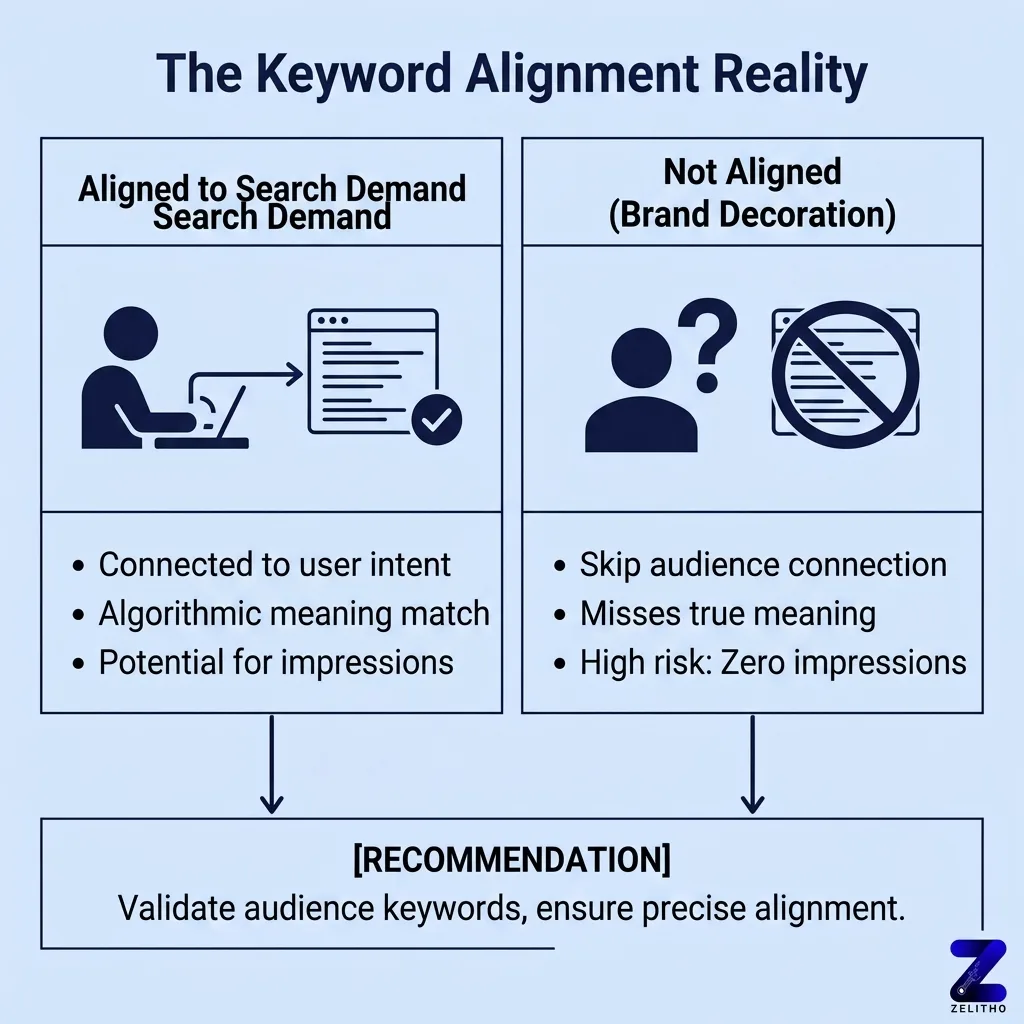
The algorithm evolution from Hummingbird to BERT made it clear that search engines read for meaning. That does not make keyword targeting less important. It makes precise targeting more important, because now the full context of your page determines whether it matches the intent behind a query.
Pages without keyword alignment earn zero impressions. Pages with heavy repetition earn penalties. The space between those two errors is where the Select-Evaluate-Place Framework operates.
Run the three steps before writing. Select a phrase that matches the intent of your target reader. Evaluate whether the difficulty is a realistic match for your site’s current authority. Place the phrase in all seven on-page locations. Then write the content that fully covers the topic.
That sequence applies to your next page. Run it before you write the first sentence.
💚People Also Read:What Is Keyword Clustering in SEO and Why Does It Matter?
FAQ
Keywords are the words and phrases people type into search engines. They connect what a searcher wants to what a page offers. Without keyword alignment, a page does not appear in results for any specific query, regardless of its quality.
The 80/20 rule in SEO refers to the idea that a small percentage of keywords drive the majority of traffic and conversions. Practically, this means identifying the high-intent phrases that actually bring qualified visitors, rather than spreading effort across hundreds of low-impact terms. Long-tail keywords with clear intent often sit in that productive 20%.
The four main keyword types are informational, navigational, transactional, and commercial investigation. Informational keywords signal a desire to learn. Navigational keywords signal intent to reach a specific site or page. Transactional keywords signal readiness to take action or purchase. Commercial investigation keywords sit between informational and transactional, used when someone is comparing options before deciding.
The 3 C’s of SEO are content, code, and credibility. Content covers what the page says and how well it matches search intent. Code covers the technical structure that allows search engines to crawl and index the page. Credibility covers the authority signals, such as backlinks, that indicate the page can be trusted on its topic.
SEO is evolving, not ending. The algorithm updates from Hummingbird through BERT show a consistent direction: search engines are getting better at reading meaning, not worse at surfacing relevant pages. What changed is the tactics. Keyword stuffing no longer works. Thin content no longer ranks. Pages that clearly address a specific search intent with depth continue to earn visibility.
References and Citations
[1]https://keyword.com/blog/guide-on-seo-keyword-types/
[2]https://en.ryte.com/wiki/Keyword
[3]https://www.finnpartners.com/uk/news-insights/keyword-importance-in-seo/