
Voice Search and AI: Preparing for Search Generative Experience (SGE)

Voice search is increasingly integrated with AI-powered search experiences like Google’s SGE and large language models (LLMs). Voice-optimized content gains extra visibility in these AI-generated responses because it’s structured conversationally and provides direct, authoritative answers that AI systems can confidently cite.
The convergence of voice and AI search represents the future of information discovery. By late 2025, ChatGPT had reached 800 million weekly users1 , and a 2025 Pew Research Center study found that 34% of U.S. adults have used ChatGPT. More significantly, an AP-NORC poll reported that about 60% of U.S. adults who use AI say they use it to search for information.
An analysis1 of more than 1 billion search sessions found that traffic from generative AI platforms is growing 165 times faster than traditional searches, and about 13 million U.S. adults have already made generative AI their primary tool for online discovery. Content optimized for voice search—conversational, direct, well-structured—naturally performs well in AI-generated responses.
Discover more around Voice Search Optimization in the below articles:
1.Essential Strategies forVoice Search Optimization
2.Voice Search Optimization:How to Rank for Conversational Queries in 2026
Optimizing for Voice + Visual Hybrid Results
Modern voice search increasingly combines spoken answers with visual elements on devices like Google Nest Hub and Amazon Echo Show. Users receive both audio responses and supporting visuals including images, videos, maps, and featured snippets. This multimodal approach enhances comprehension and provides richer, more engaging answers.
Optimize images with descriptive alt text that clearly explains what the image shows. Alt text serves dual purposes: accessibility for visually impaired users and semantic understanding for search engines and AI systems. Create video content with accurate transcripts that allow voice assistants to understand and potentially cite video content. Ensure your visual content complements spoken answers by providing diagrams, infographics, or photos that reinforce textual information.
The shift toward hybrid results reflects how users naturally consume information—hearing spoken answers while simultaneously viewing supporting visuals. Content that accommodates both modalities captures more voice search traffic and delivers superior user experiences, leading to higher engagement and conversion rates.
Building Topical Authority and Semantic Relevance
AI systems prioritize content from topically authoritative sources. Build comprehensive content clusters around core topics, demonstrating deep expertise through interconnected, detailed coverage. A single blog post on “email marketing” won’t establish authority, but a cluster of 10‑15 related articles covering segmentation, automation, copywriting, deliverability, and analytics demonstrates comprehensive expertise.
Demonstrate expertise through in-depth coverage that explores topics from multiple angles. Use semantically related terms naturally throughout content—synonyms, related concepts, and entities that search engines associate with your core topics. Avoid keyword stuffing; instead, write comprehensively about topics in ways that naturally incorporate related terminology.
Establish internal linking structures that reinforce topical relationships. Link related articles within your content clusters, use descriptive anchor text, and create hub pages that organize content by theme. This structure helps search engines understand the breadth and depth of your expertise, building the E‑E‑A‑T (Experience, Expertise, Authoritativeness, Trustworthiness) signals that both traditional search and AI systems value.
Measuring Voice Search Optimization Performance
Tracking VSO effectiveness requires monitoring specific metrics beyond traditional SEO KPIs. While direct voice search attribution remains challenging—most analytics platforms don’t explicitly label voice vs. text searches—several indicators reveal your voice optimization success and help refine your strategy.
The challenge with voice search analytics is that voice queries typically appear as organic search traffic without explicit voice attribution. Google Analytics and Search Console don’t separate voice from text searches in standard reports. However, by analyzing specific patterns—long-tail query length, question-based phrasing, mobile device usage, and featured snippet appearances—you can infer voice search performance and track improvements over time.
Key Metrics to Track
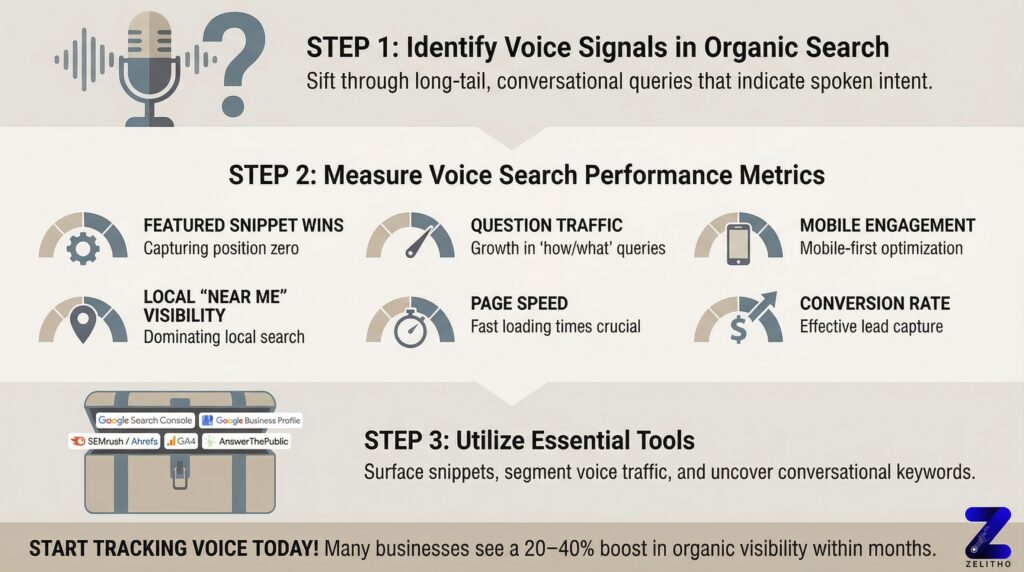
Monitor featured snippet wins, as your content appearing in position zero dramatically increases voice search visibility. Track which queries trigger featured snippets for your content and measure the increase over time. Question-based query traffic provides another valuable signal—filter analytics for queries containing who, what, when, where, why, or how to identify conversational search patterns.
Evaluate mobile session quality through engagement metrics from mobile users. Voice search predominantly happens on mobile devices, so improvements in mobile bounce rate, session duration, and pages per session often correlate with better voice optimization. Local search visibility matters tremendously—track rankings for “near me” queries and monitor Google Business Profile insights for local voice search patterns.
Measure page speed improvements regularly, as technical performance directly impacts voice search eligibility. Use Google PageSpeed Insights and Core Web Vitals reports to track loading time trends. Most importantly, monitor conversion rates from long-tail, conversational queries. These typically represent high-intent traffic, so improvements in conversion rates suggest you’re capturing qualified voice search users.
Businesses implementing voice search optimization strategies often see 20‑40% increases in organic search visibility within 6 months2 , with local businesses sometimes seeing results within 4‑8 weeks for “near me” searches.
Tools for Voice Search Analytics
Leverage Google Search Console to identify question-based queries driving traffic. Filter the Performance report for queries containing question words and sort by impressions and clicks to identify opportunities. Use SEMrush or Ahrefs for featured snippet tracking—both platforms identify which featured snippets you currently own and which you’re competing for.
Implement Google Analytics 4 with custom events for long-tail conversational queries. Set up filters or segments that isolate traffic from queries longer than 5 words or containing question phrases. This segmentation helps track voice search trends over time even without explicit voice attribution.
Monitor Google Business Profile insights for local voice search patterns. Review which search queries triggered your profile, analyze “how customers search for your business” data, and track actions taken (calls, direction requests, website visits) that often result from local voice searches.
Use tools like AnswerThePublic and AlsoAsked for ongoing keyword research. These platforms visualize the questions people ask about your topics, providing continuous insight into conversational query patterns. Regular keyword research ensures your content evolves with changing user language and search behavior.
Best Tools for Voice Search Optimization
The right tools accelerate your voice optimization efforts by identifying opportunities, tracking performance, and streamlining technical implementation. These tools specifically support conversational query research and VSO implementation.
While general SEO tools provide foundational capabilities, voice search optimization requires specialized approaches. Tools that visualize question networks, validate schema markup, and analyze conversational patterns become essential for developing and maintaining effective voice search strategies.
Keyword Research and Content Planning Tools
AnswerThePublic reveals question-based queries people actually ask, organizing them visually around the 5 W’s and 1 H. Enter any keyword and receive hundreds of real questions users type into search engines—valuable for understanding conversational query patterns.
Google’s “People Also Ask” feature shows related questions for any search, providing direct insight into what Google considers semantically related queries. Click through each question to reveal additional related questions, building a comprehensive question map. AlsoAsked.com visualizes these question networks, showing how queries connect and branch, helping identify comprehensive content opportunities.
SEO dashboards like SEMrush, Ahrefs, and Moz help identify conversational keywords and track featured snippet opportunities. SEMrush’s “Questions” filter shows question-based keywords related to your topics, while Ahrefs’ “Questions” report reveals the actual questions people search for. Both platforms track which featured snippets you own and which competitors hold, identifying optimization targets.
Google Trends reveals rising voice search topics by showing search interest over time. Filter by “Web Search” and “YouTube Search” to see which questions and conversational queries are gaining traction, allowing you to create content around emerging interests before competitors do.
Technical SEO and Schema Implementation Tools
Google’s Structured Data Testing Tool validates schema markup implementation, ensuring search engines can properly parse your structured data. Enter any URL or code snippet to identify errors and warnings that might prevent rich results eligibility.
Schema.org provides the complete schema vocabulary—documentation for every schema type, property, and value. Reference Schema.org when implementing new structured data to ensure proper syntax and completeness.
Google’s Mobile-Friendly Test ensures responsive design by analyzing how your pages render on mobile devices. The tool identifies mobile usability issues like text too small, clickable elements too close, or content wider than screen, providing specific recommendations for fixes.
PageSpeed Insights analyzes Core Web Vitals using real user data from Chrome UX Report. The tool provides both lab data (controlled testing) and field data (actual user experience), identifying specific performance bottlenecks and prioritizing fixes by impact.
Screaming Frog SEO Spider audits technical elements at scale, crawling your entire site to identify broken links, missing meta descriptions, duplicate content, and other technical issues. Use custom extraction to identify pages with and without schema markup, helping prioritize implementation.
Yoast SEO and Rank Math (for WordPress) simplify schema implementation through user-friendly interfaces. Both plugins offer FAQ schema, How-To schema, and other structured data types through simple dropdown menus and form fields, eliminating the need for manual code editing.
Future Trends in Voice Search Beyond 2025
Voice search continues evolving rapidly as AI becomes more sophisticated and integration deepens across devices and platforms. Understanding emerging trends helps future-proof your optimization strategy.
The trajectory is clear: voice technology is becoming more capable, more integrated, and more central to daily digital interactions. Looking beyond 2025, several trends will reshape how users interact with voice assistants and how businesses need to optimize content for discovery.
Deeper AI and Natural Language Processing Integration
Voice assistants are becoming increasingly sophisticated at understanding context, user intent, and nuanced language. Future voice search will better handle multi-turn conversations where users ask follow-up questions without repeating context. For example, asking “What’s the weather today?” followed by “What about tomorrow?” requires understanding that “tomorrow” refers to weather, not a general question.
Voice assistants will understand user preferences over time, delivering increasingly personalized results based on past interactions, location history, and stated preferences. They’ll deliver more contextually appropriate results that account for time of day, device type, and user history.
Integration with broader AI ecosystems including ChatGPT and other conversational AI platforms will continue deepening. A 2025 U.S. consumer survey found that 55% of respondents now use OpenAI’s ChatGPT or Google’s Gemini for tasks they previously would have asked Google Search to handle1 . This convergence means voice search optimization and AI optimization become increasingly unified strategies.
Voice Commerce and Transactional Queries
Voice commerce is expanding rapidly beyond simple reordering. Global purchases made via voice assistants on smart devices now total $164 billion in transaction value3 , and voice commerce is expected to reach $45 billion by 20284 . Users increasingly complete complex purchases, compare products, and make reservations entirely via voice.
Currently, 51% of smart speaker owners—approximately 5.5 million U.S. adults—make purchases by voice every month4 , and these percentages will increase as security improves and user comfort grows. E-commerce businesses must optimize product information for voice discovery, enable voice ordering capabilities, and create seamless voice shopping experiences.
Smart Home and IoT Integration
Voice search is expanding beyond smartphones and smart speakers into vehicles, appliances, wearables, and other IoT devices. This ubiquitous voice access creates new opportunities for contextual, location-aware queries that businesses must prepare to serve.
In vehicles, 62% of car owners who use voice assistants have used them to find nearby businesses, including auto services5 , and 41% have asked for directions to a local dealership or service center. As voice integration deepens in automobiles, location-based businesses need to optimize for in-vehicle voice searches.
Smart home integration means users ask voice assistants to control thermostats, lights, locks, and appliances. This habitual interaction increases overall voice assistant usage and comfort, making voice the default interface for an expanding range of tasks. Healthcare provides another frontier, with 68% of healthcare providers believing voice search will become important for patient engagement .
FAQ
Voice search optimization is the process of adapting your website content, structure, and technical SEO to rank for spoken, conversational queries made through voice assistants. It’s important because approximately 20.5% of people worldwide now actively use voice search, with over 153.5 million voice assistant users in the United States alone. Voice commerce has reached $164 billion in global transaction value, and businesses that don’t optimize risk losing visibility as voice becomes the dominant search modality.
Voice searches are conversational, significantly longer, question-based, and use natural language. The average voice search query is 29 words in length, compared to just three to four words for text searches. Analysis shows that only 13.1% of voice queries are identical to text samples. Users speak complete sentences like “What’s the weather like in Boston today?” rather than typing short phrases like “weather Boston.”
Focus on long-tail conversational keywords using the 5 W’s and 1 H framework (who, what, when, where, why, how). Create comprehensive FAQ sections answering common questions in natural language. Optimize for featured snippets with concise 40‑60 word answers at the beginning of sections. Implement schema markup—FAQ, speakable, local business—to signal structured data to search engines. Prioritize mobile-friendly design, fast page speed, and HTTPS security.
Use tools like AnswerThePublic, Google’s “People Also Ask,” AlsoAsked.com, and SEO platforms such as SEMrush or Ahrefs to discover question-based, conversational phrases. Filter keyword research for queries starting with who, what, when, where, why, and how that mirror natural speech patterns. Analyze customer support inquiries to understand the real‑world questions your audience asks.
Source:
1. https://tech.yahoo.com/ai/chatgpt/articles/chatgpt-effect-3-years-ai-140444947.html
2. https://www.ripemedia.com/what-is-voice-search-optimization/
3. https://www.digitalsilk.com/digital-trends/voice-search-statistics/
4. https://www.invoca.com/blog/voice-search-stats-marketers
5. https://www.synup.com/en/voice-search-statistics/