
Most marketers think personalization means adding a first name. AI-powered personalization is much bigger.

TL;DR
You ran a campaign last quarter. You swapped in first names, maybe a city. Open rates looked fine. Conversions did not move. That gap is the problem.
Most teams treat personalization as message decoration. Swap a name. Change a subject line. Call it relevant. This is mail merge with a better CRM. It does not change what the customer receives. It changes one word in what they receive.
AI-powered personalization is a connected operating model built on unified data, predictive signals, and adaptive delivery. It operates across every channel, every journey stage, and every decision point at a scale no human team manages manually. Teams building this capability report up to 40% more revenue and up to 50% lower customer acquisition costs. [1] Teams that are not building it are sending the same message to millions of people and calling it targeted.
What is AI-powered personalization in marketing?
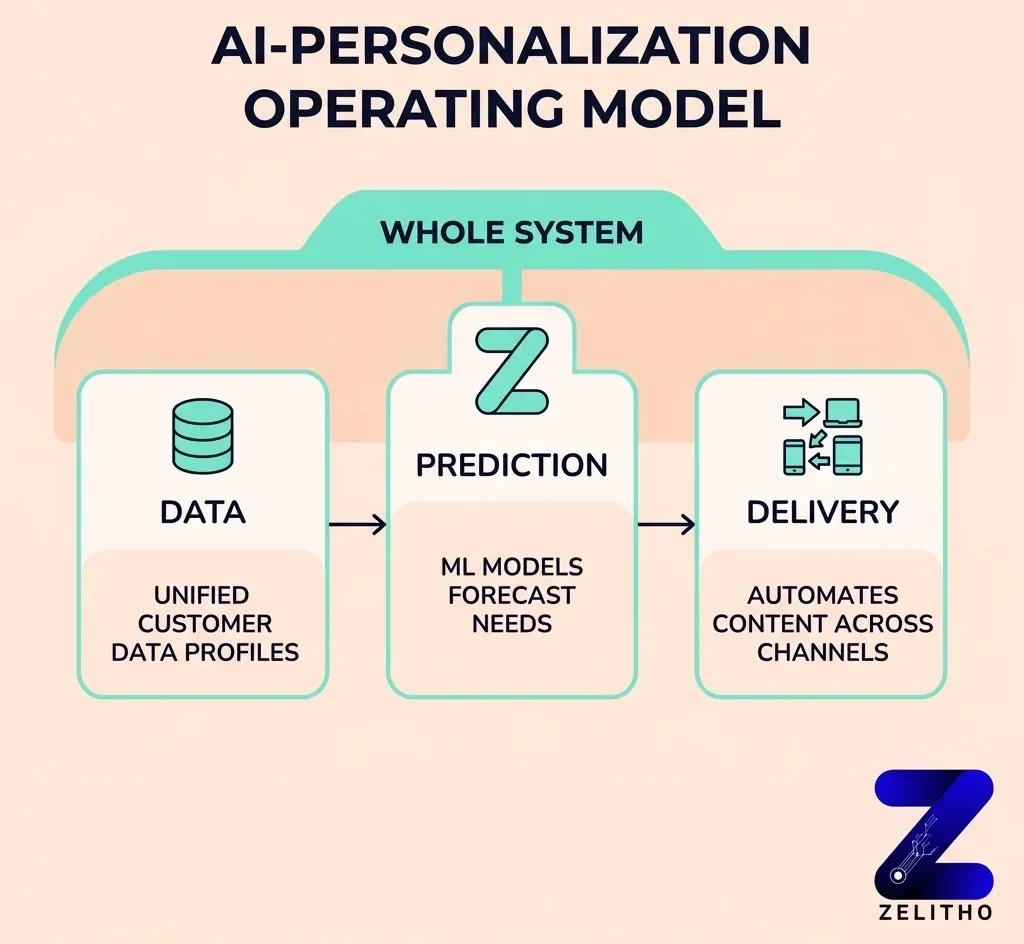
AI-powered personalization uses machine learning to predict what each individual customer needs next, then delivers that content, offer, or message automatically across channels. It is not a feature inside a marketing tool. It is a system that connects data, prediction, and delivery into one operating model. The output is relevance that scales beyond what any human segmentation process can produce.
Why first-name personalization is not personalization , it is just variable substitution
Here is the sting: putting someone’s name in a subject line does not make the message relevant. It makes it addressed.
Variable substitution pulls a stored value from a database and drops it into a template. The logic is static. The message is the same for every person in the list. Only the placeholder changes. That is not a personalization strategy. It is a formatting rule.
The data confirms that customers notice the difference. 76% of consumers get frustrated when they receive content that has nothing to do with their interests. [2] And 92% of marketers report that customers expect a personalized experience. [2] The gap between what customers expect and what most teams actually deliver is not a tools problem. It is a model problem.
Stop treating personalization as a copywriting layer. Start treating it as a decision system that operates on behavior, context, and prediction.
88% of customers say the experience a brand delivers matters as much as the product or service itself. [3] That is not a soft metric. That is a commercial signal. When the experience feels generic, the product loses perceived value regardless of quality.
The teams still optimizing subject line tokens are solving the wrong problem. The customers have moved on. Their expectations are shaped by platforms that show them what they actually want before they ask for it. A first name in an email does not compete with that.
The three capability layers that make AI personalization a system, not a feature
AI personalization operates in three layers. [1] Each layer depends on the one below it. Skip one and the system fails at scale.
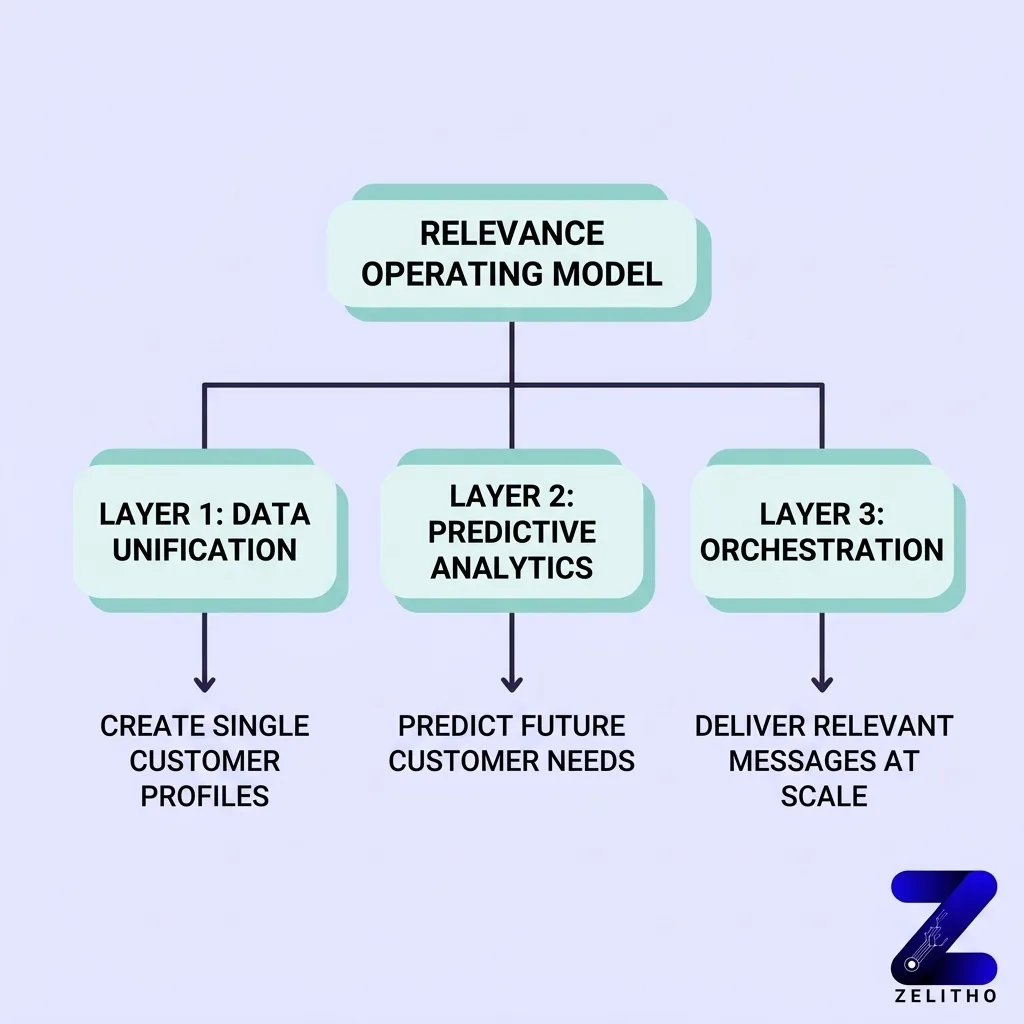
Call this the Relevance Operating Model.
Layer 1: Data Unification. Every customer signal, from browsing behavior to purchase history to support interactions, feeds into a single profile. Without this, prediction has nothing reliable to work with. A typical mid-size company pulls data from 15 to 25 separate systems. [1] Those systems rarely agree on who a customer is.
Layer 2: Predictive Intelligence. Once data is unified, models identify what each customer is likely to do next, what they are likely to need, and when they are likely to act. This layer converts history into forward signals. It is what separates reactive campaigns from proactive ones.
Layer 3: Adaptive Delivery. The system selects the right content, channel, and timing for each individual, then adjusts based on response. This is where scale becomes possible. A human team cannot manage 400 possible combinations of segment, channel, stage, and offer. [1] A connected system can.
Here is how the three layers interact at a practical scale:
Layer | What It Does | What Breaks Without It |
|---|---|---|
Data Unification | Connects signals across all touchpoints into one profile | Predictions run on partial or conflicting data |
Predictive Intelligence | Converts unified history into next-best-action signals | Delivery becomes rule-based and static |
Adaptive Delivery | Selects content, channel, and timing per individual | Scale collapses back to segment logic |
The Relevance Operating Model is not a technology stack. It is a capability sequence. You cannot buy Layer 2 and skip Layer 1. The predictive models have nothing to learn from if the data underneath them is fragmented.
This is where most teams stall. They license a predictive tool. They connect it to three of their eight data sources. They run it. The results are marginal. They conclude the tool does not work. The tool was fine. The data was not ready.
What breaks when you skip data unification and go straight to AI-driven targeting
The operational failure is specific. Fragmented data produces confident predictions about the wrong person.
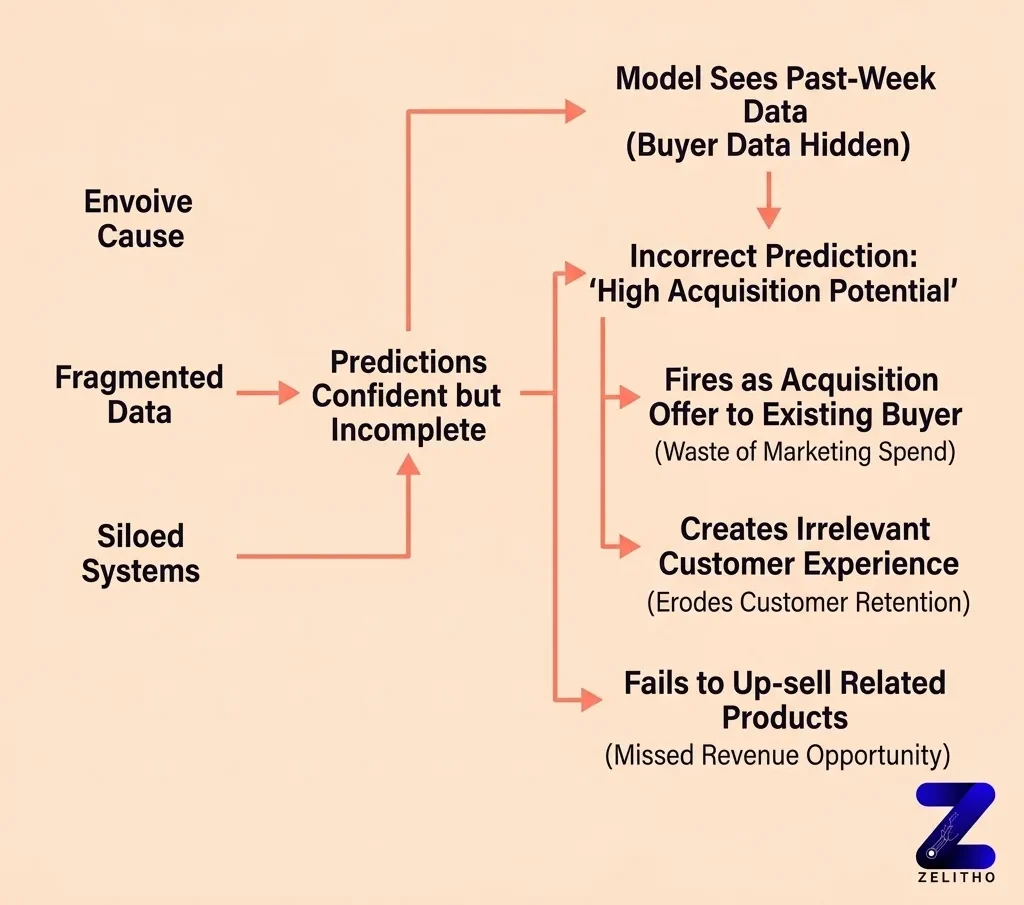
A customer who bought running shoes last week should not receive a new-customer acquisition offer. But if the purchase data sits in a separate system from the email platform, the model does not know the purchase happened. It fires an acquisition message to an existing buyer. The prediction was technically correct based on available data. The available data was incomplete.
65% of customer experience leaders say customers are more willing to switch brands when the experience feels irrelevant. [3] That switching behavior accelerates when the message actively contradicts what the customer already did. A new-customer offer sent to an active buyer does not feel like an oversight. It feels like the brand does not know them at all.
Here is the timeline cost: fragmented data can delay personalization signal processing by up to 48 hours. [1] In a behavioral sequence, 48 hours is the difference between reaching someone during a decision window and reaching them after it closes.
The fix is not sophisticated. Audit the data sources feeding your personalization layer. List every system that holds customer data. Identify which ones are connected to your prediction model and which are not. The unconnected ones are generating blind spots. Those blind spots are producing the irrelevant messages your customers are ignoring or, worse, switching brands over.
One scaling team ran AI-driven retargeting for six weeks on a fragmented data set. Cart abandonment emails were firing to customers who had completed purchases in a separate checkout flow. The “abandoned” signal was real. The purchase signal was not connected. Fixing the data pipeline before the next campaign dropped irrelevant sends by over 30% and recovered measurable revenue in the first two weeks.
Fix data unification first. Everything built on top of it becomes more accurate immediately.
How mature teams move from 20 segments to 1:1 personalization across millions of customers
Most teams start with 20 segments. [1] That is a reasonable entry point. You group by demographics, purchase history, or lifecycle stage. You write different messages for each group. This is better than one message for everyone.
The problem is that 20 segments applied to 100,000 customers means each segment contains 5,000 people receiving the same message. That is not individual relevance. It is grouped approximation.
The maturity progression looks like this:
Stage 1: Rule-Based Segments. Teams use static criteria to group customers. The message changes by group. Execution is manual. Scale is limited by team capacity.
Stage 2: Dynamic Micro-Segments. Models update segment membership based on real-time behavior. A customer who browsed three product pages in one session moves into a high-intent group automatically. The team is no longer updating segments by hand.
Stage 3: Predicted Next Action. The system stops asking which segment a customer belongs to. It asks what this specific customer is likely to do next. Messages are built around that prediction, not around demographic categories.
Stage 4: 1:1 Personalization at Scale. Every customer receives a message built for them individually, across every active channel, in real time. [1] This operates across millions of individuals. [1] No human team reviews these decisions. The system makes them.
The revenue differential between Stage 1 and Stage 4 is not marginal. Teams operating at full personalization maturity report revenue lifts up to 40% and acquisition cost reductions up to 50%. [1] The return on personalization investment compounds at 5 to 8 times for teams that reach this maturity level. [2]
The jump from Stage 2 to Stage 3 is where most teams stall. The data is mostly unified. The tools are in place. But the team is still making segment decisions manually because they do not trust the model outputs. That distrust usually points back to data quality, not model quality. When the underlying profiles are clean and connected, the model outputs become reliable enough to act on without manual review.
The realistic next build for a team at Stage 2 is not jumping straight to 1:1. It is identifying one high-value journey stage, connecting the data sources relevant to it, and running predicted next-action logic for that stage only. That produces a measurable result. That result builds internal confidence. That confidence funds the next layer.
Personalization maturity is not a project. It is a compounding capability. Each stage makes the next one faster and cheaper to build.
AI-powered personalization is not a campaign upgrade
AI-powered personalization is a capability stack, built in layers, grounded in unified data, and scaled through prediction and adaptive delivery.
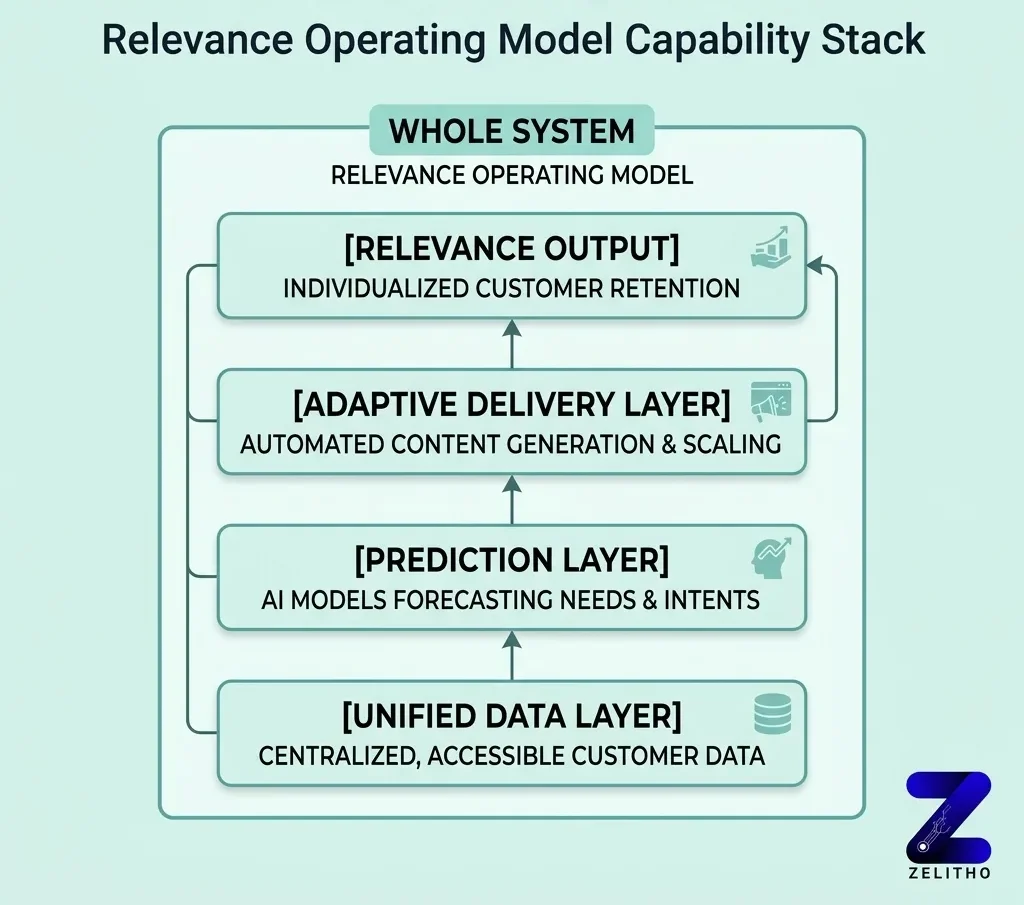
The Relevance Operating Model gives teams a way to stop debating tactics and start diagnosing which layer is actually limiting their results. If the data is fragmented, fix that first. If the data is unified but the prediction layer is absent, build that next. If prediction exists but delivery is still rule-based, the system cannot adapt and scale collapses back to segments.
First names are not a strategy. Connected, predictive, adaptive relevance is.
The teams building it now are not waiting for better tools. They are using what exists to close the gap between what customers expect and what most brands still deliver.
FAQs
Personalization in marketing means delivering content, offers, and messages that match an individual’s behavior, preferences, and context. It goes beyond addressing someone by name. Effective personalization changes what is delivered, not just how it is labeled.
AI-powered personalization uses machine learning models to predict what each individual customer needs next and deliver the right message, offer, or content automatically. It connects unified customer data with predictive signals and adaptive delivery. The result is relevance that operates at a scale no human team can manage through manual segmentation.
AI analyzes behavioral signals, purchase history, and contextual data to predict what a customer is likely to do next. It then selects the right content and channel for that individual and delivers it without manual intervention. This process runs continuously across millions of customers simultaneously.
The five promises typically cited in personalization strategy are: reaching the right person, with the right message, on the right channel, at the right time, and driving the right action. AI-powered systems are the only delivery mechanism that can fulfill all five simultaneously at scale.
AI powers personalization by processing large volumes of customer data, identifying patterns that predict future behavior, and triggering delivery decisions based on those predictions. The three core components are data unification, predictive modeling, and adaptive delivery. Each feeds the next layer of the system.
A customer browses running shoes but does not purchase. The AI model flags high purchase intent, connects that signal to their email profile, and sends a message within hours featuring the exact product viewed plus a complementary item based on their past category behavior. No human triggered that sequence.
References and Citations
[1]https://www.treasuredata.com/blog/ai-personalization
[2]https://www.bloomreach.com/en/blog/ai-personalization-5-examples-business-challenges
[3]https://www.bdo.com/insights/digital/hyper-personalized-experiences-through-automation-and-ai