
How to Analyze Keyword Competition Using Competitor Keyword Data

TL;DR
You pull a keyword list, filter by volume, and start assigning topics to writers. The list looks solid. Six weeks later, the content lands and nothing ranks. You assumed volume meant opportunity. It does not.
Standard keyword research shows you what people search for. It does not show you who already owns those terms or how firmly they hold them. That distinction determines whether your content has a realistic path to page one.
The Competitive Targeting Framework fixes this. It runs a structured competitor keyword comparison, sorts results into three opportunity buckets, and scores each gap for realistic attainability. Senior marketers, founders scaling content output, and agency owners building client pipelines use it to replace instinct-based keyword picks with a repeatable, evidence-based targeting sequence.
What is competitor keyword comparison and why does it change keyword research?
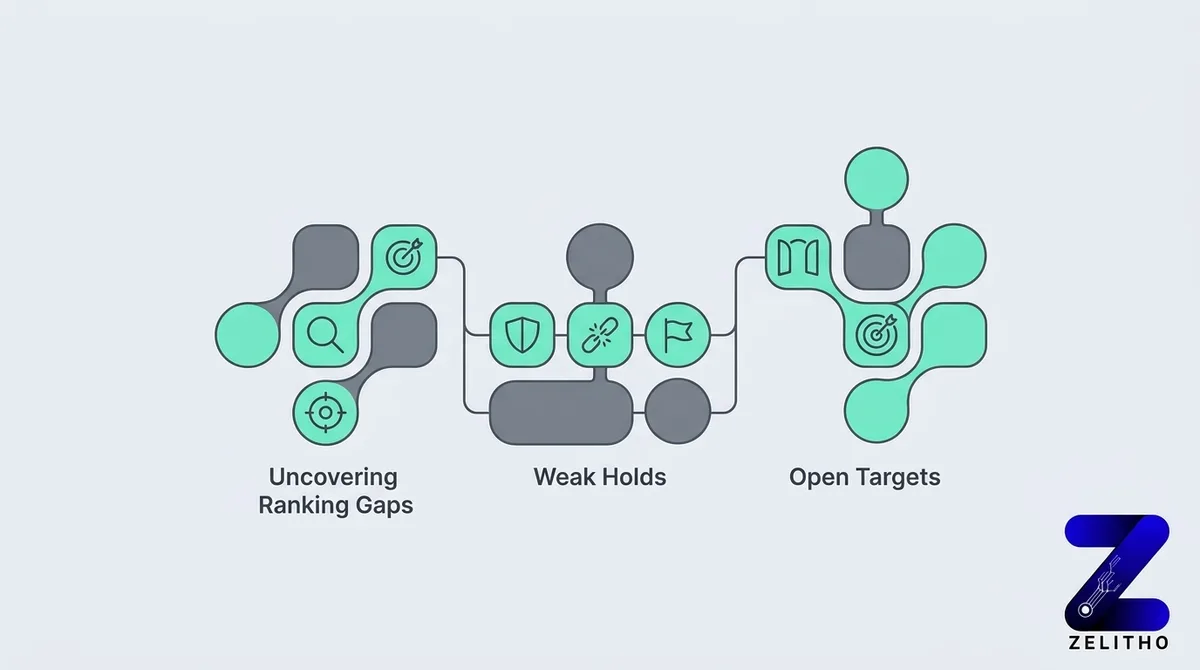
Competitor keyword comparison is the practice of pulling the ranked terms from rival pages and mapping them against your own rankings. It reveals three things your volume-only list cannot: terms you are missing entirely, terms your competitors rank for weakly, and terms no one has locked down. That three-part view replaces guesswork with a prioritized target list you can act on immediately.
Why You Think Volume Is the Signal , And Why That Belief Is Costing You
Search volume feels like signal because it is a number. Numbers feel like proof.
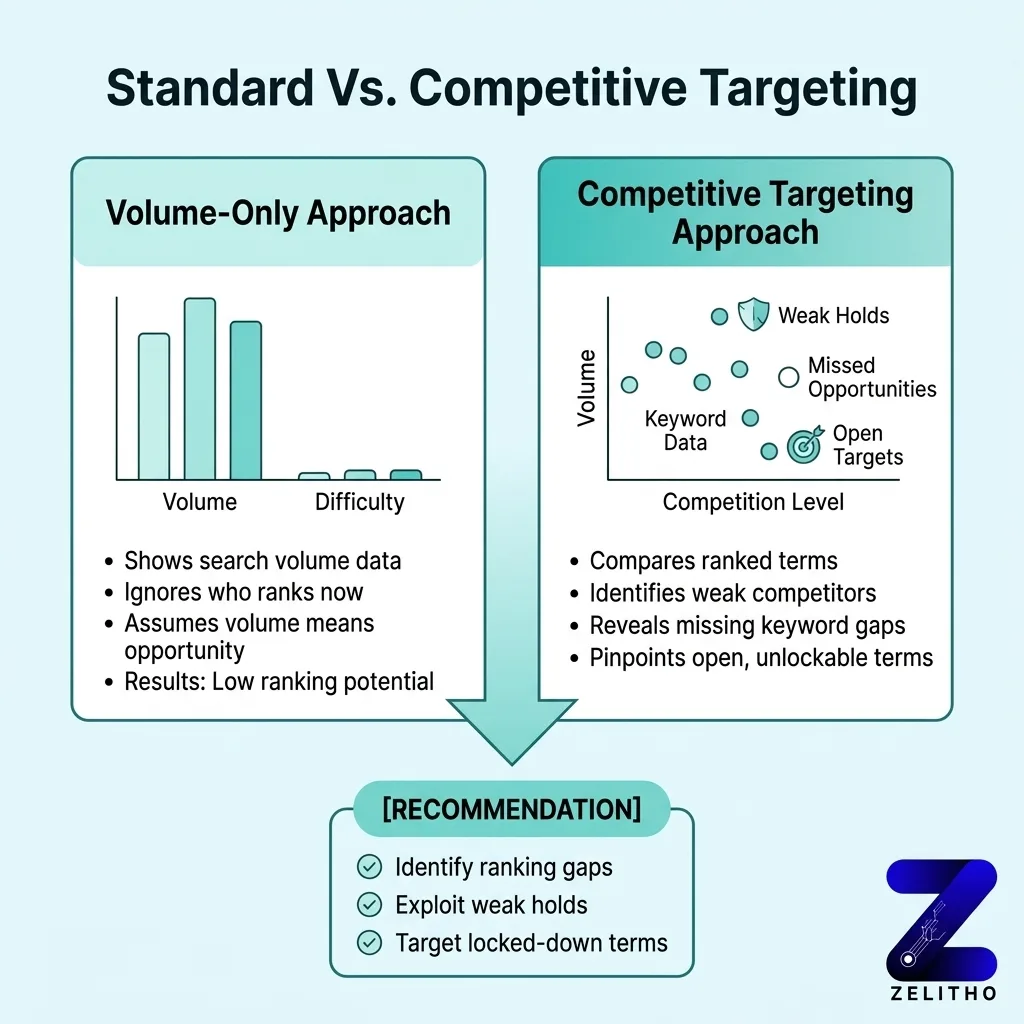
A keyword with 5,000 monthly searches looks more valuable than one with 400. That comparison is intuitive. The problem is that volume measures demand, not access. It tells you how many people search, not whether your domain can get in front of them.
Stop choosing keywords by volume first. Start by checking who already ranks and how exposed their position actually is.
The false assumption underneath most keyword research is that high volume equals high opportunity. A term with 5,000 monthly searches, locked down by three domains with 80-plus authority scores and 200 inbound links to that exact page, is not an opportunity. It is a wall.
A term with 600 searches, held weakly by a competitor who published once in 2021 and never built a link to it, is a real target. Volume did not tell you that. Competitor data did.
Ranking patterns from rival pages reveal two things volume cannot. They show you which terms are structurally available and which terms are held loosely enough that fresh, focused content can move into position.
Marketers who skip this step do not know which walls they are running at until the content fails to rank. By then, the production cost is already spent.
What Happens When You Skip Competitor Pages: Six Weeks of Work Targeting the Wrong Terms
Here is a concrete scenario. A SaaS marketing team targets eight keywords for a content sprint. Each term has solid volume. The team assigns writers, builds briefs, and publishes across six weeks. At the end of the sprint, none of the eight pieces rank on page one. Three are on page three. Five are buried past page four.
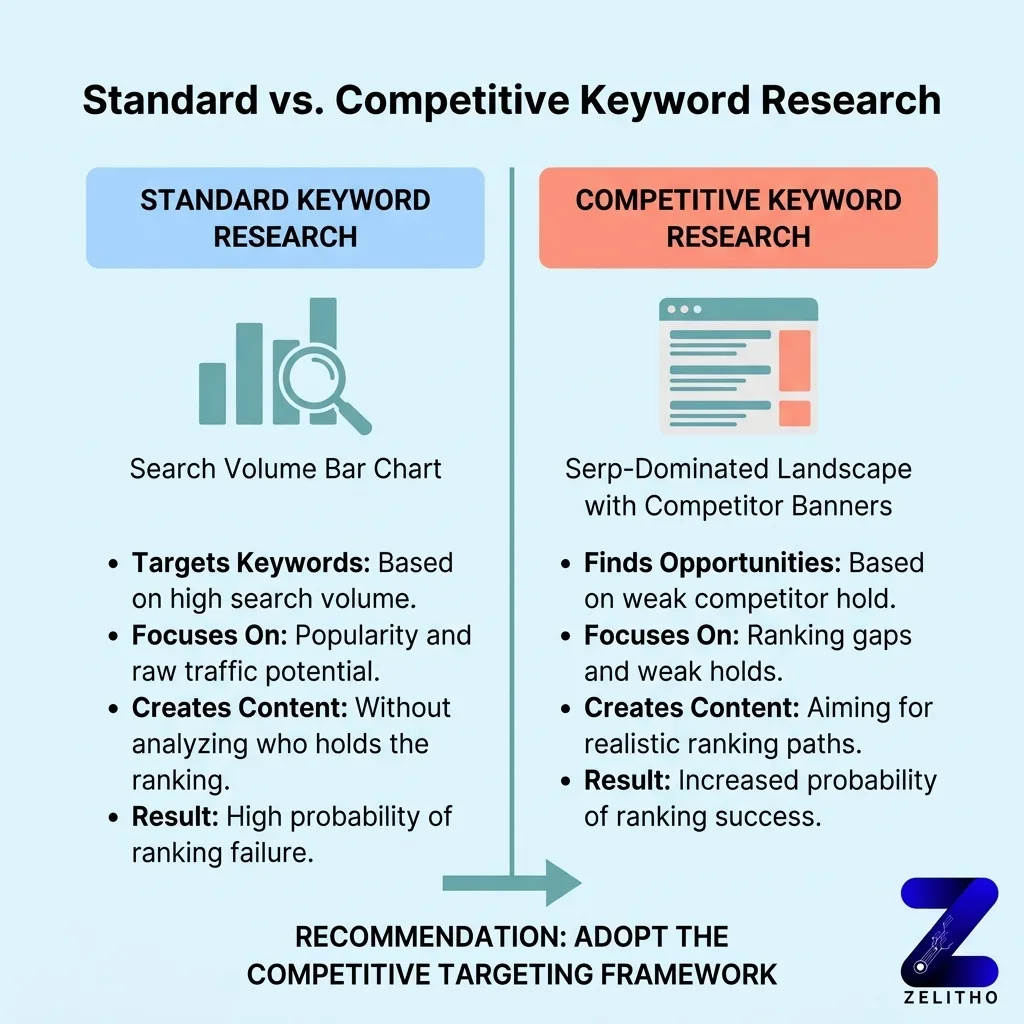
A post-sprint audit shows that six of the eight terms were dominated by pages from two competitors, each with over 150 referring domains pointing to the exact ranking URL. The terms were not available. They looked available on a volume report because nobody checked the competition.
The direct cost: six weeks of content production, eight full articles, and zero ranking gains for any target term. The opportunity cost is steeper. During those six weeks, a competitor published four articles on low-competition terms in the same category and picked up 3,200 organic visits per month in aggregate.
Two changes fixed this for the next sprint. First, every proposed keyword went through a competitor page check before it reached the brief stage. Second, the team scored each term using the Competitive Targeting Framework before approving it.
The next sprint produced seven pieces. Four ranked on page one within 45 days. The difference was not writing quality or topic selection. The difference was knowing which terms were actually open before committing production time.
That audit step costs roughly 90 minutes per sprint. Skipping it costs six weeks.
The Competitive Targeting Framework: How to Extract Ranking Gaps and Weak Holds From Rival Pages
The Competitive Targeting Framework runs in four steps. Each step builds on the last. None of them require guessing.
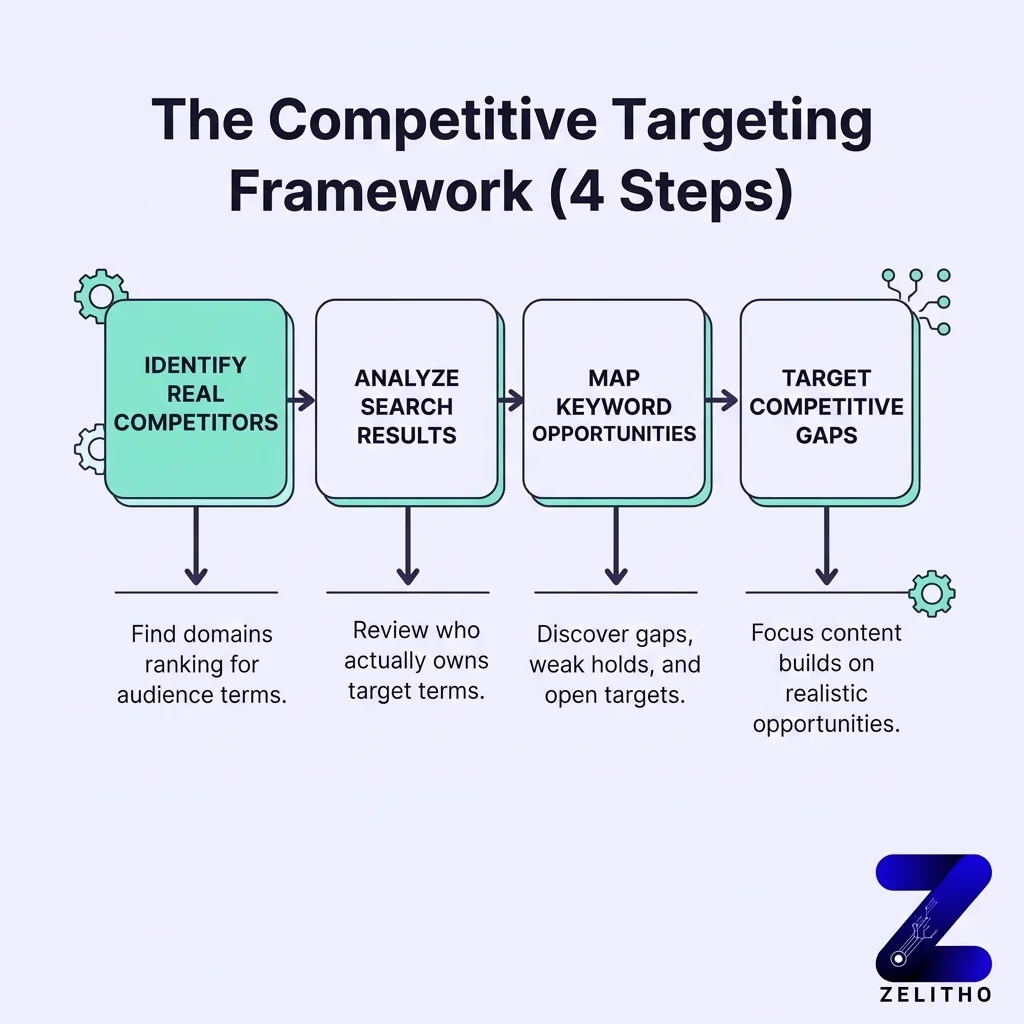
Step 1: Identify your real competitors by search, not by category.
Your actual search competitors are the domains that rank for terms your audience searches for. They are not always your business competitors. A media site, a software review platform, or an adjacent SaaS product may rank for your highest-value terms without competing with you in any other way. Pull the top ten ranking URLs for five of your core topic areas and note which domains appear repeatedly. Those are your search competitors.
Step 2: Run a keyword gap report.
Use a tool that compares ranked terms between domains. Input your domain and two to four competitor domains. Export every term your competitors rank for that your domain does not appear in the top 20 for. This is your raw gap list. It will be long. Do not filter by volume yet.
Step 3: Sort the gap list into three buckets.
This is where the framework separates from standard research.
Bucket | Definition | Signal to Look For |
|---|---|---|
Full Gap | Competitor ranks; you do not appear at all | High priority if competition score is low |
Weak Hold | Competitor ranks but position is 6–15 | Page has few backlinks or thin content |
Open Field | No one ranks strongly; top results are thin or off-topic | Rare but highest return when found |
Full gaps tell you where you are absent. Weak holds tell you where you can displace. Open field terms tell you where you can plant a flag before anyone else does.
Step 4: Check the page holding each position.
Do not rely on domain authority alone. Look at the individual page that ranks. Check the number of referring domains pointing to that page specifically, the word count and depth of the content, the publication date, and whether the page has been updated recently. A high-authority domain can hold a weak page. That page is displaceable.
A useful rule: if a page has fewer than 15 referring domains and was published more than 18 months ago with no evident update, treat it as a weak hold regardless of the domain’s overall authority.
This four-step process converts a raw keyword list into a structured opportunity map. The Competitive Targeting Framework replaces the volume-first reflex with a pattern-based check that shows you what is actually available.
Explore More: What Is Keyword Mapping and Why It Matters for SEO
Turning the Gap List Into a Ranked Decision: How to Prioritize What to Target Next
A gap list with 200 terms is not a content plan. It is a data set. Ranking it requires a scoring method.
Score each term across four dimensions. Assign a value of 1 to 3 for each.
Attainability: How weak is the current ranking page? Use referring domains to that specific URL as your primary input. Fewer than 15 referring domains scores 3. Fifteen to 40 scores 2. Above 40 scores 1.
Relevance: How directly does this term connect to a product, service, or conversion path? Direct connection scores 3. Adjacent connection scores 2. Broad topic with no clear conversion path scores 1.
Search demand: Use volume as a tiebreaker, not a primary signal. Over 1,000 monthly searches scores 3. Two hundred to 999 scores 2. Under 200 scores 1.
Bucket weight: Open field terms score a bonus point. Weak holds score standard. Full gaps with high competition score no bonus.
Add the scores. Sort descending. The top 10 terms on that list are your next targets.
This scoring method does one thing the volume-first approach cannot. It weights real access alongside demand. A term with 400 monthly searches and a score of 10 will outperform a term with 3,000 monthly searches and a score of 5 in practice, because the first term has a path to position and the second does not.
One implementation caveat: do not run this process once and archive it. Competitor pages change. A domain that held a term weakly in January may build links by April. Re-run the gap analysis quarterly. Update the bucket assignments. The ranked list is a working document, not a static plan.
The Competitive Targeting Framework produces a ranked, decision-ready output every time you run it. You choose the next keyword with a score behind it, not a gut feeling.
How competitor gap analysis replaces keyword guesswork for good
Standard keyword research gives you a demand map. Competitor gap analysis gives you an access map. You need both, but most content teams only build the first one.
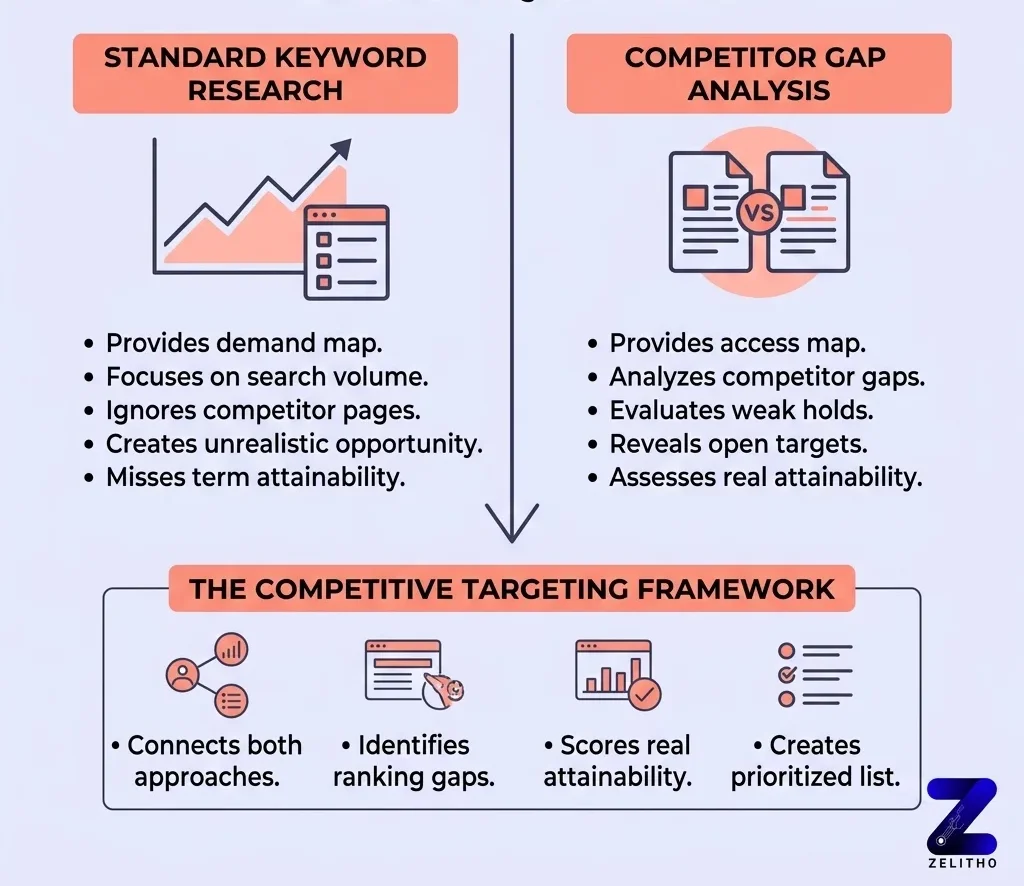
The Competitive Targeting Framework connects them. It starts with competitor page data, sorts gaps into three buckets, and scores each term for real attainability. The output is a ranked list you can hand to a writer or present to a client with a clear rationale behind every choice.
Running it before every content sprint removes the core failure mode: producing content for terms that were never available to begin with.
Your next keyword is already sitting in a competitor’s weak hold. Go find it before they notice.
FAQ
The 3 C’s of SEO are content, code, and credibility. Content covers what you publish and how well it matches search intent. Code refers to the technical structure of your site. Credibility reflects the authority your domain earns through links and trust signals.
Market research identifies what people want. It does not identify whether your current position gives you a realistic path to reach them. Execution constraints, competitive saturation, and distribution gaps can all prevent a well-researched idea from producing results.
Keyword stuffing degrades the reading experience and triggers ranking penalties from search engines. Search algorithms evaluate semantic relevance and contextual depth, not raw term frequency. Overloading a page with repeated terms signals low content quality and reduces the page’s chance of ranking.
Organic search has not been phased out. AI-generated summaries and answer features have changed how some queries resolve at the surface level. Keyword targeting that focuses on specific, high-intent queries with clear competitor gaps still produces rankable content with measurable traffic outcomes.