
How to Build a Social Media Marketing Strategy That Drives Growth

- TL;DR
- A successful social media marketing strategy requires more than random posting – it demands intentional planning. Start by setting SMART goals aligned with business objectives, then research your target audience through personas and social listening.
- Audit your current presence and analyze competitors to identify gaps. Choose 2–3 core platforms where your audience lives and establish a consistent brand voice.
- Build a content strategy with a structured editorial calendar that balances educational, promotional, and entertaining posts.
- Finally, engage authentically with your community while tracking meaningful metrics like engagement rate, conversions, and ROI.
- Continuously test, learn, and adjust based on data to transform social activity into measurable business growth.
What is a Social Media Marketing Strategy and Why Does It Matter?
A social media marketing strategy is a comprehensive, documented plan that outlines your business goals, target audience, content types, platforms, and success metrics. Unlike sporadic posting or reactive content creation, a strategy provides a roadmap that guides every social media activity toward specific objectives.
Many businesses treat social media as an afterthought, posting whenever inspiration strikes or copying what competitors do. This approach wastes time and resources while delivering inconsistent results. A structured strategy transforms social media from a content dumping ground into a powerful digital marketing engine that supports brand awareness, generates leads, and fosters genuine customer engagement.
The difference between having a strategy and not having one is measurable. Businesses with documented social strategies are more likely to report success, maintain consistent brand messaging, and justify their social media investments through clear ROI tracking. Your strategy becomes the foundation for decision-making, helping you prioritize which platforms deserve attention, what content resonates with your audience, and how to allocate budget across campaigns. It also ensures alignment between your social media efforts and broader business objectives, whether you’re launching products, building community, or driving sales.
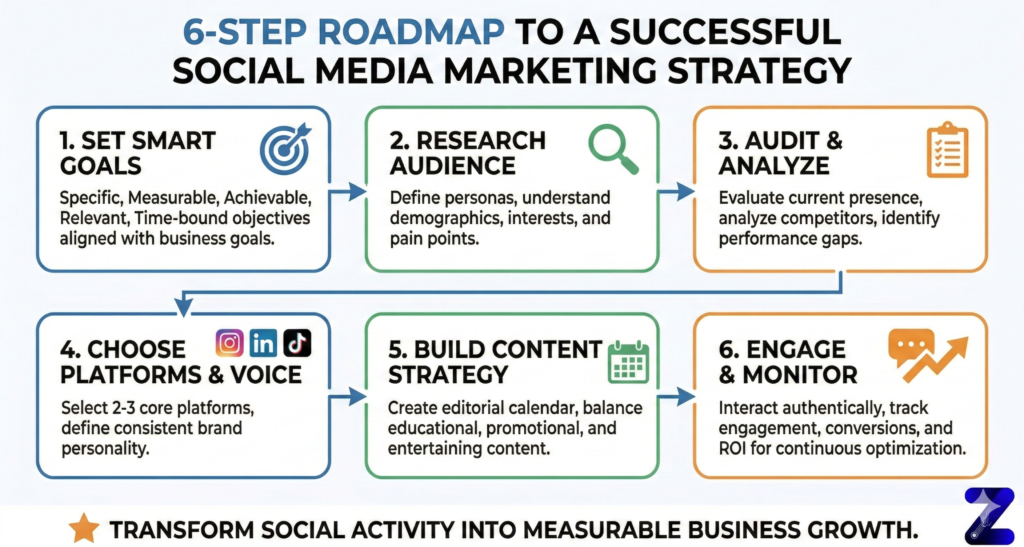
6 Step Roadmap to a successful social media marketing strategy
Step 1 – Set SMART Goals That Align With Business Objectives
Before creating a single post, you need clear goals that define what success looks like. The SMART framework ensures your objectives are Specific, Measurable, Achievable, Relevant, and Time-bound, transforming vague aspirations into actionable targets.
Specific goals eliminate ambiguity. Instead of “increase Instagram presence,” aim for “grow Instagram followers among women aged 25-40 interested in sustainable fashion by 25%.” Measurable goals let you track progress using concrete numbers rather than gut feelings. Achievable goals stretch your capabilities without setting impossible standards that demotivate your team. Relevant goals connect directly to business priorities, not vanity metrics that look impressive but don’t drive revenue. Time-bound goals create urgency and enable regular performance reviews.
Common social media goals include increasing brand awareness through reach and impressions, driving website traffic that converts into leads or sales, generating qualified leads through gated content or lead magnets, improving customer service response times, and building engaged communities that advocate for your brand. Choose 2–3 primary goals rather than trying to accomplish everything at once.
For example, a B2B software company might set this goal: “Generate 50 qualified demo requests per quarter through LinkedIn content campaigns targeting IT managers at mid-sized enterprises.” An e-commerce brand might aim to “increase website traffic from Instagram by 40% over six months, resulting in a 15% increase in online sales.” These goals connect social activity directly to business outcomes.
Focus on meaningful KPIs rather than vanity metrics. While follower counts and likes feel good, they don’t necessarily translate to business value. Instead, track engagement rate (likes, comments, shares divided by reach), click-through rate on links, conversion rate from social traffic, cost per lead or acquisition, and return on investment. These metrics reveal whether your social efforts actually move the needle for your business.
Step 2 – Research and Define Your Target Audience
Understanding your audience transforms content from generic broadcasts into relevant conversations that drive engagement. Without audience insights, you’re essentially shouting into the void, hoping someone cares about what you’re saying.
Start by creating detailed audience personas that represent your ideal customers. Include demographic information like age, gender, location, income level, and job title, but don’t stop there. Dig deeper into psychographics: what are their interests, values, pain points, and aspirations? What challenges keep them up at night? What solutions are they actively seeking? Where do they spend time online, and what type of content do they consume?
Use multiple data sources to build accurate personas. Your existing customer data provides foundational insights about who already buys from you. Social media analytics reveal demographic breakdowns of your current followers and which content they engage with most. Website analytics show how social visitors behave differently from other traffic sources. Customer surveys and interviews provide qualitative insights that numbers can’t capture.
Social listening tools help you understand what your target audience discusses, which brands they mention, what questions they ask, and what language they use. Monitor relevant hashtags, industry keywords, and competitor mentions to identify trending topics and common concerns. This research reveals opportunities to join conversations where your expertise adds genuine value.
Different audience segments may require tailored approaches. A B2B company targeting both C-suite executives and mid-level managers needs distinct messaging for each group. The executives care about strategic outcomes and ROI, while managers focus on practical implementation and team efficiency. Your content strategy should address these different needs without diluting your core message.
Document your findings in accessible formats that your entire team can reference. When everyone understands who you’re talking to, content creation becomes more focused and consistent. Revisit and update personas quarterly as you gather more data and your audience evolves.
Step 3 – Audit Your Current Social Media Presence and Analyze Competitors
You can’t improve what you don’t measure. A thorough social media audit reveals what’s working, what’s failing, and where opportunities exist. Start by creating a comprehensive list of all your social media accounts, including dormant profiles and any impostor accounts that might confuse your audience.
For each active profile, evaluate your current performance metrics. What’s your follower count and growth rate? Which posts generated the highest engagement rates? What content types and topics resonate most? When are your followers most active? How does performance vary across platforms? Document this baseline data to track improvement over time.
Assess the completeness and consistency of your profiles. Are your profile photos, cover images, bios, and links current and on-brand? Do you use consistent naming conventions and branding elements across platforms? Incomplete profiles signal low credibility and professionalism.
Review your content mix and posting frequency. Are you over-promoting products while ignoring educational or entertaining content? Do you post consistently or sporadically? How quickly do you respond to comments and messages? Engagement is a two-way street, and abandoned conversations damage relationships.
Competitive analysis provides valuable context for your performance. Identify 3–5 direct competitors and analyze their social presence. Which platforms do they prioritize? What content types and topics do they focus on? What’s their posting frequency and engagement rate? Which campaigns or posts performed exceptionally well?
Look for gaps in competitor strategies that you can exploit. If everyone in your industry focuses on LinkedIn but your audience is highly active on Instagram, you’ve found an opportunity. If competitors only share promotional content, you can differentiate by providing genuine value through educational resources. Competitive analysis isn’t about copying—it’s about learning what works in your market and finding whitespace to claim as your own.
Use social media management tools to streamline auditing and competitive tracking. Platforms like Hootsuite, Sprout Social, or native analytics dashboards compile data that would take hours to gather manually. Regular quarterly audits ensure you stay current as algorithms, audience preferences, and competitive landscapes shift.
Step 4 – Choose the Right Platforms and Define Your Brand Voice
Platform selection directly impacts your strategy’s efficiency and effectiveness. Trying to maintain active presences across every social network spreads your resources thin and dilutes your impact. Instead, focus on 2–3 core platforms where your target audience is most active and engaged.
Each platform serves different demographics and content preferences. Instagram excels for visual storytelling, reaching younger audiences interested in lifestyle, fashion, food, and visual arts. LinkedIn dominates B2B marketing, thought leadership, and professional networking. TikTok captures Gen Z attention through short-form video and trending challenges. YouTube serves long-form educational content and product demonstrations. Facebook maintains broad reach across age groups but skews older than Instagram or TikTok. Twitter facilitates real-time conversations and news updates.
Consider your content capabilities alongside audience presence. If you lack video production resources, TikTok or YouTube might not be realistic starting points. If you have strong visual design capabilities, Instagram and Pinterest become more attractive. Choose platforms where you can consistently create quality content that meets audience expectations.
Your brand voice is how you communicate across all touchpoints, including social media. It reflects your company values, personality, and relationship with your audience. Are you professional and authoritative, or casual and playful? Educational and helpful, or entertaining and irreverent? Consistent brand voice builds recognition and trust over time.
Define your voice by identifying 3–5 adjectives that describe how you want to sound. Then create practical guidelines with examples of what to do and what to avoid. If your voice is “approachable,” you might use conversational language and ask questions, but avoid corporate jargon and overly formal phrasing. If you’re “bold,” you might take strong positions and use confident language, but avoid being arrogant or dismissive of other perspectives.
Your brand voice should remain consistent across platforms while adapting to each platform’s culture and conventions. LinkedIn content naturally skews more professional, while TikTok allows more playfulness. The core personality stays the same, but the expression adjusts appropriately.
Step 5 – Build a Content Strategy and Editorial Calendar
Random posting produces random results. A structured content strategy and editorial calendar ensure consistency, quality, and strategic alignment. Your content strategy defines what you publish, while your calendar determines when and where.
Start by identifying content pillars – 3–5 core themes that align with your business expertise and audience interests. A fitness brand might focus on workout tips, nutrition advice, motivation, and product education. These pillars guide content creation and ensure variety while maintaining relevance.
Apply content mix principles to balance different post types. The 80-20 rule suggests 80% of content should educate, entertain, or inspire your audience, while only 20% directly promotes your products. The rule of thirds divides content equally among sharing your own original content, curating relevant content from others, and engaging directly with your audience through conversations.
Diversify content formats to maintain audience interest and accommodate different consumption preferences. Mix static images, carousels, videos, Stories, Reels, infographics, user-generated content, polls, and text-only posts. Some people prefer quick visual hits, while others want deeper educational content. Variety also helps you identify which formats drive the strongest engagement.
Build a content calendar that organizes posts across platforms and time periods. Use spreadsheet templates or dedicated tools like CoSchedule, Later, or Trello to visualize your content pipeline. Include post copy, visuals, hashtags, links, and publishing times. Schedule posts at least 2–4 weeks in advance, leaving flexibility for real-time opportunities or trending topics.
Optimal posting frequency varies by platform and industry. Quality always beats quantity, but consistency matters for algorithm visibility. Start with manageable frequency-perhaps daily for Instagram, 3-5 times weekly for LinkedIn, and 2–3 times weekly for Facebook-then adjust based on performance data and team capacity.
User-generated content amplifies your reach while building community. Encourage customers to share photos, reviews, or stories featuring your products using branded hashtags. Resharing this content provides authentic social proof while making customers feel valued. Always request permission and credit original creators.
Align content with the customer journey. Awareness-stage content introduces your brand and educates about problems you solve. Consideration-stage content showcases your solutions and differentiates you from alternatives. Decision-stage content removes purchase barriers through testimonials, demos, or limited-time offers. Map content types to each journey stage for comprehensive coverage.
Step 6 – Engage With Your Community and Monitor Performance
Social media is inherently social-it’s not a broadcast channel where you post and disappear. Active engagement transforms followers into community members and customers into advocates. Respond to comments and direct messages promptly, ideally within a few hours. Answer questions, thank people for compliments, and address concerns professionally.
Ask questions in your posts to invite conversations rather than passive scrolling. Use polls, quizzes, and interactive features to encourage participation. Join relevant conversations by commenting on other accounts’ posts, participating in industry discussions, and contributing to hashtag trends. This visibility introduces your brand to new audiences.
Community building extends beyond your own profiles. Create or participate in groups, host Twitter chats, or run Instagram Live sessions where you connect directly with audiences. These deeper interactions build loyalty that superficial scrolling can’t match.
Monitor brand mentions and relevant keywords even when you’re not tagged. Social listening tools track conversations about your brand, products, competitors, and industry topics across platforms. This monitoring helps you respond to feedback, identify potential crises early, and discover content opportunities.
Tracking performance metrics reveals what works and what doesn’t. Focus on meaningful KPIs tied to your SMART goals. Use platform-native analytics to monitor reach, impressions, engagement rate, follower growth, and click-through rates. Google Analytics tracks how social traffic behaves on your website using UTM parameters that identify exactly which posts and platforms drive conversions.
Compare performance across content types, topics, posting times, and formats. Which posts generated the highest engagement rates? What topics sparked the most conversations? When are your followers most active and receptive? These insights inform future content decisions.
Calculate social media ROI by comparing costs (time, tools, ads, content creation) against results (leads generated, sales attributed to social, customer acquisition cost reduction). While ROI calculation requires tracking infrastructure, it’s essential for justifying continued investment and budget allocation.
Test continuously rather than assuming you know what works. Run A/B tests on post copy, visual styles, hashtags, posting times, and calls-to-action. Small improvements compound over time, significantly boosting overall performance. Social platforms constantly evolve through algorithm changes and new features, so what worked last quarter might underperform today.
Schedule regular strategy reviews-monthly for tactical adjustments and quarterly for strategic pivots. Analyze performance data, gather team feedback, review competitive movements, and identify emerging trends. Update your strategy document to reflect new insights and changing priorities. A social media strategy is never truly finished; it evolves as your business and audience grow.
Real-World Social Media Strategy Examples That Work
Successful brands demonstrate how strategic social media drives business results. Netflix mastered Instagram by combining memes, show-specific accounts, and user-generated content that turns viewers into brand ambassadors. They understand their audience loves discussing favorite shows, so they create shareable content that sparks conversations. Their strategy balances promotional content about new releases with entertaining memes that keep followers engaged between launches.
Gymshark built a fitness empire largely through TikTok and Instagram by partnering with micro-influencers and creating challenge-based campaigns. Their 66 Days: Change Your Life challenge encouraged users to document fitness transformations using branded hashtags, generating massive user-generated content while positioning Gymshark as a lifestyle brand rather than just apparel. This influencer marketing approach leverages authentic voices that resonate more than traditional advertising.
HubSpot dominates LinkedIn through consistent thought leadership content that educates marketers on industry trends, strategies, and tools. They publish detailed articles, share original research, and engage actively in comments to position executives as trusted experts. This content strategy directly supports lead generation by capturing attention from decision-makers researching marketing solutions. Their approach proves that educational value builds authority that eventually converts to customers.
Wendy’s transformed Twitter presence through bold, witty responses and playful roasts that perfectly match the platform’s conversational culture. Their brand voice stands out in the fast-food category by taking risks and engaging authentically, even with competitors. This brand storytelling approach generates massive earned media as people share screenshots of clever exchanges, amplifying reach far beyond their follower base.
These examples share common elements: deep audience understanding, platform-appropriate content, consistent brand voice, strategic engagement, and clear alignment between social activity and business goals. You don’t need massive budgets to replicate their success-you need strategic thinking and commitment to executing your plan consistently.
Your Roadmap to Social Media Success
Building a social media marketing strategy requires intentional planning across six core steps: setting SMART goals aligned with business objectives, researching your target audience through personas and social listening, auditing current performance while analyzing competitors, choosing the right platforms and defining brand voice, creating a content strategy with an editorial calendar, and engaging authentically while monitoring performance metrics.
Your strategy is a living document that evolves with platform changes, audience preferences, and performance insights. Start with clear goals that matter to your business, stay authentic to your brand voice, and continuously optimize based on data rather than assumptions. Focus on quality over quantity, consistency over perfection, and genuine engagement over follower counts.
The businesses that succeed on social media treat it as a strategic marketing channel, not an afterthought. They invest time in planning, commit to consistent execution, and remain flexible enough to adapt as they learn. Whether you’re building a strategy from scratch or refining an existing approach, these foundational steps provide a roadmap for transforming social activity into measurable business growth. Start today by documenting your goals, understanding your audience, and taking the first step toward strategic social media success.
Frequently Asked Questions
A social media marketing strategy is a comprehensive, documented plan outlining your goals, target audience, content types, platforms, and success metrics to guide all social media activities. It ensures alignment with business objectives and transforms random posting into purposeful marketing that drives measurable results.
Use the SMART framework: goals should be Specific, Measurable, Achievable, Relevant, and Time-bound. Examples include increasing Instagram followers by 20% in six months or generating 50 qualified leads per quarter through LinkedIn campaigns targeting your ideal customer profile.
Choose 2–3 platforms where your target audience is most active based on demographics, content format preferences, and your business goals. It’s better to excel on fewer channels with quality content than spread resources too thin across every platform.
Posting frequency depends on the platform and your resources, but consistency matters more than volume. Use a content calendar to plan posts in advance and maintain a regular schedule that keeps your audience engaged without overwhelming them or burning out your team.
Focus on meaningful KPIs like engagement rate, reach, impressions, click-through rate, conversions, and ROI that directly tie to your business goals. Avoid vanity metrics like follower counts alone, which don’t necessarily indicate whether social efforts drive customer actions or revenue.