
How to Create SEO-Friendly Content: Effective Tips and Techniques for Optimization

TL;DR
• You published the post. You checked the keyword. You waited. Nothing ranked. The content exists, but search engines are not sending traffic to it. That friction is not random.
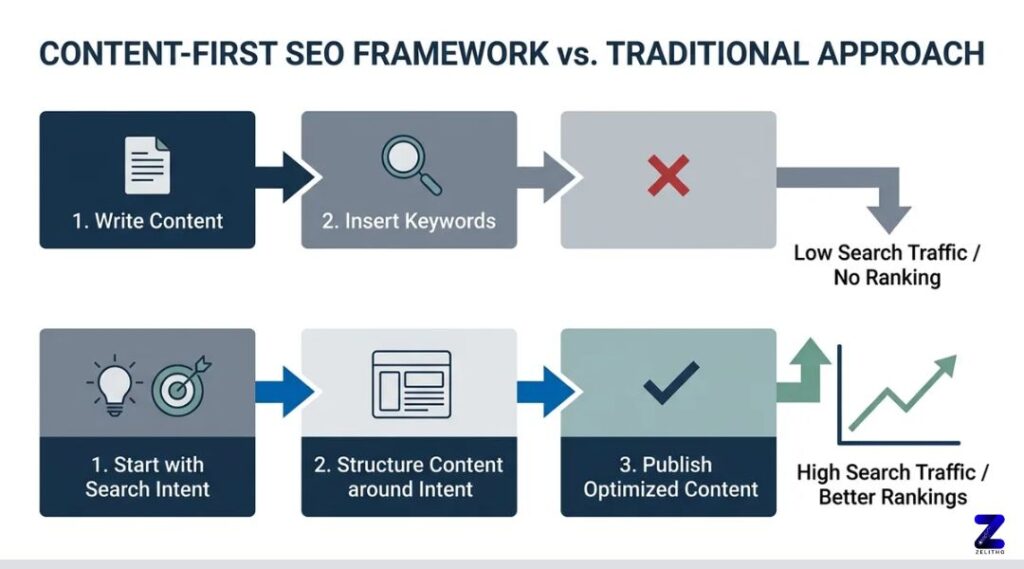
• Most writers treat SEO as a finishing step. They write the post first, then add a keyword to the title and call it done. That produces pages that compete for nothing and answer questions nobody typed.
• The Content-First SEO Framework fixes this by reversing the sequence. It starts with search intent, builds structure before writing, and folds technical hygiene into the drafting process itself. This guide is written for marketers, founders, and agency owners who need a repeatable system, not a checklist they forget between posts. Follow it once. Then repeat it.
What does SEO-friendly content actually mean?
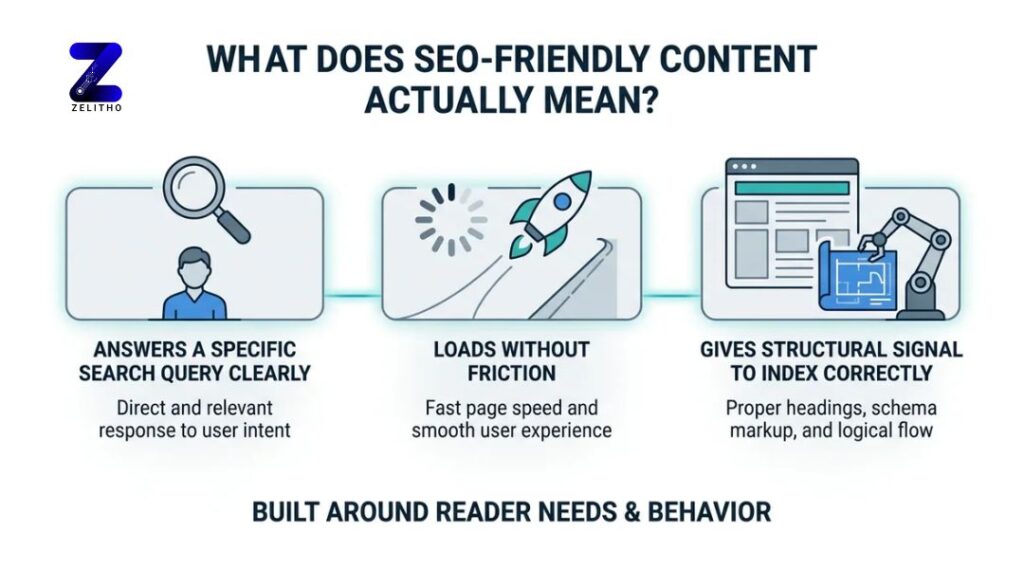
SEO-friendly content is a page that answers a specific search query clearly, loads without friction, and gives search engines enough structural signal to index it correctly. It is not content that mentions a keyword repeatedly. It is content built around how a reader searches and what they need after they click.
The Core Principles Most Beginners Get Backwards
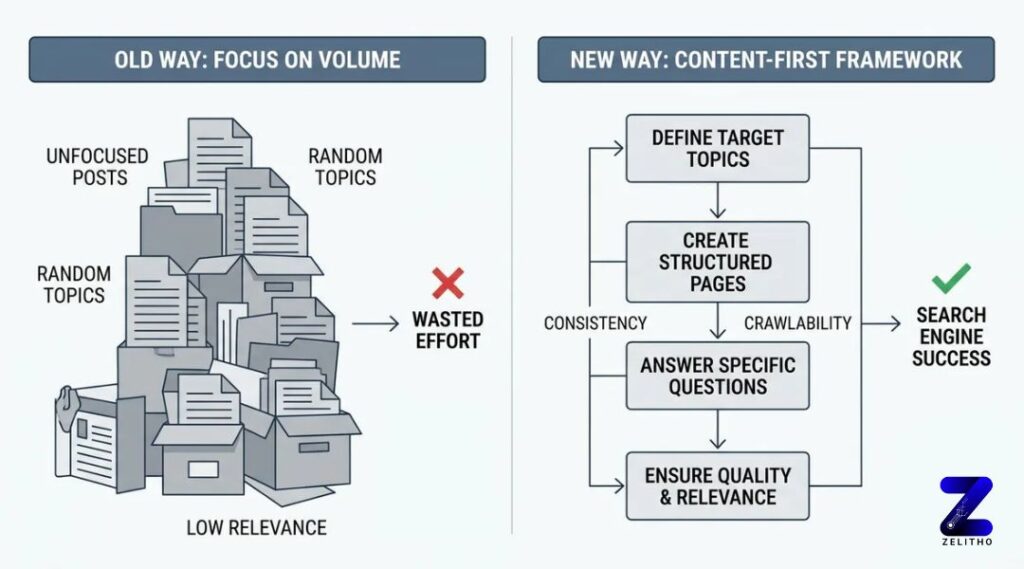
More content does not mean more traffic. That assumption is where most new content programs fail.
A site with 50 unfocused posts will consistently lose to a site with 10 well-structured pages that each answer one specific question clearly. Search engines reward usefulness, structure, and consistency. They do not reward volume.
Stop publishing more. Start publishing with a system.
This is the foundation of the Content-First SEO Framework. Quality, relevance, and crawlability are not three separate tasks you rotate between. They function as one system. When one breaks, the others weaken.
What Search Engines Actually Reward
Search engines evaluate whether a page satisfies the reader who lands on it. They look at structure, how the content is organized, how fast the page loads, and whether the site maintains itself over time.
Broken links, outdated pages, and slow load times are not neutral problems. They actively suppress pages that would otherwise rank. A crawler visiting your site has a limited budget per visit. If it wastes that budget on broken or stale URLs, newer posts take longer to get indexed.
Here is a concrete scenario: a blog publishes weekly but never audits old posts. Crawlers return to those outdated URLs repeatedly, consuming crawl budget. New posts sit unindexed for weeks. The problem is not the new content. It is the unmaintained site surrounding it.
Content-First vs. SEO-as-Afterthought
Approach | When SEO Happens | Common Result |
|---|---|---|
Content-First SEO Framework | Before the first word | Pages built for search intent from the start |
SEO as Afterthought | After writing is complete | Keyword added to title, structure unchanged |
Publish Volume Focus | Ongoing, no audit cycle | High post count, low ranking pages |
This article does not teach keyword stuffing or word count targets. It teaches you to build pages that earn their rank through structure and intent, not repetition.
Keyword Research and Content Planning Without the Guesswork
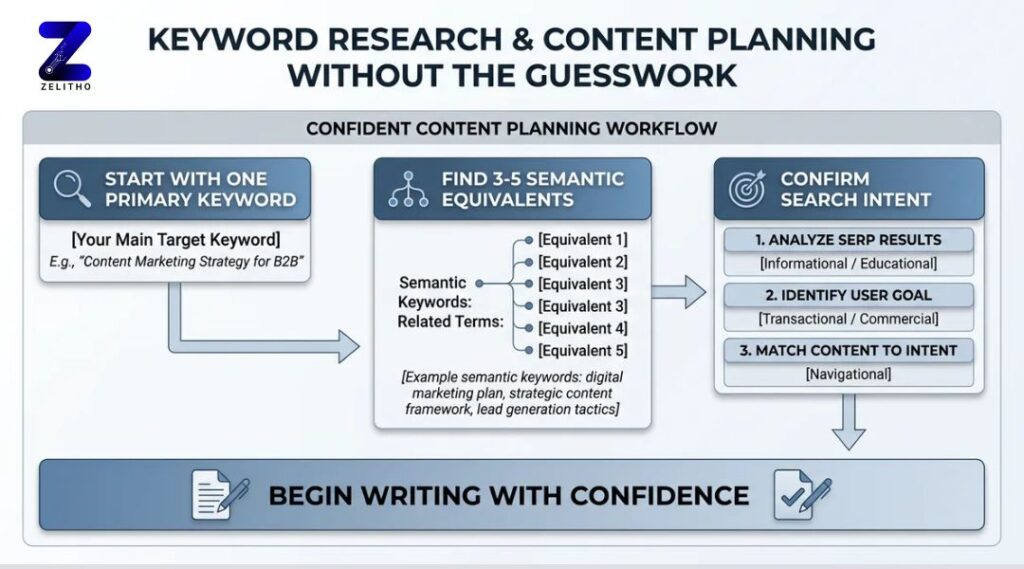
Here is the worry most beginners carry privately: what if I pick the wrong keyword and waste three weeks of work?
That fear is reasonable. The fix is a simple pre-writing habit, not a complex research stack.
Start with one primary keyword. Find three to five related terms that share the same meaning or cover the same topic from a different angle. These are semantic equivalents. Then confirm the search intent behind your primary keyword before writing a single sentence.
Search intent is the reason behind a query. A person typing “how to write a blog post” wants instructions. A person typing “blog writing service pricing” wants to compare options. Same broad topic, completely different content format.
Narrowing Intent to Reduce Competition
Targeting “how to write a blog post” puts you against thousands of established pages with years of backlinks. Targeting “how to write a blog post for a new website with no audience” narrows the intent and reduces direct competition. You are not hiding from search traffic. You are finding the part of the conversation where you can actually win.
The friend advice version of this: stop chasing the keyword with the highest search volume. Start with the query that matches exactly what your reader types when they are in your situation.
Why Intent Mapping Prevents Self-Competition
Without intent mapping, a site can quietly build 20 or 30 pages targeting variations of the same keyword. Each page splits the ranking signals that would otherwise concentrate on one strong page. Neither page performs well. The site competes against itself and loses to a competitor who published one clear, focused post.
Spend 15 minutes before writing any piece. Confirm the primary keyword, its intent, and whether you already have a page targeting it. That 15 minutes prevents months of wasted effort.
Intent Type | Example Query | Content Format That Matches |
|---|---|---|
Informational | How to optimize a blog post | Step-by-step guide or tutorial |
Navigational | Ahrefs keyword tool login | Landing page or product page |
Transactional | Buy SEO content writing service | Sales page or comparison page |
Map each piece of content to one row in that table before you outline it.
Readability and Technical Elements That Determine Whether Your Content Gets Read or Ignored
Good writing is not enough. A well-written post with no header structure, dense paragraphs, and a six-second load time gets abandoned before it gets read.
Readability signals are also ranking signals. When readers leave quickly, search engines register that the page did not satisfy the query. That lowers the page’s position over time.
Header Structure and Paragraph Length
Use one H1 per page. Use H2s as navigational anchors that let a reader scan and find what they need. Use H3s for sub-points under each section. This hierarchy tells both readers and crawlers how the content is organized.
Keep sentences under 20 words on average. Keep paragraphs to three or four sentences. If a paragraph runs longer than that, break it. Dense blocks of text signal effort to the reader before they have read a single word. Most readers leave instead of pushing through.
Technical Checks That Actually Move Rankings
The title tag is the first signal a search engine reads. Write it to match the primary keyword and the search intent. The meta description does not directly influence rankings, but it controls whether a reader clicks. Write it as a conversion tool, not a summary.
Alt text on images serves two purposes: it describes the image for screen readers, and it gives crawlers additional context about the page topic. Use it for every image, and make it descriptive rather than generic.
Internal links pass ranking authority between pages. An internal link from a high-traffic post to a newer post gives that newer post a starting signal it would not otherwise have. Without it, the new post starts from zero every time a crawler visits.
Page speed is not a bonus optimization. A page that loads slowly loses readers before the content loads. Use a tool like PageSpeed Insights to identify the specific files or scripts causing the delay.
Here is the caveat most guides skip: keyword density is not a metric worth tracking. Search engines evaluate topical relevance and semantic coverage across the full page. Targeting a 1% or 2% density is outdated guidance. It produces awkward writing. Use the keyword where it fits naturally, and rely on related terms to fill out the topic.
Five Technical Checks Before Publishing
Title tag includes the primary keyword and matches search intent
Meta description is written to prompt a click, not just describe the post
All images have descriptive alt text
At least one internal link connects this page to a related existing page
Page loads in under three seconds on mobile
Run this list on every post before it goes live. It takes under ten minutes.
How to Scale Content Creation Without Losing Quality or Direction
The fear underneath most content scaling conversations is this: I cannot keep up, and slowing down means falling behind.
That fear pushes people toward volume. Volume without structure produces a site full of posts that each rank for nothing.
Consistency beats volume. Two well-structured posts per month outperform six rushed ones. The site with fewer, cleaner pages builds ranking momentum faster because each page reinforces the others.
The Content-First SEO Framework as a Repeatable Template
The Content-First SEO Framework runs in five steps. Each step removes a decision that would otherwise slow you down or introduce error.
Step 1: Confirm the primary keyword and its search intent. Check whether you already have a page targeting it.
Step 2: Outline the structure before writing. Decide your H2s first. Know what each section answers before you write a sentence.
Step 3: Write to the reader, not the algorithm. Cover the topic clearly. Use related terms where they fit. Do not force repetition.
Step 4: Apply the five technical checks before publishing.
Step 5: Audit every 90 days. Review pages that dropped in position. Update outdated content. Fix broken links. Remove or consolidate thin pages.
The Cost of Skipping the Audit Cycle
A page can drop in rankings after a competitor publishes something stronger, after an algorithm update, or after the information on it becomes outdated. Without a scheduled audit, that drop goes unnoticed.
A marketer skipped the 90-day audit for two content cycles. A page targeting a mid-volume keyword dropped from position four to position eleven after a competitor update. Six months passed before anyone caught it. A single review session would have identified the gap and prompted a targeted update. The page recovered within five weeks of the correction, but six months of traffic at that position were gone.
Schedule audit dates on the content calendar the same way you schedule publishing dates. The system only functions if maintenance is planned, not reactive.
Read more: How to Audit Your Site for GEO Readiness: A 30-Minute Checklist for AI Search Visibility
Batching Research to Cut Production Time
A marketer who batches keyword research once a month, then uses a standard outline template for every post, cuts per-post production time significantly. The topic map is visible in advance. Internal linking becomes easier because you can see which pages connect before you write.
Without the topic map, each post gets written in isolation. Internal links get added randomly, or not at all. The site accumulates disconnected pages instead of a structured content network.
Build the calendar first. Fill it with confirmed keywords and intent types. Then write into that structure. The Content-First SEO Framework only produces compounding results when it runs as a sequence, not as a list of tips applied unevenly.
The Content-First SEO Framework Is a Sequence, Not a Checklist
The Content-First SEO Framework is not a checklist you run once. It is a sequence you repeat. Start with principles, research before writing, build readability and technical hygiene into the draft itself, and schedule audits before you need them. Beginners who treat SEO as a separate layer will keep starting over. Those who treat it as a structural habit build momentum that compounds over time. Return to this guide when you launch a new content series or when rankings stall. The framework does not change, your application of it sharpens.
FAQ
Start with a confirmed keyword and its search intent before writing. Structure the page with clear header hierarchy, short paragraphs, and at least one internal link to a related page. Apply technical checks for title tag, alt text, and page speed before publishing. The sequence matters more than any individual tactic.
Roughly 80% of your organic traffic typically comes from 20% of your pages. This means a small number of well-structured, intent-matched pages drive most results. Focusing effort on improving those pages, rather than publishing more content broadly, produces faster ranking gains.
The four pillars are technical SEO, on-page optimization, content quality, and authority building through links. Technical SEO covers crawlability and speed. On-page covers structure and keyword placement. Content quality covers relevance and depth. Authority covers how other sites reference yours. All four need to function together.
Confirm the primary keyword matches the page’s search intent. Use header hierarchy to organize the content. Add internal links to and from related pages. Write a meta description that prompts a click. Audit the page every 90 days to catch ranking drops before they compound.
ChatGPT can produce a draft, but it cannot confirm search intent, check your existing page inventory for keyword overlap, or run technical audits. It generates text. You supply the keyword research, structure decisions, and post-publishing maintenance. Using it without that input produces generic content with no clear search target.
Yes. The core process, keyword research, content structuring, technical checks, and audit cycles, requires tools and time, not a specialized team. Many founders and small marketing teams manage it effectively with a consistent workflow. The constraint is usually consistency, not capability.
Write for the reader first. Search engines evaluate whether a page satisfies the person who clicked. A page that answers the query clearly, loads quickly, and stays current will outperform a page optimized for keyword density every time.
The 3 3 3 rule is a content pacing guideline. It suggests you reach a reader in the first 3 seconds, hold attention for 3 minutes, and deliver a clear next step within 3 actions. In SEO content, this maps to a clear title, scannable structure, and one specific call to action or internal link per page.
The five concepts are search intent, crawlability, on-page structure, topical relevance, and site maintenance. Search intent determines what to write. Crawlability determines whether it gets indexed. On-page structure determines whether readers stay. Topical relevance determines whether the page ranks for related queries. Maintenance determines whether rankings hold over time.