
How to Create High-Quality Content Cost-Effectively: Tools and Strategies Explained


TL;DR
Your content budget is not the problem. The sequence your team follows to produce each piece is.
Most teams buy tools to solve workflow problems. The AI writing assistant does not fix an unclear brief. The grammar subscription does not fix three rounds of stakeholder feedback that contradict each other. The tool spend grows while the output stays inconsistent.
The Lean Content Engine solves this by front-loading clarity. Standardize the brief, generate a structured first draft, run a single human editing pass, and collect stakeholder feedback once using a form. Four steps. Defined roles. Defined outputs. Senior marketers, founders scaling content, and agency owners managing multiple clients all benefit from this system because it removes the disorder that drives revision time and tool bloat. Follow the steps in order. Skipping any one of them sends you back to the start.
How do you create high quality content?
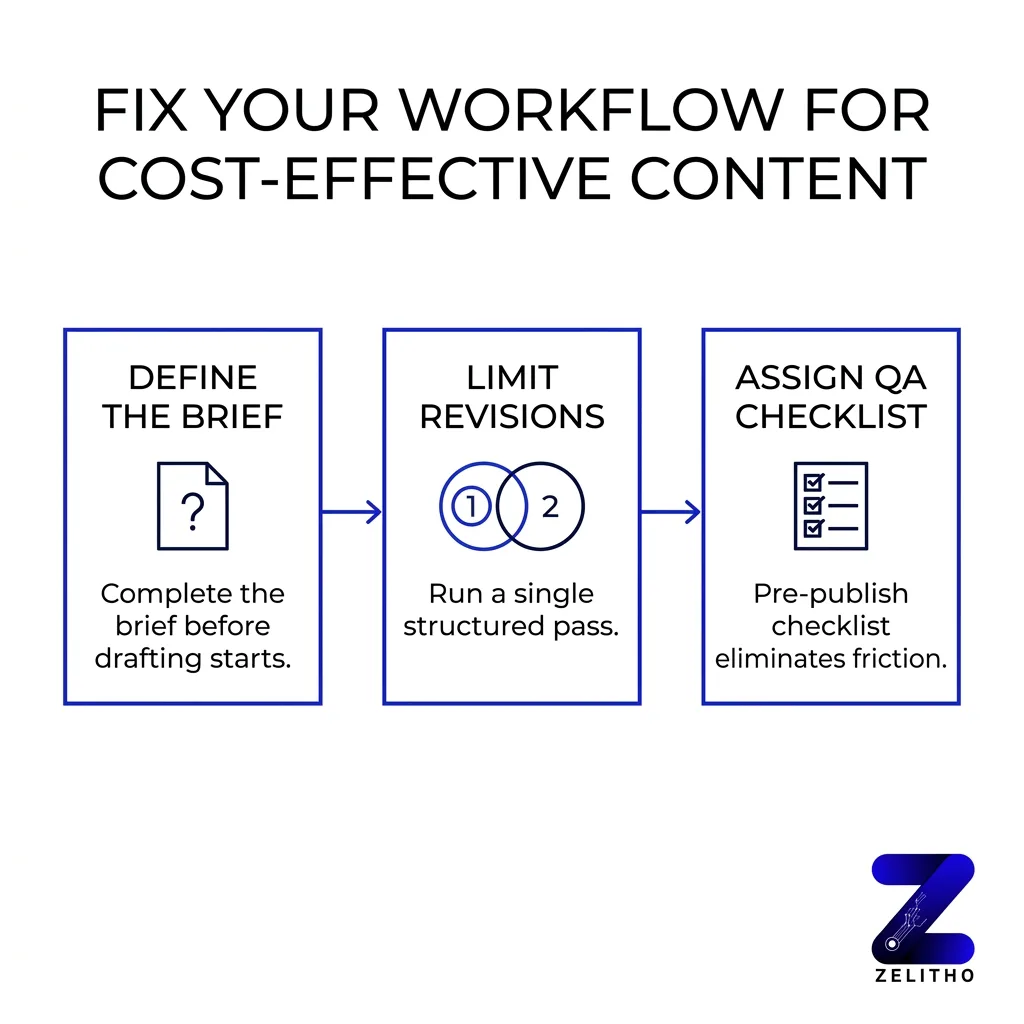
Fix your workflow before you buy another tool. Define the brief before drafting starts, limit revision rounds to one structured pass, and assign a QA checklist before any piece publishes. Cost-effective content production comes from removing friction at the source, not from finding cheaper software.
Why Your Current Content Process Costs More Than Your Tools Do
You are looking at the Asana board. Six blog posts are sitting in “In Review.” Two have been there for eleven days. Nobody flagged a tool problem. The briefs were vague, the first drafts missed the angle, and now the editor is rewriting instead of editing.
That is a workflow problem. Blaming the writing tool is the wrong diagnosis.
Stop assuming better software fixes unclear inputs. Start treating the brief as the most expensive document your team produces.
Here is the hidden cost most teams refuse to count: revision cycles. A post that goes through three rounds of substantive edits costs two to three times the time of a post that goes through one. The writing tool is not causing that. A missing style reference and an undefined brief format are causing it. Six weeks of revision cycles on a five-post batch is not a content quality problem. It is a sequencing problem that surfaced at the wrong stage.
Three workflow failures show up consistently in underpowered content operations. First, briefs have no standard format. Every writer interprets the assignment differently, and editors spend their time correcting direction instead of improving prose. Second, there is no style reference. Writers guess at tone. Editors overwrite to compensate. The feedback loop never closes. Third, tasks run sequentially when they could run in parallel. The editor waits for the writer. The designer waits for the editor. The calendar slips while everyone waits for everyone else.
The contrast matters here. A mid-tier AI writing assistant costs roughly $30 to $50 per month. Three extra revision rounds on eight posts per month, at a blended hourly rate of $60 for a content manager, costs more than $700 in recovered time. The tool budget is not the leak. The process running before and around the tool is.
The Lean Content Engine: A Four-Step Workflow Built for Tight Budgets
The Lean Content Engine is a four-step production sequence built to cut revision rounds by front-loading the decisions that usually get made too late. You do not need new software to run it. You need a defined order of operations.
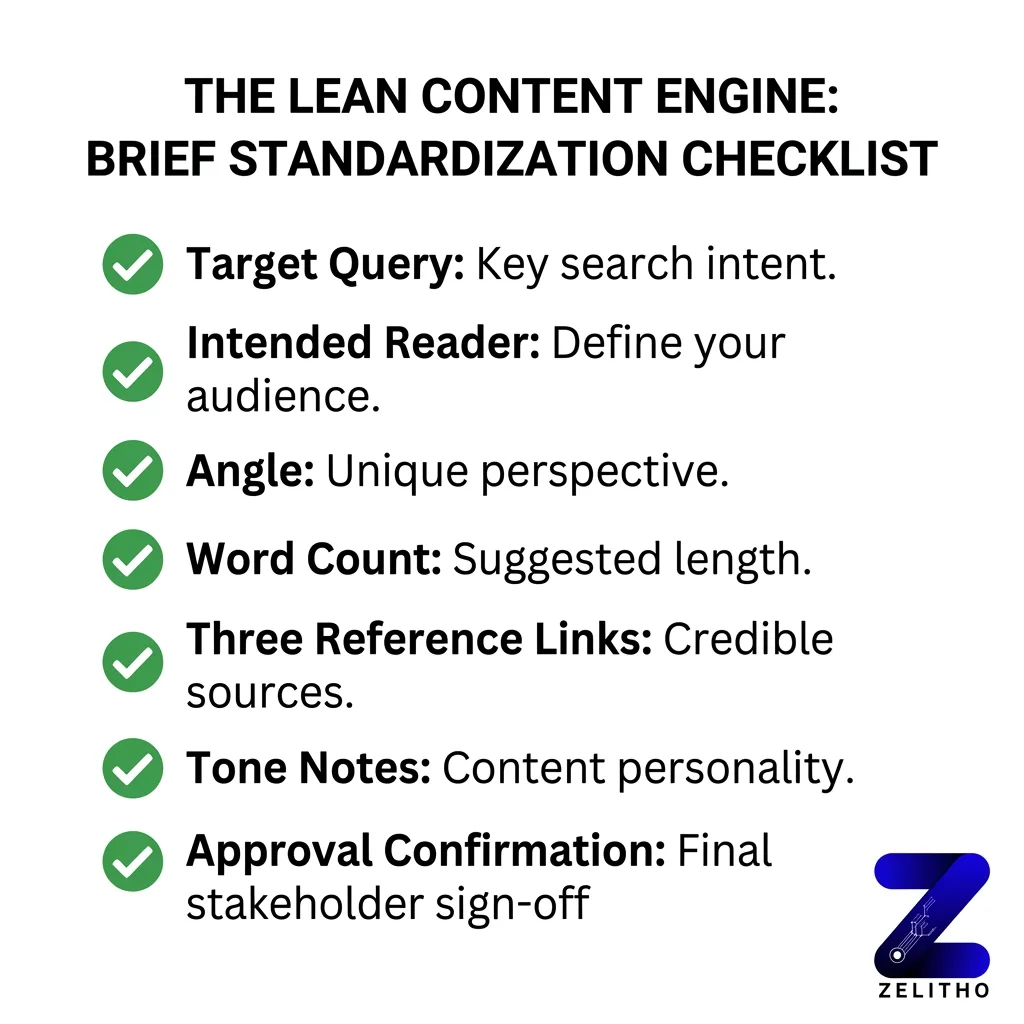
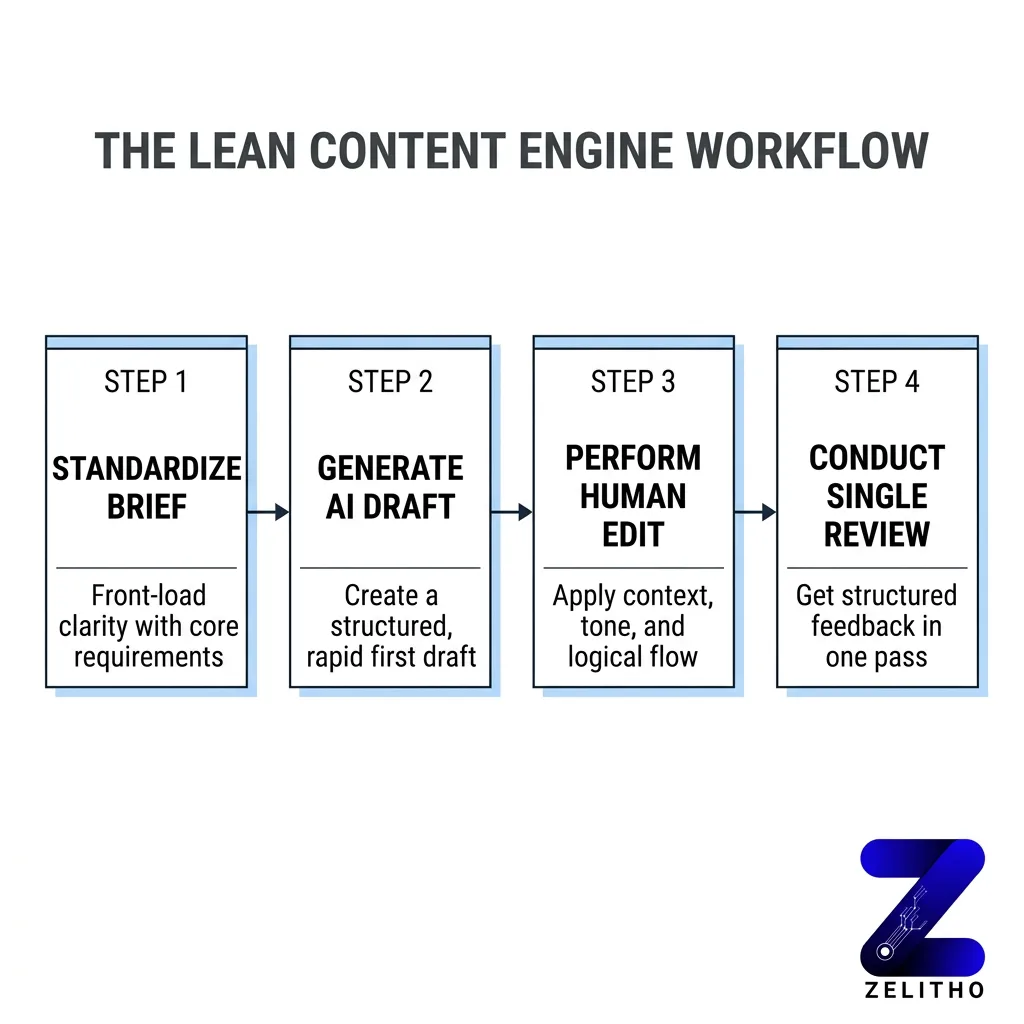
Step one is brief standardization. Use a free template in Notion, Google Docs, or any shared workspace. The brief must include the target query, the intended reader, the angle, the word count, three reference links, and tone notes. If a writer cannot start without asking a question, the brief is incomplete. Fix the brief, not the writer. Step two is AI-assisted first drafting with a defined prompt structure. Feed the AI the brief directly. The prompt should specify format, audience, angle, and one thing to avoid. The output is a structural skeleton, not a finished draft. Step three is a human editing pass focused only on tone and factual accuracy. The editor does not rewrite structure. Structure was set in the brief. If structure is wrong, the brief failed, not the draft. Fix that upstream. Step four is a single-round stakeholder review using a structured feedback form with three fields: what is factually wrong, what is off-brand, and what is missing. Freeform comments are not accepted in this round.
The Lean Content Engine produces eight blog posts per month from a two-person marketing team with no paid tools beyond a mid-tier AI writing assistant. The brief template lives in Notion’s free tier. Hemingway Editor handles readability checks at no cost. Canva’s free plan covers any visual assets. The constraint is not budget. It is discipline in following the sequence.
Step | Tool Option | Time Budget | Output Standard |
|---|---|---|---|
1. Brief Standardization | Notion (free) or Google Docs | 20 minutes per brief | Complete brief with query, angle, tone, references |
2. AI-Assisted First Draft | ChatGPT, Claude, or Notion AI | 30 minutes including prompt setup | Structural draft with all sections covered |
3. Human Editing Pass | Hemingway Editor (free) | 45 minutes per post | Tone, accuracy, and readability corrected |
4. Stakeholder Review | Google Form or Typeform (free) | 24-hour feedback window | One round of structured, categorized feedback |
Teams that run this sequence cut average revision rounds from three to one. The reduction happens because clarity moves to the front. The brief defines the direction. The prompt mirrors the brief. The editor corrects tone, not intent. The stakeholder reviews a near-final piece, not a directional draft.
Affordable Tools That Actually Earn Their Place in the Stack
Most all-in-one content platforms charge for features you use twice a quarter. Single-purpose tools used inside a disciplined workflow outperform bloated suites. The key word is inside. A tool without an assigned role in your workflow is overhead, not infrastructure.
Organize your stack by function, not by brand. For drafting, a mid-tier AI assistant handles first-draft generation when paired with a structured prompt. ChatGPT Plus or Claude Pro both work here. For editing, Hemingway Editor identifies passive voice, complex sentences, and readability grade at no cost. Combined with Grammarly’s free tier, these two tools catch roughly 80 percent of readability issues without a $30 monthly grammar subscription. For visuals, Canva’s free plan covers blog headers, social cards, and basic infographics. For distribution scheduling, Buffer’s free tier handles up to three channels. For SEO intent checks, Google Search Console is free and tells you whether a topic has measurable search demand before you invest drafting time.
Here is the operational move: audit your current stack against the four steps of the Lean Content Engine. Assign each tool to a step. If a tool does not map to a specific step, remove it from the active stack. It is consuming line items without producing a defined output.
The false belief this corrects is that a premium platform delivers better content because it does more things. It does not. A writer using Hemingway Editor and a structured AI prompt produces a tighter draft than a writer using an expensive all-in-one platform with no clear brief. The workflow determines the output. The tool executes the step.
One implementation caveat: do not swap tools mid-project. Pick one option per function, run it for sixty days, and measure revision rounds, not output volume. Volume is easy to inflate. Revision rounds tell you whether the tool is solving the right problem.
Quality Assurance on a Budget: The Checks That Prevent Costly Rewrites
A single post with a factual error does not just need a correction. It needs a correction, a republish, a social retraction if the piece was shared, and weeks of monitoring to confirm the updated URL regains its prior search position. That is not a hypothetical risk. It is a predictable cost that QA prevents for less than thirty minutes of structured review per post.
Three budget-conscious QA methods eliminate the errors with the highest downstream cost. First, run a factual accuracy pass using primary sources only. No secondary summaries. No competitor posts cited as evidence. If the fact cannot be verified at the original source, remove it or mark it clearly as an estimate. Second, set a readability score target before drafting starts, not after the piece is written. If the target is a grade 8 reading level, that instruction goes into the brief. The writer and the AI prompt both work to that target. Checking readability post-draft and finding it at grade 12 requires a structural rewrite, not a light edit. Third, run a peer read using a structured feedback form. The reviewer answers three questions: Is there a factual claim that cannot be verified? Does the tone break from the brand reference? Is there a section that could be cut without losing the argument? Freeform comments create freeform rewrites.
Assign QA tasks by role, not by seniority. Senior marketers and founders create a bottleneck when they position themselves as the final QA gate on every post. The factual accuracy pass goes to the researcher or writer. The readability check runs through Hemingway Editor before it reaches any human. The peer read goes to a second writer or a junior editor using the structured form. Seniority comes in at stakeholder review, which is step four of the Lean Content Engine, not at QA.
Here is the short checklist that runs before any piece publishes:
Brief query matches the final headline
Every factual claim traces to a primary source
Readability score meets the pre-set target
No brand tone breaks in the first three paragraphs
Visuals are correctly sized and labeled
Internal links point to live pages
Structured feedback form was used in stakeholder review
Teams that run QA as a defined step before stakeholder review eliminate the “this needs a full rewrite” response. That response appears when stakeholders see direction errors at the final review stage. Direction errors belong in the brief. If QA runs correctly, stakeholder review is a narrow pass on tone and accuracy, not a content intervention.
The Lean Content Engine Is a Sequencing Decision
The Lean Content Engine is not a shortcut. It is a sequencing decision.
You stop paying for disorder with revision time and tool bloat. You start producing consistent output with what you already have, or with what costs far less than your current stack.
Run the four steps in order. Brief standardization first. AI-assisted draft second. Human editing pass third. Single-round structured review fourth. Assign tools to roles, not to aspirations. Install the QA checklist before the next piece goes live.
The cost of high-quality content was never the budget. It was the missing system.
FAQs
The 7 times 7 rule states that a prospect needs to see your message at least seven times before acting, and that each exposure should reach no more than seven people at once in targeted communications. It reinforces the case for consistent content output over time. Irregular publishing breaks the compounding effect this rule describes.
The seven strategies commonly referenced are: content marketing, SEO, email marketing, social media marketing, paid advertising, influencer or partnership marketing, and referral programs. Content production is the operational foundation of the first three. The Lean Content Engine applies directly to the content marketing strategy and feeds assets into the others.
Accuracy, clarity, and relevance. Accuracy requires primary source verification before publishing. Clarity requires a readability target set before drafting. Relevance requires a defined audience and query inside the brief. All three are built into the QA checklist covered in this article.
The seven steps typically cover: define your audience, set content goals, audit existing content, identify topic clusters, select formats and channels, build a production calendar, and measure performance. These are strategic planning steps. The Lean Content Engine sits inside step six and seven as the execution layer that makes the calendar work without workflow breakdown.
The 5 C’s are clarity, consistency, conciseness, credibility, and connection. These describe output quality standards, not production steps. Apply them as editorial criteria during the human editing pass in the Lean Content Engine, not as workflow stages.