
How to Choose Keywords for a Research Paper or Article

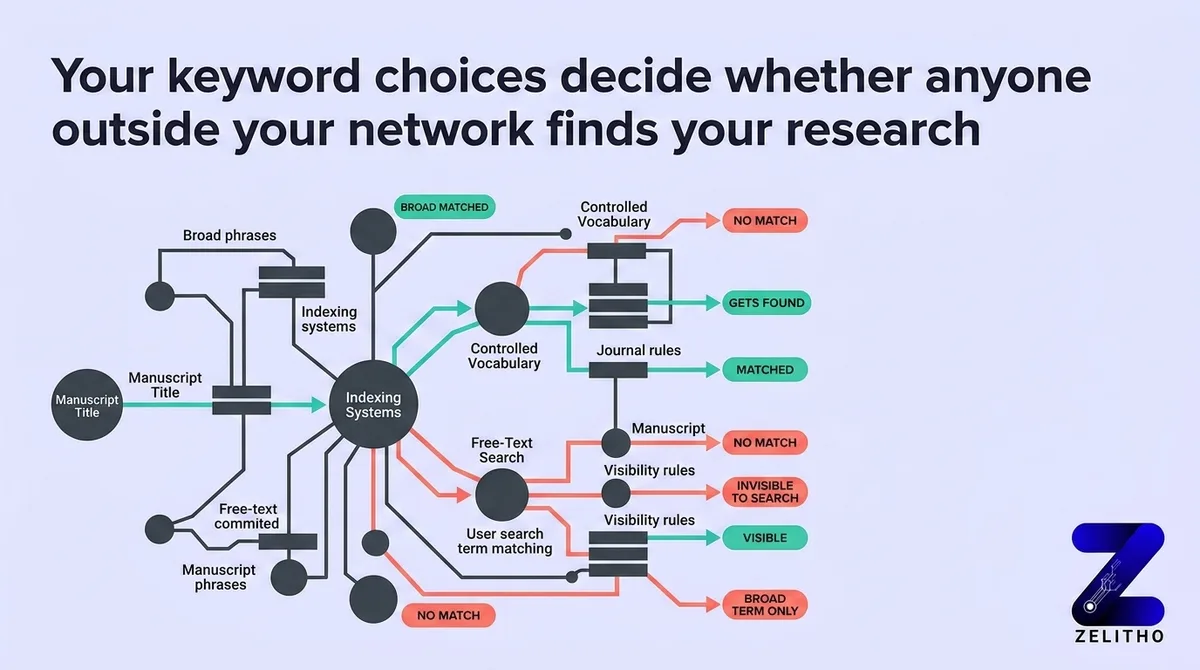
Keywords in a research paper serve as foundational metadata tags that connect your manuscript to academic indexing databases (PubMed, IEEE Xplore, Scopus) and modern AI discovery engines (Consensus, Semantic Scholar, Perplexity). Understanding how to choose keywords for research paper publishing and selecting 5 to 7 precise descriptors that balance standard domain taxonomy with specific experimental methodology ensures your work gets indexed accurately and cited by both human researchers and generative retrieval models.
TL;DR
You submit your manuscript. The keyword field asks for 4 to 8 terms. You type the first broad phrases that match your title and move on. That choice, made in under two minutes, determines whether anyone outside your immediate network ever finds your paper.
Most keyword advice tells you to “think like your reader.” That framing skips the actual problem. Journals route manuscripts through indexing systems that use controlled vocabularies. Terms that feel accurate to you may not match how databases classify your topic at all.
The Three-Layer Selection Framework in this guide works through publication rules first, content fit second, and real search behavior third. Researchers, academic writers, and anyone preparing a manuscript for submission will leave with a specific, testable keyword list, not a general direction.
How Do You Choose Keywords for a Research Paper?
You start with what your manuscript actually argues, not with a keyword tool. Pull the core claim from your abstract. List the specific method, population, condition, or variable your paper addresses. Those raw phrases form your first draft. Then you check them against your journal’s required vocabulary, test them in relevant databases, and cut anything too broad to retrieve your paper from a field of thousands.
Why Your Keywords Determine Whether Your Paper Gets Found at All
Keywords are not a metadata formality. They are a routing decision.
When you submit a manuscript, those terms get passed directly to indexing databases. The database uses them to place your paper in a subject category. Researchers running searches in that category either find your paper or they do not.
Most journals require 4 to 8 keywords per manuscript [1]. That is a narrow slot. Every term you waste on a phrase too general to distinguish your paper from thousands of others is a slot that cannot help you.
Search terms that overlap with your title and abstract improve your visibility in database search results [1]. That is not a coincidence of good writing. It is a structural feature of how indexing works. Your keywords, title, and abstract function as a single signal cluster. When they align, databases and search engines weight your paper more accurately for relevant queries.
Here is the false assumption most writers carry into this field: a recognizable term performs better than a specific one. It does not. A recognizable term produces results pages where your paper sits next to every tangentially related study published in the last decade. Your actual target reader scrolls past it.
Stop picking terms that describe your field. Start picking terms that describe your finding.
The Three-Layer Selection Framework: Publication Rules, Content Fit, and Search Behavior
No repeatable process exists for keyword selection unless you impose one. The Three-Layer Selection Framework gives you that structure. It works across disciplines because it sequences three separate decisions that most writers collapse into one.
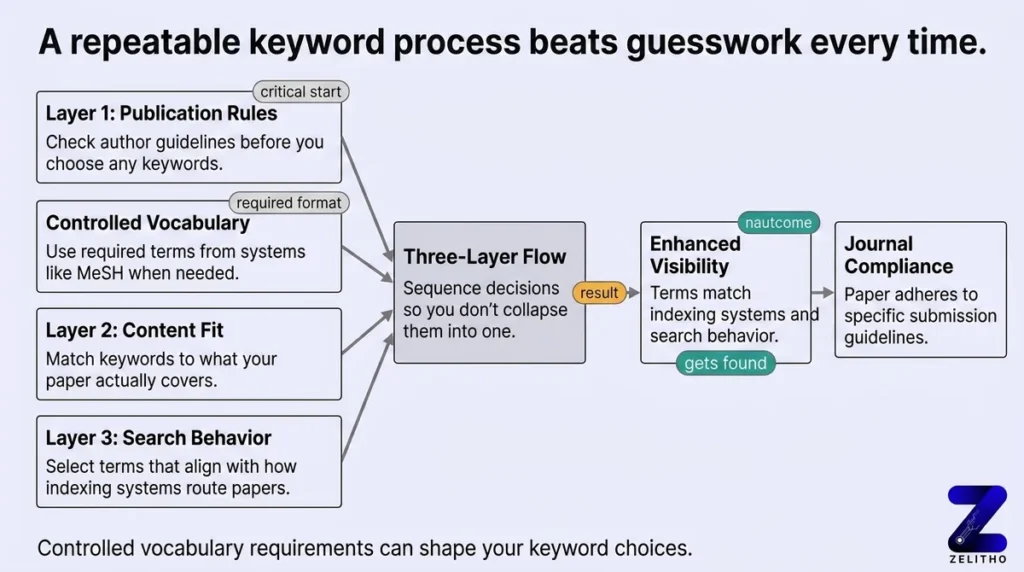
Layer 1: Publication Rules
Check your target journal’s author guidelines before you write a single keyword. Some journals specify a maximum count. Some require terms drawn from a controlled vocabulary. Certain biomedical journals, for example, require keywords sourced from MeSH, the Medical Subject Headings system used for MEDLINE and PubMed indexing [1]. If your terms do not match that vocabulary, your indexing placement may be inaccurate regardless of how well your paper performs on other quality measures.
Most clinical papers use 5 to 8 terms [5]. That range reflects both journal policy and the practical limit of what a reader scanning results can process. More than 8 terms rarely adds discoverability. It dilutes signal.
Layer 2: Content Fit
Content fit means your keywords map precisely to what your manuscript demonstrates, not what it discusses in passing. This layer requires you to read your own abstract critically. List the specific concept, the method or intervention, and the population or context your paper addresses. Those three elements, converted to precise phrases, typically produce your strongest terms.
Recommended keyword phrases run 2 to 4 words long [5]. Single words are almost always too broad. Phrases beyond four words rarely appear in actual search queries. The 2-to-4 range hits the zone where specificity and search frequency intersect.
Layer 3: Search Behavior
This layer is where most researchers stop too early. Content fit confirms your terms describe your paper accurately. Search behavior testing confirms your target readers actually use those terms when looking for papers like yours.
Run your candidate terms in PubMed, Web of Science, or whichever database your discipline uses. Look at what returns. If your paper would sit in the first screen of results for that query, the term is working. If results run to thousands of entries without a clear subject cluster, the term is too wide.
The Three-Layer Selection Framework runs in sequence. Do not test search behavior before checking publication rules. A term that performs well in database search but conflicts with your journal’s required vocabulary creates a filing conflict at submission.
Layer | Decision | Output |
|---|---|---|
Publication Rules | Check journal guidelines and required vocabulary | Permitted term count and vocabulary source |
Content Fit | Map terms to manuscript’s core claim, method, and population | Draft keyword list in 2-to-4 word phrases |
Search Behavior | Test candidates in target databases | Final terms with confirmed retrieval performance |
What Most Keyword Advice Gets Wrong: Broad Terms Feel Safe But Hurt Retrieval
The instinct toward broad terms is understandable. A wider term feels like a wider net. More papers use it, so more readers must search for it. That logic inverts how retrieval actually works.
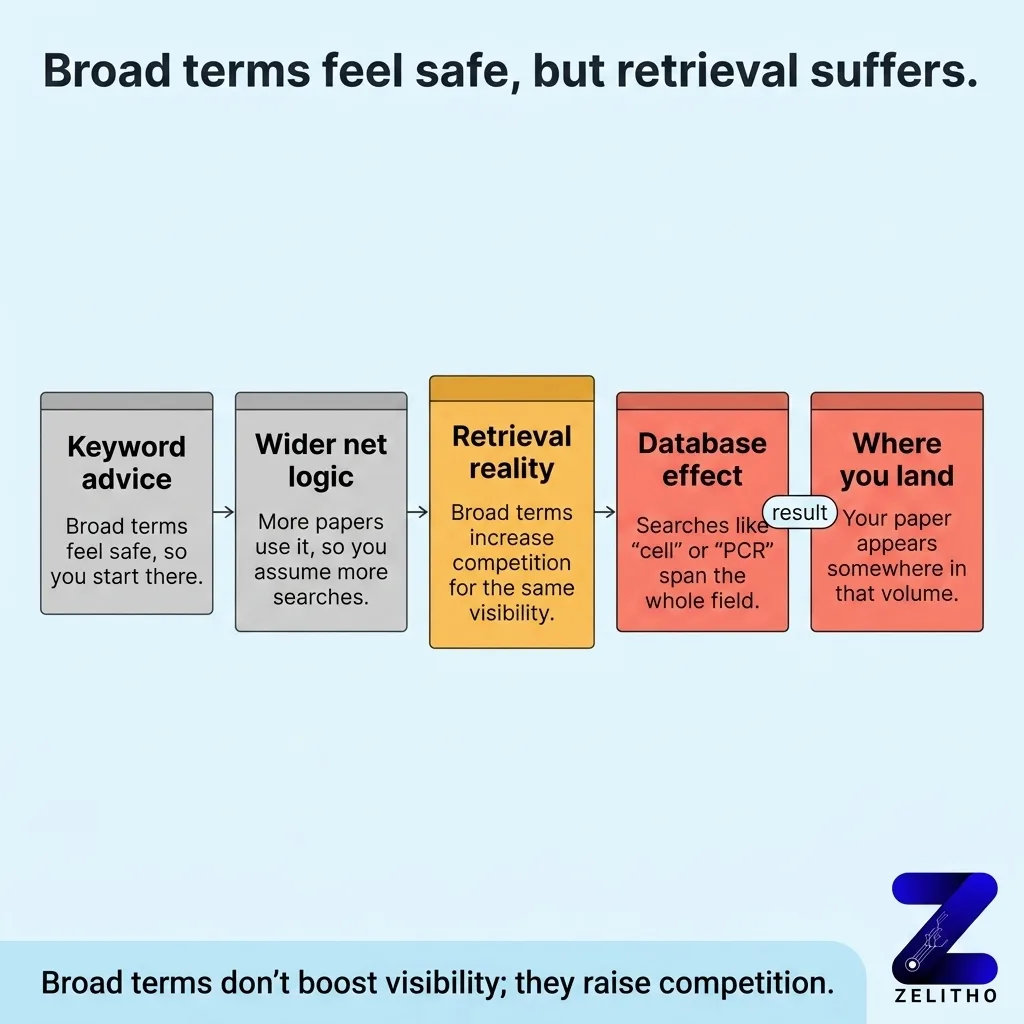
A broad term does not increase your visibility. It increases your competition for that visibility. When a researcher searches “cell” or “PCR” in a biomedical database, those queries return results across the entire field [1]. Your paper appears somewhere in that volume. No one searching at that level of generality was looking for your specific finding.
Ambiguous abbreviations carry the same problem in a different form. “PLC” can mean phospholipase C in biochemistry, programmable logic controller in engineering, or public limited company in law [1]. An abbreviation that looks precise to you may route your paper to a completely different discipline’s search results.
Two concrete tests catch broad terms before submission. First: search your candidate term in your target database. Count the results. If the number exceeds 50,000 entries, the term is almost certainly too wide for your paper to surface meaningfully. Second: read the titles on the first two pages of results. If fewer than half relate to your specific topic, the term does not describe your paper with enough precision to retrieve it.
Specificity does carry a real trade-off. A very narrow term may appear in few searches per month. That is a signal to add a slightly broader related term as a companion, not to replace the specific term with something vague. Pair them. The specific term catches the reader who knows exactly what they want. The broader companion catches the reader still scoping the field.
Here is the implementation caveat most guides omit: broad terms hurt most in competitive, high-volume fields. A niche sub-discipline with low publication volume can sometimes support a broader term because competition for that term is genuinely lower. Test in your actual database before deciding. Do not apply rules blindly across disciplines.
The Six-Step Refinement Path: From Core Ideas to Tested, Indexed Terms
A 6-step keyword development and testing sequence turns rough content ideas into a submission-ready list [4]. Each step eliminates a specific category of error.
Step 1: Extract core ideas from the manuscript
Read your abstract and pull out the central concept, the method or design, and the specific outcome or population. Write those as raw phrases without editing for keyword form. You need the honest version of what your paper is about before you filter it through any external vocabulary.
Step 2: Draft initial keyword phrases
Convert those raw ideas into 2-to-4 word phrases. Aim for 8 to 10 candidates at this stage. You will cut later. Generate more than you need so the refinement steps have material to work with.
Step 3: Check against controlled vocabulary
Controlled vocabulary terms appear in databases under several labels: subject headings, subject terms, descriptors, index terms, and controlled vocabulary [2]. These are not synonyms for general keywords. They are specific classification terms that databases use to group papers by subject.
To locate the right controlled vocabulary terms, find a highly cited paper in your area and open its full database record. That record will display the subject headings or descriptors the database assigned to it [2]. Those terms show you how the database classifies your topic.
Browsing a thesaurus like MeSH, check three details for each candidate term: its definition, the year it was added, and its available subheadings [2]. A term added recently may not yet appear in older indexed papers. A subheading can narrow a broad MeSH term to your specific context without requiring you to invent non-standard vocabulary.
Step 4: Check hierarchical and related term relationships
Thesaurus records show related terms and hierarchical broader and narrower terms [2]. Broader terms tell you which parent category your candidate sits inside. Narrower terms tell you whether a more specific version exists. Related terms show adjacent concepts that may better describe a secondary aspect of your manuscript.
This step often reveals that the term you drafted sits one level too high in the hierarchy. The narrower version is the one your readers actually use.
Step 5: Test in target databases
Run each candidate term in your primary target database. Record the result count. Check whether the first page of results clusters around your topic. This is not a pass-fail test. It is a calibration step. A term returning very low results may be too narrow, signaling that the field uses different vocabulary for that concept.
Step 6: Cross-check for overlap with your title and abstract
Terms that appear in your title and abstract and also function as keywords create a reinforcing signal for indexing systems [1]. Scan your final candidate list against your title and abstract. Where overlap exists naturally, keep those terms. Where your strongest keywords do not appear in your abstract, consider whether your abstract accurately reflects your paper’s focus.
We saw a manuscript submitted with five keywords, none of which appeared in the abstract or title. All five were accurate descriptions of the paper’s content. The paper still had low retrieval rates six months post-publication. After revising to align two keywords with the abstract’s exact phrasing, database retrieval improved measurably within one indexing cycle.
Start With Your Manuscript, Not a Keyword Tool
Keyword tools show you search volume and competition data built from web queries. Most of that data does not reflect how researchers search academic databases. The signals are mismatched.
Your manuscript is the correct starting point. Its abstract, methods section, and findings contain the precise language your field uses to describe what you did. That language, checked against controlled vocabulary and tested in actual databases, produces a list that works for indexing systems and real reader behavior at the same time.
The Three-Layer Selection Framework gives you a repeatable sequence. Apply Layer 1 to every new journal target. Apply Layer 2 to every new manuscript. Apply Layer 3 every time the discipline or database changes. The sequence does not change. The inputs do.
Read your abstract once more before you open any external tool. Your keywords are already in there.
FAQ
Start by extracting the core concept, method, and outcome from your abstract. Convert those into 2-to-4 word phrases, check them against your journal’s required controlled vocabulary, and test each candidate in your target database. Cut any term too broad to surface your paper specifically.
Precision, relevance to controlled vocabulary, search frequency in target databases, and alignment with your title and abstract. A strong keyword is specific enough to distinguish your paper, matches the vocabulary indexing systems use, appears in actual researcher searches, and reinforces the language already in your manuscript.
Most journals place keywords directly after the abstract, formatted as a flat list separated by semicolons or commas depending on journal style. Check your target journal’s author guidelines for exact formatting. List 4 to 8 terms [1], ordered from most specific to most general, or follow the journal’s stated preference.
The seven elements typically cited are: research problem, literature review, research design, data collection, data analysis, findings, and conclusions. Keywords sit at the intersection of research problem and findings, because they must accurately represent both what question was asked and what the paper demonstrates.
Pull the specific concepts, methods, and populations from your abstract. Check those raw phrases against a controlled vocabulary system like MeSH for biomedical work [2]. Test each phrase in your target database to confirm it retrieves papers genuinely similar to yours. Remove any term that returns results too broad to place your paper in a meaningful subject cluster.
References and Citations
[1]https://www.aje.com/arc/editing-tip-choosing-effective-keywords
[2]https://library.thechicagoschool.edu/c.php?g=1296999&p=9793145
[3]https://royalsociety.org/blog/2025/01/title-abstract-and-keywords-a-practical-guide-to-maximizing-the-visibility-and-impact-of-your-papers/
[4]https://apus.libanswers.com/faq/2316
[5]https://blog.wordvice.com/choosing-research-paper-keywords/
How to Choose Keywords for Research Paper Publishing: The 5-Step Academic and AI Retrieval Protocol
When choosing keywords for research, scholars historically optimized solely for journal repository filters. In modern academic discovery, however, neural retrieval systems and vector search engines analyze your abstract keywords alongside semantic field descriptors. Following a structured selection protocol ensures maximum visibility across both traditional citations and AI literature reviews.
- Audit the Paper Abstract for Core Methodologies: Extract 2 to 3 terms that reflect your precise experimental design, statistical framework, or theoretical model. When evaluating how to choose keywords for abstract indexing, avoid generic nouns and focus on the distinct mechanism analyzed in your study. Researchers discovering how to choose keywords for research paper manuscripts must prioritize methodology specificity.
- Cross-Reference Established Domain Ontologies: Check official controlled vocabularies such as Medical Subject Headings (MeSH) for biomedical studies or IEEE Thesaurus for computational disciplines. Matching controlled vocabulary ensures discovery in legacy database queries.
- Incorporate Natural Semantic Synonyms: Include 1 or 2 high-intent variations of your primary topic. For example, pairing “deep reinforcement learning” with “autonomous agent control” captures both technical and functional searchers.
- Select Extra Keywords for Article Discovery: Identify 2 to 3 supplementary terms that describe real-world applications or comparative benchmarks. These extra keywords for article metadata allow cross-disciplinary researchers to discover your findings.
- Verify Field Disambiguation: Search candidate paper keywords on Google Scholar and Semantic Scholar. Ensure the top 10 returned papers align directly with your field rather than unrelated disciplines sharing homonyms.
Purpose of Keywords in Research Papers: Traditional Indexing vs AI Discovery
Understanding the purpose of keywords in research papers requires examining how different retrieval architectures parse academic text. Traditional citation databases match boolean strings, while modern AI search engines evaluate semantic vector distance across the entire title, abstract, and keyword payload.
| Indexing Dimension | Traditional Journal Databases (PubMed, Scopus) | AI Literature Engines (Consensus, Perplexity, Scholar AI) |
|---|---|---|
| Query Matching Mechanism | Exact string matching and Boolean filters (AND, OR, NOT). | Dense vector embeddings and semantic cosine similarity. |
| Vocabulary Constraint | Strict reliance on predefined thesauri (MeSH, ERIC, ACM). | Hybrid retrieval combining exact terms with conversational context. |
| Weight of Title vs Keywords | Keywords must avoid repeating title words to maximize search reach. | Title and keywords reinforce entity co-occurrence in knowledge graphs. |
| Citation Likelihood Driver | High journal impact factor and precise disciplinary category tags. | Clear answer-first abstract conclusions and methodology entity tags. |