
Short-Tail vs Long-Tail Keywords: What Is the Difference?

TL;DR
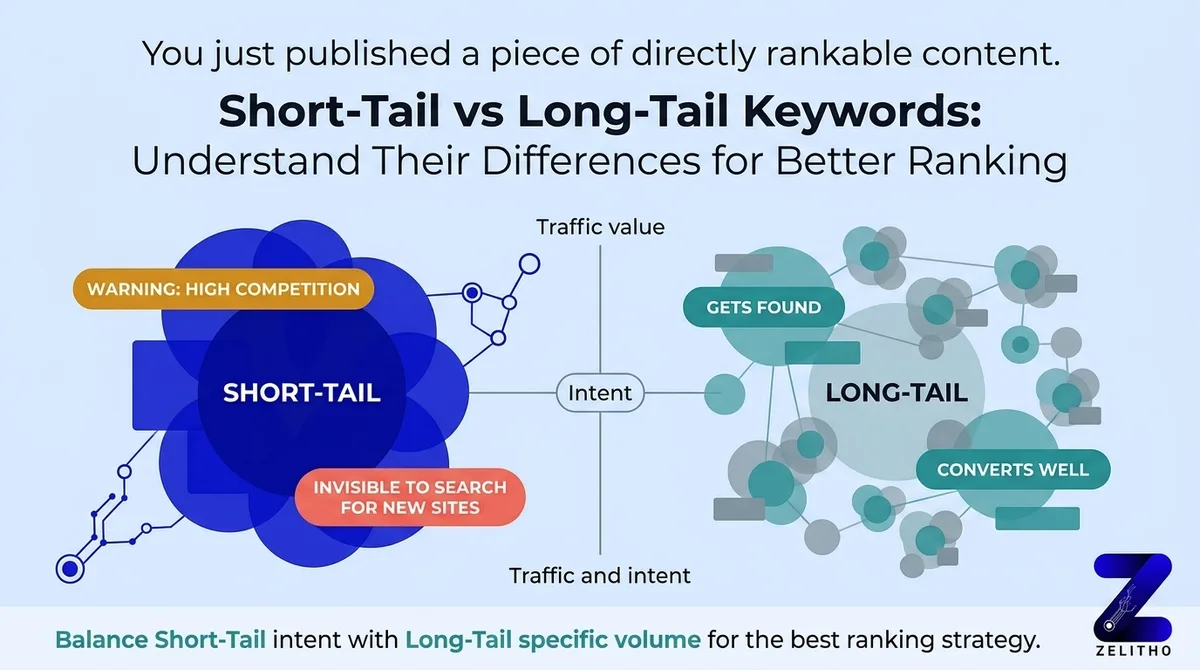
You just published a piece of directly rankable content. Now you are staring at a keyword list, trying to decide which terms are worth targeting and which ones will eat six weeks of effort with no ranking movement.
The common approach is to sort by volume and pick the biggest number. That logic fails on any site without established domain authority. High-volume terms carry competition levels that block new pages from the first page entirely.
The Intent-Competition-Value Framework gives you a repeatable three-question check before you commit to any keyword. It evaluates intent alignment, ranking difficulty, and traffic value as a set, not individually. Senior marketers building out content calendars, founders scaling their first content programs, and agency operators managing multiple client sites all benefit from this sequencing approach. Pick the keyword type that matches your authority level and content goal. Then publish.
What are long-tail vs short tail keywords?
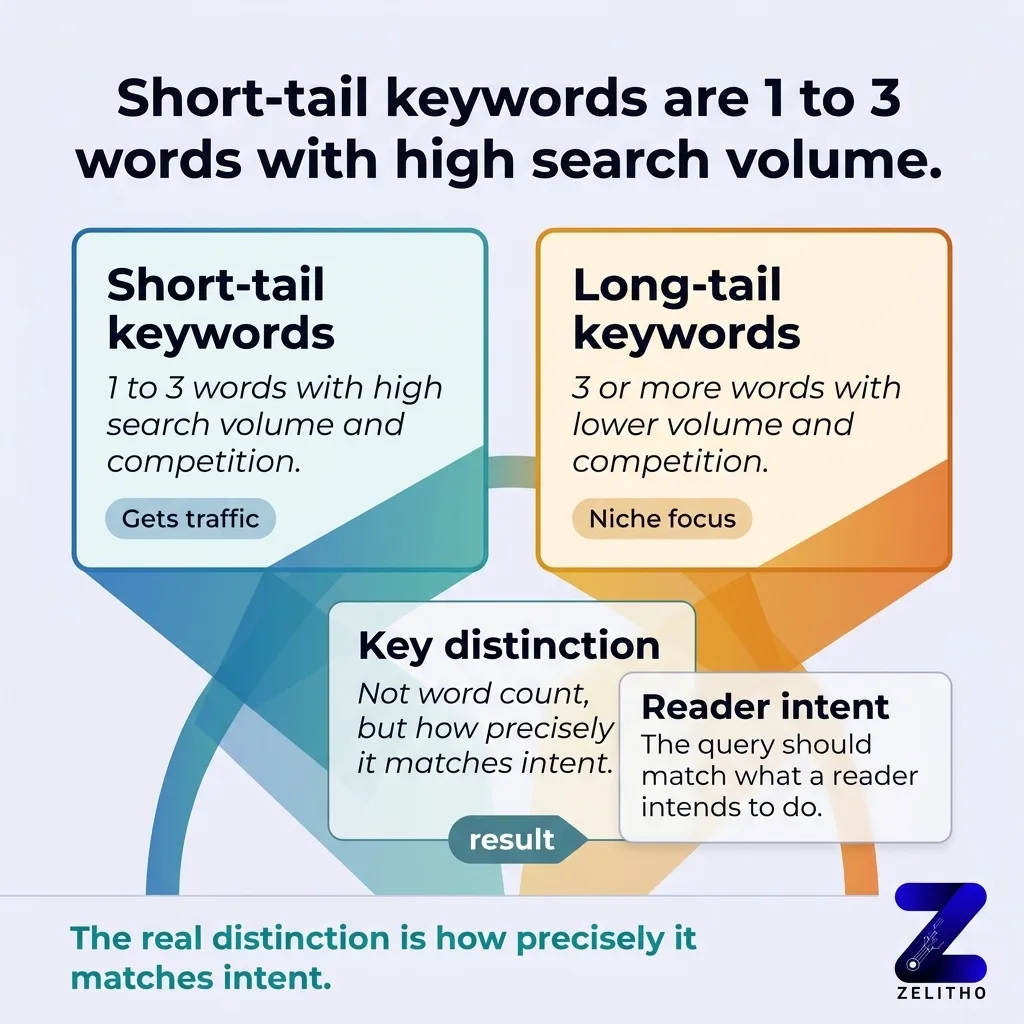
Short-tail keywords are 1 to 3 words with high search volume and high competition [1]. Long-tail keywords run 3 or more words and carry lower volume with lower competition [1]. The real distinction is not word count. It is how precisely the query matches what a reader intends to do.
What Short-Tail and Long-Tail Keywords Actually Mean
Word count is where the definition starts. It is not where the strategy ends.
Short-tail keywords are 1 to 3 words long [1]. Long-tail keywords are 3 words or more, often ranging from 3 to 5 or more words depending on the query [1][3]. That boundary matters because it shapes everything from search volume to the type of reader landing on your page.
Take “SEO” as the canonical short-tail example. That single word carries hundreds of thousands of monthly global searches and returns many millions of results [3]. It is broad, competitive, and used by people at every stage of awareness, from students to CMOs. “How to do SEO for a new blog” is its long-tail counterpart. Fewer searches. Much more specific. Typed by someone who already knows what SEO is and wants a starting point today.
The table below shows the structural contrast before you layer in strategy.
Query Type | Word Count | Example Query | Typical Volume |
|---|---|---|---|
Short-tail | 1 to 3 words | SEO | Hundreds of thousands |
Long-tail | 3+ words | How to do SEO for a new blog | A few hundred or fewer |
Length creates the first filter. What you do with that filter depends on your site’s position, your content goal, and the competitive landscape you are entering. This article moves past the basic contrast and into a selection framework that answers the real question: which type should you target right now?
You Think High Volume Means High Value , Here Is Why That Belief Costs Rankings
Stop sorting your keyword list by volume. Start sorting by whether you can actually compete for that term this month.
Here is the false assumption most content programs carry: a higher search volume term means a higher traffic opportunity. That is only true if you can rank for it. Short-tail terms carry higher search volume and higher competition [1]. Long-tail terms carry lower volume and lower competition [1]. The ranking difficulty gap between them is not minor. Short-tail terms are harder to rank for. Long-tail terms are easier [1].
The sting line is this: volume without rankability is not opportunity. It is a distraction.
Consider a real-world signal from search data. One article ranked number one for a head term and simultaneously appeared in the top ten for 240 additional long-tail keywords [2]. That result required existing authority. A new page on a new domain cannot replicate that outcome by targeting the head term directly. The page competing for “SEO” is going up against sites with years of backlink equity, deep content libraries, and brand signals Google already trusts.
The concrete consequence: a page optimized for a short-tail term on a low-authority domain will not rank after six weeks of effort. A long-tail alternative with a volume cap under 300 [2] can rank within weeks on the same domain, because fewer competing pages target that specific query with the same depth.
Long-tail terms also carry higher conversion and click-through potential compared to their short-tail counterparts [1]. The reader searching “how to do SEO for a new blog” is closer to taking action than the reader typing “SEO.” That intent gap directly affects what happens after the click.
Volume is a vanity metric for any site that cannot yet compete for it. The number looks good in a planning spreadsheet. It does not show up in your traffic report.
How Intent, Competition, and Traffic Value Actually Differ Between the Two Types
A common worry at this point: if long-tail terms have such low volume, am I targeting keywords nobody searches for?
That concern is real. Here is the data that addresses it. A SERP comparison between two related keyword variants showed 7 shared results [2]. Long-tail and short-tail queries on the same topic frequently surface the same pages. Ranking for a long-tail term can expose a page to broader discovery even when the direct volume appears small. The pages Google trusts for the specific query are often the same pages Google surfaces for the broader one.
The Intent-Competition-Value Framework evaluates any keyword across three dimensions before you commit to it.
Dimension 1: Intent alignment. Long-tail queries signal a specific need. The reader knows what they want. Short-tail queries signal broad exploration. The reader is still orienting. A page optimized for a long-tail term can match intent precisely. A page optimized for a short-tail term serves a wider range of needs, which makes it harder to satisfy any one reader completely.
Dimension 2: Ranking difficulty. Short-tail terms are harder to rank for. Long-tail terms are easier [1]. This is not a marginal difference on competitive topics. It is the difference between ranking on page one within weeks or spending months with no movement.
Dimension 3: Traffic value. Long-tail terms carry higher conversion potential [1]. The click from a specific query is worth more to your content goal than the click from a broad one, even when the broad query drives more total traffic to the SERP.
The operational benchmark for identifying true long-tail targets: a maximum monthly volume of 300 and a maximum traffic potential of 300 [2]. These numbers give you a concrete filter. Any keyword clearing both thresholds is a viable long-tail target on a low-to-mid authority site.
Dimension | Short-Tail | Long-Tail |
|---|---|---|
Intent alignment | Broad exploration | Specific need |
Ranking difficulty | Harder | Easier |
Traffic value | Lower targeted engagement | Higher conversion potential |
Run the Intent-Competition-Value Framework on any keyword before you publish. It takes less than two minutes and eliminates the most common planning mistake in content programs.
A Simple Decision Path for Choosing the Right Keyword Type for Your Content
This is not a permanent choice. It is a sequencing decision based on where your site stands today.
The Intent-Competition-Value Framework gives you the lens. Here is the branching logic beneath it.
Is your domain new or low-authority? Start with long-tail terms. Keep the volume cap under a few hundred [2]. The ranking path is shorter, the competition is thinner, and a successful ranking builds the domain signal you need to compete for broader terms later. Do not raise the long-tail volume threshold above a few hundred while your authority is still developing [2].
Is your goal brand awareness or reach? Short-tail terms become viable when your domain already carries authority. Competing for “SEO” makes sense if you have thousands of referring domains and a content library that signals topical depth. Without that foundation, it does not.
Is your goal conversion or capturing specific buyer intent? Long-tail wins here regardless of your authority level. A reader searching “best SEO tool for a solo founder with a new Shopify store” is telling you exactly what they need. Matching that query with a page that answers it precisely produces the kind of click that converts. Long-tail terms carry stronger conversion potential across the board [1].
The comparison across 10 dimensions between keyword types [1] confirms that no single axis decides this. Volume, competition, intent, ranking difficulty, conversion potential, click-through behavior, and query specificity all interact. Treating volume as the only input is how content programs stall.
Google Keyword Planner is the free starting point for checking monthly search data and competition level [3]. It requires an account and provides keyword suggestions alongside PPC competitiveness and monthly global and local search data. Use it to run the first pass on any keyword before applying the Intent-Competition-Value Framework.
A content team spent eight weeks publishing five posts targeting short-tail terms with a combined average volume of 12,000 monthly searches. None of the posts reached the top 50. They switched to a long-tail-first strategy with volume caps under 300. Four of the next five posts ranked in the top 10 within six weeks. Same team. Same quality. Different keyword sequencing.
The three-question check before any new piece of content goes live: Does the query match a specific intent? Can you realistically rank for this term at your current authority level? Does the traffic this term brings align with your conversion goal? If any answer is no, adjust the keyword before you write a word.
This article does not tell you to pick one keyword type permanently. It gives you a path to match keyword type to content purpose, every time, based on real conditions.
Match the Keyword Type to the Goal, Not the Volume
The Intent-Competition-Value Framework is the repeatable structure that replaces guesswork. Apply it before every publish.
Long-tail terms give low-authority sites a real path to first-page rankings. Short-tail terms reward sites that have already built the authority to compete. Neither type is wrong. Choosing the wrong one for your current position is the mistake.
Check volume. Check competition. Check intent. Then pick the term that matches all three to your actual situation.
Pick the keyword that fits your authority level and your content goal.
FAQ
Short-tail keywords are broad queries of 1 to 3 words with high search volume and high competition. Long-tail keywords are specific queries of 3 or more words with lower volume and lower competition. The practical difference is that long-tail queries signal clearer intent and are easier to rank for on newer or lower-authority sites.
The core difference is precision. Short-tail terms cover a broad topic and attract many searchers at different intent levels. Long-tail terms target a specific need and attract fewer searchers who are closer to taking action. Ranking difficulty and conversion potential both shift significantly between the two types.
Short-tail keywords are search queries made up of 1 to 3 words. They carry high search volume and face high competition in search results. “SEO” is a classic example, with hundreds of thousands of monthly global searches and many millions of competing results.
“SEO” is a direct example. It is one word, carries hundreds of thousands of monthly global searches, and returns many millions of results. Other examples include “running shoes,” “project management,” and “email marketing.” Each is broad enough to attract searchers across multiple intent stages.
Long-tail keywords are 3 or more words and target specific queries with lower volume and lower competition. Short-tail keywords are 1 to 3 words and attract broad interest with high volume and high competition. Long-tail terms are associated with higher conversion potential. Short-tail terms require significant domain authority to rank for effectively.
References and Citations
[1]https://www.geeksforgeeks.org/techtips/short-tail-vs-long-tail-keywords/
[2]https://ahrefs.com/blog/long-tail-vs-short-tail-keywords/
[3]https://www.lcn.com/blog/short-tail-vs-long-tail-keywords/