
What Is Keyword Proximity in SEO?

TL;DR
You published a page that includes every relevant term. It still does not rank clearly for any one thing. The problem is not which words you used. It is where they landed relative to each other.
Most proximity guidance stops at “keep terms close together.” That instruction skips the structural logic behind it. Spreading related terms evenly across a page to hit a density target produces pages that look optimized and read as hollow. The signal weakens because the terms never reinforce each other in context.
The Proximity-First Writing discipline introduced here gives senior marketers, founders, and agency owners a placement framework built around context, not counting. It works by anchoring related terms near your primary term in the sections that carry the most semantic weight. The result is a page that reads clearly and signals relevance directly.
What are keywords proximity?
Keyword proximity describes how close related search terms appear to each other within a page. When those terms sit near each other, search engines read them as contextually connected. When they drift apart, that connection weakens.
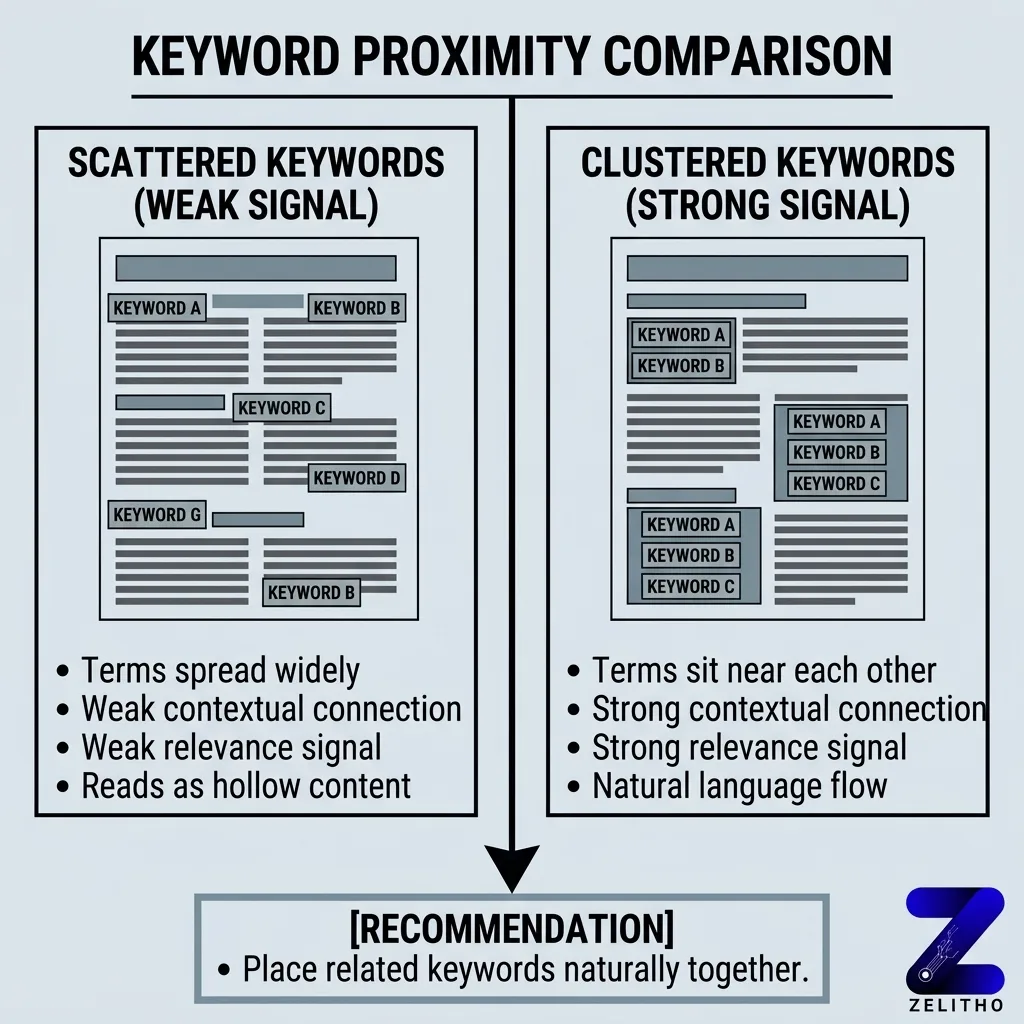
It is not a density calculation. It is a spatial relationship.
What Keyword Proximity Actually Means and Why Simple Definitions Miss the Point
Most definitions of keyword proximity reduce it to a single sentence: keep your keywords close together. That instruction is not wrong. It is incomplete.
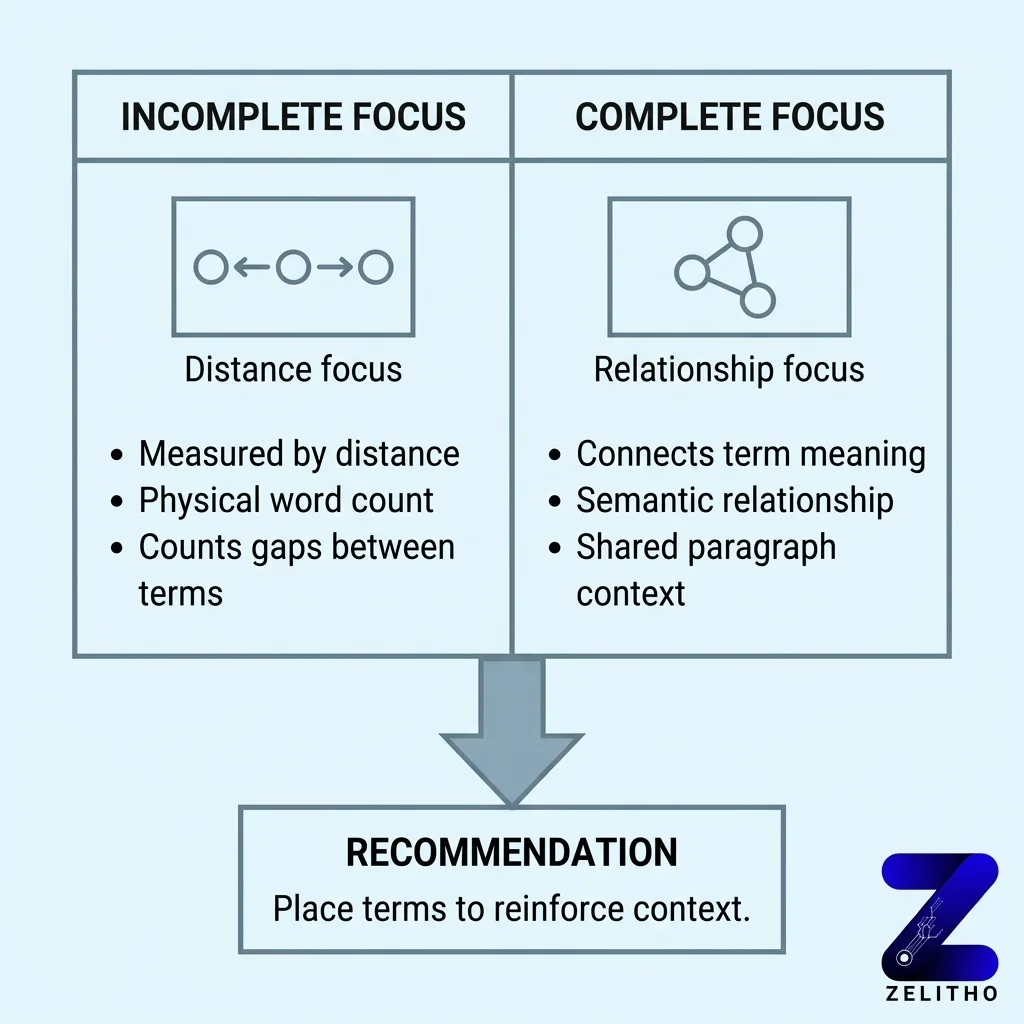
Proximity is a relationship between terms, not a distance measurement. Two terms sitting three words apart mean nothing if they appear in unrelated sentences. Two terms in the same focused paragraph, even twelve words apart, can reinforce each other clearly. What matters is whether the surrounding context connects them.
Search engines do not just scan for word pairs. They read semantic groupings. When your primary term and a related term appear within the same tight context, that grouping signals a specific meaning. When the same two terms appear fifty words apart with unrelated content between them, the grouping breaks. The signal fragments.
The first 100 words of a page carry particular weight in this process. [1] When related terms appear near each other early, before the structure branches into subtopics, the page establishes its core relevance signal quickly. When that early content spreads terms loosely, the page starts already fragmented.
Stop thinking of proximity as a single variable to adjust. Start treating it as a writing discipline that shapes how every paragraph communicates topic focus.
One sting line: a page can include every right term and still tell search engines nothing specific.
The Proximity-First Writing discipline recognizes this. It treats term placement as a structural decision, not a post-draft optimization pass. You make the proximity call when you write the sentence, not when you run a report afterward.
You Are Probably Spacing Your Terms Too Far Apart Without Knowing It
Here is the specific mistake most pages make. Related terms get distributed evenly, one per section, spread across the page to avoid repetition. It feels disciplined. It produces fragmented relevance signals.
Think about what happens when a page covers “email marketing automation” as its primary term. The writer places “automation” in the title, “email sequences” in section two, “campaign triggers” in section four, and “workflow logic” in the conclusion. Each term appears once. None of them appear near each other. The page covers the topic but never clusters its related terms around a single contextual anchor.
That structure produces a page search engines read as broadly related to several things rather than clearly focused on one.
The practical fix is simpler than most writers expect. One primary term per page, anchored in your title and opening paragraph. [2] Then three to five secondary or related terms, placed near that primary term in the sections where they directly support it. [2] Not distributed evenly. Clustered contextually.
We saw this pattern on a product page for a SaaS client. Fourteen related terms were spread across nine sections. No two closely related terms appeared within the same 150-word block. The page ranked on page three for six different queries and converted none of them. We restructured three key sections to cluster the five most relevant supporting terms near the primary term. Within six weeks, the page moved to page one for its primary query and stopped bleeding traffic across irrelevant variations.
The table below shows the contrast directly.
Approach | Term Placement | Relevance Signal |
|---|---|---|
Distributed | One related term per section | Weak, fragmented across multiple signals |
Clustered | 2–3 related terms near primary term | Strong, contextually connected |
Stuffed | Same term repeated unnaturally | Penalized, reads as manipulative |
Clustered does not mean packed. It means placed with structural intent.
Friend advice moment: stop distributing related terms to avoid repetition. Start placing them near your primary term where the context actually supports them.
The Real Cost of Ignoring Proximity: Fragmented Pages That Rank for Nothing Specific
The consequence of poor term placement is not a ranking drop. It is a ranking plateau. The page sits on page two or page three for five different queries, drives modest impressions, and converts almost nothing.
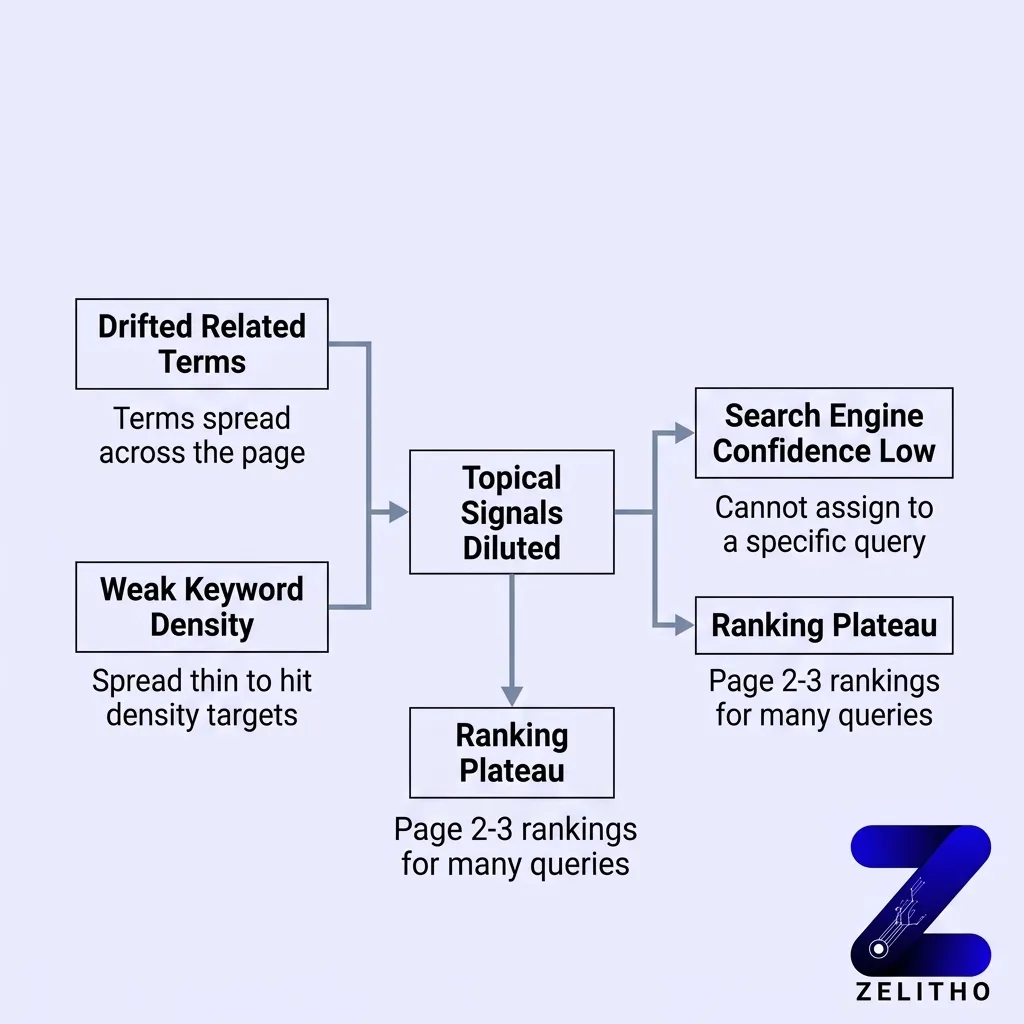
That outcome has a specific cause. When a page’s related terms drift too far from each other, the page produces diluted topical signals. Search engines cannot confidently assign the page to a single, specific query. It gets surfaced as a partial match across multiple queries instead of a clear match for one.
Consider the density math. Five keyword uses in a 500-word page equals 1% density. [1] Ten uses in a 1,000-word page equals the same percentage. [3] Neither number tells you whether those uses are contextually clustered or scattered. A 1% density figure looks identical whether the terms appear in tight, focused paragraphs or spread randomly across unrelated sections.
Density targets are a proxy measure. They track frequency, not placement logic. A page that hits 1% to 2% density with terms scattered evenly can still rank below a shorter, tighter page where the same terms appear in focused proximity.
The topical signal dilution works like this. When a search engine processes your page, it weights contextual groupings. A tight cluster of related terms in one section produces a clear signal for that topic cluster. The same terms scattered across the page produce multiple weak signals, each pointing in a slightly different direction. The page reads as covering a topic rather than owning it.
Pages that own a query rank. Pages that cover a query compete weakly and rarely win.
The opportunity cost here is directional but real. A page that could rank first for one specific query instead ranks seventh for four queries. The traffic difference between position one and position seven on a single commercial query can represent dozens to hundreds of lost visits per month, depending on search volume. Fragmented placement decisions compound across every page on a site.
Where to Place Related Terms Across Core On-Page Elements
The Proximity-First Writing discipline applies to four specific on-page elements. Each one carries a different weight. Each one requires a different placement decision.
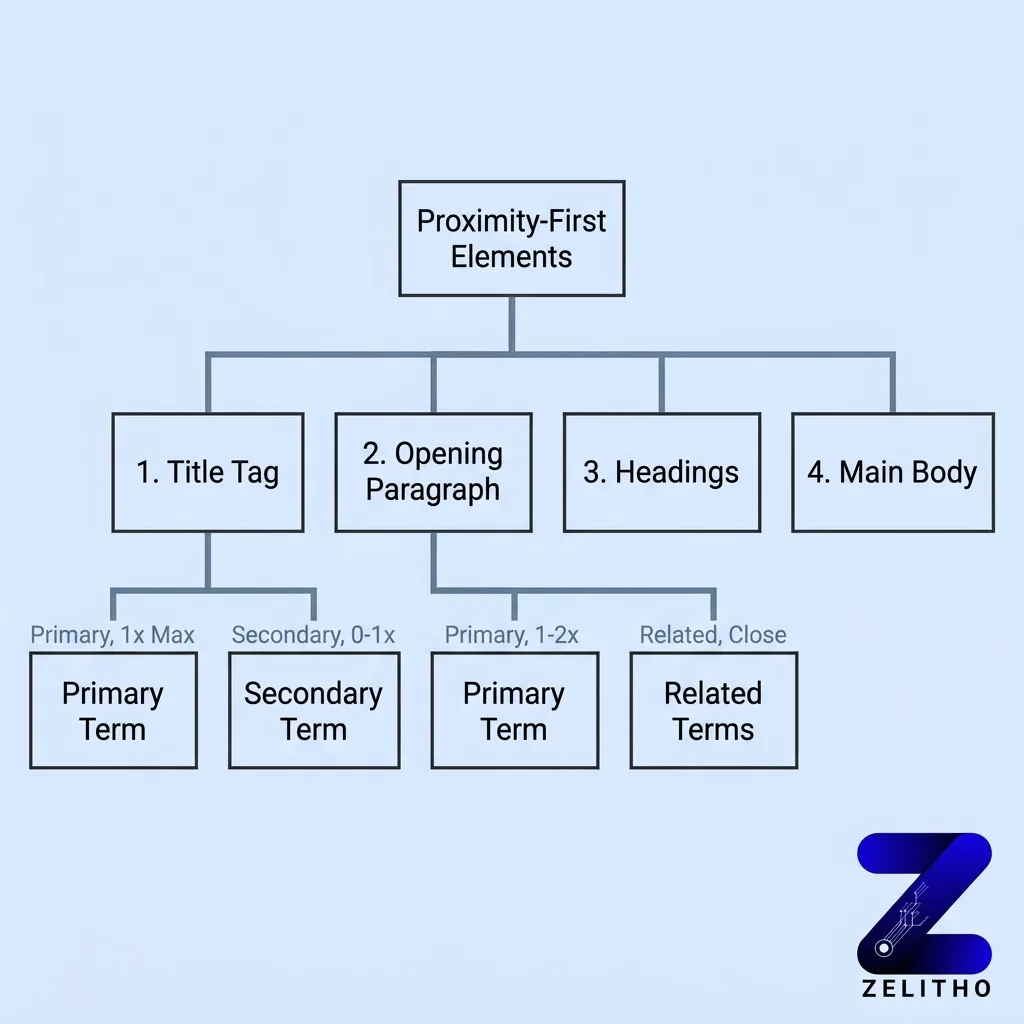
Title tag. Your primary term belongs here. One secondary term can appear if it fits naturally. Do not force two secondary terms into a title. A stuffed title reads as manufactured and loses the clarity that makes a title tag useful.
Opening paragraph. This is where proximity earns the most return. Get your primary term into the first sentence or second sentence. Place one or two closely related secondary terms within the first 100 words. [1] This is not about hitting a checklist. It is about establishing the page’s core context before the structure expands into subtopics.
Subheadings. Subheadings carry semantic weight. They tell search engines how the page is organized. Place a secondary term in a subheading when the section it introduces directly addresses that term. Do not place a term in a subheading just to add variety.
Body copy sections. Each focused section should anchor one or two related terms near the primary concept it addresses. Aim for two to four secondary terms used per focused content block. [2] When a section covers a specific subtopic, the related terms that support that subtopic belong in that section, not distributed across the page.
The table below maps each element to its placement priority.
On-Page Element | Placement Priority | Proximity Action |
|---|---|---|
Title tag | Highest | Primary term plus one secondary if natural |
Opening paragraph | High | Primary term in first two sentences, 1–2 related terms within 100 words |
Subheadings | Medium | Secondary term only when directly relevant to section content |
Body copy blocks | Medium | 2–4 related terms per focused section, near primary concept |
One implementation caveat most proximity guides skip: not every section needs related terms clustered into it. A section covering a tangential supporting point does not need to pull in your core secondary terms. Forcing proximity into every section dilutes the specific sections where it matters. Cluster where the context supports it. Leave the rest alone.
The unexpected insight here is structural. Pages that rank cleanly for a specific query often have one or two sections with very tight term proximity and several sections with almost none. The tight sections do the heavy lifting. The rest of the page supports without competing.
That is the discipline. Place related terms deliberately in the sections that establish and reinforce your primary topic. Let the other sections breathe.
Explore similar topics: What Is Keyword Density? A Simple SEO Definition and How It Is Measured
Keyword proximity is not a number to hit. It is a structural habit. When you keep related terms close in the places that carry the most weight, first paragraph, subheadings, and focused body sections, you write more clearly and signal relevance more directly.
The opposite approach, scattering every term evenly across a page to hit a density target, produces pages that feel optimized but read as hollow.
Use the Proximity-First Writing discipline introduced here: define your primary term, anchor your related terms near it in context, and let the structure carry the signal.
That is what this article rejects about most proximity guidance. It is not a checklist item. It is a writing decision you make every time you place a term on the page.
FAQ
Keyword proximity refers to how close related search terms appear to each other within a page’s content. When terms sit near each other in context, search engines read them as semantically connected. The closer and more contextually aligned the terms, the stronger the relevance signal the page produces for that topic.
The four types of keywords are informational, navigational, transactional, and commercial investigation. Informational keywords signal a user seeking to learn something. Navigational keywords indicate a user looking for a specific site or brand. Transactional keywords signal purchase intent. Commercial investigation keywords sit between research and purchase, where users compare options before deciding.
A clear proximity example: if your primary term is “project management software” and your related term is “task automation,” placing both in the same opening paragraph signals their connection directly. If “task automation” appears only in section four, with unrelated content between, the contextual link weakens and the page loses the relevance signal that tight placement would have produced.
The 3 3 3 rule in marketing is a content framework suggesting you capture attention in three seconds, deliver your core message in three sentences, and include a clear call to action within three paragraphs. It is primarily a copywriting heuristic rather than an SEO standard, but its emphasis on front-loaded clarity aligns with proximity best practices that weight the first 100 words heavily.
References and Citations
[1]https://mohitsseotraining.com/blog/seo/keyword-proximity-in-seo/
[2]https://sitechecker.pro/what-is-keyword-proximity/
[3]https://www.conductor.com/academy/glossary/keyword-proximity/