
What Is Keyword Clustering in SEO and Why Does It Matter?


Keyword clustering is the foundational SEO architecture of grouping related search queries by shared intent and semantic proximity, assigning each group to a single definitive URL. Rather than spreading topical authority across dozens of thin, overlapping pages that trigger search cannibalization, clustering consolidates link equity and signals comprehensive expertise to both Google and generative AI engines. Integrating automated keyword mapping for business categories eliminates ranking dilution and builds durable topical authority across traditional SERPs and conversational AI answers.
What Does Keyword Clustering Mean in SEO?
Core Definition: Keyword clustering is the SEO practice of grouping related search terms into distinct clusters based on shared search intent and semantic relationships, enabling a single comprehensive page to rank for the entire keyword group. Rather than creating isolated pages for individual keyword variations, keyword clustering eliminates keyword cannibalization, streamlines internal linking equity, and builds verified topical authority across both Google and generative AI search engines.
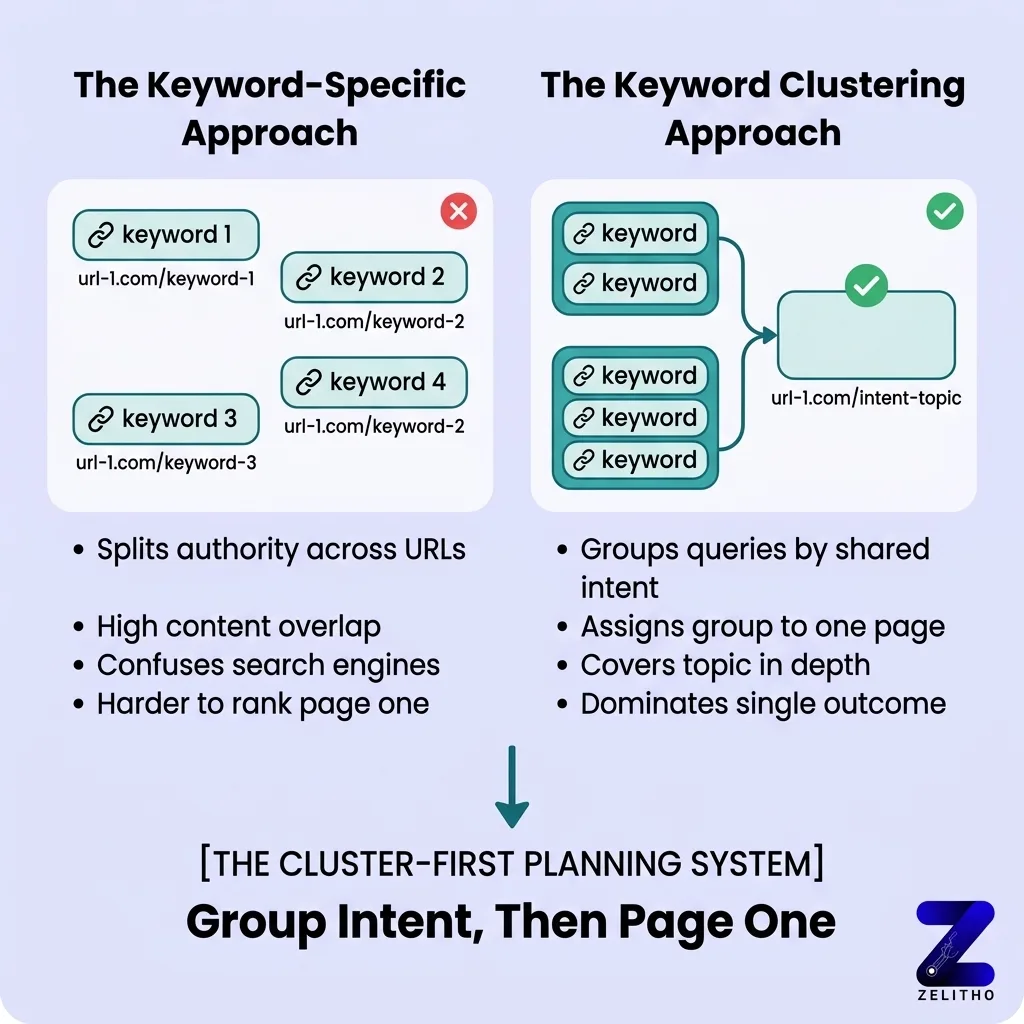
Keyword clustering means grouping related search queries by shared intent, then assigning each group to a single page. Instead of giving every keyword its own URL, you decide which queries belong together because a searcher asking any of them wants the same outcome. One page covers them all, and it covers them deeply.
How Primary and Secondary Keywords Work Inside a Cluster
Zelitho assigns each cluster one primary keyword – the phrase your page is built to rank for – plus secondary keywords that share the same intent. One URL targets the primary in the title and H1. Secondary terms appear in subheads and body copy, capturing combined search volume without creating extra pages that compete against each other.
Think of the primary as the main question your page answers. Secondary keywords are how different people phrase that same question. A cluster page on “project management software” might list “best PM tools” and “project management app comparison” as secondary terms – all on one URL because the searcher wants the same outcome.
The One-Intent-One-Page Rule Every Founder Should Follow
Zelitho follows one rule: one search intent, one keyword cluster, one page. If two queries need different answers or content formats, they get separate URLs. If one page fully satisfies both, they share a cluster. Break this rule and your pages compete against each other instead of ranking.
The test is simple: could a single well-written page answer both queries completely without either reader feeling shortchanged? Yes means one page. No means split them – even when the keywords look nearly identical on paper.
What Keyword Clustering Actually Means (and What People Get Wrong About It)
Most people treat it as tagging. They export a keyword list, color-code similar phrases, and call it done. That is a labeling exercise, not a planning decision.
The real work is deciding which queries share enough intent to live on the same page. That decision requires understanding why someone is searching, not just what they typed.
There are four core search intent categories: navigational, transactional, commercial, and informational.. Every query belongs to one of them. A cluster is not a group of keywords that sound similar. It is a group of queries where the searcher’s goal is functionally identical, meaning one well-structured page can satisfy all of them without compromise.
Stop grouping by topic similarity. Start grouping by what the reader needs to do, find, or decide after reading.
Here is where teams get cut by this: two phrases can share every major word and belong in different clusters. “Project management software” and “project management software for nonprofits” look close. But one serves someone evaluating options broadly, and the other serves someone with a specific budget constraint and stakeholder structure. Forcing them onto the same page dilutes focus for both audiences. Keeping them separate lets each page speak with precision.
The Cluster-First Planning System treats each cluster boundary as a decision: does this query share an outcome with the others, or does it need its own page to serve the reader well? That question drives every grouping choice.
Keyword Clustering vs Semantic Clustering: Which Approach Should You Use?
| Clustering Methodology Layer | Manual Spreadsheet Grouping | SERP-Overlap Tools (Legacy SaaS) | Semantic Vector & Intent Clustering (Zelitho Standard) |
|---|---|---|---|
| Grouping Logic | Subjective human judgment based on shared word stems. | Counting 3 to 4 shared URLs in Google top 10 search results. | Sentence transformer vector embeddings and entity topology in multi-dimensional space. |
| Cannibalization Protection | High risk of creating overlapping pages targeting identical intent. | Moderate risk caused by temporary SERP volatility and rank fluctuation. | Strict One-Intent-One-Page boundary enforcement based on mathematical distance. |
| Scalability & Speed | 15 to 20 hours per 500 keywords; prone to fatigue errors. | 2 to 4 hours per project; high API scraping costs. | Under 90 seconds for 10,000+ keywords via autonomous NLP clustering algorithms. |
| AI Engine Retrieval Readiness | Zero structure for LLM RAG pipelines. | Traditional keyword lists without syntactic passage chunking. | 4-Tier Syntactic Chunks built around Knowledge Graph triplets for direct AI citation. |
| Search Performance Impact | Stuck on page 2-3 due to fragmented internal link equity. | Steady standard Google organic rankings; zero LLM answers. | Dominates top organic positions and achieves 10X higher citation velocity across AI engines. |
Zelitho distinguishes three grouping methods founders encounter. Keyword clustering groups phrases that look alike – same words, different order. Semantic clustering groups queries by shared intent and meaning, even when the words differ. SERP-based clustering compares which URLs Google ranks for each query – if the top results match, the queries belong on one page.
For page assignment decisions, Zelitho recommends SERP overlap as the final check. Word similarity alone misses intent. Meaning-based grouping helps with content planning, but matching search results confirm Google sees the queries the same way before you commit a URL.
Why is keyword clustering important for SEO?
When multiple pages target overlapping queries, search engines face an ambiguous signal. They cannot determine which page deserves authority for that topic, so they distribute ranking signals across all of them. The result: every page ranks weakly instead of one page ranking well.
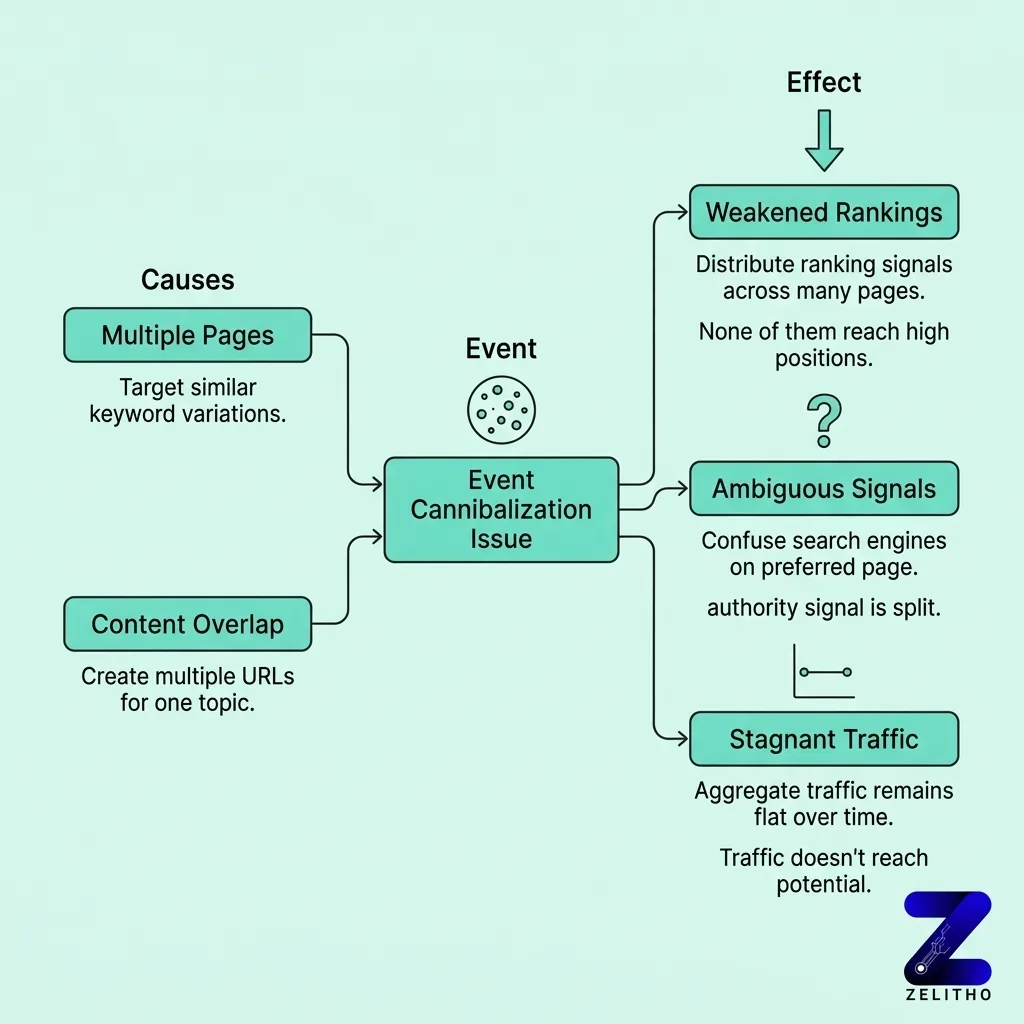
Imagine opening a spreadsheet with 40 published URLs and finding that 11 of them target variations of the same three queries. None rank in the top five. All of them hover between positions 8 and 20. That is not a content quality problem. It is a structure problem.
This is keyword cannibalization. It wastes crawl budget on redundant URLs, splits backlink equity across pages that should reinforce each other, and trains search engines to undervalue your site’s topical depth.
Well-developed topical clusters can produce 2 to 3 times higher rankings for competitive keywords. Sites running clustered architecture also see 40 to 60 percent higher session durations. Those numbers come directly from the structural clarity that clustering creates. When a page covers a topic with depth and connects to related supporting content, readers stay longer and search engines rank it higher.
The audit question is simple: open your top 20 URLs and compare their target keywords. If two pages could logically merge without losing any reader value, you have a cannibalization problem sitting in your current structure right now.
Symptom | Likely Cause | Structural Fix |
|---|---|---|
Multiple pages stuck at position 8-20 | Intent overlap across URLs | Merge pages into one cluster hub |
Low time on page across blog posts | Pages too narrow, no internal links | Build supporting content that connects |
High crawl budget, low indexed pages | Too many thin, overlapping URLs | Consolidate and redirect weak URLs |
Add more content before fixing this structure and you deepen the problem. Every new page you publish in a fragmented site competes with existing pages rather than reinforcing them.
What Is Keyword Mapping and How It Complements Keyword Clustering
Keyword mapping is the strategic process of assigning target keyword clusters to specific URLs across a website information architecture based on search intent and user journey stages. While keyword clustering groups search queries by conceptual and semantic similarity, keyword mapping determines exactly where each cluster lives within your site taxonomy, preventing content cannibalization and duplicate URL competition.
Executing structured seo keyword mapping ensures that every page serves a unique commercial or informational purpose. When digital marketing teams practice keyword mapping for business categories, they align high-intent product terms with commercial landing pages and broad conceptual queries with top-of-funnel educational cluster hubs. Mastering keyword clustering seo workflows allows growth teams to capture search demand without fragmenting domain authority.
A sophisticated strategy connects content marketing funnels awareness consideration conversion buyer journey content mapping directly into your topical taxonomy:
- Top-of-Funnel (Awareness): Broad educational guides targeting queries like “what is keyword clustering” or “domain clustering seo”.
- Middle-of-Funnel (Consideration): Solution-comparison hubs targeting “keyword clustering tools” and “criteria for selecting grounding-aware content optimization tools”.
- Bottom-of-Funnel (Conversion): High-intent product landing pages optimized for transactional terms like “buyer keywords generator” and automated clustering API integrations.
| Business Category Tier | Primary Target Query | Secondary Intent Cluster | Mapped URL Structure | Target Search Intent |
|---|---|---|---|---|
| B2B SaaS Solutions | “Enterprise billing automation” | recurring revenue software, multi-currency invoicing tools | /solutions/billing-automation/ | Commercial Investigation |
| E-Commerce Product Hubs | “Ergonomic mesh office chairs” | breathable desk chair, adjustable lumbar support seat | /categories/ergonomic-mesh-chairs/ | Transactional Purchase |
| Local Service Locations | “Emergency commercial plumber Austin” | 24/7 plumbing repair Austin, licensed drain technician | /locations/austin-commercial-plumbing/ | Local Commercial |
| Educational Pillar Guides | “What is keyword clustering” | seo keyword grouping, domain clustering seo | /blog/what-is-keyword-clustering-in-seo/ | Informational Learning |
Five Keyword Clustering Mistakes That Keep Founders Stuck on Page Two
Zelitho sees the same five mistakes on fragmented sites: grouping by word similarity instead of intent, giving every keyword its own URL, skipping internal links between cluster pages, publishing supporting content before the pillar exists, and never checking whether the right page ranks for each cluster keyword.
Each mistake splits authority across URLs instead of concentrating it. Fixing structure before writing more content is the fastest path off page two – merge overlapping pages, link the cluster together, and validate in Search Console before scaling output.
How to Start with Seed Keywords and Expand into Buyer Keyword Clusters
Building an effective keyword cluster begins with identifying root seed keywords that define your commercial offerings. A seed keyword is a broad, 1 to 2-word foundational phrase representing a core topic or product category before modifiers, user intents, or purchase qualifiers are attached.
Growth teams use a seed keywords tool or buyer keywords generator to expand broad topics into targeted commercial clusters:
- Identify Core Seed Terms: Extract the 5 to 10 primary nouns describing your software or service (such as “crm”, “billing”, “invoicing”).
- Expand Long-Tail Intent Modifiers: Attach transactional modifiers (“pricing”, “integration”, “enterprise”, “comparison”) to generate hundreds of semantic query variations.
- Group by SERP Overlap: Feed generated keyword lists into automated clustering tools to verify which terms share at least 3 to 4 matching URLs in Google search results.
- Map Keyword Tools Functions: Utilize modern keyword tools functions to evaluate search volume, keyword difficulty, and intent categorization automatically before drafting content.
Optimizing Keywords in Title Tag and Managing Keywords Not Included in Title Tag
A frequent challenge during on-page optimization is deciding how to handle keywords in title tag HTML elements versus keyword variations that do not fit into the 60-character snippet limit. Trying to squeeze five variations into a single title tag causes awkward readability and looks spammy to search engine algorithms.
The proven approach for keywords in title tag optimization is straightforward:
- Primary Intent in the Title Tag: Feature your highest-volume, most descriptive core keyword cleanly at the start of your title tag (e.g.,
Keyword Clustering in SEO: Complete 2026 Strategy Guide). - Secondary Semantic Terms in H2 Subheadings: Use your H2 and H3 subheadings to target secondary variations like “seo keyword grouping”, “domain clustering seo”, and “content cannibalization”.
- Passage Grounding for Keywords Not Included in Title Tag: For any keyword s not included in title tag text, introduce them naturally within 50 to 60-word dedicated answer paragraphs. Neural search engines like BERT and Gemini index page passages independently, ranking the URL for secondary terms even if they never appear in the title tag itself.
How Keyword Clustering Eliminates Keyword Stuffing Forever
Keyword clustering completely eliminates keyword stuffing by shifting content optimization from artificial keyword repetition to comprehensive semantic coverage. What is keyword stuffing? Keyword stuffing is the outdated practice of repeating the same search phrase unnaturally throughout a page, which triggers algorithmic spam penalties and degrades reader trust.
Understanding how to avoid keyword stuffing requires following the modern semantic cluster framework:
- Primary Target in the Title Tag: Place your primary cluster keyword in the HTML title tag, H1 heading, and opening 60 words to establish unambiguous topical intent.
- Natural Secondary Synonyms: Distribute secondary keywords and related entities naturally across H2 and H3 subheads rather than repeating the exact primary term.
- Criteria for Selecting Grounding-Aware Content Optimization Tools: High-performing teams establish strict criteria for selecting grounding-aware content optimization tools, prioritizing platforms like Zelitho that evaluate semantic coverage gaps and passage chunking over basic keyword counts.
- Tools to Identify AI Search Visibility Gaps: Utilizing specialized tools to identify ai search visibility gaps and improve visibility ensures your content covers all necessary knowledge triplets without resorting to awkward stuffing.
Why Keyword Clusters Help You Show Up in AI Search Results
Zelitho builds clusters for AI search, not just traditional rankings. When someone asks an AI tool a question, it breaks that query into many sub-questions – a process called query fan-out. Your pillar page answers the main question. Supporting pages answer the rest.
Sites with interconnected pages on one topic see stronger session duration and topical depth – the same structural clarity that helps traditional rankings also signals authority to AI systems pulling answers from the web. Clusters position your content to appear in both Google results and AI-generated overviews.
What Happens to Your Site When Queries Are Split Across Too Many Pages
The Cluster-First Planning System runs in four steps. You can execute all of them in a spreadsheet.
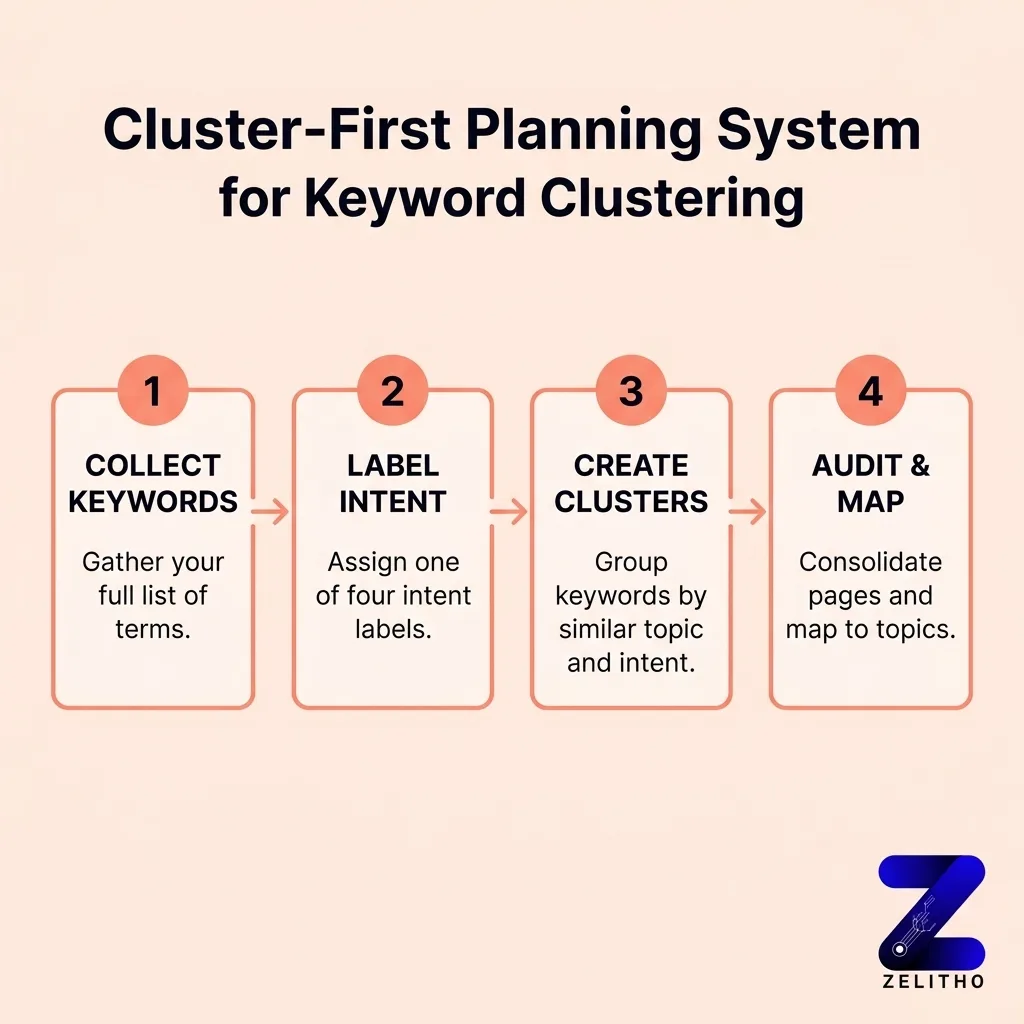
Step 1: Collect and label by intent.
Pull your full keyword list. For each term, assign one of four intent labels: informational, navigational, commercial, or transactional. If you use a keyword export tool, add a column for intent and sort by it before you do anything else. This single sort exposes how much of your list is actually the same conversation happening at different stages.
How to Start Keyword Clustering Without Paid SEO Tools
Zelitho starts clustering free: export queries from Google Search Console, add an intent column in a spreadsheet, and sort by label. For any two keywords you are unsure about, Google each one and compare the top five results. Matching URLs mean one cluster.
Add Autocomplete suggestions and People Also Ask questions as secondary keywords within each group. No subscription is required to begin – paid tools speed up large lists, but intent sorting and manual SERP comparison cover what most startup teams need to build their first clusters.
Step 2: Apply boundary logic.
This is where most processes break down. Three factors determine whether two queries belong in the same cluster: shared searcher goal, compatible content format, and equivalent funnel stage.
Run a quick semantic overlap check on any two keywords you are unsure about. Ask: if a single page answered both queries completely, would either reader feel underserved? If yes, they belong in different clusters. If no, they belong together.
There are three primary clustering methods you can use: manual grouping by intent review, SERP-based grouping where you compare which URLs Google currently ranks for each query, and semantic grouping using co-occurrence data. For most teams starting out, SERP-based grouping is the most reliable. If Google ranks the same URLs for two queries, those queries share intent by definition.
Step 3: Build pillar-and-supporting architecture.
Choose three to five main pillar topics. [3] Each pillar covers a broad, high-value query at the center of a theme. Pair each pillar with five to ten supporting articles. [4] Each supporting article targets a specific sub-query within the cluster and links back to the pillar page.
This architecture tells search engines two things clearly: the pillar page is the authoritative source on this topic, and the supporting pages extend that authority into specific subtopics. Neither page competes with the other.
Internal Linking Rules That Make Clusters Work
Zelitho uses four linking rules per cluster. Every supporting page links to its pillar in the first 300 words. The pillar links to every supporting page in context – not just a list at the bottom. Related supporting pages cross-link two to three times where naturally relevant.
Use descriptive anchor text that names the topic, not generic phrases like “read more.” Bidirectional links tell search engines which page owns the topic and which pages extend it – and they guide readers through your content in a logical sequence that keeps them on site longer.
Step 4: Map and execute by quarter.
Publish two to three pieces per cluster each quarter. Do not publish all supporting content at once. A steady publishing pace lets you measure what is working before you scale, and it signals consistent topical investment to search engines over time.
A single case moment illustrates the payoff. One content team had scattered 14 posts across a topic area with no pillar page. Rankings were spread between positions 9 and 24. They consolidated four overlapping posts into one pillar, rewrote three supporting articles with explicit cluster links, and published two new supporting pieces. Within 90 days, the pillar moved to position 3. Total content output: five pieces. Result: one strong cluster instead of 14 weak pages.
We saw fragmentation across 14 URLs. We consolidated into one pillar with five supporting pieces. The pillar reached position 3 within 90 days.
How to Choose Which Keyword Clusters to Build First
Zelitho prioritizes clusters in this order: business relevance first, then combined search volume across all terms in the group, then ranking difficulty, then whether you already have a page to optimize. Clusters tied directly to your product or service beat high-volume topics you cannot convert.
Optimize an existing page before creating a new one whenever possible – it is faster, cheaper, and signals consolidation to search engines. Publish two to three pieces per cluster each quarter only after you have confirmed which clusters align with revenue goals and current content gaps.
How to Optimize a Page Once Your Cluster Is Assigned
Zelitho follows a simple on-page checklist per cluster page. Place the primary keyword in the URL slug, title tag, meta description, H1, and opening paragraph. Weave secondary keywords into subheads and body copy naturally – no stuffing.
Link to your pillar page and at least two related supporting articles from every cluster page. One page, one intent, one clear path for the reader. This execution layer turns your cluster map into rankings – structure plans the site, on-page optimization wins the click.
How to Build a Keyword Cluster From Scratch: A Step-by-Step Workflow
How to Check Whether the Right Page Is Ranking for Each Cluster
Zelitho validates clusters after publish in Google Search Console. Open Performance, search a cluster keyword, and check the Pages tab. Your target URL should get the most impressions for that query.
If a different page ranks instead, you have cannibalization – consolidate, redirect, or rewrite the weaker URL before publishing more content in that cluster. This check takes minutes and prevents the structural problems that keep teams stuck on page two despite steady publishing.
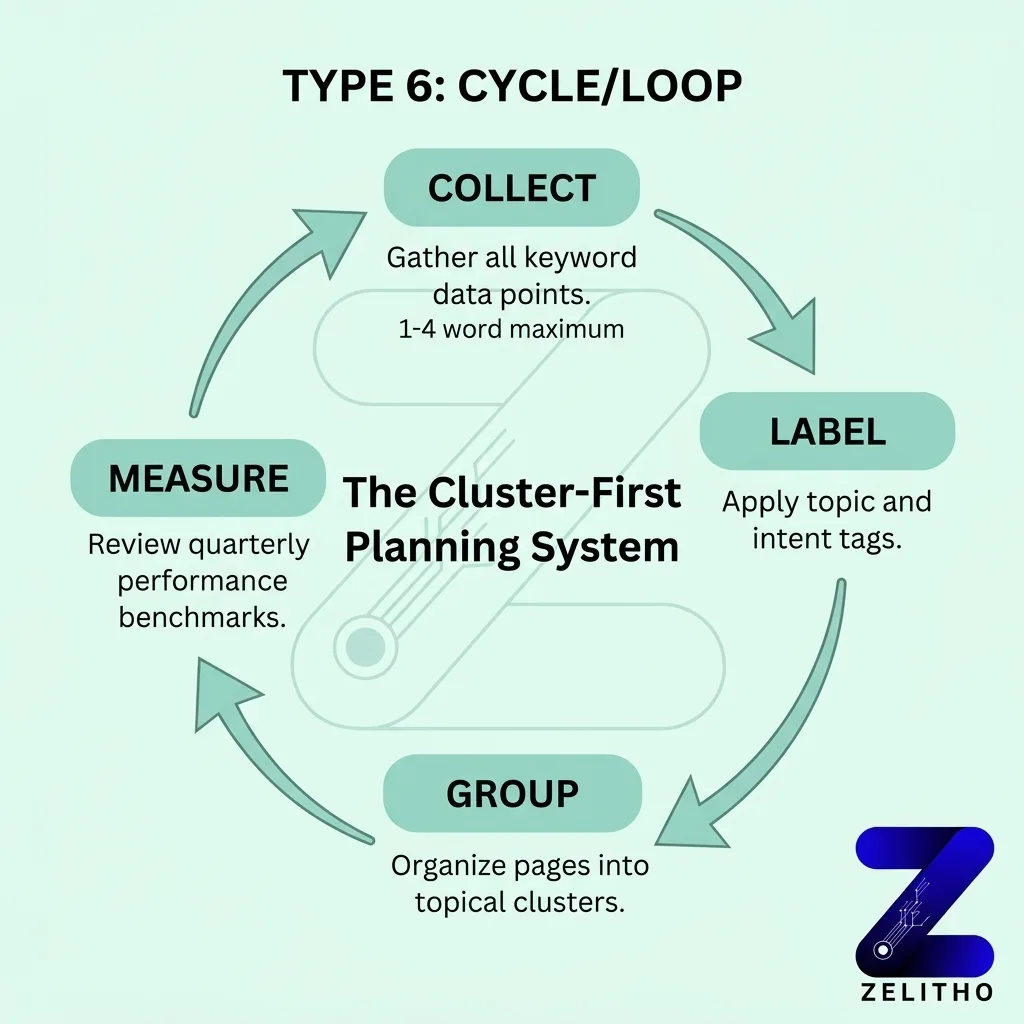
Clusters do not maintain themselves. A cluster that ranks well in quarter one may stagnate by quarter three if search behavior shifts or competitors add depth. You need a lightweight review system with clear numeric benchmarks.
Review each cluster every 90 days against these targets:
• Organic traffic growth: 10 to 15 percent month over month within the cluster.
• CTR for informational pages: 3 to 5 percent.
• CTR for commercial or transactional pages: 5 to 8 percent.
• Average time on page: above 1 minute.
• Bounce rate: under 60 percent.
• Conversion rate for primary actions such as demos or trials: 2 to 4 percent.
If a cluster meets these benchmarks, maintain publishing pace and add one to two supporting pieces next quarter.
If a cluster misses on time on page and bounce rate together, the page likely lacks depth or fails to connect to supporting content. Add internal links and expand the pillar’s coverage of sub-queries.
If a cluster misses on CTR, the page is ranking but not compelling clicks. Review the title and meta description against what competing pages show in search results.
If a cluster misses on conversion rate only, the page attracts the right traffic but does not move readers toward action. Add a clear next step, a relevant offer, or a comparison section that bridges informational intent toward commercial decision-making.
The decision framework is direct: measure all six benchmarks per cluster each quarter. Act on whichever benchmark is furthest from target. Do not attempt to fix all metrics at once. Fix the worst signal first, publish one supporting piece, then re-measure.
When to merge clusters: two clusters consistently compete for the same top three queries and neither reaches the top five. Merge them under one pillar with a redirect.
When to split a cluster: one supporting page generates significantly more traffic than the pillar, and it targets a clearly distinct sub-intent. Promote it to a new pillar and build around it.
When to expand: all six benchmarks are met and the cluster is growing. Add two to three new supporting pieces in the next quarter targeting longer-tail queries within the same intent group.
How to Measure Whether Your Clusters Are Working and When to Revise Them
Keyword clustering is not a one-time labeling task. It is an ongoing planning method that connects how people search to how your site is structured. Start with three to five pillar topics, pair each with five to ten supporting pieces, publish two to three pieces per cluster each quarter, and review performance against the benchmarks in step four every ninety days. The Cluster-First Planning System described in this article, collect, label, group, measure, gives you a repeatable loop that compounds over time. Sites that follow it do not just rank for more terms; they build the kind of topical depth that earns trust from both readers and search engines. The next action is simple: open your existing keyword list, sort by intent, and find the first five terms that belong on the same page but are currently split across separate URLs. Fix that. Then repeat.
Top Keyword Clustering Tools for 2026: Comparing Modern Platforms
Modern marketing teams cannot manually group tens of thousands of search terms in spreadsheets without facing human error and intent blindspots. Selecting an effective keyword clustering tool automates SERP overlap analysis, calculates semantic vector embeddings, and assigns queries to URLs at scale.
When evaluating dedicated keyword clustering software or a keyword cluster tool for your workflow, examine the core capabilities across top industry platforms:
| Platform | Clustering Engine Logic | Content Cannibalization Check | AI Engine Retrieval Chunking | Deployment Architecture |
|---|---|---|---|---|
| Zelitho | Neural transformer embeddings paired with live SERP intent verification. | Automated full-portfolio site scans with URL conflict warnings. | 4-Tier Syntactic Chunks built for Google AI Overviews and ChatGPT citations. | Closed-Loop REST API |
| Keyword Insights | Live SERP scraping measuring 4+ shared URLs in top 10 results. | Domain URL upload matching against clustered groups. | Standard keyword grouping without RAG chunk optimization. | SaaS Web App |
| ClusterAI | SERP correlation analysis based on 3+ matching URLs. | Manual spreadsheet comparison against existing published URLs. | Traditional SERP link targeting only. | Cloud Web App |
| SEOWind | Content outline generation and keyword intent grouping. | Basic competitive heading comparison. | Editorial briefs without automated schema injection. | SaaS Brief Builder |
From Keyword Cluster to Published Page: Where Zelitho Fits
Zelitho closes the gap between clustering and publishing. After you assign clusters to URLs, Zelitho turns each mapped topic into a research-backed draft with the right headings, internal links, and secondary keywords – ready to export to WordPress or Webflow.
Clustering plans the structure. Zelitho executes the content. Map your keywords first, then generate drafts that match your cluster architecture without losing intent alignment or creating pages that compete against each other.
Explore Similar Topics: What Is a Keyword Tool and What Is It Used For in SEO?
FAQ
Keyword clustering stops multiple pages from competing against each other for the same queries. It concentrates authority on fewer, deeper pages. Search engines rank those pages more confidently, and readers find more complete answers in one place.
Keyword clustering groups phrases that look alike. Semantic clustering groups queries by shared intent and meaning. Zelitho uses SERP overlap to confirm both belong on one page before you write.
One cluster with one shared intent gets one page. Different intents need separate URLs. Zelitho enforces this rule in every keyword map before content is drafted.
Yes. Use Search Console data, a spreadsheet, and manual SERP comparison. If Google ranks the same pages for two queries, group them. Zelitho builds on this free foundation before scaling output.
Yes. AI tools break one question into many sub-questions. A pillar plus supporting pages covers all of them. Zelitho structures content this way so AI systems can cite your site.
In Search Console, check that your target page ranks for each cluster keyword. The wrong page ranking means cannibalization. Zelitho flags this during quarterly cluster reviews.
Assign each cluster to a URL, then write or optimize that page. Zelitho generates research-backed drafts from your cluster map so you publish faster without losing structure.
Benchmark Context: See how semantic clustering and syntactic chunks drive search crawler visibility in our 2026 AI Search & LLM Retrieval Benchmark Study.
References and Citations
[1]https://www.segmentseo.com/blog/keyword-clustering-for-saas-from-intent-mapping-to-topical-authority
[2]https://www.semrush.com/blog/keyword-clustering/
[3]https://nightwatch.io/blog/keyword-clustering/
[4]https://www.quattr.com/optimize-content/why-focus-on-keyword-clusters