
What Is Keyword Mapping and Why It Matters for SEO


Keyword mapping is the systematic process of assigning target search queries to specific URLs based on search intent, semantic relationships, and content hierarchy. By establishing distinct seed keywords, organizing pages into logical topic clusters, and aligning primary and secondary keywords with user needs, keyword mapping prevents keyword cannibalization, optimizes internal linking architecture, and ensures both Google and generative AI engines cite your content as the authoritative source for each topic.
TL;DR
You published 40 blog posts. Rankings are flat. Two pages are targeting the same keyword and splitting whatever authority they had. Neither ranks on page one.
Most teams treat keyword mapping as a labeling task, something done after content is written or skipped entirely. That approach leaves page structure to chance. When two pages compete for the same term, Google picks one arbitrarily, and often picks wrong.
The One Page One Topic Framework solves this at the architecture level. Assign one focus keyword per page, match it to a specific search intent, define the metadata, and check for conflicts before publishing. Senior marketers at funded companies, founders scaling content programs, and agency owners managing client sites all benefit from this system. It prevents months of cleanup by making one structural decision per page before writing begins.
What Is Keyword Mapping in SEO?
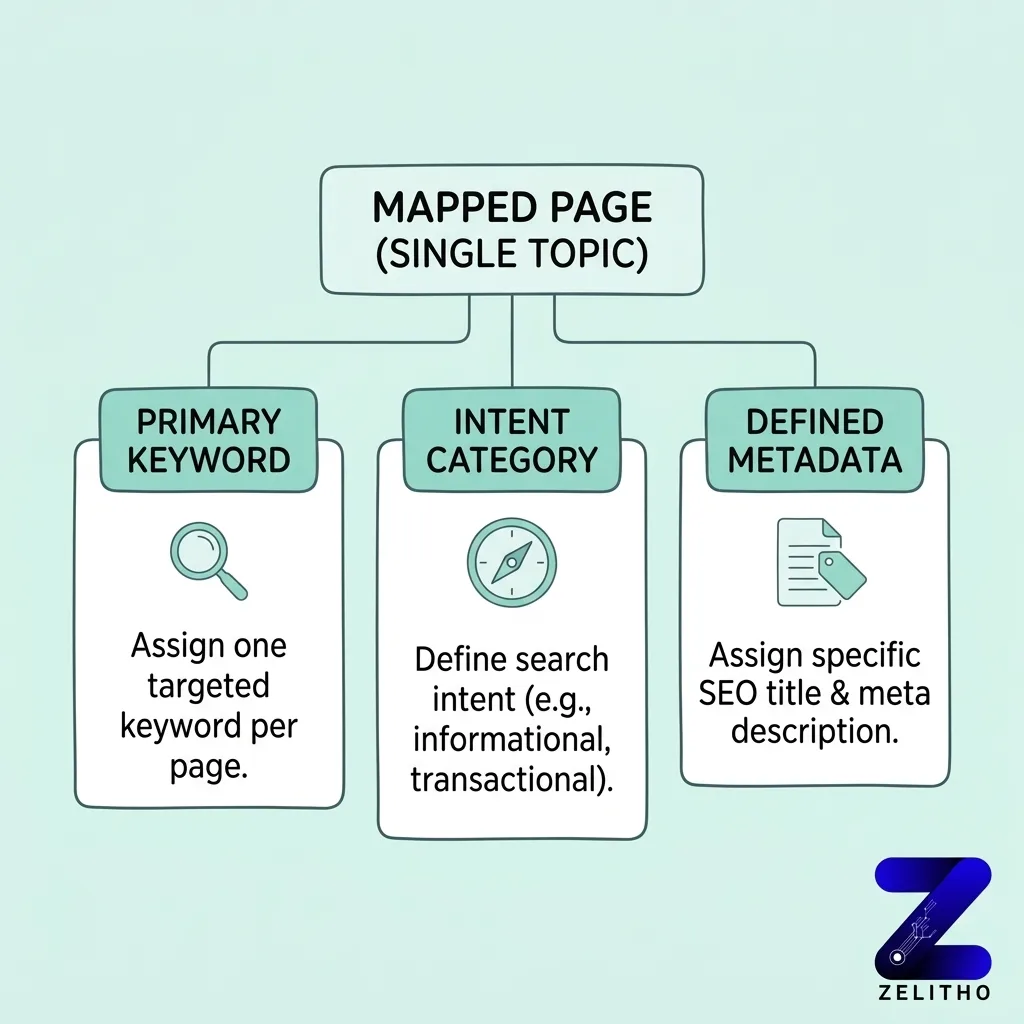
Keyword mapping is the process of assigning specific keywords to specific pages on your site. Each page receives one primary keyword, one intent category, and defined metadata. The assignment happens before content is written, not after. This gives search engines a clear signal about what each page covers and prevents two pages from targeting the same term.
Keyword URL Map vs. URL Mapping: Not the Same Thing
A keyword URL map assigns search terms to specific pages before you publish, so every URL has one clear ranking target. That is what this guide covers.
URL mapping in a site migration is different: it means redirecting old URLs to new ones to preserve traffic during a redesign. Zelitho helps with the first-deciding what each page should rank for before content goes live.
Why Keyword Mapping Matters for Your Business
Zelitho treats keyword mapping as a business planning tool, not a spreadsheet chore. Assign one keyword per page before you write, and you:
- Stop pages from competing for the same search term
- Spot content gaps before committing writing budget
- Align each page type to the right search intent
- Track which URLs actually drive traffic
- Spend less time fixing rankings after the fact
Founders who map first grow organic traffic predictably. Those who skip it publish more and rank less.
What Keyword Mapping Actually Does (And What Most Guides Get Wrong)
Most guides describe keyword mapping as organizing keywords into a spreadsheet. That framing is wrong.
A keyword map is a structural decision document. It determines which pages can rank and which cannot, before a single word is written.
Here is the false assumption worth naming early: cannibalization is a writing problem. It is not. Two pages can be written perfectly well and still destroy each other’s rankings because they were never assigned distinct topics in the first place.
The governing rule is this: one page equals one topic equals one focus keyword. That rule is architectural, not editorial.
When a site violates it, search engines face an ambiguous signal. Two pages appear to cover the same subject. Google must choose one to surface, and that choice is not always the page you intended to rank. The other page gets suppressed. Both lose traffic they would have captured separately.
Stop thinking of this process as a research deliverable. Start treating it as the document that decides your site’s ranking architecture.
The practical implication is direct. A keyword map does not organize keywords. It assigns ranking rights to specific URLs. Every page on your site either has a defined assignment or it is competing blindly.
Mapping also includes assigning both primary and secondary keywords to each page [3]. Secondary keywords cover related subtopics and semantic variations. They do not compete with the primary keyword. They reinforce the page’s topical scope and help it rank for a cluster of related queries rather than a single phrase.
Sites that skip this step tend to see one predictable outcome: content volume increases, but rankings plateau. More pages create more internal competition. The map is the mechanism that prevents that loop.
How Topic Clusters Fit Into Your Keyword Map
A keyword map works best when organized into topic clusters: one pillar page covers a broad theme, and supporting pages cover related subtopics-all linked together.
Each cluster page still gets one primary keyword. The One Page One Topic rule applies across the cluster. The pillar holds the umbrella term; cluster pages hold specific long-tail queries that feed authority back to the hub.
Link cluster pages up to their pillar page, and link the pillar down to each subtopic. Search engines read those connections as topical depth-not scattered one-off posts competing for the same audience.
How to Build a Keyword Map Step by Step: From Seed Keywords to Page Assignments
The workflow has five stages. Each stage produces a concrete output that feeds the next.
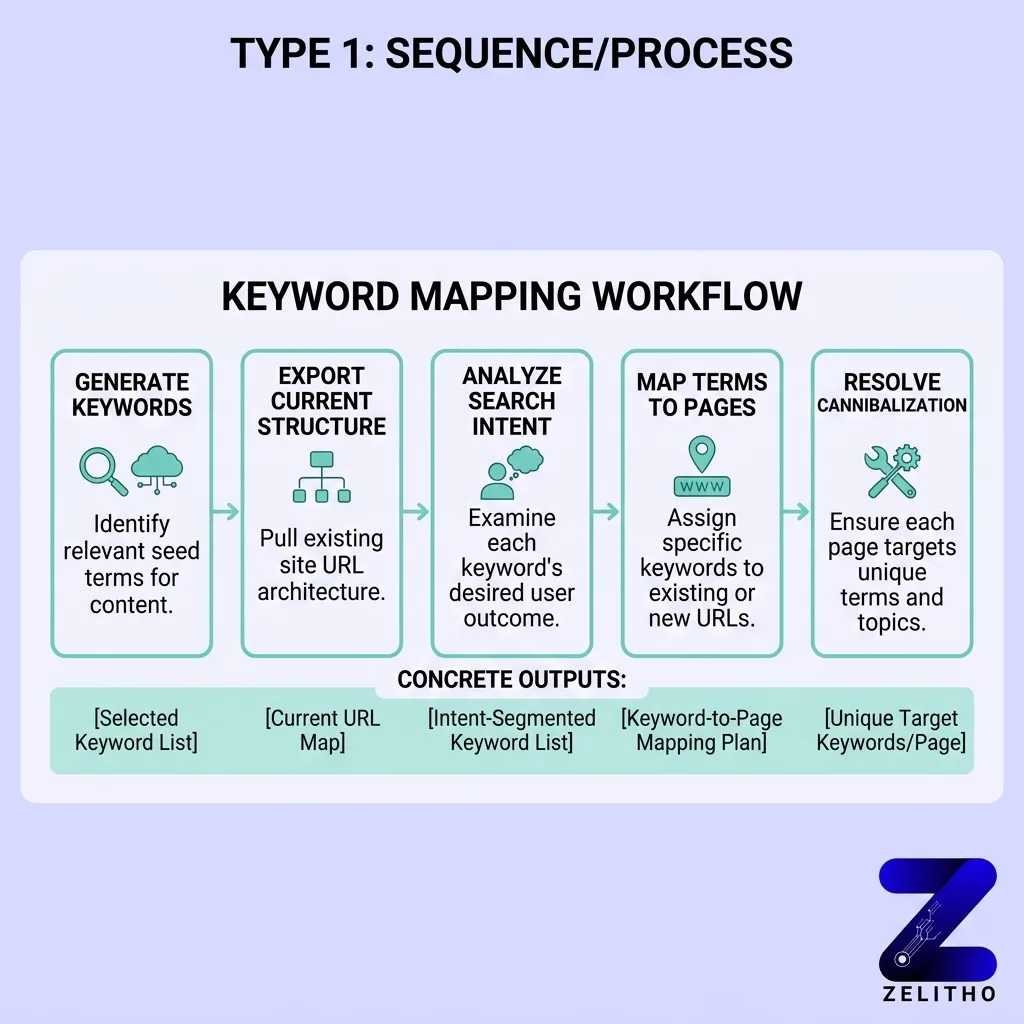
Stage 1: Generate the keyword list.
Start with seed keywords relevant to your product, service, or content category. A single seed term can generate hundreds or thousands of keyword suggestions through research tools. Export that list. You are not using all of them. You are selecting candidates that match pages you have or intend to build.
Start with keywords you already rank for. Export queries from Google Search Console before researching new terms. These show what Google already associates with your pages. Match each live URL to its strongest GSC query first-that is your fastest mapping win.
Find gaps using competitor keywords. Enter a competitor domain in Ahrefs or Semrush to see which keywords drive their traffic. Compare against your map. Any term they rank for that you have no assigned page for is a content gap. Zelitho teams use these gaps to prioritize the next articles in their publishing queue.
Stage 2: Export your existing site structure.
Pull a sitemap export. For sites with 100 or more pages, tools exist that support mapping keywords across multiple sitemaps. One structured approach maps 161 pages from a single sitemap export in one session. The export gives you a URL column. Every URL needs a keyword assignment.
Stage 3: Structure your keyword data.
Your keyword export should include at minimum four columns: keyword, position, volume, and page URL. Add two more: Keyword Difficulty and Search Intent. Keyword Difficulty, expressed as a percentage, indicates how competitive a term is to rank for. Higher percentages mean more established competitors hold the top positions.
Add a Business Priority column scored 1 to 5 for pipeline relevance. A low-volume keyword that drives demos outranks a high-volume term that attracts the wrong audience. Prioritize business value alongside volume and difficulty.
Group keywords into clusters before assigning pages. If two keywords return nearly identical Google results, they belong on one page-one primary term, the rest secondary. Search both queries and compare the top results. Strong SERP overlap means one URL, not two competing pages. This clustering step feeds directly into Stage 4 intent assignment.
Stage 4: Assign search intent to each keyword.
Search intent falls into four categories: navigational, informational, transactional, and commercial [6]. Each intent type maps to a different page type. Informational intent matches educational content. Transactional intent matches product or service pages. Commercial intent matches comparison or review pages. Navigational intent matches branded destination pages.
Assigning intent before assigning keywords prevents a common error: putting a transactional keyword on an informational page. The content may be excellent. The mismatch still suppresses rankings because Google reads intent signals at the page level.
Match search intent to the right page type. Informational intent belongs on blog posts and guides. Transactional intent belongs on product or service pages. Commercial intent fits comparison pages. Navigational and branded terms belong on your homepage or about page-not every keyword belongs on your homepage. One primary keyword per URL, regardless of page format.
Stage 5: Make the page assignment.
Match each keyword to one URL. If no page exists for that keyword, flag it as a content gap. If two keywords are competing for the same URL, decide which one is primary and move the secondary term to a supporting page.
Column | What It Contains | Why It Matters |
|---|---|---|
URL | Specific page address | Anchors the assignment |
Primary Keyword | One focus term per page | Prevents cannibalization |
Search Intent | Informational, transactional, commercial, navigational | Aligns page type to query type |
Keyword Difficulty | Percentage score | Sets ranking expectation |
Volume | Monthly search estimate | Prioritizes effort |
Secondary Keywords | Related terms for same page | Expands topical coverage without cannibalization |
Business Priority | 1 to 5 score for pipeline relevance | Focuses effort on revenue-linked terms |
Title Tag / Meta Description | Draft SERP copy | Last checkpoint before publish |
Status | Create / Optimize / Done | Turns map into action queue |
One session, structured this way, removes all the guesswork from content planning. Every new piece of content starts with a known URL, a known keyword, and a known intent. Writers do not make those decisions. The map does.
Tools to Build Your Keyword Map (Free and Paid)
Free tools: Google Search Console (queries you already rank for), Google Keyword Planner (volume estimates), Screaming Frog (free crawl up to 500 URLs for your page list), and Google Sheets for the map itself.
Paid tools: Ahrefs and Semrush add keyword clustering, competitor gap analysis, and difficulty scoring at scale.
After mapping: Zelitho turns assigned topics into research-backed drafts ready for WordPress or Webflow-so the map becomes published content, not a dormant spreadsheet.
Mark every row with a status: Create if no page exists, Optimize if the page is live but not ranking, or Done if it matches its assigned keyword. Prioritize Optimize rows first-they deliver faster wins than net-new content.
The Metadata Layer: Why Your Keyword Map Must Include Title and Description Fields
A keyword map without metadata columns is incomplete. The keyword assignment tells you what topic a page covers. The metadata columns tell you how that page competes in search results.
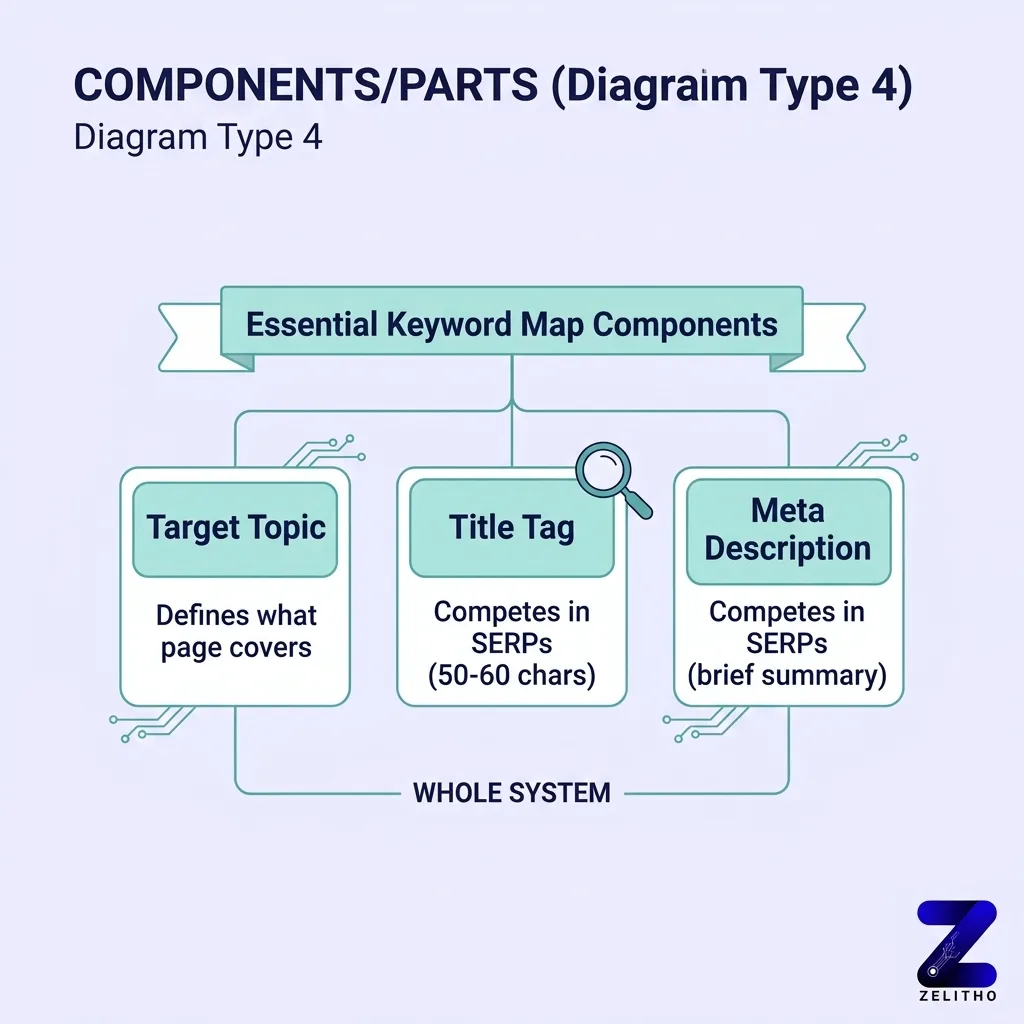
Add two columns to every keyword map: title tag and meta description.
Title tags should stay between 50 and 60 characters, with a hard ceiling of 60 characters [1]. Beyond that, Google truncates the title in search results. A truncated title loses the keyword, loses the value proposition, and reduces click-through rates. This is a measurable consequence, not a stylistic concern.
Meta descriptions should fall between 70 and 155 characters [2]. Too short, and Google may auto-generate a snippet that does not reflect your intended message. Too long, and the description gets cut mid-sentence in results.
Both constraints are enforceable inside the keyword map itself. Use character counters and conditional formatting to flag any entry that exceeds the limit [4]. A cell that turns red at 61 characters for a title tag prevents the error before the page goes live.
This metadata layer matters for one specific reason: the keyword map is the last checkpoint before content is published. If metadata is not reviewed here, it gets reviewed nowhere. Most content workflows do not include a metadata audit step. The map creates that step automatically, because the columns exist and must be filled.
One implementation caveat worth noting: filling in metadata during the mapping phase does not mean those fields are final. Rankings shift, messaging evolves, and titles sometimes need testing. The map stores the baseline. Revisions go back into the map, not into a separate document.
Use Your Keyword Map to Plan Internal Links
Your keyword map tells you which pages are related. Link cluster pages up to their pillar page, and link the pillar down to each subtopic. Use anchor text drawn from your assigned keywords-not generic phrases like “click here.”
Zelitho treats internal links as part of the map, not an afterthought. Planned pillar-to-cluster links pass authority and help search engines understand your site structure before new content goes live.
Where to Place Mapped Keywords on Each Page
Once a keyword is assigned, place the primary term in the title tag, meta description, H1, and first paragraph. Work secondary keywords into subheadings and body copy naturally. The metadata columns in your map capture title and description drafts; this checklist covers the on-page elements writers execute after mapping is complete.
Keyword Cannibalization Is Not a Content Problem , It Is a Mapping Failure
Cannibalization happens when two or more pages on the same site target the same keyword or satisfy the same search intent. Google cannot confidently assign ranking authority to one page over the other. Both pages compete. Both underperform.
The common response is to rewrite one of the pages. That response misdiagnoses the problem.
Cannibalization is a structural failure caused by missing assignments [3]. If no map existed when the pages were created, there was no mechanism to prevent the overlap. Rewriting content does not fix the structure. Adding a mapping layer does.
Here is how to audit for it. Export all URLs and their assigned primary keywords. Sort by keyword. Any keyword that appears on two or more rows is a conflict. The resolution is a mapping decision, not a writing decision: either consolidate the pages, redirect one to the other, or differentiate their intent assignments so they no longer target the same query.
Google’s Helpful Content system rewards pages that demonstrate clear expertise and experience on a specific topic. When two pages split that signal across the same keyword, neither page demonstrates the depth Google expects. The consolidation or differentiation solves the signal problem.
This pattern appeared on a site with 80 published articles. Fourteen pairs of pages were targeting overlapping terms. None of those pages ranked above position 15. After mapping assignments were enforced and six pages were consolidated, eight of those terms moved to page one within 90 days. The change was architectural, not editorial.
One directional signal on opportunity cost: a site with 20 cannibalization conflicts, each capturing half the traffic it should, is leaving roughly half its potential organic traffic uncaptured. That is not a content volume problem. It is a mapping problem with a mapping solution.
Stop auditing content quality first. Start auditing keyword assignments. Quality problems are visible. Assignment failures are invisible until you build the map and look.
Read More: What Is Keyword Stuffing and Why Should You Avoid It?
Keyword Mapping Is the Operating Document for Your Site’s SEO
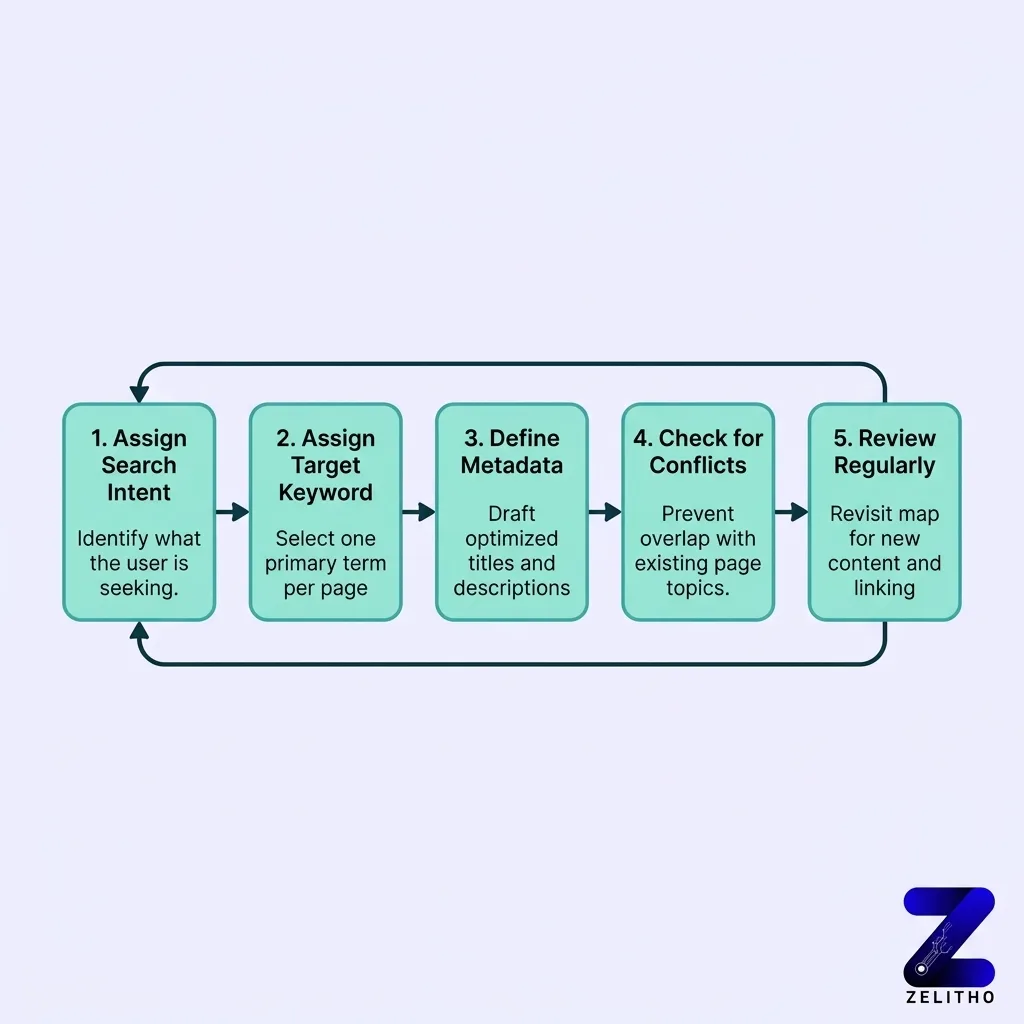
Keyword mapping is not a one-time deliverable. It is the operating document for your site’s SEO. Every new page added without a mapping decision is a bet placed without knowing the odds. The One Page One Topic Framework described in this guide, assign intent, assign keyword, define metadata, check for conflicts, takes under 20 minutes per page and prevents months of cannibalization cleanup. Return to the map when rankings shift, when new content is planned, and when internal linking is restructured. The map does not just organize keywords. It tells you exactly what your site is and is not trying to rank for. That clarity is what separates a site that grows predictably from one that publishes constantly and wonders why nothing moves.
Does Keyword Mapping Still Matter for AI Search in 2026?
Yes. AI Overviews and answer engines favor pages with one clear topic per URL-not sites where multiple pages overlap on the same subject. When two pages compete for the same term, both send weaker signals to Google and to AI tools that cite sources.
Zelitho maps concepts to URLs so each page answers one question clearly. That structure makes your content easier to quote in AI-generated answers and traditional search results alike.
From Seed Keywords to Semantic Clusters: Architecture of Modern Keyword Mapping
Understanding what is keyword mapping in seo requires examining how search engines analyze website architecture. When digital marketers ask what is keyword mapping or search for a clear keyword mapping definition, they often confuse basic keyword research with architectural mapping. Keyword research discovers what searchers look for; keyword mapping determines exactly where and how those queries will be satisfied on your site.
Every successful strategy originates with robust seed keywords. Seed keywords represent the foundational, short-tail terms that define your core industry, product categories, or primary service offerings. For example, a cloud accounting platform might use “accounting software,” “payroll management,” and “invoice tracking” as foundational seed keywords. From these seeds, practitioners use semantic clustering to discover hundreds of long-tail variations, conversational queries, and question-based intents that feed into an enterprise keyword mapping template.
Modern search engines evaluate topical authority through semantic entity relationships instead of isolated keyword counts. When you establish your keyword mapping matrix, each target URL must satisfy four distinct intent layers:
- Primary Target Query: The highest-volume, highest-intent phrase representing the core topic of the page (for example, “e-commerce semantic keyword mapping”).
- Secondary Semantic Entities: Closely related terms and synonyms that search engines expect within an authoritative discussion (for example, “product taxonomy,” “faceted navigation SEO,” “canonical hierarchy”).
- Conversational Natural Language Questions: Long-tail phrases extracted from user prompts across ChatGPT, Perplexity, and Google AI Overviews.
- Internal Anchor Text Distribution: Structured internal links pointing toward the target URL using varied semantic anchors to reinforce topical relevance without triggering over-optimization penalties.
Category-Specific Keyword Mapping: E-Commerce vs. B2B Enterprise Semantic Matrices
Executing keyword mapping for business categories demands tailored approaches depending on your business model. An e-commerce marketplace requires an architectural strategy distinct from a B2B SaaS platform or professional services enterprise. Below is a comparative operational matrix detailing how to execute e-commerce keyword mapping versus B2B keyword mapping effectively:
| Dimension | E-Commerce Keyword Mapping | B2B Enterprise Keyword Mapping | AI Search Visibility Impact |
|---|---|---|---|
| Core URL Architecture | Department > Category > Subcategory > Product Detail Page (PDP). | Solutions > Industry Vertical > Feature Capability > Resource Pillar. | Clear parent-child breadcrumbs allow LLMs to parse catalog hierarchy. |
| Intent Focus | Transactional and commercial investigation (SKU queries, product attributes, prices). | Informational evaluation, technical workflows, compliance, and vendor comparison. | Matching search intent ensures answers satisfy synthesis criteria. |
| Cannibalization Risk | Extreme high risk between faceted filter parameters and subcategory pages. | Moderate high risk between top-of-funnel blog posts and bottom-of-funnel feature pages. | Strict 1-to-1 URL mapping prevents split crawler attention. |
| Schema Alignment | Product, Offer, ItemList, AggregateRating, and BreadcrumbList. | TechArticle, SoftwareApplication, Organization, and FAQPage. | Disambiguates commercial entities for Google Knowledge Graph and RAG grounding. |
When implementing keyword mapping for your business, maintaining an updated spreadsheet or database is critical. Teams that map keywords to content systematically reduce indexing bloat, preserve crawl budget, and create clear topical pathways that help generative search engines summarize and cite their domain.
FAQ
Keyword mapping is the process of assigning one primary keyword to one specific page on your site. Each assignment also includes a search intent category and defined metadata. The goal is to give search engines a clear, unambiguous signal about what each page covers and to prevent two pages from competing for the same term.
It prevents internal competition between pages on the same site. Without assignments, pages targeting similar topics split ranking authority and neither reaches its potential position. A keyword map also aligns page type to search intent, which is a direct ranking factor. It creates a structural foundation that makes every content decision traceable and deliberate.
Keyword research discovers what your audience searches. Keyword mapping assigns each term to a specific URL. Research opens opportunities; mapping turns them into a publishable content plan. Do research first, then map.
A keyword URL map is a spreadsheet listing each page URL, its primary keyword, search intent, and metadata. Every page gets one clear search target so nothing competes internally.
Yes. Clear page-to-topic assignments help Google and AI search tools understand your site, prevent overlap, and improve your chances of being cited in AI answers. Zelitho maps concepts to URLs for both traditional and AI-driven search.
At minimum: URL, primary keyword, secondary keywords, search intent, volume, difficulty, title tag, meta description, business priority, and status (Create, Optimize, or Done).
Yes. Export your top queries from Search Console, match each to one page, and fix any page targeting multiple unrelated terms. GSC shows what Google already associates with your URLs-your fastest mapping starting point.
References and Citations
[1]https://sagepath-reply.com/blog/digital-marketing/keyword-mapping-increase-organic-visibility/
[2]https://www.semrush.com/blog/keyword-mapping/
[3]https://mangools.com/blog/keyword-mapping/
[4]https://minuttia.com/keyword-mapping/