
How to Build and Implement a Scalable Marketing Strategy That Improves Results Without Sacrificing Quality

TL;DR
You just got traction. A piece of content ranked. Traffic moved. Now your instinct says: do more of that, faster.
That instinct is the trap. Most marketing operations break under growth not because the tactics were wrong, but because the foundation was never built to repeat. Teams scale effort before they scale structure. Output goes up. Quality drops. Results plateau.
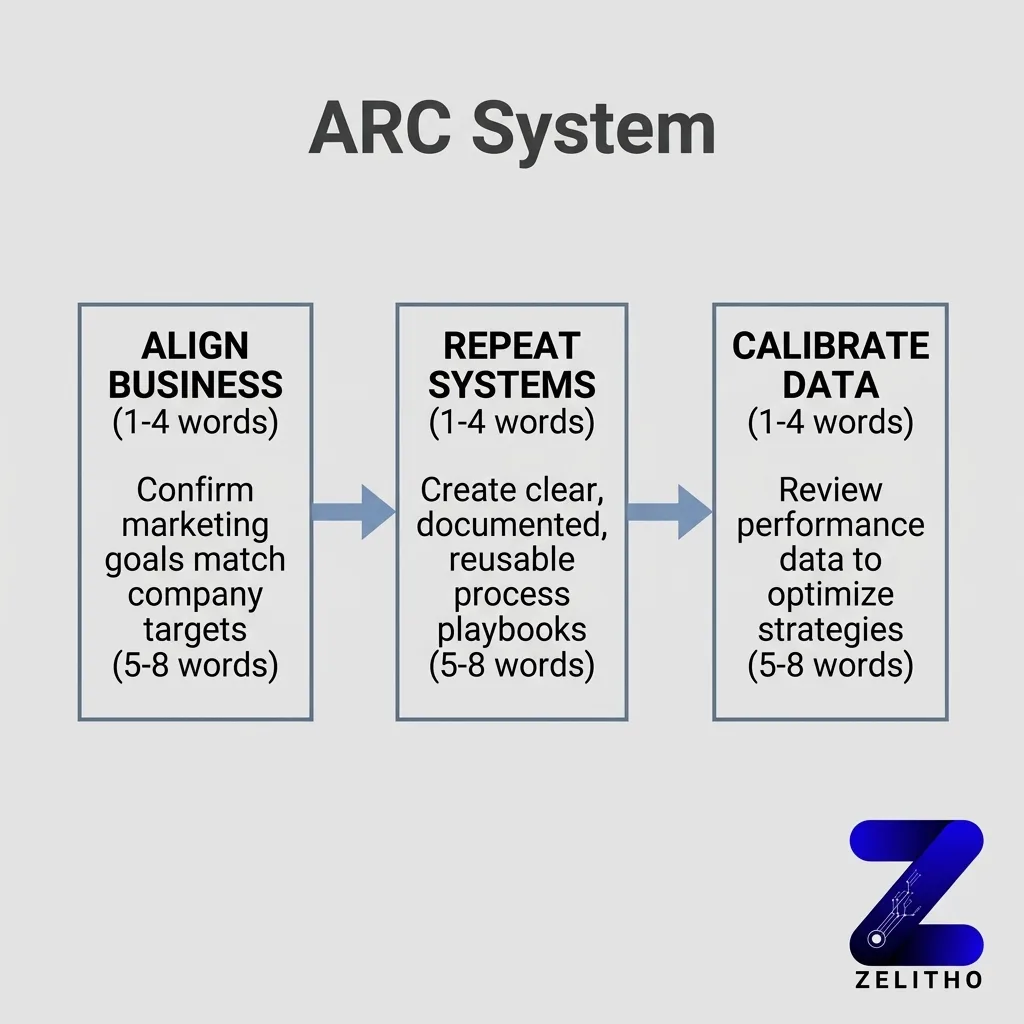
This guide introduces the ARC System: Align, Repeat, Calibrate. It is a sequential framework for senior marketers, founders, and agency operators who need growth that holds. Align every tactic to a measurable business outcome first. Then build repeatable systems that run without constant intervention. Then use data to calibrate continuously before wasted spend compounds. The teams that follow this sequence spend less time rebuilding and more time compounding.
What Does a Scalable Marketing Strategy Actually Require?
A scalable marketing strategy requires three things working in sequence: clear business alignment, documented repeatable systems, and a recurring data review that drives reallocation. Without all three, growth creates noise instead of results. Most teams have one. Few have all three operating together.
Step 1 , Align Every Marketing Goal to a Measurable Business Outcome Before You Build Anything
Here is the false assumption that costs teams months: a marketing plan is the same as a marketing strategy.
A plan lists what you will do. A strategy defines what outcome you are building toward, and why each action connects to that number. Without that connection, every tactic feels equally valid. That is how budgets scatter.
Start with the business goal. Not the channel goal. Not the content goal. The business goal. A concrete anchor looks like: increase revenue by 20% over the next 12 months [3]. From that number, you work backwards. What does revenue growth at that rate require in terms of pipeline, leads, and traffic? Each layer becomes a marketing objective.
Marketing objectives need to follow SMART criteria: Specific, Measurable, Achievable, Relevant, and Time-bound [1]. That is not a formatting preference. It is a functional requirement. A vague objective cannot be evaluated. An objective you cannot evaluate cannot be improved.
A useful working example: increase website traffic by 50% within six months [2]. That target is specific enough to assign ownership. It is measurable enough to track weekly. It is time-bound enough to trigger a decision if you are behind at month three.
The reason most marketing teams skip this step is not ignorance. It is urgency. There is a content calendar to fill, a campaign to launch, a channel someone heard about at a conference. The work feels productive. But if none of it connects to a defined outcome, the work is motion, not momentum.
Stop measuring activity. Start measuring whether your activity is moving a number that the business cares about.
Business Goal | Marketing Objective | Success Metric |
|---|---|---|
Increase revenue by 20% in 12 months | Generate 400 qualified leads per quarter | Lead volume, close rate |
Expand into a new customer segment | Increase organic traffic from target persona by 50% in 6 months | Segment traffic, conversion rate |
Reduce customer acquisition cost | Improve paid channel ROAS by 30% within 90 days | Cost per acquisition, ROAS |
Once the goal is written and the objective is set, every channel decision becomes a filtering question: does this move the number? If the answer is unclear, the tactic does not belong in the plan yet.
The Part Most Marketing Plans Get Wrong: Scaling Tactics Before the Foundation Is Repeatable
A mid-sized SaaS team ran three content channels at once: a blog, a newsletter, and a LinkedIn presence. Each had its own workflow, its own voice guidelines, its own approvals process. Nothing was documented. Output depended on who was available.
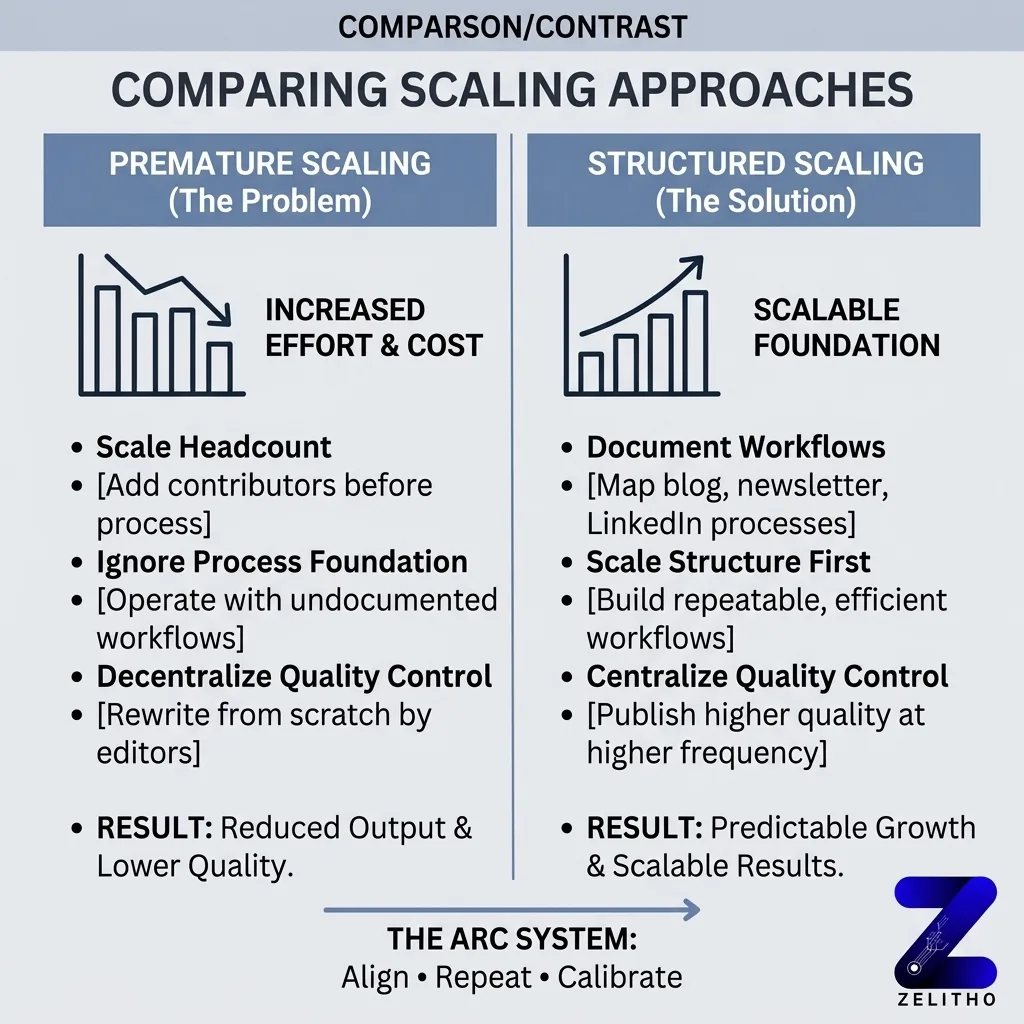
When they hired two more content contributors, quality dropped immediately. Editors were rewriting from scratch. Publish frequency fell. The team was bigger and producing less.
They had scaled headcount before scaling process. That sequence always fails.
Building a scalable marketing foundation typically takes three to six months [3]. That timeline is not a warning. It is a design parameter. If you are trying to build something durable in six weeks, you are not building a foundation. You are patching a process.
The audit question is simple: if your best-performing person left tomorrow, could the work continue at the same standard? If the answer is no, you are not running a system. You are running a dependency.
Here is what to look for when you audit your current setup. Find the processes that only work because a specific person remembers how they work. Find the approvals that happen through Slack threads instead of documented criteria. Find the channels where output quality varies based on who touched it last.
Those are not people problems. They are system gaps.
Document the repeatable work before you scale the repeatable work. That means writing down the inputs, the steps, the output standard, and the quality check for every core process. Brief templates. Publishing checklists. Campaign naming conventions. Distribution sequences.
The teams that skip this step spend the next 12 months firefighting instead of compounding. They produce more content that performs less. They run more campaigns that cost more and convert less. The volume goes up. The results do not follow.
That is the real cost of scaling broken process: not one failed campaign, but months of compounding waste that looks like execution but delivers like noise.
Step 2 , Design Flexible, Automated Systems That Scale Output Without Scaling Headcount
Once your goals are set and your core processes are documented, the question shifts. The question is no longer what you should do. It is how you make the doing sustainable.
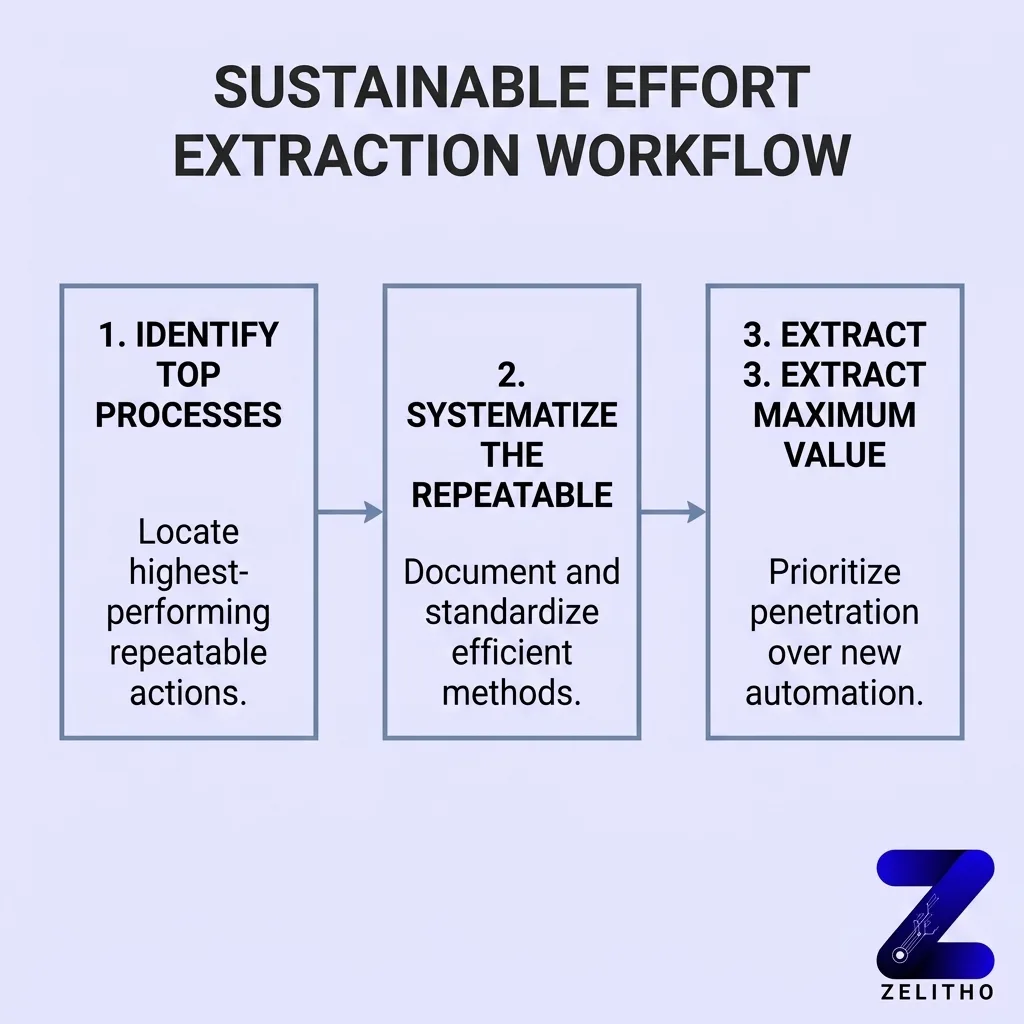
Market penetration, meaning increasing sales within your existing market without new products, is the least risky growth strategy available [1]. That framing matters here. Before you automate new channels or build new workflows, extract more from what is already working. Systematize the repeatable parts of your highest-performing processes first.
Diversification, launching new products into new markets, is the riskiest growth move [1]. Teams that automate before they have a proven process end up automating the wrong work. They move faster toward a result they have not validated yet.
The practical sequence looks like this. Identify the two or three processes that run the most frequently and require the least judgment. Content distribution is one. Lead nurturing sequences are another. Social publishing schedules. Report generation. These are not creative decisions. They are operational tasks that eat time.
Systematize those first. Build the template. Define the trigger. Set the sequence. Then let the tool run it.
The second layer is workflow automation for anything that requires handoffs. A piece of content that moves from draft to edit to publish to distribute touches four or five people or steps. Every manual handoff is a delay and a quality risk. A documented workflow with clear stage ownership removes the delay. An automation tool removes the manual trigger.
The implementation caveat most teams miss: automation does not fix a broken process. It accelerates it. If your brief-to-publish workflow produces inconsistent output, automating the distribution step will not help. Fix the process, then automate the handoff.
Stop adding new channels before the current channels are running on documented, repeatable systems. Start with the process that already works and build the infrastructure around it.
The result is not just efficiency. It is predictability. When output is predictable, forecasting becomes possible. When forecasting is possible, budget decisions become defensible.
Step 3 , Use Data to Calibrate Continuously Across Content, Acquisition, Retention, and Budget
Alignment and systems get you moving. Calibration keeps you moving in the right direction.
Most teams review performance monthly at best. Some review quarterly. By the time the data informs a decision, the spend has already compounded in the wrong direction. Two months of underperforming paid campaigns. Three months of content going to the wrong audience. That is not a data problem. It is a review cadence problem.
Build a weekly signal check and a monthly reallocation review into your operating rhythm. The weekly check is not a deep analysis. It is a flag system. Are the key metrics moving in the right direction? If not, what changed? If nothing changed, why is the metric moving?
The monthly review is where decisions happen. This is where you ask: which channels are producing qualified results, and which are producing volume without value? Which content topics are driving traffic that converts, and which are driving traffic that bounces?
The ARC System, specifically the Calibrate layer, works because it removes gut-feel from budget decisions. You are not deciding based on which channel feels productive. You are deciding based on which channel is moving the specific metric connected to the business goal you set in Step 1.
The data you need is not complex. Traffic by source. Conversion rate by channel. Cost per acquisition by campaign. Retention rate by cohort. These four views, reviewed on a consistent cadence, will tell you where to reallocate before the waste compounds.
One operational adjustment that changes outcomes: stop treating underperforming channels as projects to fix. Treat them as budget waiting to be redeployed. If a channel has had three monthly review cycles to prove movement and has not, move the budget. The opportunity cost of staying in a non-performing channel is not just the spend. It is the growth you did not fund on the channel that was working.
The Calibrate step is also where content strategy gets honest. A blog that drives 40,000 visits per month but converts at 0.1% is not a content asset. It is a traffic vanity metric. The calibration question is not: how do we get more traffic? It is: how do we get traffic that does something.
Use data to make the hard calls. That is what the review cadence is for.
The ARC System Is How Quality Survives Growth
The ARC System, Align, Repeat, Calibrate, is not a one-time project. It is a way of operating.
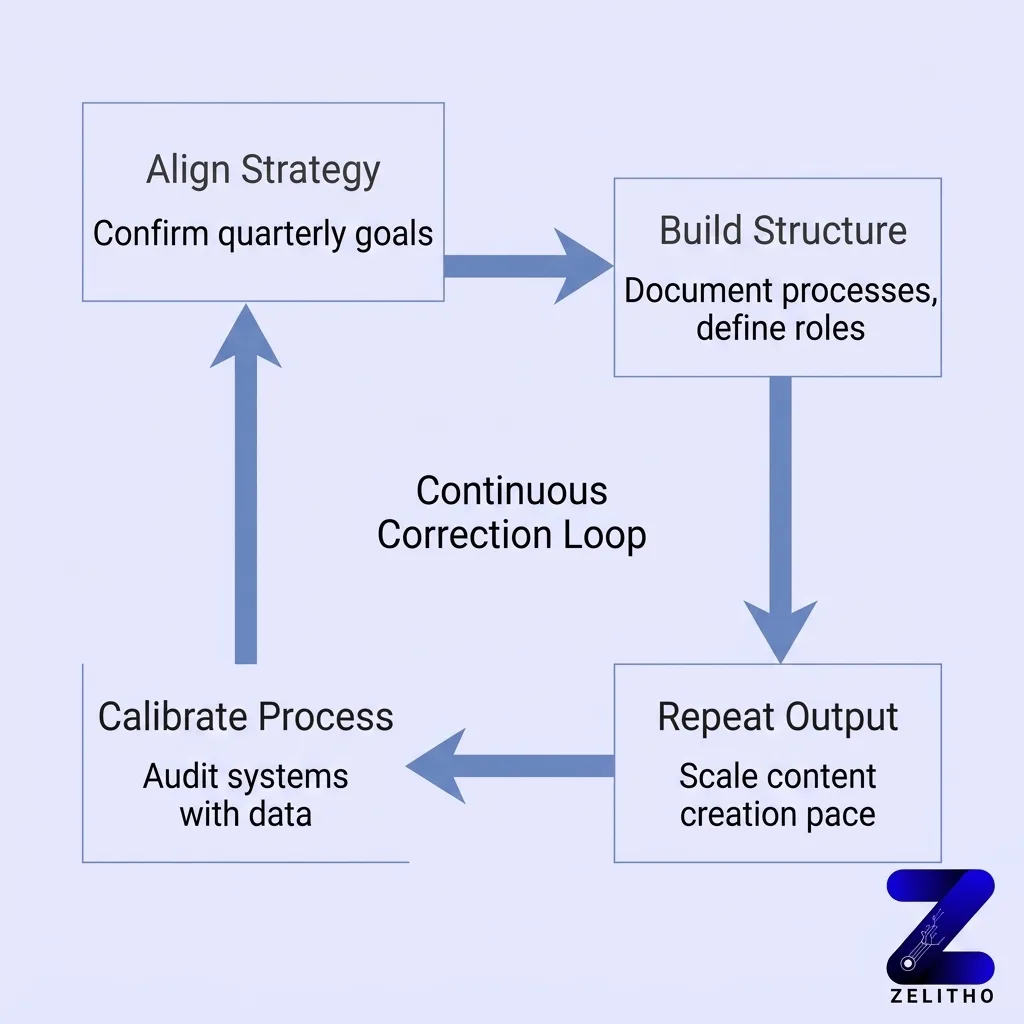
Marketers who treat strategy as a living system, not a static document, are the ones who scale results without scaling chaos. Revisit your alignment every quarter. Audit your systems every six months. Let data make the hard calls.
The teams that compound results do not do more things. They do the right things on a documented, reviewed, and continuously corrected loop. That loop is the ARC System.
Quality survives growth when the structure was built to carry it.
FAQ
The 3 3 3 rule is a content framework suggesting you divide your audience’s attention into three segments: one-third of content builds brand awareness, one-third drives direct engagement, and one-third promotes offers or conversions. It is a pacing guideline, not a strategy. It works best when each third connects to a defined business objective.
The 40-40-20 rule originated in direct mail and states that 40% of campaign success comes from the quality of the audience list, 40% from the offer, and 20% from the creative. The implication is that most teams over-invest in creative and under-invest in audience targeting and offer design. Applying this to digital marketing means your segmentation and offer clarity matter more than your copy or design.
The 5 C’s are Company, Customers, Competitors, Collaborators, and Climate. They form a situational analysis framework used before building or revising strategy. Running through the 5 C’s before setting marketing objectives helps ensure your goals reflect actual market conditions, not assumptions. Skipping this audit is one reason marketing plans fail to connect to real business outcomes.
A scalable marketing strategy is a set of processes, systems, and objectives that can increase output or reach without requiring proportional increases in headcount or budget. It is built on documented repeatable workflows, clear goal alignment, and a regular calibration loop that reallocates resources based on performance data. Building a strong scalable foundation typically takes three to six months.
Sources
[1]https://www.ama.org/marketing-news/how-to-develop-an-effective-marketing-strategy/
[2]https://hsdigisolutions.com/how-to-build-a-scalable-marketing-strategy-for-long-term-success/
[3]https://www.coachingly.ai/blog/single/how-to-build-a-scalable-marketing-strategy-from-the-ground-up