
How the Content Marketing Funnel Works: A Step-by-Step Guide to Creating Targeted Content for Each Stage

TL;DR
You published twelve articles last quarter. Traffic climbed. Pipeline stayed flat. That gap is the real problem, and it is not a content volume problem.
Most teams treat every piece of content as interchangeable. A blog post for someone who has never heard of you gets the same format, CTA, and distribution as content meant to close a deal. The funnel collapses because the buyer’s intent is ignored at every stage.
The Targeted Funnel Framework maps content type, distribution channel, and measurement signal to each of three distinct phases: awareness, consideration, and conversion. It also includes a retention layer most editorial calendars skip entirely. Senior marketers, founders scaling content, and agency operators will use this guide to audit existing libraries, build stage-specific workflows, and measure the right signals before a broken stage costs them pipeline.
What Is the Content Marketing Funnel?
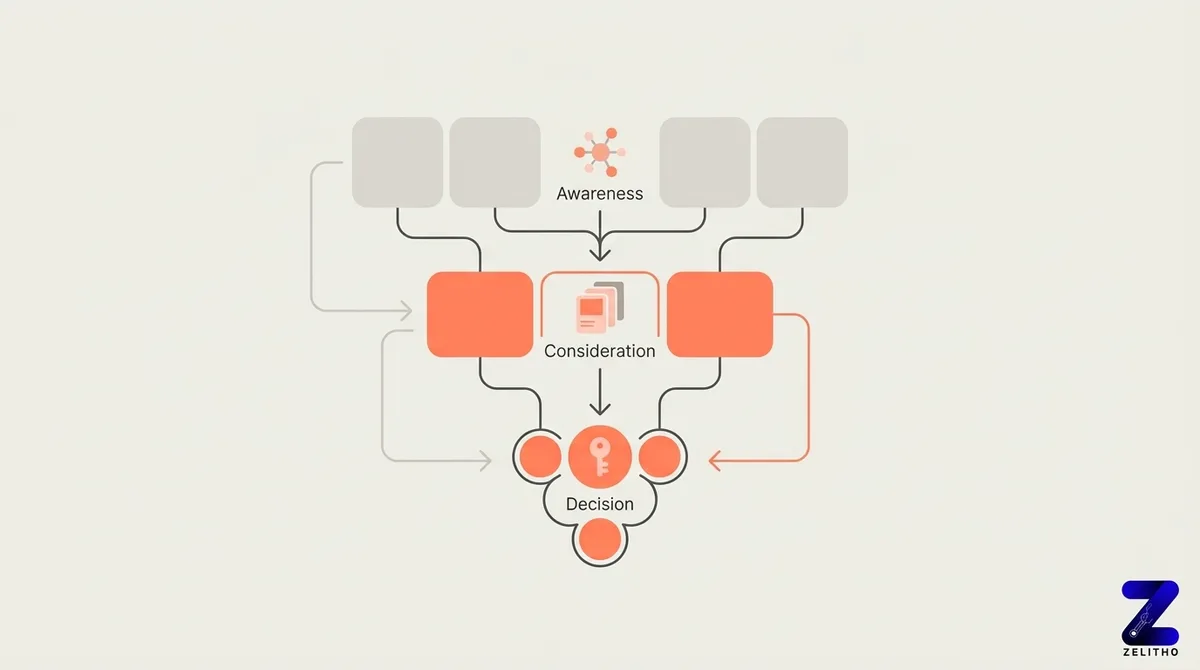
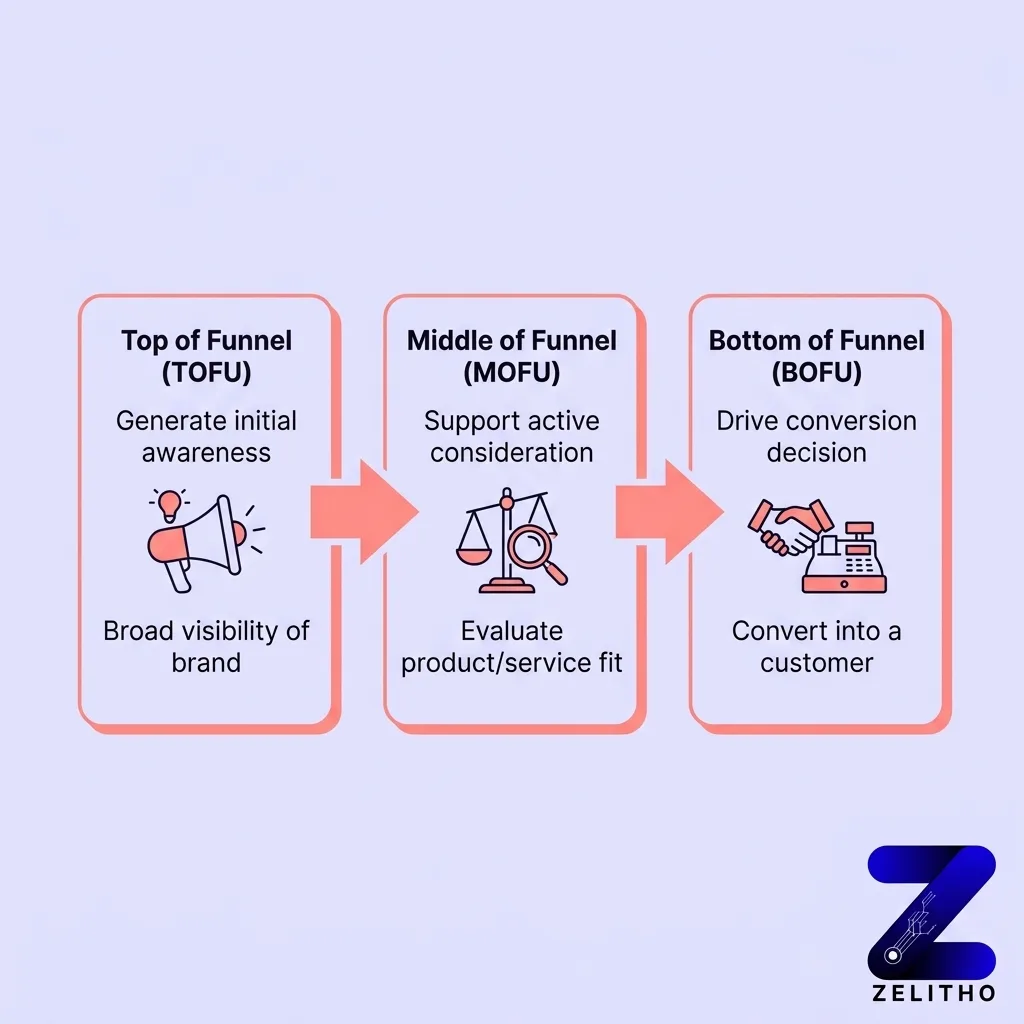
The content marketing funnel is a stage-based model that matches content decisions to buyer intent. It moves a buyer from first awareness through active consideration to a purchase decision, using different content formats and channels at each phase [3]. Most implementations follow three stages: top of funnel (awareness), middle of funnel (consideration), and bottom of funnel (conversion) [3].
Why Most Content Plans Fail Before They Start: Misreading What Buyers Actually Need at Each Stage
Here is the false assumption worth naming early: more content means more conversions.
It does not. Volume without stage alignment produces traffic that exits without converting. You end up with a blog that ranks and a pipeline that stalls.
The breakdown happens because most content plans are built around topics, not intent. A buyer searching “what is content marketing” needs something entirely different from a buyer searching “content marketing agency pricing.” Both queries could land on your site. If you serve them the same experience, you lose the second buyer almost immediately.
Consider what buyers actually signal at each stage. At awareness, they carry a problem but no vocabulary for the solution yet. At consideration, they compare approaches and want proof. At conversion, they want confirmation that choosing you is the right call. These are three different psychological states. They require three different content responses.
Stop writing content for yourself. Start writing content for the question your buyer is asking right now, not the question you wish they were asking.
The cost of misalignment is measurable. If a consideration-stage buyer lands on awareness content, they leave without converting. If ten thousand monthly visitors face that mismatch, you are converting a fraction of the pipeline you could capture. That is not a traffic problem. It is a targeting problem.
66% of customers expect companies to understand their unique needs [1]. When content ignores where a buyer sits in their decision process, it signals the opposite. It tells them you are broadcasting, not responding.
The audit question for your current library: for each piece of content, can you name the specific buyer intent it serves and the next step it creates? If the answer is vague, the content is undifferentiated. That is the starting point for a stage-specific rebuild.
The Targeted Funnel Framework: Stage-by-Stage Content Types, Channels, and Creation Tactics
The Targeted Funnel Framework organizes content decisions across three phases. Each phase has a defined content format list, a primary distribution channel set, and a creation logic. Here is the full structure.
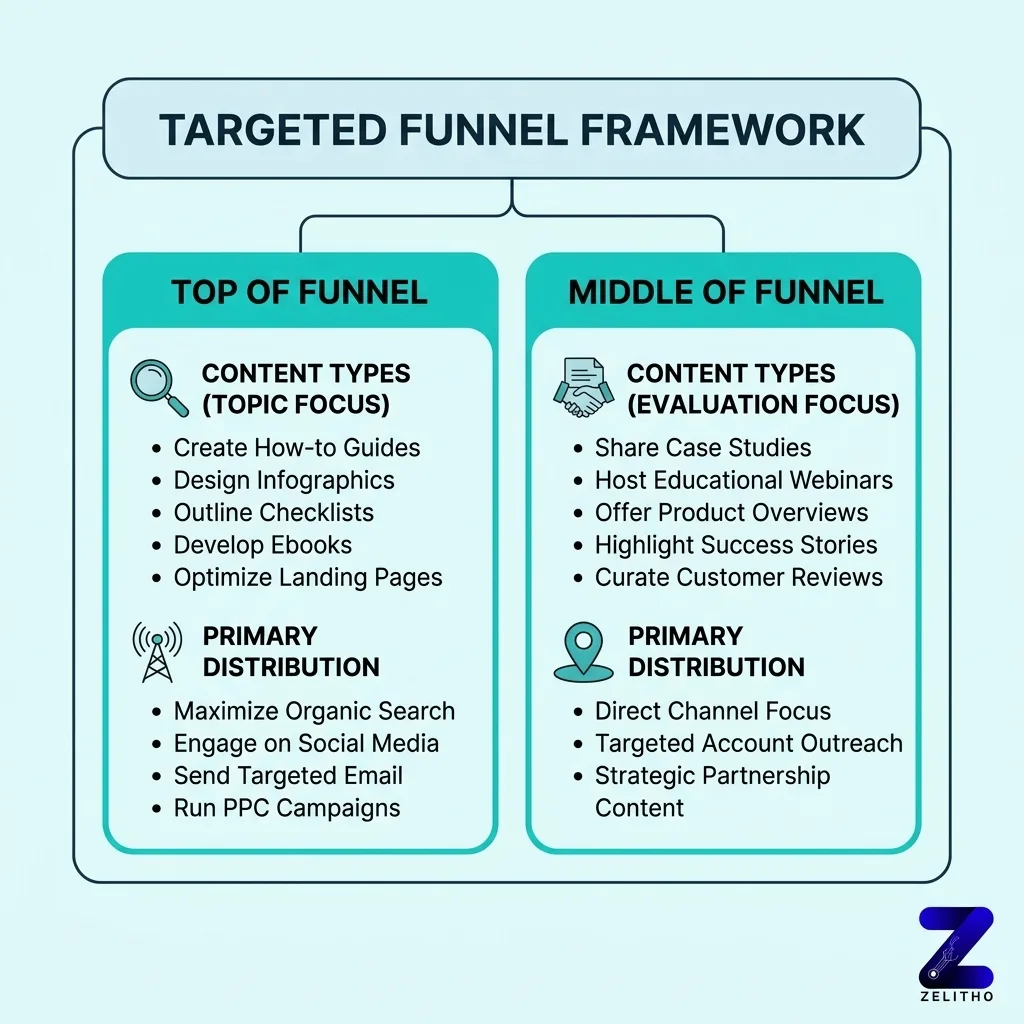
Funnel Stage | Primary Content Types | Top Distribution Channels |
|---|---|---|
Top of Funnel (Awareness) | How-to guides, infographics, checklists, ebooks, landing pages | Organic search, social media, email, PPC |
Middle of Funnel (Consideration) | Case studies, webinars, product overviews, success stories, reviews | Email, organic search, social media |
Bottom of Funnel (Conversion) | Product overviews, customer reviews, success stories | Email, organic search, PPC |
Top of Funnel: Capture Attention Without Asking for Too Much
The top of funnel is where buyers encounter your brand while researching a problem. They are not ready to buy. They are gathering context.
The five most effective formats here are how-to guides, landing pages, infographics, checklists, and ebooks [2]. Each of these answers a specific question without requiring the buyer to know your product exists. The goal is relevance, not persuasion.
Distribution at this stage runs through organic search, social media, email, PPC, and influencer channels [2]. Organic search carries the highest leverage because it captures active query intent. A well-ranked how-to guide does not need a budget to stay visible.
Creation logic at the top of funnel: lead with the problem, not the product. Every sentence should earn the reader’s next click. If the content pivots to selling before the reader has received value, they exit.
Middle of Funnel: Convert Interest Into Serious Consideration
The middle of funnel is where buyers compare solutions. They know their problem. They are evaluating options, including yours.
For lead generation at this stage, the strongest formats are how-to guides, product overviews, case studies, landing pages, and webinars [2]. For nurturing leads already in your system, success stories, product overviews, case studies, and customer reviews perform best [2].
The channel split shifts here. Email becomes the primary nurture channel because it allows sequenced communication [2]. Organic search still supports discovery, but email controls the pacing of the relationship.
A practical example: one SaaS team ran 22 middle-funnel blog posts but zero case studies. Their lead volume was healthy. Their lead-to-demo conversion sat at 4%. They added three detailed case studies targeting specific use cases. The lead-to-demo rate moved to 9% within 60 days. The content volume did not change. The content type did.
52% of customers expect offers to always be personalized [1]. At the middle of funnel, personalization means matching the case study to the buyer’s industry or the webinar topic to their specific use case. Generic content at this stage reads as indifference.
Bottom of Funnel: Reduce Friction at the Moment of Decision
The bottom of funnel is where a buyer decides. The question is no longer “what is this” or “how does it work.” The question is “should I trust this enough to pay for it.”
The three content types that move buyers at this stage are product overviews, customer reviews, and success stories [2]. These formats reduce perceived risk. They show the buyer what choosing you looks like in practice.
Distribution concentrates through email, organic search, and PPC [2]. Email works because you already have a relationship. PPC works because you can intercept buyers searching competitor names or high-intent queries like “best [category] software.”
Creation logic at the bottom of funnel: remove every obstacle to a yes. Unclear pricing, missing proof, and vague next steps all create friction. Each piece of content at this stage should answer the last objection, not introduce a new topic.
How to Measure Whether Your Funnel Is Actually Working , and What to Fix When It Is Not
Most teams measure total traffic and total conversions. That tells you if the funnel is alive. It does not tell you where it is bleeding.
The Targeted Funnel Framework assigns specific metrics to each stage. When a stage underperforms, those metrics isolate the problem before it compounds downstream.
Top of funnel metrics: number of visitors, conversion rate from visitor to lead, time on page, and bounce rate [2]. A high bounce rate combined with low time on page signals a relevance mismatch. The content attracted the wrong query, or the opening failed to hold attention.
Middle of funnel metrics: conversion rate, number of leads, number of visitors, time on page, and ROI [2]. If lead volume is healthy but conversion rate stalls, the nurture sequence is likely too generic. Return to the content type audit. Are you deploying case studies and success stories, or just more how-to content?
Bottom of funnel metrics: conversion rate, number of payments, and ROI [2]. A high lead count with low payment count is a bottom-funnel problem. The buyer reached decision stage without enough proof to commit.
Across all stages, track cost per acquisition (CPA) and customer lifetime value (LTV) [3]. CPA is calculated by dividing total campaign cost by number of conversions [3]. LTV measures the ongoing revenue contribution of each customer [3]. Together, they tell you whether a stage is profitable, not just active.
Conversion rates apply at each stage transition [3]. The top-of-funnel conversion rate tracks visitors becoming marketing qualified leads. The middle-funnel conversion rate tracks leads becoming sales qualified leads. Each transition is a measurable gate.
The diagnostic sequence: if overall revenue is flat, check bottom-funnel conversion rate first. If bottom-funnel rate is healthy, check middle-funnel lead quality. If lead quality is poor, go back to top-funnel targeting. Work backward from the problem, not forward from the assumption.
One caveat: do not optimize a single stage in isolation. Improving top-funnel traffic without fixing middle-funnel nurture just fills a leaky system faster. Diagnose the full sequence before intervening at any one point.
The Stage Most Marketers Ignore: Why Retention Content Drives More Revenue Than Any Top-of-Funnel Campaign
Most editorial calendars end at the sale. The funnel closes, the customer converts, and the content team moves back to generating new leads. That logic is expensive.
91% of customers are more likely to make another purchase after a great service experience [1]. Content is a direct vehicle for that experience. Onboarding guides, feature education emails, and use-case tutorials all serve existing customers. They also drive repeat revenue without the acquisition cost of a new buyer.
For subscription businesses, LTV is the metric that determines whether the model is viable [3]. A customer who renews twice is worth three times a customer who churns after the first term. Retention content directly affects that calculation. A well-timed tutorial helps a customer get more value from your product and reduces churn. A success story showing an advanced use case plants the seed for an upsell.
The practical build: identify the three moments where customers are most likely to disengage in your first 90 days. Build one piece of content for each moment. It does not require a new channel or a new team. It requires treating existing customers as an audience with specific needs, not a closed file.
Stop celebrating the conversion as the finish line. Start treating it as the beginning of a content relationship that compounds over time.
The Targeted Funnel Framework Is Not a One-Time Build
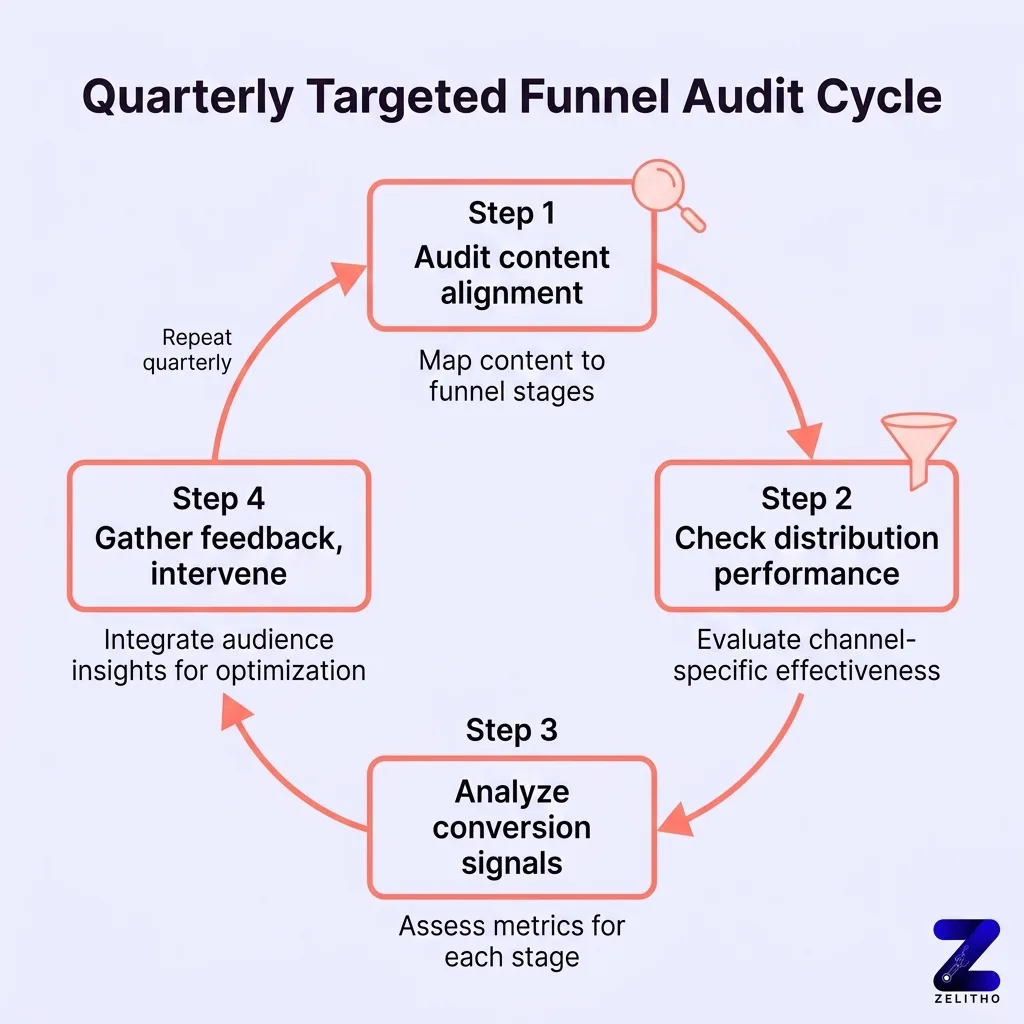
Once you have stage-specific content mapped, distributed through the right channels, and measured by the right signals, the Targeted Funnel Framework tells you where to intervene before a problem compounds.
Most marketers optimize the top of the funnel because traffic is visible. The real leverage sits in the middle and bottom, and in the retention phase that most editorial calendars never touch.
Return to this framework every quarter. Audit each stage against its metrics. Treat audience feedback as a continuous input rather than an annual project.
That discipline separates teams that generate content from teams that generate revenue.
FAQ
The five stages most commonly referenced are Awareness, Interest, Consideration, Intent, and Purchase. Some models add a sixth stage for Loyalty or Retention. Each stage requires different content and messaging based on how close the buyer is to a decision.
A seven-phase funnel typically expands the standard model to include: Awareness, Education, Evaluation, Engagement, Commitment, Purchase, and Retention. Each phase adds nuance to where a buyer sits mentally. For most content teams, collapsing these into three operational stages is more practical for editorial planning.
The content marketing funnel runs through three core stages: top of funnel (awareness), middle of funnel (consideration), and bottom of funnel (conversion) [3]. Many teams add a fourth stage for retention, targeting existing customers with content that drives repeat purchases and reduces churn.
A common seven-step content marketing process includes: define goals, research your audience, audit existing content, map content to funnel stages, create and publish, distribute through relevant channels, and measure results. The critical step most teams skip is the audit that maps existing content to specific buyer intent.
The four-step funnel follows the AIDA model: Awareness, Interest, Desire, and Action [3]. Awareness captures attention, Interest builds engagement, Desire creates preference, and Action drives the conversion. Each step maps to specific content formats and distribution decisions.
The 7 times 7 rule suggests a prospect needs to see your message at least seven times before taking action, and each message should reach them through a different channel or format. It reinforces the need for multi-channel distribution across funnel stages rather than a single-touchpoint strategy.
The golden rule of marketing is to serve the customer’s need before promoting your own product. In content terms, this means leading with information or value the buyer actually wants before introducing a commercial message. Applying this rule by funnel stage keeps content relevant at every step.
Sources
[1]https://www.lucidchart.com/blog/content-marketing-funnel
[2]https://www.semrush.com/blog/content-marketing-funnel/
[3]https://contentsquare.com/guides/marketing-funnel/