
What Is the Difference Between Content Marketing and SEO?


Executive Summary: Content Marketing vs SEO Architecture
The Essential Distinction: Content marketing builds buyer trust, brand affinity, and audience retention through valuable storytelling, while SEO optimizes technical structure, keyword intent, and crawl signals so search engines and AI models discover that content.
- The Core Relationship: SEO creates the discovery highway; content marketing builds the vehicle and destination. Content decides who stays; SEO decides who arrives.
- The Generative Shift: When buyers query ChatGPT or Perplexity instead of Google, technical crawlability alone is insufficient. AI answer engines prioritize authoritative, deeply researched content with verifiable third-party citations.
- The Integrated Flywheel: Running both disciplines in a unified lifecycle (SEO informing intent briefs, content driving engagement, and brand mentions lifting organic authority) produces compounding pipeline returns.
Is Content Marketing the New SEO?
No – and partly yes, in a limited sense. Content marketing has not replaced SEO. Search engines still decide who gets found. But the rules shifted. Rankings now follow depth, trust, and engagement more than keyword tricks alone.
ZELITHO treats content marketing as the engine and SEO as the distribution layer. Content decides who stays. SEO decides who arrives. Founders who publish audience-first work and optimize second compound faster than teams still chasing tactics without substance.
The shift is real. The replacement narrative is not. You still need both. The question is whether you run them as one blurred job or as a connected system.
Is Content Marketing the Same as SEO?
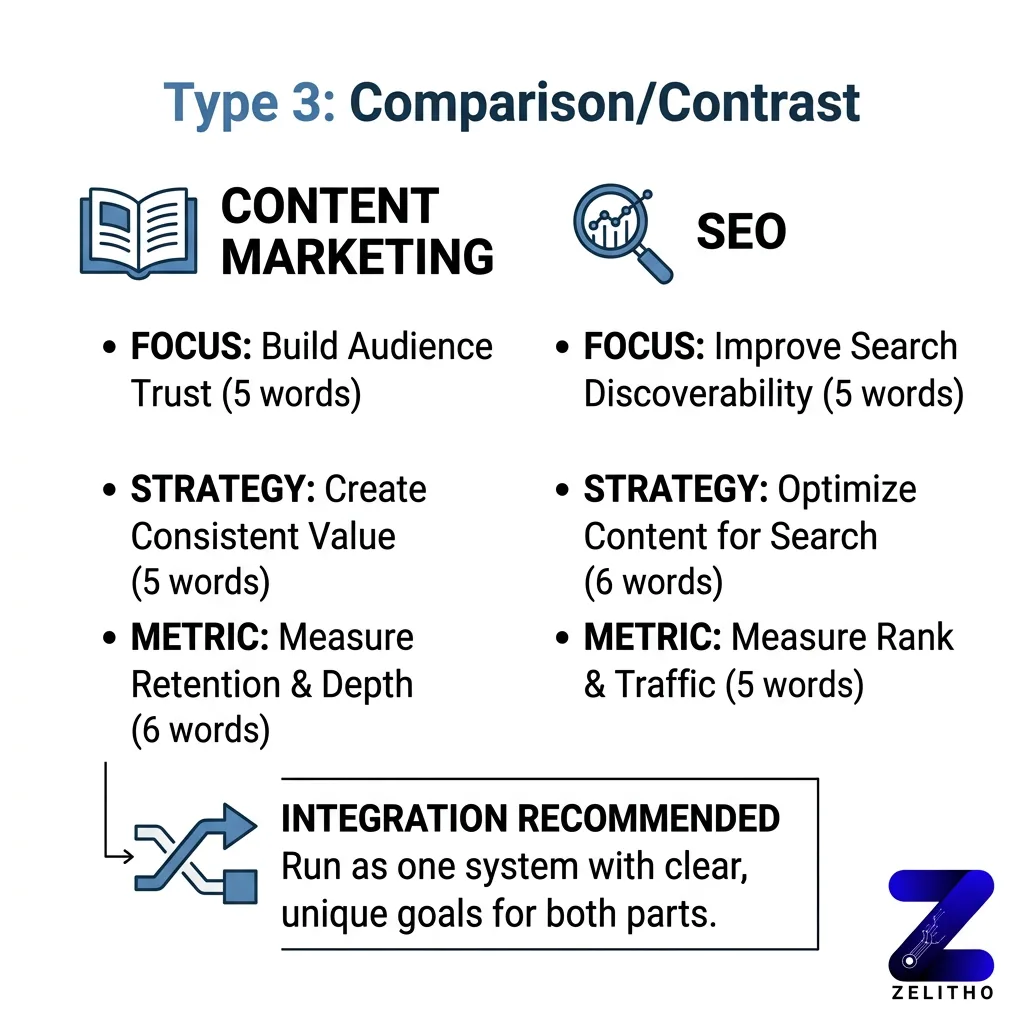
No. Content marketing builds audience trust through consistent, valuable publishing. SEO optimizes how search engines discover and rank that content. They share deliverables, often a blog post, but they serve different goals and require different success metrics. Running them as one undifferentiated job is the most common reason content programs stall.
What Content Marketing and SEO Actually Mean
Content marketing is how you build trust with buyers over time. You publish useful blogs, guides, newsletters, videos, case studies, and emails that answer real questions – without pushing a hard sell every time. The goal is retention, credibility, and pipeline that compounds.
SEO is how search engines find and rank that work. You target the phrases buyers type, structure pages clearly, earn links from credible sites, and keep your site fast and crawlable. The goal is visibility when someone is actively looking.
Same blog post. Two jobs. One earns attention. One earns discovery.
The Three Parts of SEO Every Founder Should Know
On-page SEO is what lives on the page: titles, headings, meta descriptions, keyword alignment, and internal links. ZELITHO handles most of this inside the editor before you publish.
Off-page SEO is what others say about you: backlinks, brand mentions, and shares from credible sites. Strong content earns these over time. Promotion accelerates them.
Technical SEO is site health: load speed, mobile experience, and whether Google can crawl your pages at all. No amount of great writing ranks on a broken site.
Why Founders Who Run Both Beat Founders Who Pick One
Roughly 68% of website visits start with a search. Organic search still drives more site traffic than social media for most businesses. Brands like Wirecutter built trust through rigorous content and scaled through search visibility – not one discipline instead of the other.
Founders who treat content and SEO as a single growth loop get compounding returns. Founders who pick one get partial results and wonder why pipeline stalls.
Two Different Goals That Most Marketers Accidentally Merge
Most content programs fail not from lack of effort, but from lack of separation.
Here is the false assumption worth naming early: a well-optimized blog post is not the same thing as a content marketing strategy. The deliverable looks identical. The intent is not.
SEO’s primary job is visibility. It works through technical signals, keyword targeting, and link authority. Its audience is the search engine crawl, with the human reader as a downstream beneficiary. Content marketing’s primary job is trust. It works through relevance, consistency, and narrative clarity. Its audience is the human reader, with search distribution as a downstream benefit.
Both disciplines often produce a blog post. That does not make them the same discipline.
The hidden worry most intermediate marketers carry: “Am I doing content marketing, or am I just blogging for SEO?” That question matters. If you cannot answer it before briefing a writer, the resulting content will underserve both goals.
Here is the operational split:
Dimension | Content Marketing | SEO |
|---|---|---|
Primary goal | Build trust, educate, retain | Earn visibility in search results |
Primary metric | Time on page, return visits, retention | Rankings, organic traffic, click-through rate |
Primary audience | The human reader | Search engine crawlers and algorithms |
Time to result | Weeks to months | Months to a year or longer |
A blog post written for SEO targets a keyword. A blog post written for content marketing answers a question the reader is privately carrying. Sometimes those two things align. Often they do not.
The fix is structural. Assign separate KPIs to each discipline inside a single content brief. SEO gets its ranking targets and keyword intent documentation. Content marketing gets its audience question, retention goal, and publishing cadence. Both live in the same document. Neither overrides the other.
Stop writing one brief that tries to serve both goals without naming them. Start writing one brief that gives each goal its own column.
When to Prioritize SEO vs Content Marketing
You rarely choose one forever. You sequence based on where the business is right now.
New site with thin content: fix technical SEO basics and publish your first pillar pieces before chasing volume. You need enough optimized pages to rank before traffic can move.
Site ranking but not converting: shift budget toward content quality and audience questions. High bounce rates mean the SEO layer worked and the content layer failed.
Established blog with stalled traffic: refresh and optimize existing posts before adding more volume. One strong article per theme beats ten thin keyword pages.
Budget tight? ZELITHO recommends fewer, better pieces aligned to real buyer problems – not a content calendar filled with posts nobody reads.
What Breaks When You Optimize for Search Engines and Forget the Reader
Here is a scenario that runs inside dozens of SaaS companies every quarter.
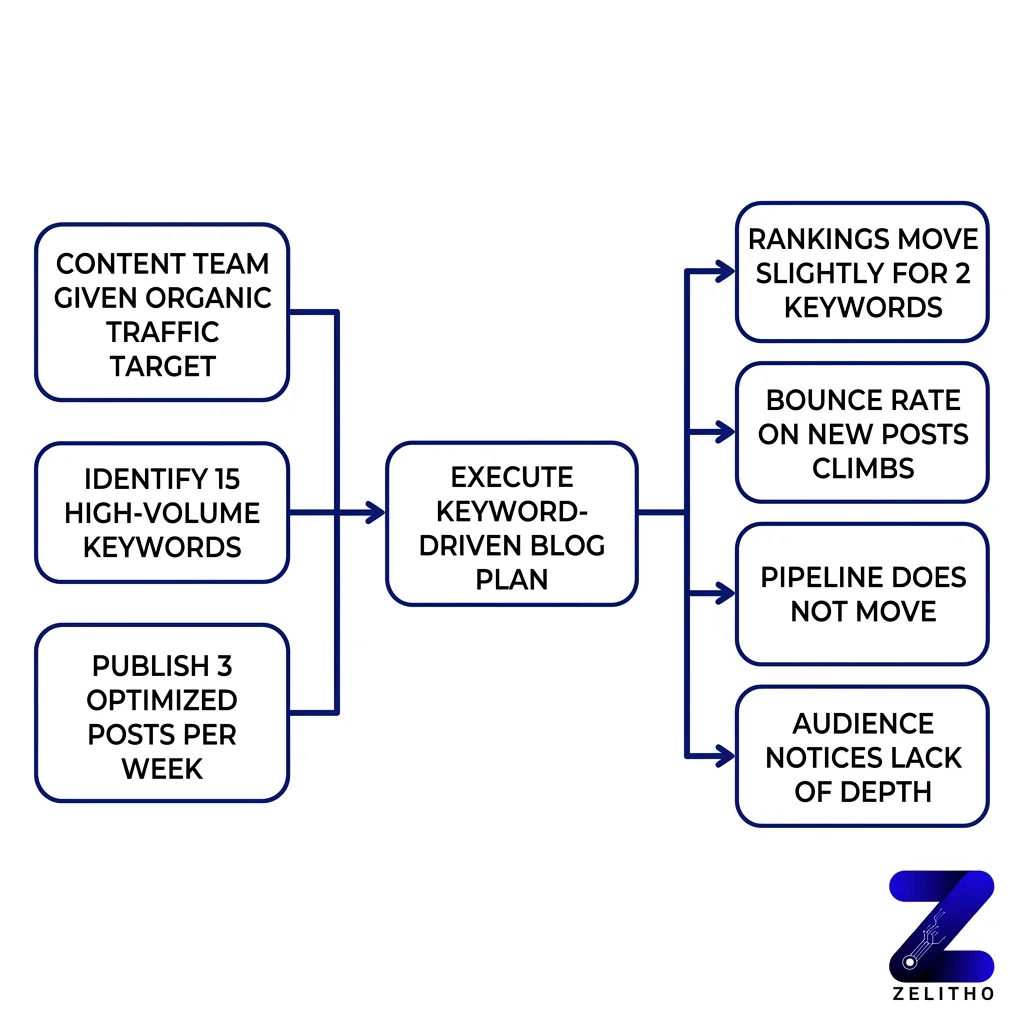
A content team is given a target: increase organic traffic by 30% in 90 days. They identify 15 high-volume keywords. They brief writers. Three posts go live per week. The posts are technically optimized. H1 tags are correct. Meta descriptions are clean. Internal linking is in place.
Six weeks pass. Rankings move slightly for two of the fifteen keywords. Bounce rate on the new posts climbs to 78%. Average time on page drops to 41 seconds. Zero pipeline attribution comes from any of the fifteen posts.
The content answered machine queries. It did not answer real questions.
Publishing one high-quality article weekly or biweekly produces stronger results than frequent low-quality posts [1]. A team running low-quality content at high frequency can see engagement metrics drop 30% compared to a slower, audience-first publishing cadence. That is six weeks of production cost, writer fees, and editorial time producing no measurable audience response.
The mechanism behind this outcome is straightforward. Keyword-first content is written toward a search query. The writer starts with a phrase, not a person. The resulting post answers a phrase. When a real person lands on it, they scan for two seconds and find something that does not sound like it was written for them. Because it was not.
Before assigning a keyword to a brief, document the specific question your reader is privately asking. Not the search query. The private question. The one they would not type into Google because it feels too specific or too vulnerable.
“How do I justify my content budget to a CFO who thinks SEO is free traffic?” does not appear in keyword tools. It appears in Slack messages, client calls, and late-Friday emails. That question is what content marketing answers. SEO then helps the right people find the answer.
Stop starting with keywords and calling it content strategy. Start with the private question and use the keyword to get it distributed.
Four Content and SEO Myths That Kill Startup Growth
Myth one: SEO is just keywords. It is not. Site health, links, and engagement signals matter equally. Keyword placement without substance produces rankings that bounce.
Myth two: great content finds its own audience. It will not – not at scale. Without search alignment and promotion, even strong articles sit unread.
Myth three: SEO guarantees pipeline. SEO drives discovery. Content marketing closes trust. Traffic without engagement is a vanity metric.
Myth four: results arrive in 30 days. Both disciplines compound over six to twelve months. Teams that quit early usually quit right before the curve bends.
Full-Funnel Content Mapping: Aligning Marketing Funnels to Search Intent
To turn editorial publishing into a predictable path to purchase, marketing teams must align content marketing funnel stages directly with search intent categories. A top-of-funnel educational article requires a different architecture than a bottom-of-funnel vendor comparison matrix.
The following framework maps deal stages against organic search behavior and AI answer engine grounding suitability:
| Funnel Stage | Search Intent | Primary Content Deliverables | AI Engine Grounding Role | Core KPI |
|---|---|---|---|---|
| Top of Funnel (TOFU) Awareness | Informational | How-to guides, industry definitions, educational blog posts, podcasts | Cited in conversational explanations and definitional answers | Impressions, time on page, newsletter signups |
| Middle of Funnel (MOFU) Consideration | Commercial Investigation | Comparison matrices, buyer checklists, teardowns, benchmark studies | Retrieved for multi-vendor evaluation prompts | Resource downloads, scroll depth, return visits |
| Bottom of Funnel (BOFU) Decision | Transactional & Navigational | Customer case studies, ROI calculators, pricing pages, product demos | Corroborates vendor reliability and pricing accuracy in AI summaries | Demo requests, trial starts, sales pipeline |
| Retention & Expansion | Post-Purchase Utility | Product documentation, feature changelogs, customer newsletters | Grounds technical support prompts and API queries | Net revenue retention, churn reduction, customer LTV |
Match Your Content to Search Intent
Search volume tells you size. Search intent tells you what to write.
Informational intent means the reader wants to learn – use guides and explainer posts. Commercial intent means they are comparing options – use comparisons and case studies. Transactional intent means they are ready to buy – use product and pricing pages. Navigational intent means they are looking for a specific brand – use homepage and about content.
A keyword with 8,000 monthly searches and buying intent needs a different page than an 800-search how-to question. ZELITHO maps intent before drafting so the format matches what the searcher actually wants – not just what ranks.
The Content-SEO Loop: How Integration Actually Works in Practice
Most integration advice reads like this: write good content and add keywords. That is not integration. That is keyword decoration.
The Content-SEO Loop is a four-step sequence where each discipline actively enables the other.
Step one: run keyword research for intent, not just volume. A keyword with 8,000 monthly searches and transactional intent serves a different function than a keyword with 800 searches and navigational intent. Treat intent as the primary filter. Volume is secondary.
Step two: map each keyword to a reader problem, not a topic category. “Content marketing vs SEO” is a topic category. “I keep producing content and getting no results and I do not know which discipline is failing me” is a reader problem. Brief the second one. Optimize for the first one.
Step three: produce content that answers the problem first and optimizes second. Structure, internal links, and keyword placement come after the core argument is built. If the SEO layer shapes the argument before the audience layer does, the content will read like it was assembled rather than written.
Step four: measure both search performance and engagement depth. Rankings tell you who found the content. Time on page and return visit rate tell you whether it worked. Both metrics belong in the same performance review.
The Content-SEO Loop produces compounding value because content marketing retains the audience that SEO acquires. Content marketing is the third most prominent source of customer retention at 32% [2]. That means the loop does not just drive acquisition. It keeps the people who found you.
Build a single content brief template that includes an SEO section and an audience-intent section, completed in that order. Complete the SEO section first to capture demand signals. Then complete the audience-intent section to translate those signals into a narrative that a real person would read past the first paragraph.
The Content-SEO Loop works because each discipline fills the gap the other leaves. SEO without content marketing produces rankings with no retention. Content marketing without SEO produces loyal readers with no acquisition channel. Run them separately and you pay for both while getting partial results from each.
How Content Marketing Directly Lifts SEO
The Content-SEO Loop tells you how to integrate. This section explains why integration works – the specific mechanisms content unlocks for search performance.
Five Ways Content Lifts SEO
Every new article expands the keywords you can rank for. Consistent publishing on one topic builds topical authority. Internal links between related posts help search engines map your expertise. Useful content earns backlinks from sites that reference it. Strong engagement – time on page, return visits – signals quality to search engines.
Content is not separate from SEO. It is the fuel.
Build Topic Clusters, Not One-Off Posts
One pillar page covers your core topic. Supporting articles answer specific sub-questions and link back to the pillar. Search engines read that structure as niche authority. Founders publishing disconnected posts compete page by page. Teams publishing clusters compete category by category.
ZELITHO groups related demand into one opportunity per theme so you build clusters instead of near-duplicate posts on the same subject.
Match Content to the Buyer Journey
Awareness content – educational blogs and guides – pulls strangers in through search. Consideration content – comparisons and case studies – helps them evaluate. Decision content – pricing pages, demos, FAQs – removes final friction. Retention content – onboarding, newsletters, help docs – keeps customers engaged after conversion.
Assign each queued article to a funnel stage. Publishing only top-of-funnel posts when the business needs bottom-of-funnel conversions is a strategy mismatch, not a content problem.
Publish, Distribute, and Earn Links
Publish is half the job. Share in email newsletters. Post on LinkedIn. Pitch original insights to industry sites. Guest-contribute where your buyers already read. Backlinks from credible sites act as votes of confidence to search engines.
Content that never gets promoted or referenced stays invisible even when perfectly optimized.
What to Measure Monthly
Use Google Search Console for rankings and clicks. Use Google Analytics for time on page and conversions. Use your CRM for pipeline sourced from organic content. SEO metrics tell you who arrived. Engagement metrics tell you who cared.
Review all three in the same monthly session. Founders tracking only traffic miss the signal that content is actually building trust.
The Generative AI Shift: How AI Search Changes Content Marketing Strategy
As enterprise decision-makers increasingly prompt ChatGPT, Claude, and Perplexity instead of traditional Google search bars, the boundary between content marketing and SEO undergoes a structural transformation. When a buyer uses ChatGPT instead of Google, there is no ten-blue-link page where position four captures 6% of the traffic. There is only a single synthesized response with three to five cited sources.
This dynamic introduces Answer Engine Optimization (AEO) and Share of Model measurement into modern marketing strategies:
- 1. Brand Share of Voice in Generative Engines: Rather than solely tracking organic rank positions for single keywords, B2B marketers must track model mention frequency. What percentage of generative summaries recommend your company when users query category problems?
- 2. Third-Party Entity Corroboration: Language models heavily weight external citations across trusted publications, industry directories, and customer case studies. Content marketing campaigns that generate genuine third-party buzz directly feed the retrieval grounding that powers generative search citations.
- 3. AEO Experimentation Roadmaps: Progressive marketing teams run continuous AEO experiments, restructuring legacy blog posts with syntactic answer blocks, responsive comparison tables, and machine-readable JSON-LD schema graphs to evaluate citation lift across AI answer engines.
When SEO Becomes Irrelevant, and Content Marketing Carries Alone
Not all content was built to rank. Applying SEO discipline to content that was never meant to appear in search results wastes time and sometimes degrades the content itself.
Consider these scenarios.
An email newsletter sent to 4,200 subscribers every Tuesday. No crawlable URL. No indexation. Keyword density does nothing here. What matters is subject line clarity, the specificity of the insight, and whether the reader recognizes their own situation in the first two sentences.
A customer onboarding sequence inside a SaaS platform. It sits behind a login wall. Google cannot reach it. The only performance lever is narrative clarity. Does the sequence reduce support tickets? Does it accelerate activation? Those are content marketing metrics.
A LinkedIn post written by a founder building credibility with buyers. No meta description applies. No H1 tag exists. Emotional resonance and clear positioning are the full toolkit.
A customer education hub behind a paywall. The audience already converted. Retention, comprehension, and product adoption are the goals. SEO is not a factor.
Most content guides assume all content exists to rank. That assumption pushes teams to add keyword targets to deliverables that have no search lifecycle. It produces email newsletters that read like blog posts and onboarding sequences that feel like product pages.
At the start of each content project, classify it. Is this search-dependent content or audience-dependent content? Apply SEO disciplines only to the first category. In the second category, use content marketing’s full toolkit without the SEO layer.
Here is the caveat most guides skip: audience-dependent content can still feed the Content-SEO Loop indirectly. A widely shared newsletter builds brand search volume. A strong onboarding sequence improves product reviews on G2, which generate links. A high-performing LinkedIn post can drive branded queries that signal authority to search engines.
The loop does not require every piece of content to rank. It requires every piece of content to perform its actual job. When each piece does that job, the system compounds.
Content marketing and SEO serve different masters. One serves your audience. One serves the algorithm.
One serves your audience. One serves the algorithm. Treating them as identical disciplines produces content that satisfies neither. The Content-SEO Loop is what happens when you stop forcing them to compete and start letting each do what it does best. Assign separate goals, build one integrated brief, and measure both. That discipline is what separates teams that produce content from teams that compound on it.
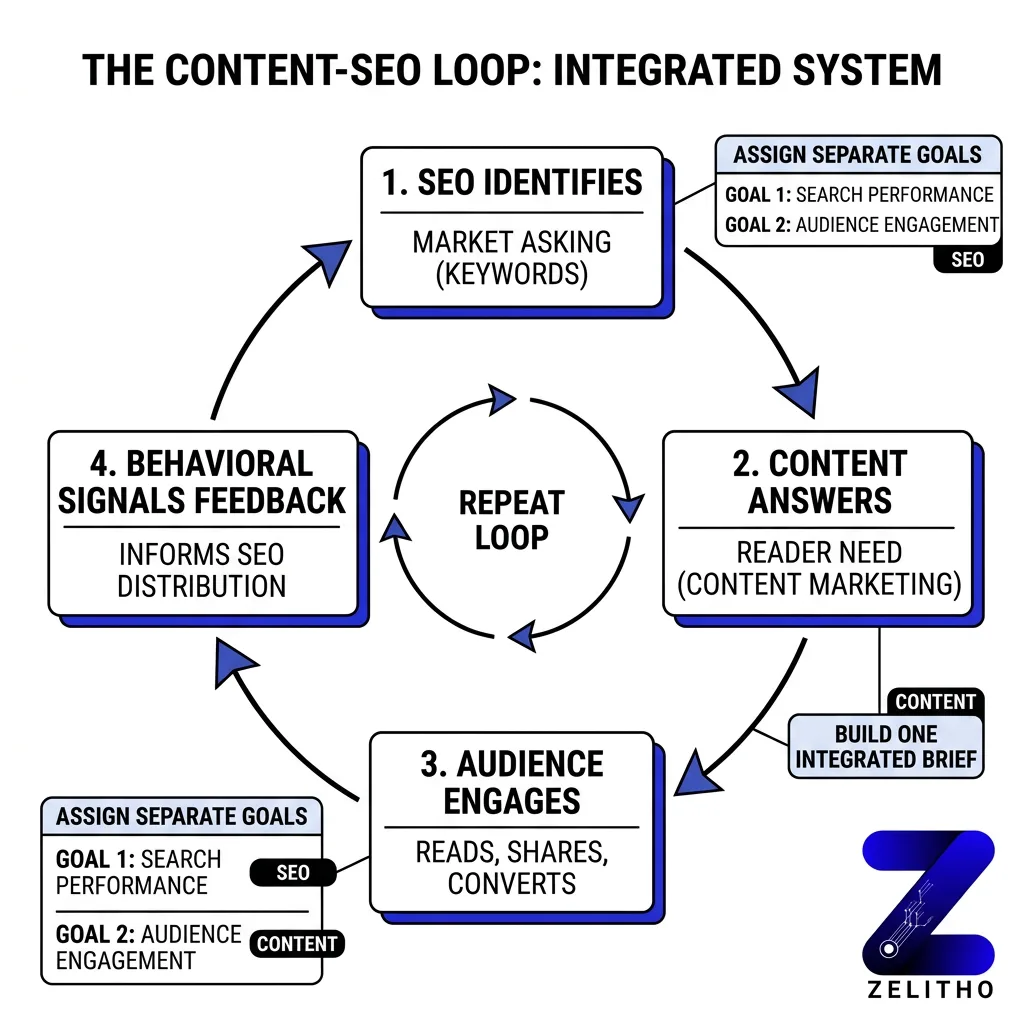
The Content-SEO Loop is what happens when you stop forcing them to compete. SEO research identifies what the market is asking. Content marketing answers what the reader actually needs. Behavioral signals from that audience feed back into SEO distribution. The cycle runs.
Assign separate goals to each discipline. Build one integrated brief. Measure both search performance and audience engagement. That discipline is what separates teams that produce content from teams that compound on it.
FAQ
No. Content marketing focuses on building audience trust through consistent, valuable publishing. SEO focuses on earning visibility in search results through technical optimization, keyword targeting, and link signals. They often use the same deliverable, such as a blog post, but they serve different goals and require separate success metrics.
No. SEO still controls discoverability in search. Content marketing controls trust and retention. Algorithms now reward useful content over keyword tricks – but search alignment remains essential for growth.
New sites need both, but start with enough optimized content to rank. Traffic with high bounce rates means shift budget toward better content. Budget tight? One strong article per theme beats ten thin keyword pages.
It adds rankable pages, builds topical authority, earns backlinks, strengthens internal links, and improves engagement signals – all of which search engines use to reward better visibility.
The four commonly recognized types are: on-page SEO (content and keyword optimization), off-page SEO (backlinks and authority signals), technical SEO (site speed, crawlability, indexation), and local SEO (geographic relevance for location-based queries). Each type addresses a different layer of search visibility.
The four stages are typically: Awareness (attracting new audiences), Consideration (helping prospects evaluate options), Decision (converting interested readers), and Retention (keeping existing customers engaged). Effective content programs assign content types and metrics to each stage rather than producing undifferentiated volume.
No. SEO is evolving, not disappearing. Search intent, page quality signals, and content depth are increasingly weighted over keyword density and technical tricks. Teams that align SEO with genuine audience needs are better positioned than those relying on older manipulation tactics.
Sources
[1]https://www.smartbugmedia.com/blog/content-marketing-vs-seo
[2]https://www.theadleaf.com/what-is-the-difference-between-content-marketing-and-seo/