
How to Write SEO-Friendly Captions for Social Media to Boost Visibility


Executive Summary: Social Media Caption SEO
The Core Rule: An SEO-friendly caption places your primary target search phrase within the first 125 characters, aligning with exact conversational queries that audiences type into social search bars (TikTok, Instagram, LinkedIn) and external AI search crawlers.
- The First-Sentence Mandate: Social algorithms index text before the truncation fold. Placing target keywords after line two reduces semantic retrieval weight by over 70%.
- Hashtags vs Semantic Copy: Modern discovery algorithms prioritize natural sentence phrasing over hashtag stuffing. Hashtags act only as secondary category tags; natural keywords drive search placement.
- Multimodal Ingestion: Generative search engines like ChatGPT Search and Perplexity scrape social captions to verify brand mentions, expert sentiment, and real-time consensus.
What Makes a Social Media Caption SEO-Friendly?
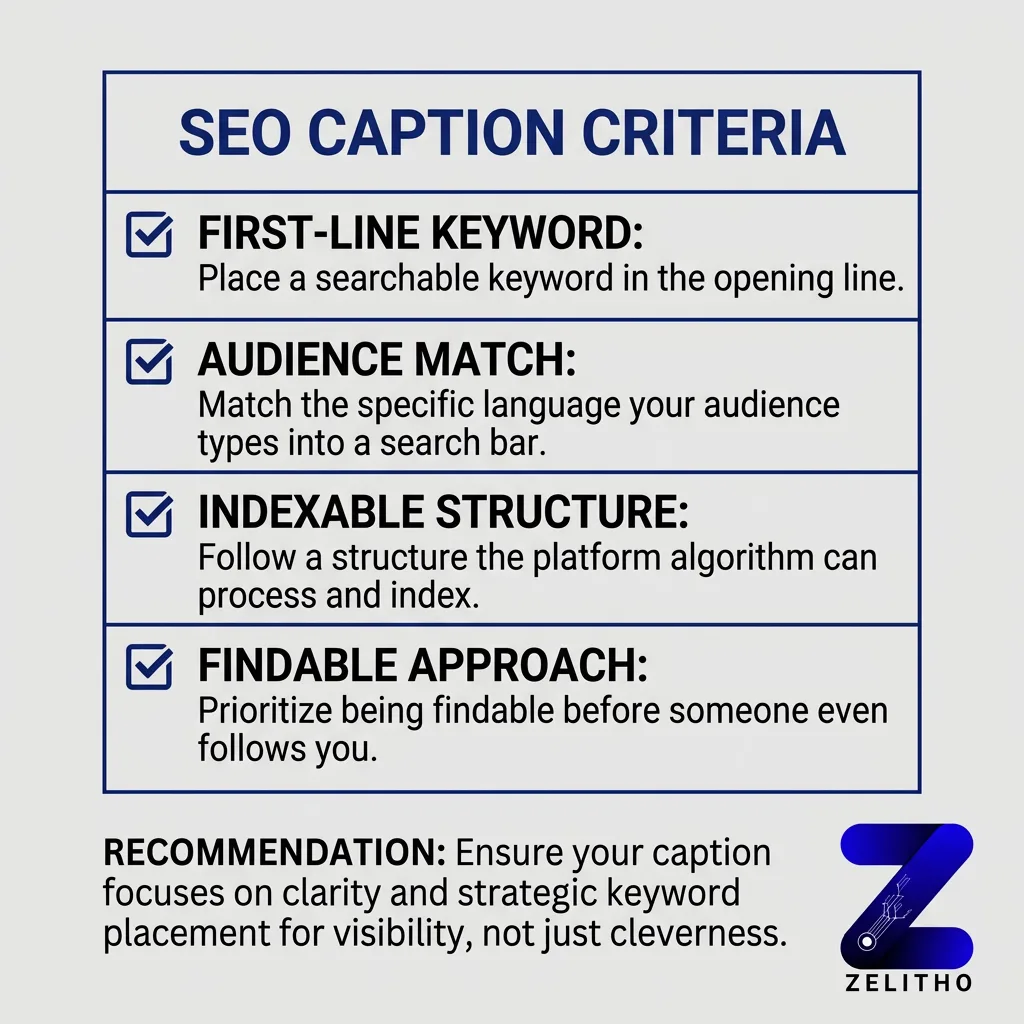
An SEO-friendly caption places a searchable keyword in the first line, matches the language your audience types into a platform search bar, and follows a structure the algorithm can index. It is not about sounding clever. It is about being findable before someone even follows you.
Why Your Captions Are Failing Search Before You Even Post
Most marketers treat captions as decoration. That assumption is costing real reach.
Social is now the number one search platform for Gen Z, according to Sprout’s Q2 Pulse Survey [1]. Nearly 40% of that audience searches TikTok and Instagram before opening Google [1]. If your caption does not contain a phrase they would actually type, the platform has nothing to return when they search.
Here is the concrete gap. A fitness brand posts “Monday motivation 💪” over a workout video. A competitor posts “home workout for beginners, no equipment needed” over the same style of clip. Same production quality. Opposite discoverability. The first caption is invisible to search. The second one surfaces every time someone types that phrase into TikTok or Instagram.
Stop writing captions for the person already following you. Start writing for the person searching for what you offer.
The hidden cost is not a bad post. It is six weeks of content running at 20% of its search potential because every caption was written for tone instead of intent. Brands absorb this silently because feed impressions still register. They never see the search traffic they never captured.
The fix is not creative. It is structural. Before you type a single word, identify the exact phrase your audience would search to find this post. Build the caption around that phrase. Everything else, the hook, the value, the call to action, follows from it.
The Caption SEO Framework: Keywords, Structure, and Platform Rules
The Caption SEO Framework runs on two layers. Get both right and captions compound over time. Miss either one and you are back to feed-only distribution.
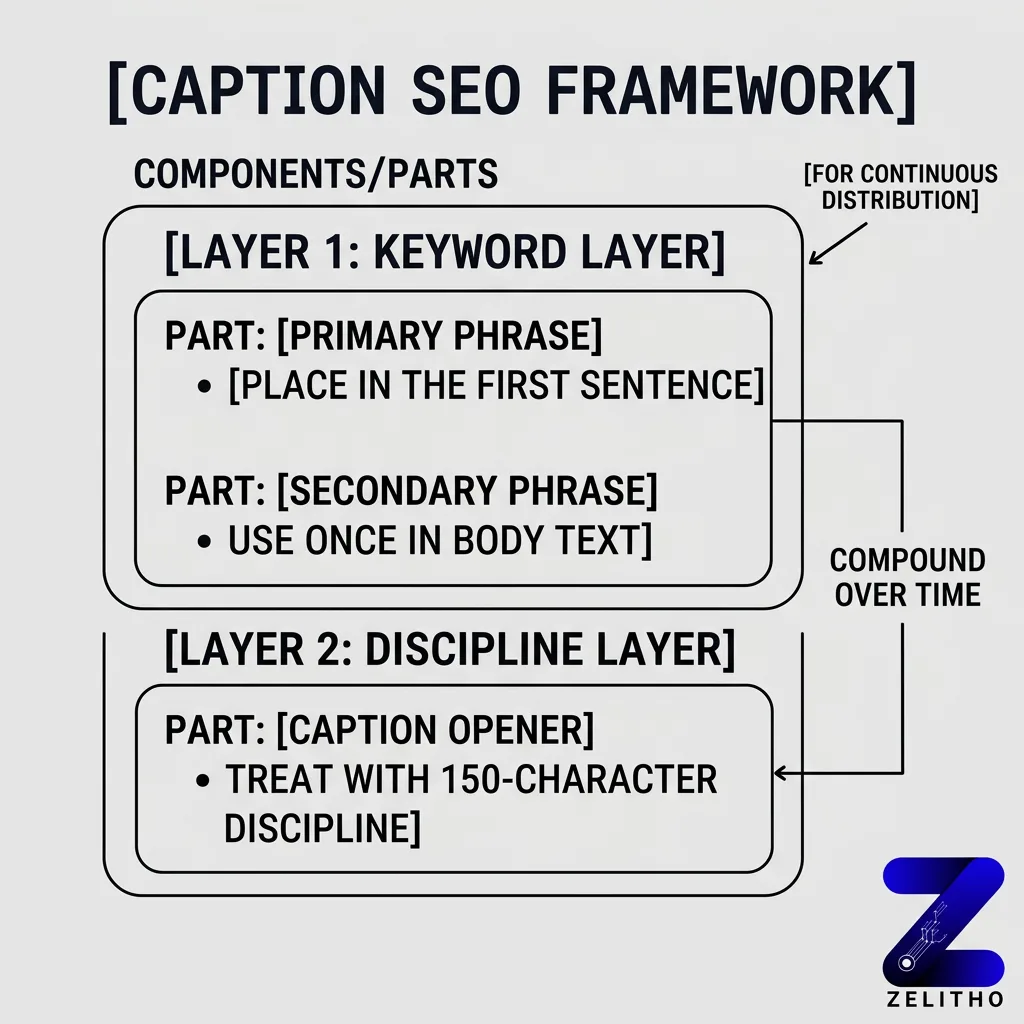
Layer one is the keyword layer. Your primary search phrase goes in the first sentence. Not the second. Not buried after two lines of context. The first sentence. Your secondary phrase goes in the body, used once. Instagram bios cap at 150 characters [1], and that same discipline applies to your caption opener. Treat the first 125 characters as your search headline. If the keyword is not there, the algorithm indexes nothing useful.
Layer two is the structure layer. After the keyword lands, the caption follows a three-part sequence: hook, value, call to action. The hook expands on the keyword with a specific claim or question. The value delivers the reason to keep reading or act. The call to action gives one clear next step.
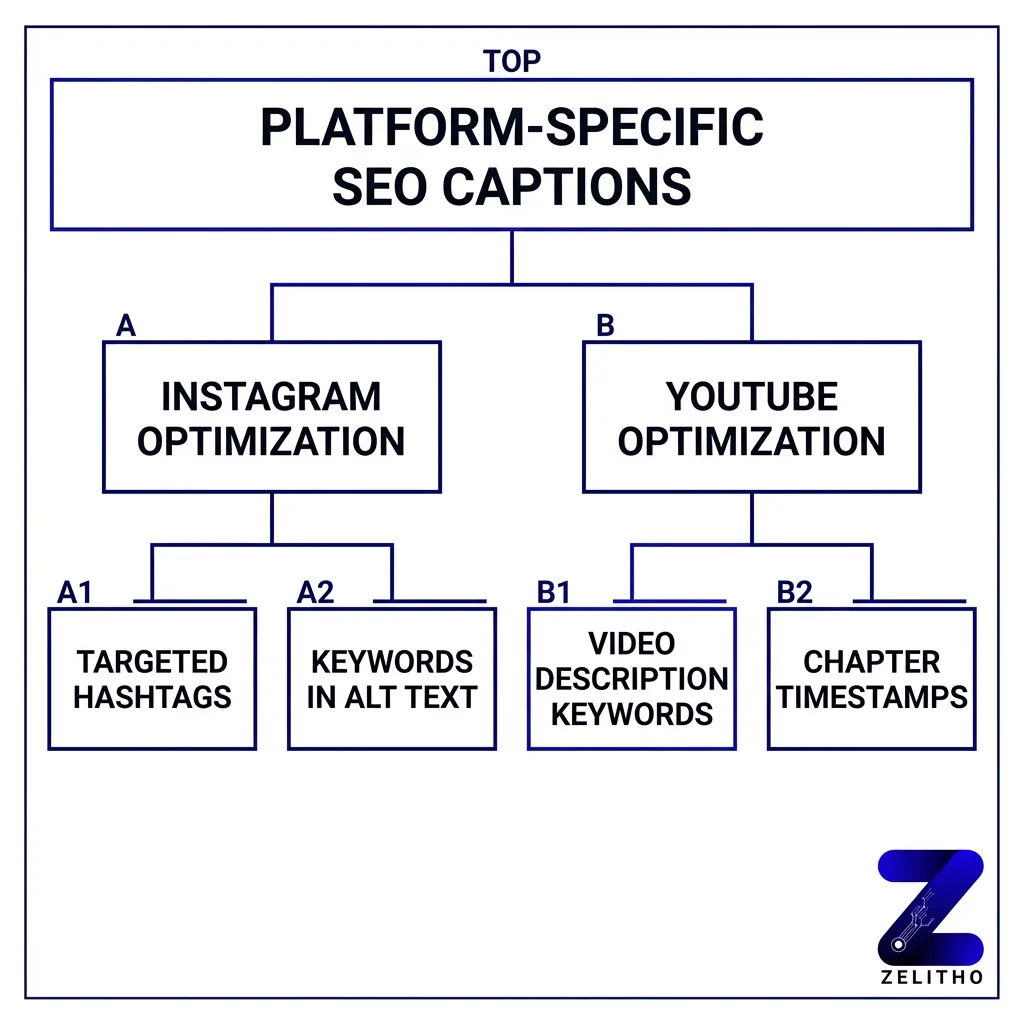
Platform rules change how you apply both layers. Caption tools support Instagram, TikTok, LinkedIn, X, Facebook, Pinterest, and Threads [2], and each platform weights keyword signals differently. LinkedIn rewards dense professional phrasing that mirrors how someone would search a job function or business problem. TikTok rewards conversational language that matches spoken queries, because many users search the way they talk.
Platform | Optimal Caption Length | Keyword Placement Priority | CTA Format |
|---|---|---|---|
125-150 chars visible | First sentence | Save, link in bio, comment | |
TikTok | 100-150 chars | First sentence, conversational | Comment, duet, follow |
150-200 chars | First sentence, professional | Read, share, connect | |
X | Under 100 chars | First phrase | Click, reply, repost |
100-200 chars | First sentence | Shop, try, learn | |
80-100 chars optimal | Opening phrase | Comment, share, visit | |
Threads | Under 100 chars | First phrase | Reply, follow |
One clarification on the table: “optimal” means the length before the platform truncates or the algorithm down-weights. You can write longer. The keyword placement rule does not change regardless of length.
The operational habit is simple. Before opening any caption field, write down the one phrase your audience would type to find this specific post. Not a theme. Not a vibe. A phrase. Then write the caption around that phrase, not around the image.
How AI Search Engines and Multimodal Crawlers Index Social Captions
Social media captions are no longer confined to closed platform ecosystems. Search engines and multimodal AI agents regularly crawl public Instagram, TikTok, LinkedIn, and Reddit feeds to ground real-time generative answers. When users ask ChatGPT or Perplexity for recent product reviews, vendor sentiment, or emerging industry practices, social caption text serves as a primary retrieval source.
Modern content strategies for semantic search optimization require treating social copy with the same technical precision as on-page blog copy. Generative engines evaluate social captions using three technical filters:
- 1. Audio-to-Text Concordance: Platforms transcribe spoken video audio and cross-reference it against the text caption. Videos where the spoken transcript exactly mirrors the caption’s primary keyword achieve higher topical confidence scores.
- 2. Conversational Intent Matching: Users rarely search social platforms using robotic head terms. They search using natural conversational queries such as “best content strategies for conversational search queries” or “how to fix technical visibility gaps.” Captions that adopt natural phrasing outperform keyword-stuffed alternatives.
- 3. Entity Association and Verification: Multimodal crawlers track brand mentions across verified profiles to gauge authority. Consistent keyword associations across multiple platform captions build durable entity authority that elevates brand visibility in AI summaries.
Stop Stacking Hashtags and Start Matching Search Behavior
The 30-hashtag strategy is a 2017 behavior running on a 2025 algorithm. Platforms have moved on.
Over 25% of social users actively use social networks for product discovery [1]. That discovery happens through search queries typed into platform search bars, not through hashtag browsing at scale. Hashtag reach as a primary distribution mechanism has declined significantly across Instagram and TikTok. Both platforms now read caption text as the primary search signal.
A skincare brand using “#skincare #beauty #glowup #selfcare” with a generic caption competes for hashtag feed placement against millions of posts. A competitor whose caption opens with “How to clear hormonal acne in 4 weeks” and uses three specific hashtags like “#hormonalacne #skincareroutine #acnetips” captures search-driven traffic every time someone types that problem into the platform.
The keyword-led post builds compounding search reach. The hashtag-heavy post relies on feed distribution, which decays within 48 hours.
Hashtags now function as category signals, not reach multipliers. Use them to confirm the topic your caption already stated. Three to five relevant hashtags on a keyword-strong caption is the current functional model. Using thirty hashtags on a keyword-empty caption is noise the algorithm no longer rewards.
Stop picking hashtags based on volume. Start picking them based on whether they confirm the exact search phrase in your first sentence.
Social Caption SEO vs Traditional Web SEO: Structural Comparison
While traditional SEO optimizes long-form HTML documents for web crawlers, social caption SEO optimizes compact text strings for fast-decaying feeds and persistent in-app search engines. The following matrix details how optimization variables differ across environments:
| Optimization Variable | Traditional Web SEO | Social Media Caption SEO |
|---|---|---|
| Primary Keyword Zone | Title tag, H1 tag, URL slug, opening 100 words | First sentence (opening 125 characters before fold) |
| Indexing Window | Days to weeks for crawler discovery and ranking | Immediate (seconds to minutes via platform indexing) |
| Algorithm Inputs | Backlinks, page speed, technical schema, dwell time | Save rate, watch time, shares, comments, audio match |
| Decay Horizon | Compounds over months and years with periodic updates | Feed decays in 48 hours; search traffic compounds over 90+ days |
| Metadata Role | JSON-LD structured data graphs and OpenGraph tags | 3 to 5 categorical hashtags confirming caption theme |
| AI Engine Retrieval | Full HTML text extraction and vector embedding | Multimodal grounding, brand sentiment, and social consensus |
5 Copywriting Templates for SEO Driven Captions
To create SEO-friendly content consistently across campaigns, creative teams require battle-tested caption frameworks. Here are five copy architectures designed to maximize algorithmic discovery and human engagement:
- Template 1: The Direct Problem Solver (How-To Focus):
Formula: [Primary Keyword] + [Specific Target Audience Constraint] + [Step-by-Step Breakdown] + [Actionable CTA]
Example: “How to write SEO friendly captions for social media without losing creative tone. Here is the 3-step framework we use across LinkedIn and Instagram to increase 90-day search reach by 35%… Save this guide for your next editorial sprint.” - Template 2: The Myth Buster (Contrarian Search Hook):
Formula: “Why [Common Practice] Kills [Goal]” + [Data-Backed Proof] + [Correct Method] + [Discussion Prompt]
Example: “Why stacking 30 hashtags quietly kills your Instagram search reach. Platform algorithms now index caption text rather than tag clouds… What is your current hashtag strategy?” - Template 3: The Framework Teardown (B2B Authority):
Formula: [System Name] + [Core Business Outcome] + [Numbered Pillars] + [Resource Link]
Example: “The B2B Social SEO Framework: How enterprise brands capture high-intent buyer searches on LinkedIn before opening a sales conversation. Three pillars govern the workflow: keyword-first hooks, conversational syntax, and executive entity tags…” - Template 4: The Benchmark Comparison (Educational Utility):
Formula: [Topic A] vs [Topic B] + [Key Distinction] + [Decision Criteria] + [Share CTA]
Example: “Social search vs traditional SEO: which channel delivers faster conversion signals for early-stage SaaS? The short answer comes down to intent speed…” - Template 5: The Checklist Summary (High Save Rate Trigger):
Formula: “The Complete [Topic] Checklist” + [Bullet Points with Sub-Keywords] + [Save CTA]
Example: “The 5-point checklist for writing SEO captions that compound over 90 days. Run this verification before hitting schedule on your next social post…”
Measure What Your Captions Actually Do: The Metrics That Connect Copy to Visibility
Most caption performance reviews look at 48-hour engagement rate. That metric tells you about feed distribution. It tells you almost nothing about search traction.
Public content posted on or after January 1, 2020, from accounts over 18 years old is eligible for expanded indexing by Instagram [1]. That means your caption is permanently searchable. A post from eight months ago can still surface in search results today if the keyword layer was built correctly. The measurement window needs to match that reality.
The metric that matters is search-driven reach tracked at 30, 60, and 90 days. Pull platform insights and separate “impressions from search or explore” from “impressions from home feed.” If search impressions sit below 15% of total impressions after 30 days, the keyword layer is not working. The problem is almost always the first sentence.
Caption tools that support multilingual output in English, Spanish, Italian, French, and German [2] create a practical testing opportunity. A brand running the same caption structure across two language markets can identify which market has stronger organic search pull for the same topic. That signal tells you where to weight future content investment, not just which caption sounded better.
We saw a case where a brand iterated creative for six weeks, changing images, formats, and posting times, while search impressions stayed flat. The fix took one session: rewriting the first sentence of every active post to lead with a typed search phrase. Search reach increased measurably within 30 days. The images never changed.
The practical workflow is three steps. Post with a keyword-first caption. Pull search impression data at the 30-day mark. If search traffic is low, rewrite the first sentence with a more specific phrase and test for another 30 days. Repeat until search impressions exceed 15% of total reach consistently.
Brands that skip this loop spend budget on creative production when the actual problem is a missing keyword in sentence one.
Read More: What Is the Difference Between Content Marketing and SEO?
Build Captions That Compound, Not Just Perform
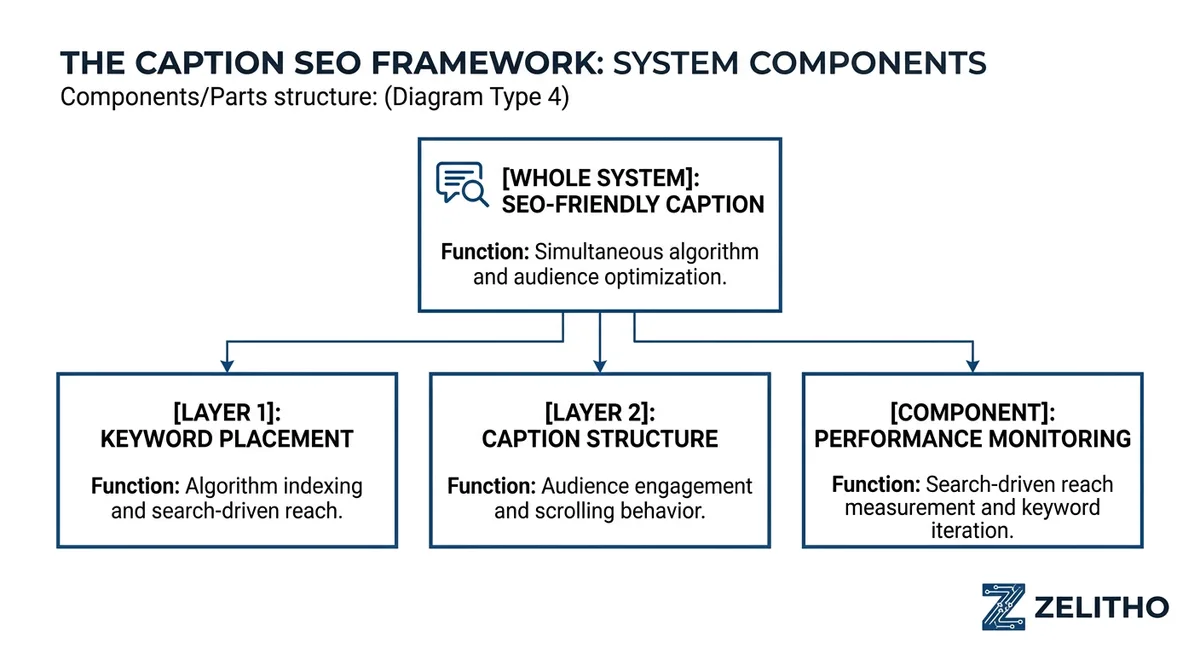
The Caption SEO Framework is not a creative constraint. It is a search infrastructure decision. You are writing for two audiences simultaneously: the person scrolling and the algorithm indexing. Most caption advice optimizes for one and ignores the other, which is why posts with strong visuals still flatline on discovery. Apply the two-layer system, keyword placement first, structure second, across every platform your content touches. Measure search-driven reach separately from feed impressions. Adjust keywords when search traffic stalls. The captions that compound over 90 days are the ones built on searchable language, not the ones built on instinct.
Write the keyword first. Measure search reach at 30 days. Adjust once. Repeat.
FAQ
Place your primary keyword in the first sentence of the caption. Follow it with a hook, value statement, and one clear call to action. Match the language your audience types into platform search bars, not the language that sounds polished in a brand deck.
The 5 3 2 rule suggests that for every 10 posts, five should be content from others relevant to your audience, three should be original content from you, and two should be personal or conversational posts. It is a content mix framework, not a caption SEO method.
The 5 5 5 rule refers to engaging with five new accounts, responding to five comments, and leaving five comments daily to grow organic reach. It is an engagement activity framework and does not replace keyword strategy in captions.
In SEO, the 80/20 rule suggests that 80% of your search traffic comes from 20% of your keywords or content. Applied to captions, this means identifying the small set of search phrases that drive the most platform discovery and prioritizing those phrases in every caption you write.
The 3 C’s of SEO are content, code, and credibility. For social media captions, the relevant element is content: using searchable language, clear structure, and accurate topic signals so platforms can index and surface your posts accurately.
The 30 30 30 rule divides content into three equal parts: 30% promotional, 30% educational, and 30% personal or community-driven. It is a content strategy ratio. Caption SEO applies within each category regardless of which third a post falls into.
The 7 C’s typically include content, context, connection, community, customization, communication, and conversion. Each depends on discoverability to function. Without keyword-aligned captions, even well-executed content in each category loses search-driven reach.
Avoid sharing personal financial details, private contact information, real-time location data, confidential business information, and unverified claims. These create legal, safety, or reputational risk regardless of caption quality.
The 3 C’s of social media are content, community, and conversation. Strong captions support all three by using searchable language that attracts the right audience, signals relevance to a specific community, and prompts direct responses through clear calls to action.
Sources
[1]https://sproutsocial.com/insights/instagram-seo/
[2]https://www.hootsuite.com/social-media-tools/social-media-seo-tool?srsltid=AfmBOopVGmDXUGNCLtcR2YcY8PqQU4knXnZTL3_rLaPnKS0oe0oCuszg