
How to Create and Optimize SEO Content: Key Concepts and Best Practices

TL;DR
• You just published content that ranked. Now you’re staring at a traffic graph that peaked in week two and has been sliding since. The page looked right. The keywords were there. Something underneath broke.
• Most guides tell you to write more, publish faster, and target low-competition keywords. That approach produces volume without durability. Rankings drop when competitors refresh their pages and your content stays frozen at its publish date.
The Content Foundation System covered in this guide gives marketers, founders, and agency owners a repeatable structure built on three pillars: content quality, keyword relevance, and site maintenance. Apply it to each page you create. Return to every page on a six-month cycle. That cycle is what separates content that holds from content that fades.
What does it take to actually rank and keep traffic from SEO content?
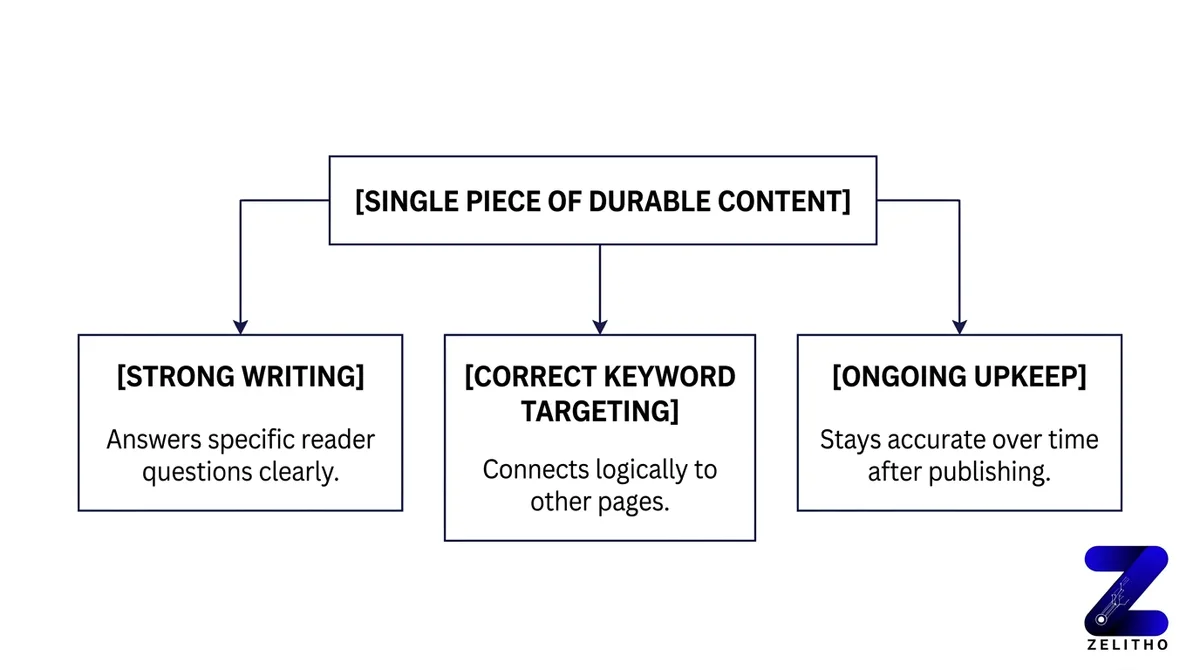
Ranking requires more than a keyword in your headline. Search engines reward pages that answer a specific question clearly, connect logically to other pages on the same site, and stay accurate over time. A single piece of content requires three things working together: strong writing, correct keyword targeting, and ongoing upkeep after publishing.
Read More: How to Create and Optimize SEO-Rich Content to Boost Search Rankings and User Engagement
The Content Foundation System: What SEO Content Actually Requires
Most people treat SEO as a keyword placement task. Place the phrase in the title, drop it in the first paragraph, and repeat it throughout. That is not a system. That is a habit with no structural support.
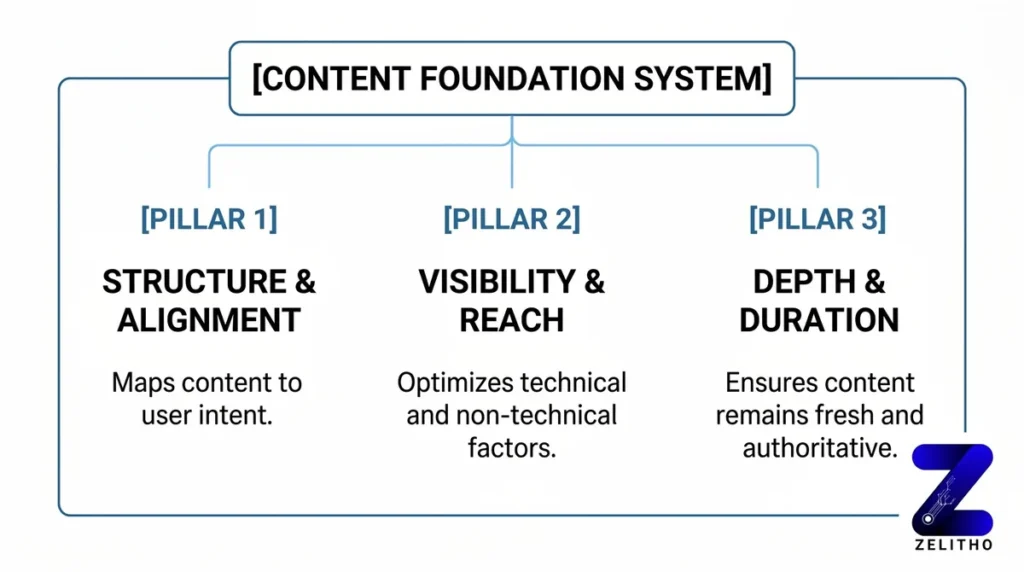
The Content Foundation System rejects that approach. It organizes every piece of content around three pillars, each controlling a different layer of performance.
Stop guessing which part of your content is failing. Start auditing all three pillars separately.
Pillar | What It Controls | What Breaks Without It |
|---|---|---|
Content Quality | Clarity, structure, and answer completeness | High bounce rate, low time on page |
Keyword Relevance | Topic coverage and semantic depth | Poor ranking for related search queries |
Site Maintenance | Broken links, outdated facts, page speed | Rankings drop as competitors refresh content |
Each pillar depends on the others. Strong writing on a page with broken internal links loses authority. Correct keyword targeting on a page with thin answers does not hold position.
Keyword relevance means more than targeting one phrase. Research supports using 7 to 10 related keywords per topic to cover the full semantic range a reader might use [1]. A page targeting “SEO content” should also address terms like “content optimization,” “on-page SEO,” and “keyword research process.” That breadth signals topical authority.
Site maintenance is the most skipped pillar. It means fixing broken internal links, correcting outdated statistics, removing pages that return errors, and confirming that every page loads correctly on mobile. These are operational tasks, not creative ones. They belong on a calendar, not a to-do list.
You Are Probably Writing for Search Engines When You Should Be Writing for People
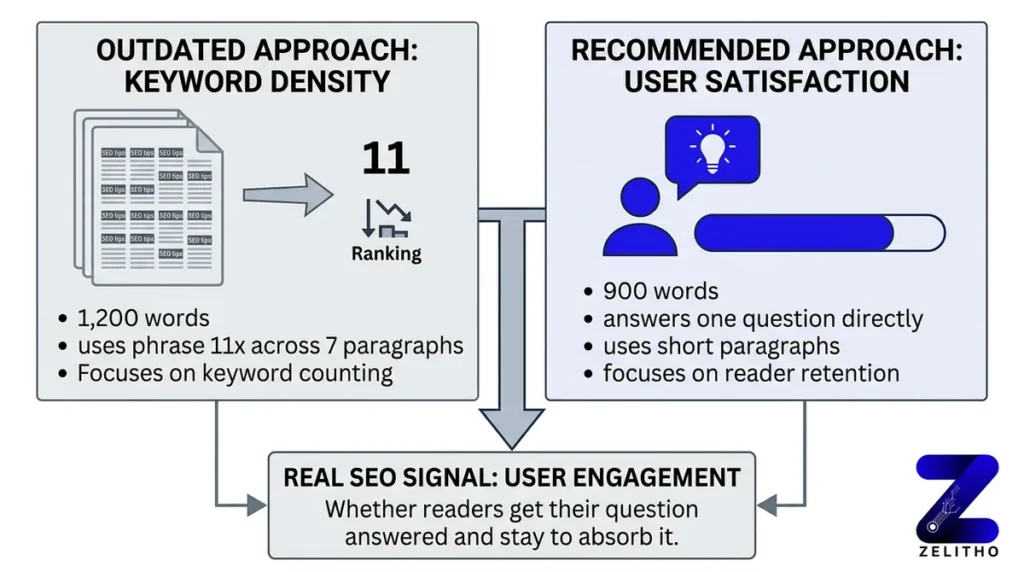
Here is the false assumption that ruins most early SEO work: keyword density drives rankings. It does not. It never did consistently.
The real signal is whether a reader gets their question answered and stays on the page long enough to absorb it.
Consider two posts covering the same topic. The first runs 1,200 words and uses the phrase “best SEO tips” eleven times across seven paragraphs. The second runs 900 words and answers one question directly with short paragraphs and clear subheadings. The second post holds its ranking longer. Not because it followed a formula, but because readers finished it.
Short paragraphs reduce visual friction. Subheadings let readers scan before they commit. Plain language keeps them moving forward. These choices lower bounce rate and raise time on page. Both signals influence how a page is evaluated over time.
There is a concrete check you can run right now. Pull your last three published posts. Count how many times you repeated the primary keyword. Then count how many times you directly answered a specific question the reader came to your page with. If the keyword count is higher than the answer count, the draft was written for a crawler, not a person.
This is not a crisis. It is a drafting habit, and habits change fast.
Step-by-Step: How to Build and Optimize a Single Piece of Content
Every strong piece of optimized content follows the same sequence. Skipping steps does not save time. It creates rework when rankings stall.
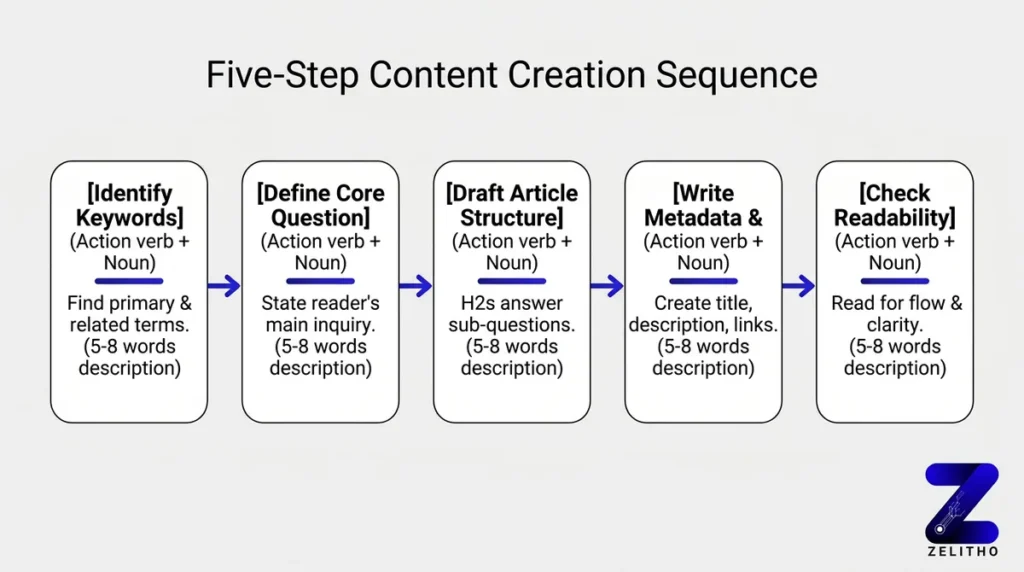
The five-step process:
Choose a primary keyword and identify 7 to 10 related terms covering the full topic [1].
Write out the reader’s core question before touching the headline.
Draft with structure: each H2 answers a specific sub-question.
After drafting, write the title tag, meta description, and add internal links.
Read for readability before publishing. Cut any sentence that does not move the reader forward.
Most guides tell you to focus on word count. This system focuses on question completeness instead. A 600-word page that answers one question fully outperforms a 2,000-word page that circles the same point without resolution.
Here is what that difference looks like in practice:
What Most Guides Say | What Actually Moves the Needle |
|---|---|
Hit a minimum word count | Answer the question completely, then stop |
Place keywords in exact positions | Use related terms naturally across subheadings |
Publish frequently | Publish less and maintain what you have |
Add more sections for coverage | Remove sections that don’t answer a reader question |
Step four gets skipped most often. Writers draft, publish, and move on. The title tag gets left as a default. The meta description pulls from the first paragraph. Internal links point only to the homepage.
Each of those gaps costs discoverability without any dramatic warning. The page simply ranks lower than it should.
Map the reader’s question before you write the headline. That single habit changes what you write in every section that follows. You’re not filling a structure. You’re answering someone.
Ignoring Content Maintenance Is the Fastest Way to Lose Rankings You Already Earned
Published content is not finished content. That distinction costs people real traffic.
Here is a directional scenario that happens regularly. A page climbs to position 4 over three months. Traffic holds steady. Six months later, a competitor updates their version of the same page with fresher data, adds two internal links pointing to related posts, and fixes a broken anchor link. Their page moves to position 2. Your page drops to position 14. Nothing changed on your page. That is the problem.
Search engines re-evaluate pages continuously. A page that looked accurate in January can look stale by August if the topic moved. Competitors update. New research gets published. Your data stays from the original publish date.
The minimum maintenance cycle is a review every six months per published URL. Each review checks three things: outdated facts, broken internal links, and whether the keyword the page was targeting still matches what readers search for today. That last item is called keyword drift, and it happens more often than most people expect.
Connect this back to the Content Foundation System. Pillar one and pillar two do their job when you publish. Pillar three is what keeps the first two working over time. Skip it, and the work you put into quality and relevance slowly erodes without any visible trigger.
The operational move is simple. Create a spreadsheet with three columns: published URL, original publish date, and last reviewed date. Sort by publish date. Anything older than 12 months goes to the top of your review queue. Work through it in order.
A marketing team skipped this process for 14 months across 40 published posts. When they finally audited, 22 pages had at least one broken internal link, and 9 had statistics referencing data that was three years outdated. After fixing both, average position across those pages improved within 60 days.
Do not wait for traffic to drop before you review. By then, recovery takes longer than prevention would have.
The Content Foundation System is not a set of tricks.
It is a repeatable structure with three connected parts.
Build content around quality and relevant keywords. Write for the person reading the page. Follow the five-step creation process on every piece you publish. Then maintain what you have already published on a fixed six-month cycle.
Beginners who skip site maintenance lose ground they worked months to gain. A page ranking in position 4 can fall to position 14 with no change to the page itself, simply because a competitor updated theirs.
Apply the five-step process to your next piece. Set a calendar reminder to return to it in six months. Search performance is not a launch event. It is a creation and maintenance cycle that compounds over time.
Your next publish date and your next review date carry equal weight.
Sources
[1]https://foundryco.com/blog/8-best-practices-to-boost-seo-performance/