
How SEO and Content Management Roles Work Together to Improve Website Visibility

Executive Summary: SEO and Content Management Operations
The Operational Mandate: Sustainable website visibility is achieved when search engine optimization and editorial content management operate as an integrated production system, embedding technical search intent, semantic entity mapping, and syntactic chunking directly into editorial briefs before drafting begins.
- The Handoff Failure: Reviewing SEO factors after content is written creates expensive editorial rework and produces shallow keyword retrofitting that fails both Google rankings and AI answer selection.
- The Modern SEO Content Manager: Bridges technical architecture (schemas, internal links, crawl budgets) with editorial excellence (brand voice, original research, narrative pacing) to capture page-one rankings.
- AEO-Ready Workflows: Modern editorial teams structure content with direct answer blocks and structured tables, ensuring articles are easily digested by LLM crawlers like Bingbot and ChatGPT-User.
Why Separating SEO and Content Quietly Kills Rankings
Look at your content calendar.
Now look at your ranking dashboard.
If those two documents are not built together, you’re creating pages that will never rank.
Here is the structural mistake:
•Writers choose headlines without keyword data.
•Content managers approve outlines without validating search intent.
•SEO specialists review pages after publication.
At that point, optimization becomes retrofitting.
The top Google result captures nearly 32% of clicks, and about 25% of users never scroll past page one. If your page was not built to compete structurally from the first draft, it will not reach meaningful traffic.
The issue is not talent.
It is timing.
SEO input must happen at the brief stage, not the review stage.
Why Treating SEO and Content as Separate Departments Quietly Costs You Rankings
You are looking at a content calendar with 18 articles scheduled for the next six weeks. The SEO specialist is in a separate Slack channel, flagging technical issues on pages published two months ago. Nobody is connecting the two conversations.
That is not an edge case. It is the default operating mode for most funded marketing teams.
Here is the false assumption worth exposing: more content output means more rankings. It does not. Uncoordinated content produces pages that compete with each other, miss search intent, and drain crawl budget without returning traffic.
The cost is measurable. The top position on Google receives nearly 32% of user clicks, roughly 25% of web users never scroll past the first page of results [1]. If your content is not built to target rankable positions from the first draft, most of it will never reach the traffic threshold that justifies its production cost.
The structural break happens at the handoff. SEO input arrives after the content is written. The writer chose a headline without keyword data. The content manager approved a structure without checking search intent. The SEO specialist now has to recommend revisions on a page the writer has mentally closed.
Stop treating SEO review as a publishing gate. Start treating SEO input as a brief requirement.
Every week that gap stays open, your content archive grows larger and your rankable page count stays small. One position improvement in search rankings increases click-through rates by approximately 30.8% [1]. That compounding effect only activates when the content was built to rank in the first place.
The Integrated Visibility System: How SEO and Content Roles Overlap in Practice
The Integrated Visibility System is not a new org chart. It is a shared operating layer where SEO and content roles carry overlapping responsibilities at specific workflow stages.
Here is what that looks like in practice.
| Workflow Stage | SEO Specialist Input | Content Manager Input |
|---|---|---|
| Brief Creation | Keyword targeting, search intent, competitor gap | Topic angle, audience fit, content format |
| Draft Review | Heading structure, internal linking, entity coverage | Readability, tone, argument clarity |
| Post-Publish | Ranking monitoring, crawl health, schema | Refresh triggers, CTA performance, repurposing |
Neither role disappears. Each role sharpens its lane while sharing data at three fixed points.
One client running this structure grew keyword rankings from 5 to 101 in 8 months [2]. The mechanism was not a content volume increase. It was role alignment: SEO data shaped briefs, and content managers built to those specs from day one.
There is a structural reason this works. Highest-ranking pages on Google consistently show longer and more detailed content [2]. That depth does not happen accidentally. It requires a content manager who knows what questions a page needs to answer, sourced from keyword and intent data the SEO specialist provides.
The overlap point most teams miss is the brief stage. Most content managers receive a topic and a deadline. They need to receive a topic, a target query, a competing URL, and a content depth signal. That package comes from the SEO role. When it does not, the content manager fills the gaps with assumptions, and the page reflects those assumptions in its rankings.
The friend advice version: if your SEO specialist and content manager are not in the same brief review meeting, fix that before you fix anything else.
The Modern SEO Content Manager: Core Skills and Operational Responsibilities
The traditional divide between “the person who writes the copy” and “the technical person who monitors rankings” has collapsed. Fast-growing marketing organizations now rely on the SEO Content Manager: a hybrid operational role responsible for translating keyword opportunities and search intent data into high-converting editorial assets.
An effective SEO content manager operates at the intersection of three functional domains:
- 1. Search Intent Architecture: Identifying high-opportunity search terms, analyzing competing SERP features, and building structured content briefs that outline exact H2 and H3 hierarchies before writers draft a single word.
- 2. Editorial Quality Governance: Ensuring content satisfies rigorous human editorial standards, demonstrates genuine first-party expertise (E-E-A-T), and avoids generic AI-generated fluff that dilutes topical authority.
- 3. Technical Content Enablement: Configuring CMS templates, implementing valid JSON-LD schemas, managing internal linking silos, and ensuring all tables and visual assets are fully responsive across mobile viewports.
RACI Responsibility Matrix: SEO vs Content Management Across the Editorial Lifecycle
To eliminate operational bottlenecks and publishing delays, marketing teams must define clear decision rights. The following RACI matrix outlines role accountabilities across every production phase:
| Production Phase | SEO Specialist | Content Manager | Writer / Creator | Core Deliverable |
|---|---|---|---|---|
| Topic Discovery & Opportunity Mining | Accountable | Consulted | Informed | Target keyword inventory & SERP gap analysis |
| Brief Creation & Intent Mapping | Responsible | Accountable | Informed | Standardized content brief with H2/H3 blueprint |
| Drafting & Answer-First Structuring | Informed | Consulted | Accountable | Completed draft with answer summaries & tables |
| Technical Optimization & Schema Injection | Accountable | Responsible | Informed | Dual-layer JSON-LD schemas & internal linking graph |
| CMS Publishing & Instant Indexing | Consulted | Accountable | Informed | Live published URL & IndexNow API submission |
| 30-60-90 Day Performance Review | Accountable | Accountable | Informed | Content refresh triggers & ranking optimization plan |
Step-by-Step: Aligning Content Production to Search Intent and Technical Requirements
Building content that ranks requires SEO and content decisions to happen in the same sequence, not in parallel silos that merge at the end.
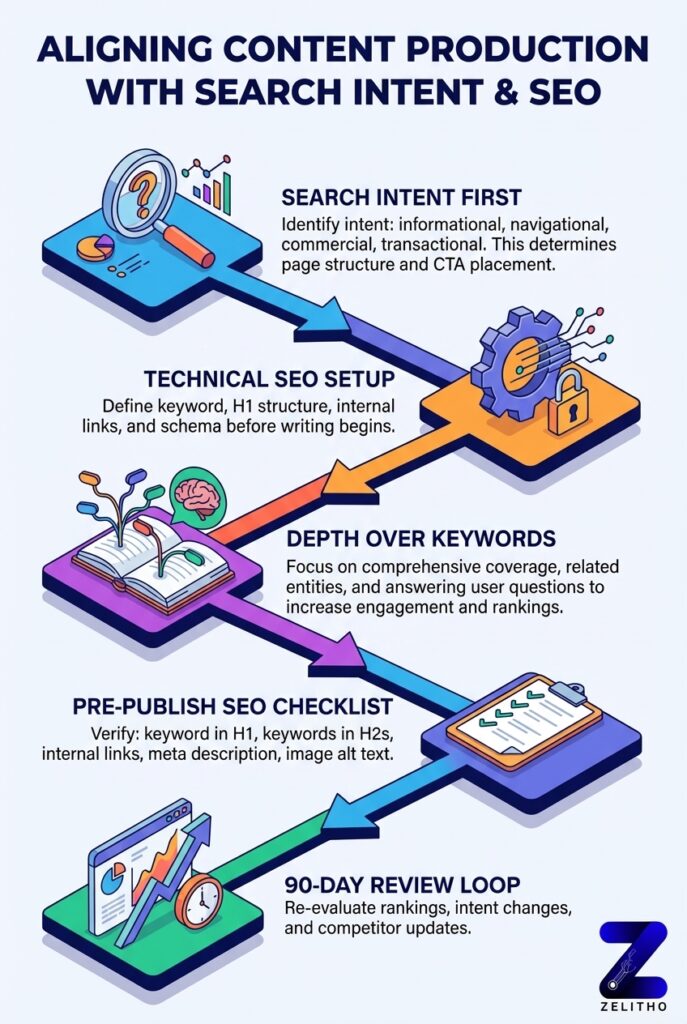
Step 1: Anchor the brief to a search intent category.
Every content brief must identify whether the target query is informational, navigational, commercial, or transactional. That classification determines page structure, heading depth, and call-to-action placement. A commercial intent page structured like a blog post will not rank against comparison pages built for that query.
Step 2: Map technical requirements before the first word is written.
The SEO specialist confirms the target keyword, primary heading structure, required internal links, and any schema type before writing starts. This takes 20 minutes per brief. Retrofitting those elements after publishing takes days and still underperforms a page built with them from the start.
Step 3: Build content depth to match ranking benchmarks.
Content optimization on a single blog produced an 885% traffic increase and an 855% increase in prospects over 10 months[2] . The same optimization lifted average reader time from 34 to 145 seconds, a 326% gain in engagement. That result came from depth targeting, not keyword stuffing. The content manager answered more questions, covered related entities, and structured the page for sustained reading.
Step 4: Run a pre-publish SEO checklist as part of the content approval workflow.
The checklist is not a final audit. It is a confirmation that requirements set in the brief were executed in the draft. It covers: target keyword in H1, supporting keywords in H2s, internal link count, meta description presence, and image alt text. If any item is missing, it returns to the writer, not the SEO specialist.
Step 5: Set a re-evaluation trigger at 90 days.
No page is finished at publication. Rankings shift, competing pages update, and search intent evolves. A 90-day review flag built into the content calendar ensures that pages get reassessed before they decay past recovery.
This workflow embeds SEO into production rather than layering it on top. The content manager does not wait for SEO approval. The SEO specialist does not chase down published pages. Both roles execute their part of a shared sequence.
Continuous Optimization and Multi-Channel Distribution: Where the Integrated Visibility System Compounds
Publishing a page is the start of the ranking process, not the end. The Integrated Visibility System compounds when teams build an ongoing loop rather than a one-time output.
Content consolidation is the first lever. When a site has multiple pages targeting similar queries, search engines split ranking signals across them. Consolidating weaker pages into a single authoritative page concentrates those signals. Consolidation improvements typically show measurable results within 6 to 12 weeks.
The case moment: a team had four blog posts covering overlapping subtopics. Traffic was split across all four, and none ranked on page one. They merged three into a primary pillar post with redirects from the others. Within eight weeks, the consolidated page ranked on page one for the primary query and two supporting terms.
Multi-channel distribution is the second lever. A ranked page feeds other channels with lower acquisition cost. A LinkedIn post referencing a top-ranking article earns credibility from the ranking signal. An email segment driving traffic to an optimized page strengthens behavioral signals that Google uses for ranking adjustments. Distribution is not separate from SEO. It feeds it.
The SEO specialist tracks which distributed channels drive return visits and time-on-page. That data tells the content manager which formats warrant expansion. The loop closes: distribution data informs the next brief, which produces a page optimized for both ranking and conversion.
One operational checkpoint to install: a monthly ranking review where the SEO specialist and content manager review pages ranked in positions 5 to 15. Those pages are the highest-leverage targets for optimization. A one-position improvement for a page at position 8 can increase click-through by approximately 30.8% [1]. That lift requires a focused rewrite, not a new article.
The mistake most teams make is treating distribution as a marketing function and optimization as a technical function. Both are part of the same output loop. When the SEO specialist owns ranking data and the content manager owns distribution data, neither has the full picture. Share both dashboards in one standing review.
AI Workflow Services: Building Trustworthy, AEO-Ready Content Pipelines
Modern enterprise content operations increasingly deploy AI workflow services for search visibility optimization. Rather than using artificial intelligence to mass-produce shallow articles, leading editorial teams integrate AI tooling into structured verification pipelines that enhance speed without sacrificing factual accuracy.
When selecting AI content optimization software for editorial teams, organizations evaluate platforms against four critical criteria:
- 1. Grounding and Fact Verification: Automated cross-checking of claims against primary documentation to eliminate hallucinations and maintain citation trustworthiness for US readers.
- 2. Syntactic Chunking Engine: Algorithmic parsing of long-form drafts into clean 40-word answer blocks, definition summaries, and mobile-friendly comparison matrices.
- 3. Search Intent Concordance: Real-time analysis comparing draft headings against current Google SERP features and Bing AI opportunity queries.
- 4. Seamless CMS Integration: Direct API handoffs that push structured HTML, custom metadata, and JSON-LD graphs into WordPress without human formatting errors.
The Integrated Visibility System Is an Operational Posture
The Integrated Visibility System is not a one-time project. It is an operational posture that teams adopt and repeat. SEO specialists who understand content production make better technical recommendations. Content managers who understand search intent write pages that rank without rework. When both roles share data, timelines, and accountability, the compounding effect becomes measurable within weeks, not quarters.
Start by auditing one workflow where SEO input arrives after content is already drafted. Fix that handoff first. Everything downstream improves from there.
FAQ
SEO increases visibility by aligning page content, structure, and technical signals to what search engines index and rank. When a page targets the right query with the right depth and structure, it earns placement in positions that receive substantial traffic. The top position on Google captures nearly 32% of clicks. Lower positions receive exponentially less.
SEO defines what a page needs to rank: target query, intent category, structural requirements, and internal link context. Content production fills that structure with depth, argument, and readability. When both functions operate from the same brief, the resulting page satisfies both search engine requirements and reader expectations simultaneously.
SEO and PPC share keyword data that benefits both channels. PPC reveals which queries convert, informing SEO content targeting. SEO reveals which organic pages rank well, reducing PPC spend on queries where organic visibility already exists. Teams that share keyword performance data across both channels avoid duplication and prioritize budget against gaps.
Content management controls what gets published, when, and in what format. Without structured content management, SEO recommendations do not get implemented consistently. A content manager who understands search intent ensures that briefs, approval workflows, and publishing schedules reinforce SEO goals rather than working around them.
The four pillars are technical SEO, on-page optimization, off-page authority, and content relevance. Technical SEO covers crawlability and site structure. On-page covers headings, metadata, and keyword placement. Off-page covers links and signals from external sources. Content relevance ensures the page depth and topic coverage match what the target query demands.
Start by identifying which pages rank in positions 5 to 15 and optimise those first. Consolidate overlapping pages that split ranking signals. Align new content briefs to specific search intent categories before writing starts. Build internal links between topically related pages. Monitor ranking shifts at 30-day intervals and adjust content depth based on what competing pages are covering.
The 3 C’s are content, code, and credibility. Content refers to relevance and depth. Code refers to technical structure and crawlability. Credibility refers to the authority signals a page and domain earn through links and behavioural engagement. All three must align for a page to rank competitively on high-volume queries.
The five pillars are audience targeting, search intent alignment, content format selection, distribution planning, and performance measurement. A content strategy that omits intent alignment produces content that does not rank. A strategy that omits measurement produces no feedback loop for improving future content decisions.
The five core concepts are crawlability, indexability, relevance, authority, and user experience signals. Crawlability ensures search engines can access and read your pages. Indexability ensures they are eligible to appear in results. Relevance connects content to query intent. Authority reflects external trust signals. User experience signals, including time-on-page and return visits, influence ranking position over time.
Sources
[1]https://www.agencyjet.com/blog/improving-your-online-visibility-the-role-of-seo-and-digital-marketing-in-2024
[2]https://www.scriblymedia.com/blog/seo-and-content-marketing