
What Is SEO Strategy: A Comprehensive Guide to Understanding and Planning SEO for 2026 and beyond

- TL;DR
- SEO strategy is a high-level roadmap that defines how your website will compete and win in organic search, not just a list of tactics.
- It involves setting measurable goals, understanding your unique competitive positioning, and executing across four core pillars: technical SEO, user experience, on-page optimization, and off-page authority building.
- A complete strategy starts with thorough keyword research aligned to audience intent, prioritizes high-quality E-E-A-T content, and builds authoritative backlinks.
- SEO is a long-term investment requiring continuous monitoring and adaptation to algorithm changes, voice search trends, and mobile-first indexing.
- This guide walks through a step-by-step framework to build, execute, and refine a sustainable SEO strategy that drives meaningful organic growth.
SEO strategy is one of the most misunderstood concepts in digital marketing. Many professionals confuse it with a laundry list of tactics or a simple planning document. The reality is far more nuanced. An effective SEO strategy is a cohesive, high-level roadmap that defines why your website deserves to rank ahead of competitors and how you’ll achieve sustainable organic visibility.
This comprehensive guide clarifies what SEO strategy truly means, breaks down its core components, and provides a practical framework for building a plan that drives measurable results. Whether you’re starting from scratch or refining an existing approach, you’ll learn how to align goals, differentiate your positioning, and execute tactics that support long-term organic growth.
Understanding SEO Strategy vs. SEO Tactics and Planning
One of the biggest mistakes marketers make is treating strategy, tactics, and planning as interchangeable terms. This confusion leads to unfocused campaigns that chase quick wins without sustainable direction.
Goals define your destination-what you want to achieve through SEO. Examples include increasing organic sessions by 30 percent in six months, generating 100 qualified leads per month, or ranking on page one for five high-intent keywords. Goals answer the question “what do we want to accomplish?”
Strategy is your competitive positioning-how you’ll differentiate your site and win against competitors. It explains why your website deserves to rank for target keywords. For instance, a strategy might focus on becoming the most comprehensive resource for beginner web developers by offering free tools, detailed tutorials, and community support that competitors lack. Strategy answers “why should search engines and users choose us?”
Tactics are the specific methods you’ll use to execute your strategy. These include keyword optimization, creating pillar content, building backlinks, improving page speed, and optimizing meta descriptions. Tactics answer, “how will we implement the strategy?”
Planning breaks down the execution timeline, assigns responsibilities, and allocates resources. It turns strategy and tactics into a manageable project schedule. Planning answers “who does what, when, and with what resources?”
Understanding these distinctions is crucial. A campaign built on tactics alone lacks direction. A strategy without tactical execution remains theoretical. According to 2023 HubSpot data, sales, leads, and conversions are the most important metrics tracked by web analysts, emphasizing the need for goal-focused strategic planning rather than random tactical efforts.
The Four Core Components of a Complete SEO Strategy
Every robust SEO strategy addresses four interconnected pillars that work together to improve organic rankings and user satisfaction. Neglecting any single component weakens your overall performance.
Technical SEO ensures search engines can crawl, index, and understand your website efficiently. This includes site architecture, XML sitemaps, robots.txt configuration, canonical tags, structured data markup, and HTTPS security. Technical issues create barriers that prevent your content from ranking, regardless of quality.
User Experience Optimization focuses on how visitors interact with your site. Search engines increasingly prioritize engagement metrics like bounce rate, session duration, and pages per visit. A fast-loading, mobile-friendly, intuitively navigated site keeps users engaged and signals quality to algorithms.
On-Page Optimization involves improving individual pages through strategic keyword placement, compelling meta titles and descriptions, proper header tag hierarchy, optimized image alt text, and internal linking. Each page should target a specific keyword intent without cannibalizing other pages.
Off-Page Optimization and Link Building establish your site’s authority through external signals. High-quality backlinks from reputable sources act as endorsements, telling search engines your content is trustworthy and valuable. Brand mentions, social signals, and partnerships also contribute to off-page strength.
These four pillars are not isolated efforts. Technical SEO creates the foundation for excellent user experience. Strong on-page optimization makes link-building outreach more successful. User engagement signals reinforce the value of your backlinks. A complete strategy addresses all four systematically.
Technical SEO and Site Performance
Technical SEO is the invisible infrastructure that makes everything else possible. If search engine crawlers cannot access or understand your content, no amount of keyword optimization will help you rank.
Start with site architecture. Your URL structure should be logical, shallow (ideally three clicks or fewer from the homepage to any page), and descriptive. Use HTTPS encryption for security and trust signals. Implement XML sitemaps and submit them through Google Search Console and Bing Webmaster Tools to guide crawlers to important pages.
Page speed directly impacts both rankings and user satisfaction. Compress images without sacrificing quality, enable browser caching, minify CSS and JavaScript, and consider a content delivery network for faster global load times. Google’s Core Web Vitals-Largest Contentful Paint, First Input Delay, and Cumulative Layout Shift-are now official ranking factors.
Mobile optimization is non-negotiable. With mobile-first indexing, Google predominantly uses the mobile version of your site for ranking. Ensure responsive design, readable font sizes without zooming, and touch-friendly navigation. Test your site using Google’s Mobile-Friendly Test tool.
Finally, implement structured data markup (Schema.org) to help search engines understand your content’s context. Rich snippets can improve click-through rates by displaying ratings, prices, or event information directly in search results.
On-Page and Off-Page Optimization Essentials
On-page optimization involves fine-tuning individual pages to match user intent and search engine requirements. Start with keyword research to identify target terms, then naturally integrate them into title tags, H1 headers, and the first 100 words of content. Avoid keyword stuffing-aim for natural language that prioritizes readability.
Meta descriptions do not directly impact rankings, but they influence click-through rates. Write compelling, concise descriptions (150-160 characters) that include your target keyword and a clear value proposition. Each page should have a unique meta description.
Header tags (H1, H2, H3) structure your content for both users and crawlers. Use one H1 per page (typically your page title), and organize subsections with H2s and H3s. This hierarchy helps search engines understand content relationships and improves scannability for readers.
Internal linking distributes page authority throughout your site and helps users discover related content. Link to relevant pages using descriptive anchor text that includes target keywords naturally. Avoid generic phrases like “click here.”
Off-page optimization centers on building authority through external validation. Focus on earning backlinks from high-quality, topically relevant websites. A single link from an authoritative industry publication carries more weight than dozens of links from low-quality directories.
Guest posting, creating shareable research or infographics, participating in industry forums, and building genuine relationships with influencers are effective link-building methods. Avoid paid link schemes or link farms-these violate search engine guidelines and can result in penalties. Quality always trumps quantity in modern SEO.
How to Build an Effective SEO Strategy: Step-by-Step Framework
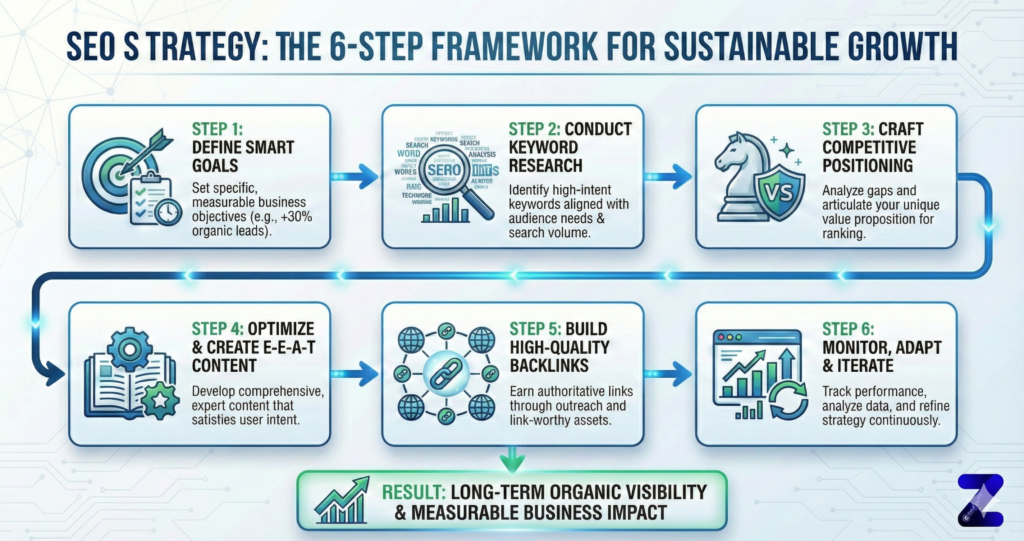
Building a winning SEO strategy requires methodical planning and clear priorities. This six-step framework provides a proven roadmap from goal-setting through execution and refinement.
First, define specific, measurable goals tied to business outcomes. Instead of “get more traffic,” aim for “increase organic sessions by 30 percent in six months, driving 50 additional qualified leads.” Clear metrics create accountability and help you assess ROI.
Second, conduct comprehensive keyword research to understand what your audience actually searches for. Use tools like Google Search Console to identify existing rankings, then expand with platforms like SEMrush, Ahrefs, or Google Keyword Planner. Prioritize keywords with strong search volume and manageable competition.
Third, craft your unique competitive positioning. Analyze competitor content to identify gaps and opportunities. Your strategy should articulate why your site deserves to rank-what unique value, perspective, or resources you provide that others don’t.
Fourth, optimize existing content and create new material based on keyword priorities and user intent. Focus on comprehensive, E-E-A-T-compliant content that demonstrates expertise, experience, authoritativeness, and trustworthiness.
Fifth, build high-quality backlinks through outreach, partnerships, and creating link-worthy assets. Track your backlink profile using Google Search Console or third-party tools.
Sixth, monitor results continuously and iterate. SEO is not a one-time project. Regularly review organic traffic, rankings, conversion rates, and user engagement metrics. Adjust tactics based on performance data and algorithm changes.
Step 1: Define Clear, Measurable SEO Goals
Vague objectives like “improve SEO” provide no direction or success criteria. Effective goals follow the SMART framework: Specific, Measurable, Achievable, Relevant, and Time-bound.
Begin by aligning SEO goals with broader business objectives. If your company aims to generate more sales leads, your SEO goal might be “increase organic traffic to product pages by 40 percent in Q2, resulting in 75 additional demo requests.” If brand awareness is the priority, focus on impressions and rankings for broad industry terms.
Break large goals into smaller milestones. Instead of “rank number one for competitive keyword,” set progressive targets: “enter top 20 in three months, top 10 in six months, top 5 in twelve months.” This approach maintains motivation and allows for tactical adjustments.
According to 2023 HubSpot data, sales, leads, and conversions are the most important metrics tracked by web analysts. Ensure your goals connect SEO performance to these business-critical outcomes rather than vanity metrics like total pageviews.
Document your goals clearly and share them with stakeholders. Transparent objectives facilitate buy-in and justify resource allocation for long-term SEO investments.
Step 2: Conduct Thorough Keyword Research and Prioritization
Keyword research is the foundation of content strategy. It reveals what your audience searches for, how they phrase queries, and which opportunities offer the best return on effort.
Start with existing data. Export all keywords your site currently ranks for using Google Search Console. Identify high-potential terms where you rank between positions 4-20-these often require minor optimization to reach page one.
Expand your keyword list using research tools. Enter seed keywords related to your products, services, or content topics into platforms like SEMrush, Ahrefs, or Google Keyword Planner. Look for variations, long-tail phrases, and question-based queries that indicate specific user intent.
Analyze search volume, competition, and user intent. High-volume keywords are attractive, but extremely competitive terms may require months or years to rank. Focus on keywords with moderate competition scores (ideally under 50 on a 100-point scale) and search volume above 100 monthly queries.
Prioritize based on intent alignment. Informational keywords (how-to, what is, guide) attract top-of-funnel traffic. Commercial investigation keywords (best, review, comparison) target mid-funnel prospects. Transactional keywords (buy, pricing, demo) convert bottom-funnel users. Match keywords to appropriate content types.
Avoid keyword cannibalization by assigning one primary keyword per page. Create a content map that shows which page targets which keyword. If multiple pages compete for the same term, consolidate or differentiate their focus.
Content Optimization and Creation Best Practices
Content quality remains the most influential ranking factor in 2026. Search engines increasingly prioritize content that demonstrates genuine expertise, practical experience, authoritativeness, and trustworthiness-Google’s E-E-A-T framework.
Create comprehensive content that fully addresses user intent. Shallow articles rarely rank well. If users searching “SEO strategy” expect a complete guide, deliver exactly that. Use the “People Also Ask” feature and “Related Searches” to identify subtopics users care about.
Optimize meta elements systematically. Write unique, compelling title tags (50-60 characters) that include your target keyword near the beginning. Craft meta descriptions (150-160 characters) that entice clicks by clearly stating the benefit users will gain.
Structure content with clear header hierarchies. Your H1 should match or closely reflect your title tag and contain your primary keyword. Use H2s to divide major sections, and H3s for subsections. This organization helps both crawlers and readers navigate your content.
Optimize images by compressing file sizes (use tools like TinyPNG or ImageOptim) and writing descriptive alt text that includes relevant keywords naturally. Alt text improves accessibility and provides context for search engines.
Build internal linking pathways between related content. When writing a new article, link to 3-5 relevant existing pages using keyword-rich anchor text. Update older articles to link to new content, creating a cohesive knowledge network.
Avoid targeting the same keyword across multiple pages. If two articles compete for “SEO strategy,” consolidate them or clearly differentiate their angles (e.g., “SEO Strategy for E-commerce” vs. “SEO Strategy for Local Businesses”).
Marketers cite blogging as the top media format they aim to use for the first time in 2024, according to HubSpot’s Ultimate List of Marketing Statistics for 2024, underscoring content’s continued centrality in SEO strategy.
Building Authority Through Link Building and Off-Page SEO
Backlinks remain a critical ranking signal because they represent third-party validation. However, modern link building prioritizes quality over quantity. One authoritative link can outweigh dozens of low-quality links.
Focus on earning links from relevant, high-authority sites in your industry. A link from a respected industry publication, government website, or academic institution carries significant weight. Use tools like Ahrefs’ Domain Rating or Moz’s Domain Authority to assess potential link sources.
Create link-worthy assets that naturally attract backlinks. Original research, comprehensive guides, interactive tools, infographics, and data-driven case studies are highly shareable. Promote these assets through outreach, social media, and industry forums.
Guest posting on reputable sites builds both links and brand awareness. Pitch well-researched article ideas that provide genuine value to the host site’s audience. Include natural, contextual links back to relevant pages on your site.
Build relationships with industry influencers, journalists, and bloggers. Genuine networking often leads to organic link opportunities. Participate in industry discussions, comment thoughtfully on relevant blogs, and share others’ content before asking for links.
Monitor your backlink profile regularly using Google Search Console or third-party tools. Disavow toxic links from spam sites or link farms that could harm your rankings. Focus your efforts on building new, high-quality links rather than chasing hundreds of low-value links.
Avoid manipulative link schemes like buying links, participating in link exchanges, or using automated link-building services. These violate search engine guidelines and can result in penalties that devastate your organic visibility.
Adapting Your SEO Strategy to 2026 Trends and Algorithm Changes
SEO is not static. Search engines continuously refine algorithms, user behavior evolves, and new technologies reshape how people find information. Successful strategies adapt to these changes while maintaining core principles.
Voice search optimization is increasingly important as smart speakers and voice assistants become ubiquitous. Optimize for conversational, long-tail keywords and question-based queries. Structure content to directly answer common questions-featured snippets often serve as voice search results.
Video content gains prominence in search results. YouTube is the world’s second-largest search engine. Create video content that addresses user queries, optimize titles and descriptions with target keywords, and transcribe videos to make content searchable.
Mobile-first indexing is now standard. Google predominantly uses mobile versions of sites for ranking. Ensure your mobile experience is flawless-fast loading, easy navigation, readable text without zooming, and touch-friendly buttons.
User experience signals carry more weight. Core Web Vitals-loading performance, interactivity, and visual stability-directly impact rankings. Sites that provide smooth, frustration-free experiences gain advantages over slower, clunkier competitors.
E-E-A-T (Expertise, Experience, Authoritativeness, Trustworthiness) guides content quality assessment. Demonstrate your credentials, cite reputable sources, display author bios with relevant credentials, and maintain transparent contact information and privacy policies.
Local SEO grows in importance for businesses serving specific geographic areas. Optimize Google Business Profile listings, maintain consistent NAP (Name, Address, Phone) information across directories, and encourage customer reviews.
Remember that SEO is a long-term investment. Algorithm updates may cause temporary ranking fluctuations. Depending on competition and execution quality, you may see initial improvements in three to six months, with significant gains typically materializing within six to twelve months. Consistency, quality, and continuous monitoring are essential for sustained success.
Conclusion: Building a Sustainable SEO Strategy for Long-Term Success
An effective SEO strategy is not a checklist of isolated tactics-it’s a cohesive plan that aligns measurable goals with unique competitive positioning and systematic execution. By understanding the critical distinction between strategy, tactics, and planning, you create focused campaigns that drive meaningful results rather than chasing algorithmic quick fixes.
Address all four core components systematically: technical SEO establishes the foundation, user experience optimization keeps visitors engaged, on-page optimization targets the right keywords effectively, and off-page authority building signals trust to search engines. Each pillar supports the others to create sustainable organic growth.
Follow the step-by-step framework: set SMART goals tied to business outcomes, conduct thorough keyword research aligned to user intent, craft differentiated positioning that explains why you deserve to rank, create E-E-A-T-compliant content, build high-quality backlinks, and continuously monitor and refine based on performance data. Remember that SEO is about why your site deserves to rank, not just how to optimize it. Start with solid goals, craft a differentiated strategy, execute a focused plan, and adapt to evolving trends for lasting organic success.
FAQ
SEO strategy is the high-level approach that defines why your site deserves to rank and how you’ll differentiate from competitors. It focuses on unique positioning, competitive advantage, and long-term direction. SEO tactics are the specific methods you use to execute that strategy, such as keyword optimization, link building, technical fixes, and content creation. Strategy answers “why should we win?” while tactics answer “how will we implement?”
SEO is a long-term investment requiring patience and consistency. Initial improvements may appear within three to six months as search engines crawl your optimized content and recognize technical improvements. Significant, sustained gains typically materialize within six to twelve months, though highly competitive keywords may take longer. Timeline depends on competition level, existing site authority, execution quality, and consistency.
Key factors include high-quality, E-E-A-T-compliant content that demonstrates expertise and trustworthiness, mobile-friendly responsive design, fast page speed and positive Core Web Vitals scores, HTTPS security, strong user engagement metrics like low bounce rates and high session duration, and authoritative backlinks from reputable sources. Voice search optimization and video content are increasingly influential as user behavior evolves.
Use keyword research tools to identify terms with substantial search volume and manageable competition scores, ideally under 50 on a 100-point scale. Focus on keywords that align with user intent-informational, commercial investigation, or transactional-and match them to appropriate content types. Prioritize keywords connected to business goals like lead generation or product sales over vanity metrics. Avoid targeting the same keyword across multiple pages to prevent cannibalization.