
Zero-Click Search Is Here: What to Measure, Why It Matters, and How to Win

As zero-click searches rise across Google and AI platforms, marketers can no longer rely solely on traffic and CTR to measure performance. Success today depends on understanding impression share, SERP feature ownership, branded search lift, and AI citation frequency. This article explains how to track these emerging metrics and build a search strategy built for the future.
Search is changing fast. With zero-click results, AI Overviews, and answer engines taking over the SERP, traditional SEO metrics no longer tell the full story. To stay competitive, brands must shift from measuring clicks to measuring visibility, authority, and entity strength.
Want to learn more about Zero-Click SEO Mastery? Read our previous blog here.
How to Measure Success in a Zero-Click World: New Metrics That Matter
Traditional click-focused metrics tell incomplete stories in zero-click environments. Expand measurement frameworks to capture visibility, authority, and brand impact beyond immediate traffic.
Track impression share as a primary KPI. Google Search Console reports how often your content appears in search results for target queries. Growing impression share indicates increasing visibility even when clicks remain stable or decline.
Monitor SERP feature ownership percentage. Calculate what portion of your target keywords triggers featured snippets, AI Overviews, or other rich results where your content appears. Increasing ownership signals growing authority in your topic space.
Measure branded search volume trends. When users see your brand repeatedly in zero-click features, they’re more likely to search your brand name directly in future sessions. Growing branded search volume validates zero-click visibility strategy effectiveness.
Track citation frequency in AI Overviews for target topics. While this requires manual monitoring or specialized tools, understanding how often AI systems reference your content provides crucial authority feedback. Research1 indicates AI search visitors deliver 4.4x more value than traditional organic traffic.
Calculate Entity Association Strength by analyzing how consistently your brand appears alongside specific topics in search results. Strong entity association builds long-term competitive advantages difficult for competitors to replicate.
Understanding the Difference Between SEO, AEO, and GEO
The evolution of search requires new optimization frameworks beyond traditional SEO practices. Understanding these distinctions helps clarify strategic priorities.
Traditional SEO focuses on ranking web pages to earn clicks through organic search results. The goal centers on maximizing website traffic from search engines through keyword targeting, link building, and technical optimization.
Answer Engine Optimization (AEO) focuses specifically on making content readable and extractable for AI systems to display as direct answers in featured snippets and AI Overviews. AEO prioritizes answer structure, concise formatting, and factual accuracy over comprehensive coverage.
Generative Engine Optimization (GEO) targets optimization for AI-generated responses across platforms including ChatGPT, Claude, Perplexity, and Google’s AI systems. GEO emphasizes source credibility, citation-worthy information, and content that AI models can confidently reference.
These three approaches complement rather than replace each other. Modern search strategies integrate all three, recognizing that different content types and business goals require different optimization priorities. Some content should drive traffic (SEO focus), some should capture answer visibility (AEO focus), and some should establish authoritative source status (GEO focus).
Which Content Formats Perform Best in Zero-Click and AI Search?
Certain content structures consistently outperform others for zero-click visibility. Understanding these patterns helps prioritize content creation and reformatting efforts.
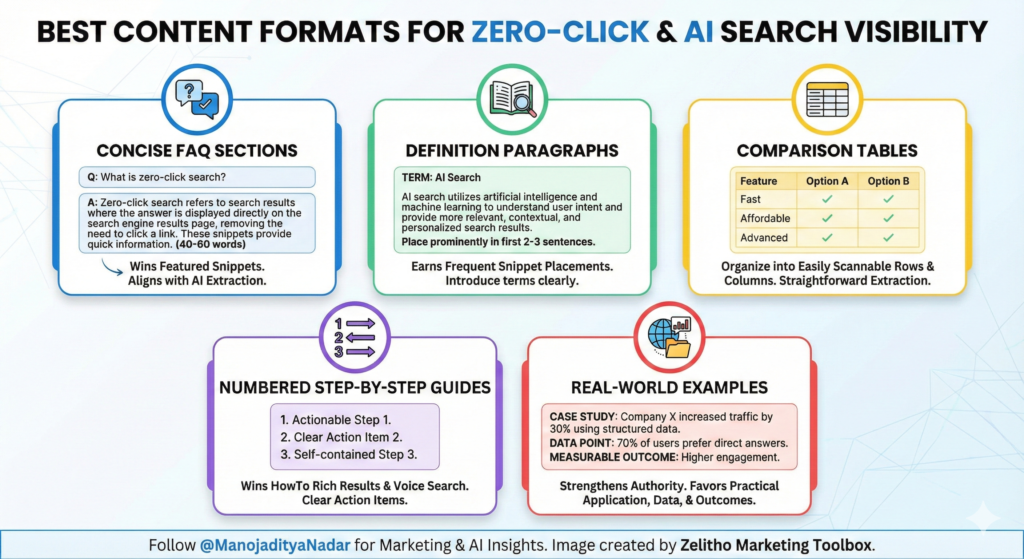
Concise FAQ sections with clear question headings and 40-60 word answers win featured snippets frequently. The structured Q&A format aligns perfectly with how users search and how AI systems extract information.
Definition paragraphs that introduce terms and provide clear explanations in the first 2-3 sentences earn frequent snippet placements. Place definitions prominently rather than burying them in broader explanatory text.
Comparison tables organizing information into easily scannable rows and columns perform well for product comparisons, feature lists, and option evaluations. Tables make information extraction straightforward for both users and algorithms.
Numbered step-by-step guides with clear action items win HowTo rich results and voice search answers. Each step should be self-contained and actionable without requiring extensive context.
Real-world examples with specific, concrete details strengthen content authority. AI systems favor content that demonstrates practical application rather than purely theoretical knowledge. Include case studies, data points, and measurable outcomes whenever possible.
What’s Coming in 2026: The Future of Zero-Click Search
Zero-click search evolution continues accelerating as AI capabilities expand and user behaviors shift. Understanding emerging trends helps position content strategies for sustained visibility.
AI Overviews will expand to more query types throughout 2026. Current data2 shows AI summaries now appear for 35-38% of searches, with industry analysts estimating over 70% of searches could result in no external click by end of 20253 .
Multimodal search integration will deepen, combining text, images, video, and voice into unified search experiences. Google’s Deep Search already demonstrates this direction—Elizabeth Reid, VP and Head of Search at Google, notes the technology can issue hundreds of searches and create expert-level, fully-cited reports in minutes4 .
Entity recognition sophistication will increase, making brand authority signals more important than individual page optimization. Search engines will evaluate brands holistically rather than treating each content piece independently.
Voice and conversational AI will drive longer, more specific queries. Sundar Pichai notes AI Mode already leads to searches two to three times longer than traditional queries4 . Optimizing for these detailed, contextual questions becomes increasingly valuable.
The brands that adapt proactively—building comprehensive topic authority, implementing robust structured data, and creating genuinely helpful answer-focused content—will dominate search visibility regardless of specific algorithm changes.
The Practical Starting Point: Your Zero-Click SEO Action Plan
Implementing zero-click SEO requires systematic execution across multiple tactical areas. This roadmap provides a clear starting point for organizations at any maturity level.
Start with a SERP feature audit. Use Google Search Console and SEO tools to identify where you currently appear in featured snippets, AI Overviews, and other rich results. Document your baseline SERP feature ownership percentage for target keywords.
Identify high-volume queries showing featured snippets where you rank positions 2-10. These represent immediate opportunities—you’re already ranking well but need better answer formatting to capture position zero.
Prioritize content optimization for identified opportunities. Restructure content to answer questions directly in the first 40-60 words, add clear formatting using lists or tables, and implement relevant schema markup.
Implement comprehensive schema markup across priority content. Start with FAQ, HowTo, and Article schema as these directly impact zero-click visibility. Use JSON-LD format and validate implementations before publishing.
Track impressions and SERP feature appearances in Google Search Console weekly. Monitor trends rather than daily fluctuations—most visibility gains appear within 4-8 weeks of implementing optimizations.
Expand topical authority systematically. Create supporting content around core topics, build internal linking clusters, and publish consistently. Authority building requires sustained effort rather than one-time optimization.
Set realistic expectations with stakeholders. While traffic may decline initially, visibility and brand awareness metrics should improve. The long-term value of establishing answer authority outweighs short-term traffic fluctuations for most organizations.
Conclusion: Winning the Zero-Click Future Through Visibility and Authority
Zero-click SEO represents strategic adaptation rather than surrender. While 57-60% of searches now end without clicks, this shift creates opportunities for brands willing to reframe success around visibility, authority, and answer ownership rather than immediate traffic alone.
The data validates this strategic direction. Brand awareness increases 15-25% within three months of capturing featured snippets. AI search visitors deliver 4.4x more value than traditional organic traffic. Appearing consistently in AI Overviews and position zero establishes brand memory associations that influence purchase decisions across channels.
Success requires executing the nine core tactics systematically: winning featured snippets through direct answer formatting, building topical authority across content clusters, creating AI-extractable content blocks, implementing comprehensive schema markup, targeting People Also Ask opportunities, optimizing visual content, dominating local results, refining metadata, and maintaining technical excellence.
Start with actionable quick wins. Audit current SERP feature ownership, identify high-volume queries with existing snippet opportunities, optimize top-performing content for answer-focused structure, implement schema markup on priority pages, and track impressions rather than clicks as primary success metrics.
The brands that adapt now—embracing visibility-focused strategy while maintaining technical excellence—will dominate search presence throughout 2026 and beyond. Zero-click search isn’t the end of SEO; it’s the evolution toward authority-based visibility that builds lasting market position.
FAQs
Zero-click searches occur when users find answers directly on the search engine results page without clicking through to any website. Examples include featured snippets, AI Overviews, knowledge panels, local map packs, and instant answer boxes that display complete information within the SERP itself.
Yes, zero-click searches can reduce click-through traffic. Organic clicks for AI Overview queries dropped 61% since mid-2024 according to available data. However, they don’t reduce visibility—they increase brand awareness, authority, and long-term recognition. The trade-off proves valuable when brand visibility leads to future conversions and establishes market leadership.
Answer questions clearly and directly in the first 40-60 words of content. Use structured formatting like bullet lists, numbered steps, or definition paragraphs. Add schema markup, keep answers concise, and place responses early in content rather than building up gradually. Target questions where you already rank positions 2-10.
Google Search Console helps track impressions, query visibility, SERP feature appearances, and overall search presence for zero-click features. It’s essential for measuring success beyond clicks by monitoring how often your content appears in featured snippets and AI Overviews, providing crucial data for optimization decisions.
Sources:
1. https://searchengineland.com/guide/zero-click-searches
2. https://cellainc.com/insights/blog/5-key-insights-to-revamp-your-seo-for-ai-and-zero-click-search/
3. https://neotype.ai/zeroclick-searches
4. https://surferseo.com/blog/zero-click-searches