
Essential Strategies for Voice Search Optimization


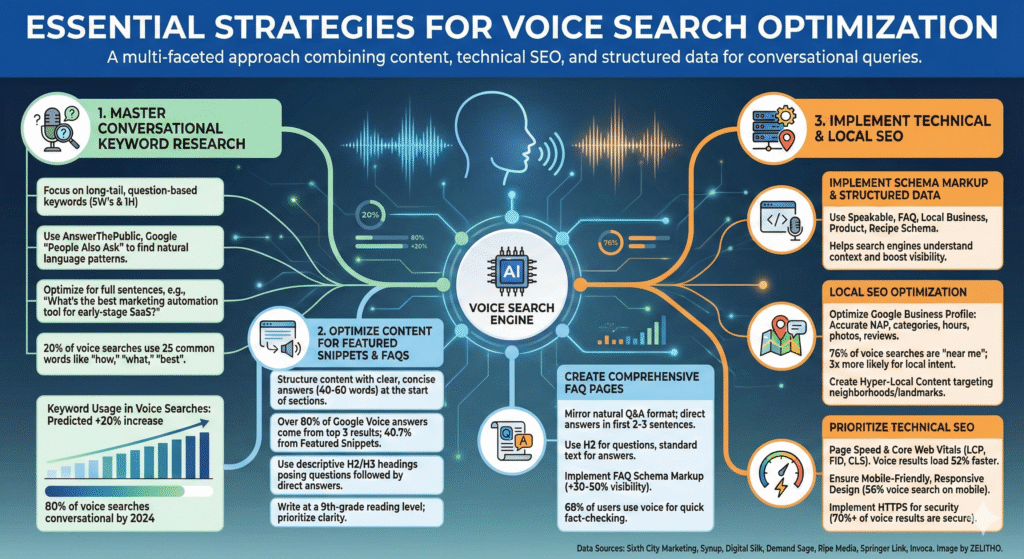
Ranking for voice search requires a multi-faceted approach combining content optimization, technical SEO, and structured data. These core strategies work together to help search engines understand and serve your content in response to spoken queries.
The foundation ofsuccessful voice search optimization rests on understanding that voice assistants need clear, concise, conversational content that directly answers user questions. Unlike traditional SEO where keyword density and backlink profiles dominated, voice search prioritizes relevance, clarity, and semantic understanding. Search engines must confidently extract and vocalize your content, which means every element—from keyword selection to technical performance—must align with how voice systems retrieve and present information.
Best Content Strategies for Conversational Search Queries (2026 Framework)
According to Zelitho’s Conversational Search Architecture Framework, developing content strategies for conversational search requires shifting from isolated keyword targeting to dialogue-state intent modeling. Conversational queries average 8 to 14 words and reflect iterative problem-solving; effective content strategies organize information into modular problem-resolution blocks, entity relationship trees, and conversational intent clusters that AI search engines (ChatGPT Search, Perplexity, Siri, Gemini) can parse as conversational dialogue turns.
| Content Strategy Pillar | Traditional SEO Editorial Approach | Conversational Search Architecture (Zelitho Standard) | Conversational Engine Retrieval Mechanism |
|---|---|---|---|
| 1. Dialogue-State Intent Mapping | Targets linear keywords (informational vs. transactional) | Models multi-turn conversational dialogue (trigger question → clarification prompt → resolution synthesis) | Enables AI search engines to track user context across follow-up queries |
| 2. Modular Q&A Decomposition | Writes long continuous essays (1,500+ words) with buried takeaways | Decomposes complex topics into autonomous, self-contained 45–60 word question-and-answer units | Fits single-passage speech synthesis and conversational answer card limits |
| 3. Entity Relationship Context Grounding | Repetitive keyword placement in body copy | Structures content around entity-attribute pairs ([Subject] [hasProperty] [Value]) linked to clear ontology | Voice engines resolve pronoun ambiguities (“it”, “they”) without losing context |
| 4. Natural Prosody & Vocal Readability | Dense, passive, jargon-heavy academic prose | Active voice syntax with natural conversational cadence and Flesch reading ease score > 65 | Voice assistants (Siri, Alexa, Google Assistant) vocalize answers without awkward pauses |
| 5. Speakable Microdata & Dialogue Schema | Basic OpenGraph metadata and standard article schema | Valid JSON-LD SpeakableSpecification and FAQPage explicitly declaring primary vocalization passages | Provides search algorithms an explicit machine-readable roadmap for audio output selection |
1. Master Conversational Keyword Research
The foundation of VSO is identifying how users naturally speak their queries. Focus on long-tail, question-based keywords using the 5 W’s and 1 H framework (Who, What, When, Where, Why, How). Research shows that approximately 20% of voice searches feature variations of 25 keywords, including common words like “how,” “what,” “best,” and more1.
Use tools like AnswerThePublic, Google’s ‘People Also Ask’ feature, and SEO dashboards to discover common spoken queries. These tools reveal the exact questions people ask, providing invaluable insight into natural language patterns. For example, instead of targeting the broad keyword “marketing automation,” optimize for the conversational query “What’s the best marketing automation tool for early-stage SaaS?” This longer, more specific phrasing mirrors how someone would actually speak to their voice assistant.
The shift to conversational keywords requires rethinking your entire keyword strategy. Typed searches are fragmented and abbreviated, while voice searches are complete thoughts. Analysis shows that keyword usage in voice searches is predicted to increase by 20%, and around 80% of voice searches are predicted to be conversational bin the future. This means incorporating natural phrases, including prepositions, articles, and complete sentence structures into your content.
2. Optimize Content for Featured Snippets (Position Zero)
Voice assistants primarily pull answers from featured snippets, making them critical for voice search visibility. Over 80% of answers delivered by Google’s voice assistant come from the top three results in search engine results pages2, and 40.7% of all voice search answers come specifically from featured snippets.
Structure content with clear, concise answers at the beginning of sections. Pages that rank for voice searches typically have an average of approximately 2,312 words, but the featured snippet itself needs to be brief—typically between 40‑60 words. Use bullet points and numbered lists when appropriate, as these formats are easier for voice assistants to parse and vocalize.
Format content with descriptive headings that mirror common questions. Each H2 or H3 should pose a question that users might actually ask, followed immediately by a direct answer. Google voice search results are typically written at a reading level equivalent to ninth grade, so prioritize clarity and accessibility over technical jargon. The combination of conversational structure, appropriate length, and direct answers dramatically increases your featured snippet and voice search visibility.
3. Create Comprehensive FAQ Pages
FAQ sections perfectly mirror the natural question‑and‑answer format of voice queries. They provide exactly what voice assistants need: clear questions followed by direct, conversational answers. Identify commonly asked questions in your industry by analyzing customer support inquiries, monitoring Google’s “People Also Ask” sections, and reviewing competitor content.
Provide direct, conversational answers that address the question completely in the first 2‑3 sentences. Remember that 68% of individuals use digital assistants for quick fact-checking3 , so your FAQ answers should deliver immediate value without requiring users to read through lengthy explanations.
Structure each Q&A with proper heading tags—use H2 for questions and standard paragraphs for answers. This hierarchy helps search engines understand the relationship between question and answer. Most importantly, implement FAQ schema markup to explicitly signal to search engines that this content is structured Q&A format. Properly implemented schema markup can increase voice search visibility by 30‑50% within 3 months4.
4. Implement Schema Markup and Structured Data
Schema markup helps search engines deeply understand your content’s context and meaning, significantly boosting voice search visibility. A longitudinal case study found that optimizing newly identified SEO-based ranking features for voice search queries resulted in significant improvement in web page ranking, with monthly users increasing from 82 in February 2021 to 857 in November 2021 after implementing identified SEO factors5.
Implement speakable schema for content you want read aloud by voice assistants. This schema type explicitly tells Google which sections of your content are optimized for text-to-speech conversion. Use FAQ schema for question-based content, local business schema for location-based queries, and product or recipe schema for specific content types. Each schema type provides search engines with structured information they can confidently present in voice results.
Structured data gives your content an edge in AI-powered search results. Pages that appear in Google voice search results have an average domain rating of 76.8, and 70.4% use HTTPS2. Schema implementation, combined with technical excellence, positions your content as authoritative and trustworthy in the eyes of both search engines and voice assistants.
Local SEO Optimization for Voice Search
With 46‑58% of voice searches having local intent and 75% of local searches expected via voice by 2025, local optimization is mission-critical for location-based businesses. Voice users frequently ask “near me” questions or mention specific neighborhoods when searching for services.
The local advantage in voice search is substantial. “Near me” and local searches make up 76% of voice searches3 , and voice searches are three times more likely to be used for local search queries compared to text searches. Search queries with “near me” or “close by” have surged, with Google noting a 900% increase over a two-year period.
The conversion impact is equally impressive. Approximately 88% of consumers who conduct a local search on their smartphone visit or call a store within a day6, and 78% of location-based mobile searches result in an offline purchase. For local businesses, voice search optimization directly translates to foot traffic and phone calls—two of the highest-value engagement types.
Optimize Your Google Business Profile
Your Google Business Profile is the cornerstone of local voice search visibility. Businesses with complete Google My Business listings are 70% more likely to attract location-based inquiries via voice search6 . Ensure complete profile information with accurate NAP (Name, Address, Phone number) consistently displayed across all online properties.
Select all relevant business categories to maximize visibility across different query types. Maintain up-to-date hours and services, as voice searches often include time-specific queries like “restaurants open now near me.” Actively collect and respond to customer reviews—90% of consumers use reviews and ratings to evaluate local businesses, and businesses with excellent reviews can expect consumers to spend 31% more.
Add high-quality photos that showcase your business, products, and services. Visual elements complement voice search results on devices like Google Nest Hub and smart displays. Use the Q&A feature to address common questions proactively. With 86% of people looking up the location of a business on Google Maps, your Google Business Profile serves as the primary discovery tool for local voice searchers.
Create Hyper‑Local Content
Develop content targeting neighborhood-specific and hyper-local queries. With 22% of voice search queries looking for location-based content, granular geographic targeting pays dividends. Use location-specific long-tail keywords such as “best coffee shop in downtown Richmond” or “emergency plumber in Silver Lake neighborhood.”
Create location-specific landing pages for each service area you serve. These pages should include unique content that mentions local landmarks, neighborhoods, and community context naturally. Avoid creating duplicate content with only city names changed—each page should provide genuine value and local expertise.
Mention local landmarks and neighborhoods naturally throughout your content. When users ask voice assistants for directions or nearby services, these geographic references help search engines understand your relevance to specific areas. Develop content around local events and community topics to establish topical authority within your geographic market. This hyper-local approach positions you as the go-to expert for your specific area, not just your broader city or region.
Technical SEO for Voice Search Success
Technical optimization ensures your site can be quickly crawled, understood, and served by voice assistants. Speed, mobile-friendliness, and site architecture are foundational elements that dramatically impact voice search rankings.
Voice search results load 52% faster than average search results, and the average time for a voice search result page to load is 4.6 seconds. This performance advantage isn’t coincidental—voice assistants prioritize fast-loading pages because they provide better user experiences. Technical excellence separates sites that occasionally appear in voice results from those that dominate them.
Prioritize Page Speed and Core Web Vitals
Page speed directly correlates with voice search visibility. Research indicates that for every one-second delay in page load time, conversions can crash by up to 20%7. Voice assistants favor fast sites because they need to deliver answers immediately—delays in loading contradict the convenience promise of voice search.
Optimize for Google’s Core Web Vitals: Largest Contentful Paint (LCP), First Input Delay (FID), and Cumulative Layout Shift (CLS). These metrics measure real user experience—how quickly content loads, how responsive your site is to interaction, and how stable the layout remains during loading. Compress images using modern formats like WebP, minify CSS and JavaScript to reduce file sizes, leverage browser caching to speed up repeat visits, and use a content delivery network (CDN) to serve content from servers geographically closer to users.
A Backlinko study analyzing 10,000 voice search results found that the time to first byte for a voice search result is significantly shorter than for the average webpage8 . This finding underscores that technical performance isn’t just a ranking factor—it’s a prerequisite for voice search consideration.
Ensure Mobile-Friendly, Responsive Design
Most voice searches occur on mobile devices, making mobile optimization non-negotiable. Smartphones are the most popular device for voice search, accounting for 56% of usage, and 27% of people use voice search specifically on their mobile devices.
Implement responsive design that adapts seamlessly to all screen sizes, from smartphones to tablets to desktops. Ensure easy navigation with thumb-friendly buttons placed in accessible locations for one-handed use. Use readable font sizes without requiring zooming—small text frustrates users and signals poor mobile optimization to search engines.
Avoid intrusive interstitials like full-screen pop-ups that block content, especially on mobile devices. Test mobile usability regularly with Google’s Mobile-Friendly Test tool to identify and fix issues before they impact rankings. Remember that mobile optimization extends beyond aesthetics to performance: mobile users often have slower connections, making speed optimization even more critical.
Implement HTTPS and Secure Connections
Security (HTTPS) is a foundational ranking factor that voice assistants prioritize when selecting sources. More than 70% of websites that rank on Google Voice search are HTTPS-secured, and 70.4% of URLs shown in voice search results use HTTPS, while only 50% of Google desktop results do the same.
Ensure your entire site uses HTTPS encryption, not just key landing pages or checkout pages. Update all internal links to HTTPS versions to avoid mixed content warnings. Maintain valid SSL certificates by monitoring expiration dates and renewing before they lapse. Security isn’t just about protecting user data—it’s a trust signal that tells search engines and voice assistants your content is safe to recommend.
Voice assistants serve as trusted intermediaries between users and content. They’re selective about which sources they cite because recommendations reflect on their credibility. Sites without HTTPS signal lower trustworthiness, making them less likely candidates for voice search results regardless of content quality.
Sources:
1. https://www.sixthcitymarketing.com/voice-search-stats/
2. https://www.digitalsilk.com/digital-trends/voice-search-statistics/
3. https://www.demandsage.com/voice-search-statistics/
4. https://www.ripemedia.com/what-is-voice-search-optimization/
5. https://link.springer.com/article/10.1007/s10462-024-10780-9
6. https://www.synup.com/en/voice-search-statistics/
7. https://www.connectionmodel.com/blog/voice-search-seo-strategies-to-dominate-the-search-results
8. https://digitalmarketinginstitute.com/blog/prepare-for-the-future-of-voice-search