


TL;DR
This guide is your starting point for understanding and using AI-powered SEO. We define what AI SEO is and explain how it makes complex search engine optimization tasks more manageable for beginners. You will learn how artificial intelligence is changing the search landscape with features like Google’s AI Overviews and why this matters for your website. We provide a practical, four-step framework for applying AI to core SEO areas: keyword and topic research, content creation and optimization, technical on-page tasks, and smarter data analysis. Finally, we share essential best practices to ensure you use AI as a powerful assistant, not a replacement for human strategy and quality control.
Your Complete Beginner’s Guide to AI-Powered SEO
Welcome to the new era of search engine optimization. This guide explains everything you need to know about AI-powered SEO, breaking down how artificial intelligence can help you improve your website’s visibility, drive more organic traffic, and achieve your goals faster. You’ll learn exactly what AI SEO is, how it’s reshaping search, and the four core areas where you can start using it today.
What is AI SEO? (And Why Should Beginners Care?)
AI SEO is the practice of using artificial intelligence and machine learning tools to enhance and automate search engine optimization tasks. While traditional SEO relies heavily on manual data analysis, intuition, and time-consuming research, AI SEO leverages technology to process vast amounts of data, identify patterns, and generate actionable insights in a fraction of the time.
Think of it as the difference between navigating with a paper map and using a GPS. Both can get you to your destination, but one is faster, more efficient, and adapts to real-time conditions. For beginners, the benefits are significant:
- Saves Time: AI handles repetitive work like analyzing keyword lists or checking for broken links, freeing you to focus on strategy.
- Data-Driven Decisions: You don’t need to be a data scientist. AI tools translate complex performance metrics into clear recommendations.
- Streamlined Workflow: From discovering topics to writing and optimizing content, AI can assist at every stage of the SEO workflow, making the entire process less intimidating.
Essentially, AI-powered SEO automation levels the playing field, giving you access to insights that were once reserved for large teams with extensive resources.
How AI is Reshaping the Search Landscape
Beyond just providing new tools, artificial intelligence is fundamentally changing how search engines operate. The most prominent example is Google’s AI Overview, which generates direct, summarized answers at the top of the search engine results page. This feature is accelerating a trend known as “zero-click searches,” where users get the information they need without ever clicking on a website link.
This shift means the old goal of simply ranking #1 is evolving. Today, success often means being the source for the answer featured in an AI-powered search result. This new paradigm is sometimes called Generative Engine Optimization (GEO), and it requires a different approach.
- Providing clear, concise, and factual answers to common questions.
- Building topical authority by covering a subject comprehensively.
- Structuring your content so AI can easily understand and parse it.
Understanding this change in search behavior is crucial. AI isn’t just an addition to your toolkit; it’s a core component of the environment you’re now operating in.
Getting Started: How to Use AI for SEO in 4 Core Areas
Now that you understand the “what” and “why,” let’s move to the “how.” Integrating AI into your SEO strategy doesn’t have to be overwhelming. You can start by applying it to four fundamental pillars of website optimization to drive more organic traffic and improve your digital marketing efforts.
1. AI-Driven Keyword and Topic Research
Effective keyword research has always been about understanding user intent-what someone really wants when they type a query into Google. AI supercharges this process. AI tools can analyze millions of search patterns to move you beyond single keywords and into building powerful topic clusters.
- Discover Untapped Questions: Uncover long-tail, question-based keywords that signal strong purchase intent or a specific informational need.
- Group Keywords by Intent: Automatically cluster keywords into groups based on whether the user wants to buy, learn, or find a specific website.
- Perform Competitor Analysis: Instantly identify the keywords your competitors rank for that you don’t, revealing valuable content gaps you can fill.
- Predict Emerging Trends: Some advanced tools can analyze search patterns to forecast topics that are gaining popularity before they become highly competitive.
This AI-driven keyword research gives you a more strategic and comprehensive map of your content landscape.
2. AI-Assisted Content Creation and Optimization
Content is the heart of SEO, and AI offers powerful assistance in creating material that satisfies both users and search engines. However, this is the area where human oversight is most critical. The goal is to use AI to augment your abilities, not replace them.
- Generate a Brief: After your topic research, use an AI tool to create a detailed content brief. It can analyze the top-ranking pages and suggest an ideal word count, headings to include, and related concepts to cover.
- Develop an Outline: Ask the AI to structure your topic into a logical outline with H2s and H3s. This ensures you cover the subject thoroughly.
- Draft and Refine: While you can use AI to help draft sections, you should always review, edit, and rewrite the content to match your brand’s voice, add unique insights, and ensure accuracy.
- Optimize the Final Piece: Once your draft is ready, use on-page SEO features in AI tools to check for semantic keyword inclusion, readability, and tone. This final content optimization step helps ensure your article is primed to rank.
By following this process, you create helpful content that is both comprehensive and authentic.
3. Automated On-Page and Technical SEO
Technical SEO can be one of the most daunting aspects for beginners. It involves optimizing the non-content elements of your website. AI tools excel at simplifying these complex and often tedious tasks.
- Generate Schema Markup: Schema is code that helps search engines understand the context of your content (e.g., that a page is a recipe, a product, or an event). AI tools can generate this code for you automatically.
- Write Meta Descriptions at Scale: Writing unique meta descriptions for hundreds of pages is a monumental task. AI can generate optimized, compelling descriptions in seconds.
- Conduct Site Audits: AI-powered crawlers can perform comprehensive site audits to instantly find issues like broken links, missing image alt text, slow page speeds, and duplicate content, then provide clear instructions on how to fix them.
- Suggest Internal Linking: Building a strong internal linking structure helps search engines discover your content and understand its hierarchy. AI can analyze your site and suggest relevant internal linking opportunities you might have missed.
These automations allow you to maintain a technically sound website without needing to become a coding expert.
4. Smarter Off-Page SEO and Data Analysis
Off-page SEO primarily involves building authority through backlinks and brand mentions. At the same time, data analysis helps you understand what’s working. AI brings new levels of efficiency and clarity to both.
- Analyze Competitor Backlinks: AI tools can quickly dissect your competitors’ backlink profiles to identify high-authority websites linking to them.
- Monitor Brand Mentions: Set up AI-powered alerts to track mentions of your brand across the web, allowing you to engage in conversations or request a link from unlinked mentions.
For data analysis, AI transforms raw numbers into actionable stories. Instead of staring at charts in Google Analytics, AI can analyze your SEO performance and deliver plain-language summaries, helping you make better strategic decisions.
Best Practices for a Successful AI SEO Strategy
To get the most out of AI, you need to approach it with the right mindset. These best practices will help you build a sustainable and effective AI SEO strategy that delivers real results.
- Human-in-the-Loop: Always remember that AI is an assistant, not a replacement for a human strategist.
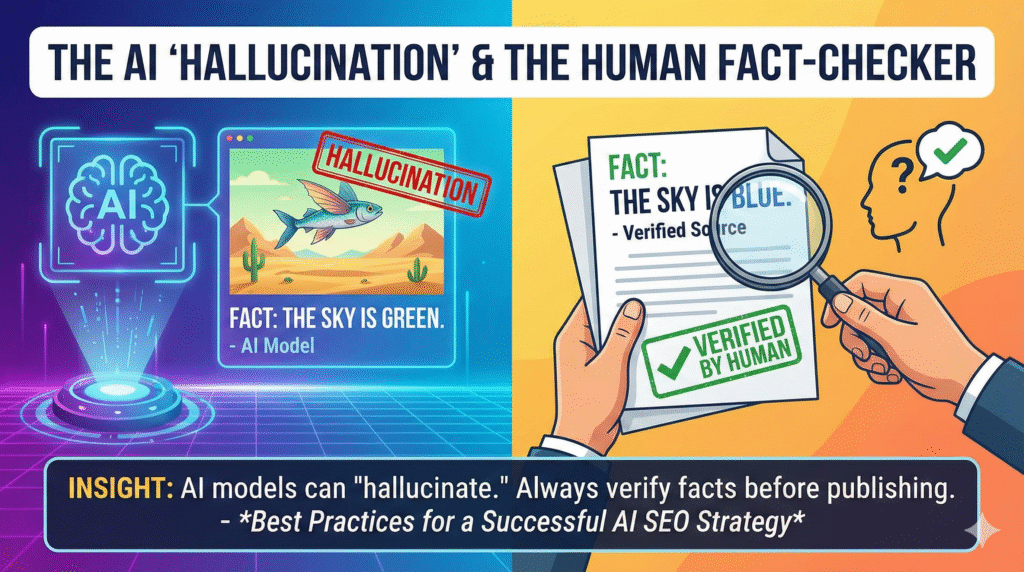
- Fact‑Check Everything: AI models can “hallucinate.” Verify any facts or statistics before publishing.
- Prioritize E‑E‑A‑T: Edit all AI-assisted content to add your unique experiences, expert insights, and personal voice.
- Focus on User Experience: Never sacrifice UX for an SEO recommendation. Trust your human judgment when something feels unnatural.
By combining the power of AI with your strategic oversight, you can create a human-centered content strategy that is both efficient and highly effective.
Frequently Asked Questions (FAQ)
What is the main purpose of AI in SEO?
The main purpose of AI in SEO is to increase efficiency and effectiveness. It automates repetitive tasks like keyword research and data analysis, processes massive datasets to uncover insights humans might miss, and helps create highly optimized content faster.
Can AI replace human SEO professionals?
No, AI is a powerful tool that enhances, but does not replace, human expertise. Critical thinking, creativity, understanding nuanced user intent, and building relationships for link building all require human oversight.
What are some examples of AI SEO tools for beginners?
Many accessible tools are available. For content creation and optimization, platforms like Surfer SEO and Frase are popular. For keyword research and ideation, you can use the AI‑powered features within platforms like Semrush or even ChatGPT.
How do you optimize for Google’s AI Overviews?
To optimize for AI Overviews, focus on creating clear, concise, and factual content that directly answers common user questions. Use structured data (schema markup) on your pages to help Google better understand your content’s context.
Embrace the Future: Your Journey with AI SEO Starts Now
AI is no longer a futuristic concept in search marketing; it is a practical and accessible tool that is reshaping the industry. For beginners, it represents an incredible opportunity to streamline complex processes, make smarter decisions, and achieve better results more quickly.
Your journey starts with a single step. Choose one area discussed today-like topic research or generating meta descriptions-and experiment with an AI tool. See firsthand how it can simplify your process and unlock new opportunities for growth.
Really helpful overview! I especially liked how you defined the four core areas where beginners can start using AI in their SEO workflow: especially the distinction between AI as an assistant rather than a replacement.