
AI Agents Guide: Architecture, Use Cases & Workflows (2026)

Autonomous AI agents represent the evolution of large language models from passive text generators into goal-directed software systems capable of planning, executing multi-step reasoning, calling external APIs, and inspecting their own outputs. In modern enterprise workflows, deploying a specialized ai marketing agent or marketing agent team allows organizations to automate technical search auditing, citation gap monitoring, and programmatic content optimization. Analyzing the benchmark performance of ai agents 2025 and ai agents autonomous 2025 systems reveals that deploying a marketing ai agent within stateful execution graphs enables businesses to achieve continuous autonomous search visibility across both Google SERPs and generative answer engines.
TL;DR
AI agents, powered by advanced LLMs, are poised to transform enterprise industries in 2026. This guide defines these autonomous systems, differentiates them from traditional bots, and explains their cognitive loop involving perception, memory, reasoning, and action. We explore key applications across sectors, examine leading development platforms like Lyzr AI and LangChain, and detail essential strategies for monitoring AI agents, ensuring performance, data privacy, and ethical operation.
An AI agent is an autonomous software system that perceives its environment, reasons over a goal, and takes actions across tools – without human input per step. Unlike chatbots that respond to prompts, AI agents plan, execute, and self-correct across multi-step tasks. Zelitho defines three tiers: simple bots (rule-based), AI assistants (command-driven), and AI agents (goal-driven and autonomous).
Explore the surging landscape of AI agents and LLMs in 2026.
This comprehensive guide covers what AI agents are, how they work, top development platforms, their applications, and essential strategies for effective monitoring and management.
Keywords AI: How to Monitor LLMs and AI Agents in 2026
The year 2026 marks a significant inflection point in artificial intelligence. We are moving beyond static AI models and witnessing the proliferation of dynamic, autonomous systems: AI agents powered by Large Language Models (LLMs). These advanced entities reshape industries, automate complex tasks, and introduce a new paradigm of intelligent automation. This article will define AI agents, explain their operational mechanics, survey the top development platforms, illustrate their widespread applications, and provide comprehensive strategies for effectively monitoring and managing these powerful systems to ensure reliability and ethical deployment.
The Rise of AI Agents and LLMs: Why 2026 is a fundamental Year
The landscape of artificial intelligence is experiencing an unprecedented acceleration, with 2026 emerging as a breakout year for AI agents and LLMs. These technologies are transitioning from experimental concepts to practical, impactful solutions across various sectors.
Investors, including those at Y Combinator, are keenly observing the rise of “vertical AI agents,” specialized systems designed to tackle specific, complex business challenges. These agents promise to embed intelligence directly into workflows, transforming how SaaS companies deliver value.
The rapid advancement in generative AI capabilities, combined with increasing computational power, enables LLMs to serve as the “brains” for these autonomous entities, allowing them to perceive, reason, plan, and act with unprecedented sophistication. This evolution signifies a fundamental shift from simple AI tools to intelligent, self-directed systems capable of driving significant operational efficiencies and competitive advantages.
What Exactly Are AI Agents?
An AI agent represents a leap beyond conventional software. At its core, an AI agent is an autonomous system designed to perceive its environment, make decisions, and take actions to achieve specific goals. These agents operate with a degree of independence, distinguishing them from simpler, rule-based programs.
Key characteristics define AI agents:
- Perception allows them to gather information from their environment, whether through sensors, data streams, or user inputs.
- Memory enables them to retain past experiences and learnings, informing future decisions.
- Reasoning equips them to process information, evaluate options, and formulate plans.
- Action allows them to interact with their environment, executing tasks and influencing outcomes.
Distinguishing AI Agents from Bots and AI Assistants
Understanding the nuances between AI agents, bots, and assistants is crucial for appreciating their respective capabilities and suitable use cases. While these terms are sometimes used interchangeably, they represent distinct levels of intelligence and autonomy.
- Simple bots typically follow predefined rules or scripts, executing repetitive tasks and responding to specific commands with limited learning.
- AI assistants offer more advanced natural language processing, handling a broader range of commands, integrating with services, and sometimes learning user preferences. However, they generally require explicit commands within a bounded framework.
- AI agents, conversely, exhibit higher autonomy and intelligence. They can independently set goals, plan multi-step actions, adapt to unforeseen circumstances, and self-correct based on feedback.
Types of AI Agents in 2026
AI agents fall into four types based on how they make decisions:
- Simple reflex agents – react to current input only, no memory. Example: a rule-based customer service bot.
- Model-based reflex agents – maintain internal state to handle incomplete information. Example: a chatbot that remembers conversation history.
- Goal-based agents – plan multi-step actions toward an objective. Example: an AI research agent that searches, reads, and summarises.
- Utility-based agents – optimise for the best outcome across competing options. Example: an AI agent that A/B tests subject lines and picks the highest performer.
In 2026, most production AI agents used by founders and marketers are goal-based – powered by LLMs like GPT-4o or Claude, built on frameworks like LangChain or CrewAI.
How AI Agents and LLMs Work: The Cognitive Loop
The operational prowess of AI agents stems from a sophisticated “cognitive loop,” a continuous cycle of perception, memory, reasoning, and action. This architecture allows AI agents to exhibit adaptive and intelligent behavior, with Large Language Models (LLMs) playing a central role in driving their decision-making and execution.
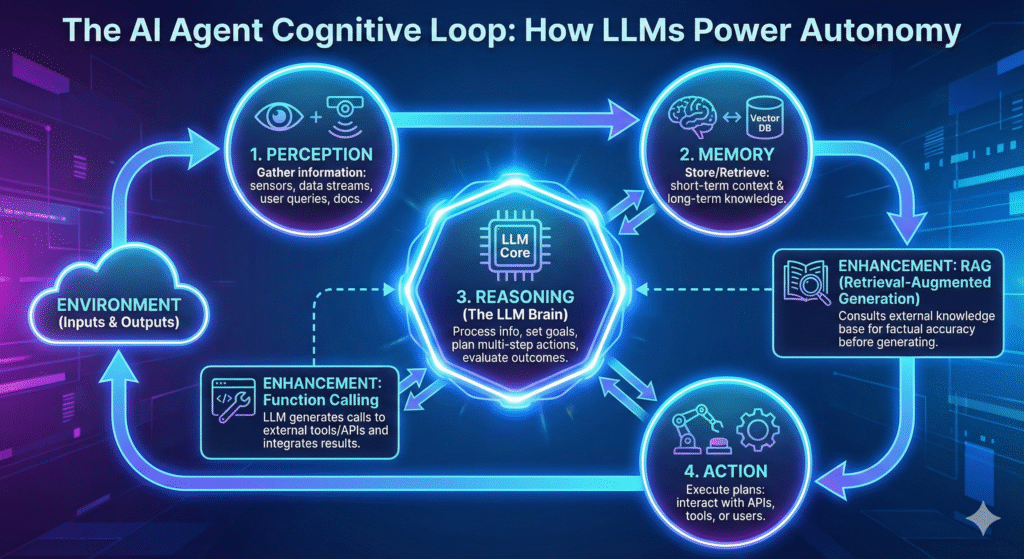
Perception
The agent gathers information from its environment-reading documents, processing sensor data, monitoring logs, or interpreting user queries. This perceived data is then fed into the Memory module.
Memory
The Memory module stores relevant information-both short-term context and long-term knowledge. It often uses a vector database for efficient semantic search and retrieval of past experiences or learned facts.
Reasoning
The LLM processes the perceived information and retrieved memories, performing tasks such as goal setting, planning multi-step actions, evaluating outcomes, and generating responses. It translates high-level objectives into actionable steps.
Action
The Action module executes the LLM’s planned steps-interacting with external tools, APIs, or human users. This output influences the environment, which is then perceived by the agent, restarting the loop.
Retrieval-Augmented Generation (RAG)
RAG enhances LLM performance by retrieving factual information from an external knowledge base before generating a response, mitigating hallucination and ensuring accuracy.
Function Calling
LLMs can interact with external tools by generating structured calls to functions (e.g., web search, database query). The results are incorporated back into the agent’s reasoning process.
Key Applications and Use Cases of AI Agents Across Industries in 2026
AI agents are rapidly moving beyond theoretical discussions to become indispensable tools across a myriad of industries. In 2026, their ability to automate, personalize, and optimize processes is transforming operations and creating new value propositions worldwide.
Customer Service
From basic chatbots to proactive problem-solvers, agents handle complex inquiries, offer personalized recommendations, manage appointments, and anticipate customer needs.
Enterprise AI & Workflow Automation
Automating repetitive tasks-supply chain management, invoice processing, onboarding-while integrating with ERP and CRM systems.
Specialized Business Tasks
Market research, data synthesis, report generation: agents scour datasets, identify trends, summarize findings for actionable insights.
Healthcare
Administrative tasks, patient scheduling, preliminary diagnostic support, freeing professionals for critical roles.
E-commerce
Personalization, inventory management, dynamic pricing based on real-time demand and competitor analysis.
AI Agent Strategies for Founders and Marketers in 2026
Most AI agent guides are written for developers. This section is for founders, SMBs, and marketers who want to deploy agents without writing code from scratch.
The three strategies that work without a technical team:
- No-code agent builders – tools like n8n, Make, and Zapier now support AI agent workflows. Connect triggers, LLM steps, and actions visually. Best for: lead routing, content repurposing, email triage.
- Low-code frameworks – CrewAI and AgentGPT allow multi-agent workflows with minimal coding. Best for: research pipelines, SEO gap analysis, competitor monitoring.
- Purpose-built marketing agents – tools like Zelitho’s content agent handle blog production end-to-end: keyword clustering, draft generation, GEO optimisation, and schema injection. Best for: founders who need to rank without hiring a content team.
The rule Zelitho follows: start with one agent, one goal, two tools maximum. Scale only after the first workflow runs without errors for two weeks.
Nothing to lose: Test Zelitho on your hardest keyword.
No sales calls, no contracts. Generate one complete, citation-ready article for $5. If it doesn’t outperform standard AI text, you’ve lost nothing.
LangChain Agents 2025 Updates: Multi-Agent Graphs, State Persistence, and Tool Integration
The transition from early autonomous prototypes to enterprise production systems is marked by rapid advancements in agent orchestration frameworks. Tracking langchain agents 2025 updates and understanding the langchain agents overview 2025 reveals that the ecosystem has shifted from linear chains to cyclic execution graphs powered by LangGraph, CrewAI, and AutoGen. The rise of ai agents 2025 established new paradigms for memory and tool use that define current best practices.
When engineering modern ai agents autonomous systems 2025 and designing ai agents autonomous workflows 2025, software architects focus on five core architectural advancements:
- Cyclic Graph Execution (LangGraph): Traditional chains followed rigid acyclic pathways. The langchain agents 2025 update introduces state machines that permit iterative loops, allowing agents to test code, inspect errors, and refine answers autonomously before responding.
- State Persistence and Memory Checkpoints: Early agents suffered from catastrophic forgetting between turns. The langchain agents 2025 new features store short-term execution state in Redis or Postgres checkpoints, preserving complete contextual history across multi-day tasks.
- Deterministic Tool Calling: Rather than relying on fuzzy text parsing, newer models enforce strict JSON Schema tool validation, guaranteeing safe interaction with external REST APIs, databases, and headless browsers. Comprehensive langchain agents documentation 2025 confirms that type-safe schemas reduce runtime tool errors by over 90%.
- Multi-Agent Role Specialization: Teams of specialized agents (such as a Researcher agent, a Writer agent, and a Schema Validator agent) collaborate through structured messaging queues, accelerating langchain enterprise adoption or use cases 2025 while reducing token costs and hallucination rates.
- Human-in-the-Loop Safeguards: Production agent architectures incorporate explicit interrupt gates where humans review sensitive API calls (such as code deployments or financial transactions) before execution proceeds.
LangChain Adoption Trends 2025: Industry Use Cases, Competitive Advantages, and Best Practices
Analyzing langchain adoption trends 2025 indicates that over 65% of enterprise AI teams building autonomous applications have standardized on the LangChain and LangGraph framework. Exploring langchain industry use cases 2025 highlights how companies across finance, healthcare, and e-commerce build production-ready systems by applying established langchain best practices 2025.
Key langchain competitive advantages 2025 include native support for cyclic agent state graphs, granular checkpointing, streaming event inspection, and extensive ecosystem integrations with vector databases. Prominent companies using langchain 2025 deploy autonomous agent clusters for three primary operational scenarios:
- Enterprise Customer Resolution: Autonomous triage agents that route complex support tickets, query internal knowledge bases via RAG, and execute account actions through verified REST endpoints without human intervention.
- Programmatic Research and Financial Due Diligence: Multi-agent teams that scrape earnings transcripts, calculate financial valuation metrics, cross-verify source filings, and synthesize comprehensive executive briefing dossiers.
- Search Engine Visibility and AI Citation Auditing: Continuous autonomous agents that inspect search visibility, measure brand citation share of voice across ChatGPT and Perplexity, and repair retrieval gaps in content architecture.
Deploying an AI Marketing Agent: Go-To-Market Automation and Search Visibility
Among the highest-ROI enterprise use cases is deploying an autonomous ai marketing agent to handle digital marketing and search visibility operations. Modern growth leaders utilize ai agent marketing frameworks and the best ai agents for go-to-market strategies 2025 to monitor brand mentions across LLMs, audit technical crawl logs, and automate content optimization.
Enterprise teams learning how to use ai agents in 2025 partner with top ai seo agencies ai-driven services or deploy in-house systems to handle automated search operations:
- Automated AI Citation Monitoring: The latest ai agents 2025 prompt ChatGPT, Perplexity, and Google AI Overviews across thousands of commercial intent queries to evaluate brand citation share of voice and competitor positioning.
- Retrieval Gap Detection: When an LLM cites a competitor instead of your brand, the agent compares vector similarity scores to diagnose missing semantic entities and syntactic chunking flaws.
- Closed-Loop CMS Deployment: Rather than generating static PDF reports, advanced ai workflow services ai search visibility optimization engines and ai workflow services for search visibility optimization write and patch content directly into WordPress or headless CMSs via REST APIs.
- Future of Blogging and Conversational AI Workflows: Mastering the future of blogging: how to adapt content creation workflows for conversational ai search and user engagement trends requires engineering an ai workflow trustworthy aeo-ready articles us readers and global audiences extract as direct answers.
- AI-Driven Search Visibility Expert Help: For complex enterprise architectures, pairing autonomous ai agent 2025 systems with ai-driven search visibility expert help ensures brand safety while maximizing generative search reach.
| Agent Framework | Orchestration Architecture | State Persistence | Multi-Agent Collaboration | Enterprise Production Ready |
|---|---|---|---|---|
| Zelitho Autonomous Engine | Closed-loop telemetry diagnostic paired with automated CMS REST remediation. | Cloud PostgreSQL state database with crawler session history. | Coordinated citation analysis, schema synthesis, and verification sub-agents. | Production (Zero-touch CMS deployment) |
| LangGraph (LangChain) | Cyclic state graphs with fine-grained conditional branching and checkpoints. | Built-in memory savers (MemorySaver, SqliteSaver, PostgresSaver). | Hierarchical agent-supervisor and network-based handoffs. | Production (Developer framework) |
| CrewAI | Role-based autonomous crews with sequential and hierarchical task delegation. | Short-term, long-term, and entity memory via local embedding stores. | Autonomous delegation between specialized persona agents. | Mid-Market / Fast Prototyping |
| Microsoft AutoGen | Event-driven conversational agent orchestration with code execution sandboxes. | Session conversation buffers with Docker execution isolation. | Multi-party group chats with round-robin or LLM speaker selection. | Research & Enterprise Sandbox |
Top Platforms and Frameworks for Building AI Agents
1. Lyzr AI: Low-Code and Agentic Approach
Lyzr AI is a low-code framework engineered for building sophisticated generative AI applications. Its agentic approach allows creation of powerful AI agents with minimal coding.
- Integrated RAG pipelines ensure access to up-to-date, factual information from private or proprietary data sources.
- Local deployment options provide enhanced data privacy and security.
- Custom AI agent development tailored to specific business needs.
2. LangChain: The Versatile Framework for LLM Applications
LangChain allows developers to chain components-LLMs, prompts, parsers, tools-to create complex workflows. It offers memory management and community support for connecting agents to diverse data sources and APIs.
3. Other Notable Frameworks and Libraries (e.g., AutoGen, AutoGPT)
- AutoGPT: Autonomously pursues goals by breaking them into sub-tasks, orchestrating LLMs for decision-making.
- AutoGen: Enables multi-agent systems where agents collaborate to solve tasks-communicating, debating, and strategizing.
Strategies for Monitoring and Managing AI Agents and LLMs Effectively
Key Performance Indicators (KPIs) for AI Agent Success
- Task completion rates
- Response times
- Decision accuracy
- Resource utilization
- Rate of successful tool calls
Ensuring Data Privacy and Security in Agent Deployments
Adopt privacy-by-design, data governance policies, access controls, secure infrastructure, and local deployment options to protect sensitive data.
Troubleshooting, Adapting, and Iterating AI Agent Behavior
- Error handling mechanisms for graceful recovery or escalation.
- Comprehensive logging and observability tools.
- Feedback loops: fine-tune prompts, update knowledge bases, refine logic.
How Long Does It Take to See Results from AI Agents?
For founders and marketers deploying AI agents in 2026, realistic timelines are:
- Content agents: first draft output in under 2 hours. Quality on par with a junior writer within 2 weeks of prompt tuning.
- Research agents: reliable competitor and keyword summaries within the first run. Accuracy improves with better tool configuration over 1-2 weeks.
- SEO agents: Google reindexing takes 3-7 days after deployment. Citation shifts in Perplexity and ChatGPT visible within 2-4 weeks of adding structured answer blocks.
Zelitho’s benchmark: blog production time drops from 8 hours to under 90 minutes per post when a content agent handles research, drafting, and GEO optimisation in a single pipeline.
For a deeper look at how AI agents and crawlers interact with web infrastructure, our 2026 AI Search & LLM Retrieval Benchmark analyzes 6,094 AI bot crawls across ChatGPT, Claude, and Bytespider.
Current Challenges and Future Limitations in AI Agent Development and Deployment
- Hallucinations & incorrect information generation.
- Scalability issues due to computational intensity.
- Complexity of debugging emergent behaviors.
- Ethical dilemmas: accountability, bias, transparency.
- Resource intensity limiting widespread adoption.
Getting Started: Choosing the Right AI Agent Approach for Your Needs
Begin by defining the problem you aim to solve. Consider technical capabilities, data privacy requirements, scalability needs, and community support versus vendor assistance. Start with a pilot project, iterate, and scale.
The Autonomous Future: Effectively Monitoring and Managing AI Agents
AI agents promise unprecedented efficiency and innovation across industries. Success hinges on understanding their mechanisms (cognitive loop, RAG), choosing the right development platform, and implementing robust monitoring, KPIs, data governance, and continuous improvement.
By prioritizing performance, security, and ethical considerations, organizations can navigate the complexities of this autonomous future, ensuring AI agents drive sustained innovation and deliver tangible value.
FAQs
Cloud computing resources, vector databases, LLM APIs, monitoring tools.
Lyzr AI (low-code), LangChain (modular), AutoGPT/AutoGen (open-source).
Platform websites, GitHub repositories, academic papers, AI community blogs.
Increased autonomy, specialized vertical agents, multi-agent collaboration, improved RAG, focus on ethics and privacy.
An AI agent is an autonomous software system that perceives its environment, reasons over a goal, and takes actions across tools without human input per step. Unlike chatbots, AI agents plan, execute, and self-correct across multi-step tasks like research, content creation, and code deployment.
AI agents fall into four types: simple reflex agents, model-based reflex agents, goal-based agents, and utility-based agents. In 2026, most production agents used by founders and marketers are goal-based.
Founders can use no-code tools like n8n, Make, and Zapier, low-code frameworks like CrewAI, or purpose-built tools like Zelitho’s content agent for end-to-end blog production and GEO optimisation.
Google reindexing takes 3-7 days. Citation shifts in Perplexity and ChatGPT are typically visible within 2-4 weeks of adding structured answer blocks above the fold.